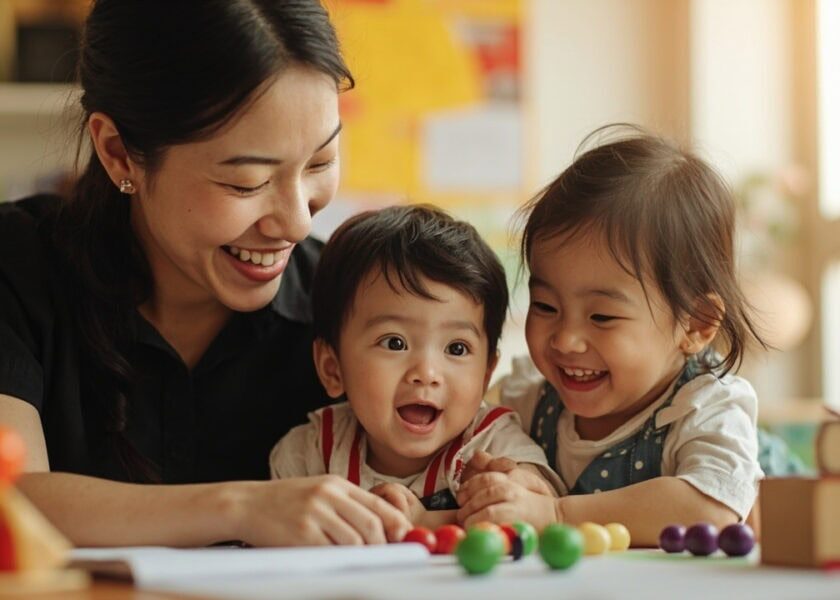
The Framework Singapore Parents Need to Identify Genuine Quality Childcare
What Quality Childcare Actually Looks Like
There is a particular kind of moment that many Singapore parents know well. You are standing in a childcare centre—the one with the immaculate playrooms and the glossy welcome pack—listening to the director describe their curriculum, their enrichment programmes, their commitment to developing the whole child. You nod politely. Everything looks beautiful.
And yet, something does not feel quite right. But you cannot name it. You do not have the words.
Maybe it was the way the teacher changed the diaper on that crying toddler—efficient, but without a glance downward, without a word to the child. Maybe it was the child in the corner who seemed persistently unhappy. Maybe it was the row of babies in their high chairs, facing forward, watching a screen. Or maybe it was simply a feeling—the accumulated weight of small observations that did not quite cohere into a picture of warmth.
You leave the tour wondering if you are being too demanding. Other parents seem satisfied. The centre has excellent reviews. But something bothered you, and you cannot articulate what.
You are not alone in this. You are, in fact, experiencing the most important moment of any childcare decision: the gap between what you sense and what you can name.
This is the gap that separates parents who find genuine quality from parents who find polished marketing. And it is a gap that no amount of centre websites or parent forums can close—because the issue is not insufficient information. The issue is the absence of a framework. The issue is that you have not yet been given the language that child development science has spent decades developing.
The Framework: What Science Tells You to Look For
If you are a parent researching infant care or childminding in Singapore, this article offers something more useful than a checklist or a rating. It offers a way of seeing.
Child development science is not abstract. Once you understand its core principles, they become immediately visible in any childcare environment. You will be able to observe what is actually happening—not what the marketing says is happening, but what your own eyes are telling you. Once you know what to look for, you cannot unsee it.
Here is the framework you will gain:
- Attachment signals that reveal whether children feel genuinely safe or merely supervised
- Responsive caregiving translated into specific observable behaviours
- Scaffolding—how skilled caregivers support growing independence
- Emotional climate—the felt quality of a room that photographs cannot capture
- Engagement versus activity—why a child building quietly with blocks may tell you more than a structured activity session
Each principle comes with specific observations you can make on your next tour. By the end, you will have something more valuable than a recommendation—you will have the ability to evaluate any childcare environment with trained eyes.
Attachment Science: The Foundation of Quality Care
Attachment theory tells us that infants and young children need consistent, responsive emotional connection with at least one primary caregiver. This is not a philosophy or a preference. It is developmental science. Children who experience secure attachment in their early years show measurable differences in emotional regulation, social competence, and cognitive development—not just in the moment, but across their lifetimes.
In a childcare context, this translates into observable, concrete signals. You do not need to take anyone’s word for it. You can see it.
Look for these attachment signals on any tour:
- Does the child run toward a familiar adult when the parent leaves—or cling, then gradually settle with reassurance?
- Does the child seek out the caregiver for comfort when distressed?
- Are there signs of consistent, warm relationship—not just supervision, but genuine knowing?
- Where does the child go when something goes wrong?
Watch the room for two or three minutes before the tour begins, before the adults begin speaking. Notice where children naturally gravitate. Notice how caregivers respond when a child signals need. These are not marketing promises. These are visible facts. And they are the difference between a child who feels safe and a child who is simply being kept.
Responsive Caregiving and Scaffolding
Responsive caregiving is the quality of interaction that happens in the ordinary moments—the diaper change, the hand-washing, the arrival, the departure. It is the texture of care that determines whether a child learns that people are reliable, that their signals matter, that the world responds to them.
A responsive caregiver speaks to the child, not about the child. They narrate what is happening. They wait for the child’s response. They adjust their own behaviour based on what the child signals.
You can see responsive caregiving in action. Watch for these specific behaviours:
- Do staff members speak with the children, or about them to each other?
- When a child points at something, does the teacher respond with attention and words?
- When a child makes an attempt—to grasp a toy, to climb a step, to communicate—does the caregiver notice and acknowledge it?
- During transitions, are children informed about what comes next, or simply moved from one activity to another?
When a baby signals distress, what does the caregiver do? If the answer is vague, or involves waiting for the child to self-soothe in the context of a busy room, you are seeing something important. If the answer involves specific strategies—comfort, holding, responsive speech, adjustment of the environment—you are seeing something equally important. The difference matters enormously, and it is visible.
Scaffolding describes the way skilled caregivers support children to achieve slightly beyond what they could manage alone, then gradually withdraw that support as the child develops mastery.
In practical terms, this means:
- A toddler learning to climb a small ladder is given close physical proximity—near enough to assist, but not hovering
- A child learning to self-feed is given food in a form they can manage, with patient tolerance for the mess
- When a child is frustrated, a caregiver helps not by doing the task for them, but by breaking it down into manageable steps, by encouraging persistence, by showing faith in the child’s capacity
You will notice scaffolding in the way children are allowed to try. In the way teachers offer support without taking over. In the way the environment is arranged to allow appropriate challenge.
You will notice its absence in rooms where children are entertained but not engaged, where tasks are done for children rather than with them, where the primary goal is compliance and order rather than growing capability.
Emotional Climate and True Engagement
The emotional climate of a childcare environment is the foundation beneath all of these principles. It is the quality of the atmosphere—the unspoken mood that pervades the room. Emotional climate is not something that can be photographed for a brochure. It is felt. You know it when you walk in.
The question is whether you trust yourself to notice it.
Some children look happy in a centre. Others look merely compliant. Some caregivers appear energized by their work; others appear to be enduring the day. The children are not the only ones whose emotional state is being shaped by the environment. The caregivers are, too. And when caregivers feel respected, supported, and genuinely engaged with their work, the children feel it.
Spend five minutes in a room before the tour begins. Notice how it feels:
- Is it tense? Is it chaotic? Is it quietly alive?
- Is there laughter? Are there moments of calm pleasure?
- Do the children look engaged or merely occupied?
If the room does not feel like a place you would want to spend your day, consider whether your child will feel differently. You spend more time in offices and MRTs than you would like, but your child will spend their earliest, most formative hours in this environment. The quality of that emotional climate matters.
Many centres will tell you about their activities: music time, art time, sensory play, story time. But activity is not engagement. A child placed in front of a music session who is looking at the ceiling is not engaged. A child doing art with materials they do not understand, while a teacher finishes a conversation with a colleague, is not engaged. A room full of toys that no child is actually playing with is not engaged.
Engagement is a specific quality of absorption. The child is focused, involved, processing, trying, doing. You can see it. It looks like the child is working—not in the sense of labour, but in the sense of active investment. Engagement is when a child’s face shows concentration, or delight, or the satisfaction of persistence.
Ask yourself, on your next tour: what are the children actually doing? Not what are they scheduled to be doing—what are they visibly, actually engaged in?
If you see a child building with blocks with full absorption, that is worth more than ten children completing a prescribed art activity without genuine involvement. Quality is not measured by the activity. It is measured by the engagement.
This distinction protects you from being impressed by the wrong things. A beautiful wall mural tells you nothing about whether children are learning. An imported wooden toy tells you nothing about whether children are using it with purpose. Look past the aesthetics. Look at what is actually happening.
Questions That Reveal Practice
When you walk into a room and something feels off, it probably is. When you notice that a caregiver does not speak warmly to the children, or that the children seem restless or listless, or that the environment is beautiful but the children are not using it—these are data points. They are not excuses to panic, but they are not things to dismiss either.
Ask questions about what actually happens:
- What do your teachers do when a baby cries for more than a few minutes?
- How do you handle conflicts between toddlers over toys?
- How long have the caregivers in the infant room been working here?
- How much time do babies spend in their cots or high chairs versus on the floor, engaged with people and materials?
Listen not just for the content but for the ease, the specificity, the confidence. Vague answers or answers that deflect are themselves data points. Answers that are specific and grounded in observable practice are also data points.
Observe during the tour, not after. Ask to spend time in the room before you speak to the director. Watch how children and caregivers interact. Notice what the children are doing. Notice the ratio—how many children per caregiver, especially in the infant room. This is not a detail. It is the foundation of everything else.
If you leave a tour unable to describe what you actually saw, you may have been shown a presentation rather than a programme. The question to ask yourself is simple: if I could not watch my child during the day, would I feel comfortable? If the answer changes depending on whether you are in the room, that is worth sitting with.
Why Quality Matters in the First Thousand Days
The first thousand days of a child’s life matter in ways that research continues to make clearer. The brain is building at a pace it will never again match. The patterns of emotional response are being laid down. The body is learning what the world feels like—whether it is safe, whether people are reliable, whether exploration is rewarded or punished.
These are not abstractions. They are the architecture of a person.
When parents understand this, they do not look for childcare. They look for quality childcare. And quality is not found in the sophistication of the curriculum or the quality of the snacks. It is found in the micro-moments—the thousand daily instances of responsive attention, warm interaction, scaffolded challenge, and genuine engagement. These moments are the substance of early childhood.
The Ratio That Makes Everything Else Possible
No philosophy of care can survive an impossible ratio. If there are too many children per caregiver, the quality of individual responsiveness breaks down—regardless of what the centre’s values say on paper.
Within the ECDA Childminding Pilot framework, careful attention to caregiver ratios allows for the genuine responsiveness that developmental science identifies as foundational. This is the reason caregivers can notice, respond, engage, and support—not merely supervise. It is the reason a child can form a genuine attachment rather than simply being cared for.
Transparency as Practice, Not Policy
Where deployed, measures such as CCTV allow parents to witness the care their children receive—not because trust is absent, but because transparency and trust are not opposites. A service confident in its standards does not hide from observation. It welcomes it.
Making Quality Accessible
The pilot fee structures have been designed to make quality care accessible to families who need it. Monday through Friday care blocks provide the consistency that children’s development requires. CDA and Baby Bonus usability means families can apply the resources they have to the care their children deserve—without navigating unnecessary complexity.
Affordability and quality are not opposites. The ECDA Childminding Pilot represents an acknowledgement that professional childminding is serious work—work that requires training, support, and respect. It is an acknowledgement that families deserve real options, not just the institutional ones that have dominated the landscape.
Your Framework for Choosing Quality Childcare
You now have a way to see. Here is what to look for:
- Attachment signals—children who seek out caregivers, who settle with reassurance, who show signs of genuine relationship
- Responsive interaction—caregivers who speak to children, not about them; who narrate, wait, and respond
- Scaffolded support—children who are allowed to try, who receive help that builds capability rather than dependence
- Emotional climate—a room that feels alive, warm, and regulated
- True engagement—children absorbed in meaningful activity, not merely occupied
You know the questions to ask. You know how to trust your observations and how to look beneath the surface. You are not helpless in the face of polished marketing. You are not dependent on reviews from parents who may have different values than your own. You have language. You have principles. You have a way to see.
Common Questions Addressed
“How do I know if I’m being too demanding?”
You are not being too demanding. The weight you feel about this decision is reasonable. You are choosing an environment that will shape your child’s experience of safety, of learning, of relationship, of self. That choice deserves more than a brochure and a feeling. It deserves a framework—which you now have.
“How do I evaluate without being fooled by aesthetics?”
Look past the wall murals. Look past the wooden toys. Look at the children. Are they engaged? Are they regulated? Are they connected to the caregivers? Then look at the caregivers. Are they present? Are they warm? Are they doing more than supervising? The environment is the backdrop. The relationships are the curriculum.
“Is home-based care as good as centre-based care?”
The question is not the model. The question is the quality of caregiving within the model. A home environment with a skilled, responsive caregiver who maintains appropriate ratios may offer more developmental richness than a centre where children are managed rather than engaged.
Singapore parents deserve more than institutional childcare. You deserve a service that will not just accept your scrutiny but welcome it. You deserve answers that are honest and specific. You deserve to ask the hard questions and receive answers that reflect genuine practice, not rehearsed reassurance.
Your child deserves quality care. You deserve to recognise it when you see it. And you now have the eyes to look.
The next step is yours.
For families seeking a different kind of childcare relationship—one built on developmental responsiveness, professional standards, and genuine care—EduNanny Singapore offers a thoughtfully designed alternative within the ECDA Childminding Pilot. Reach out to learn more about what quality looks like up close.