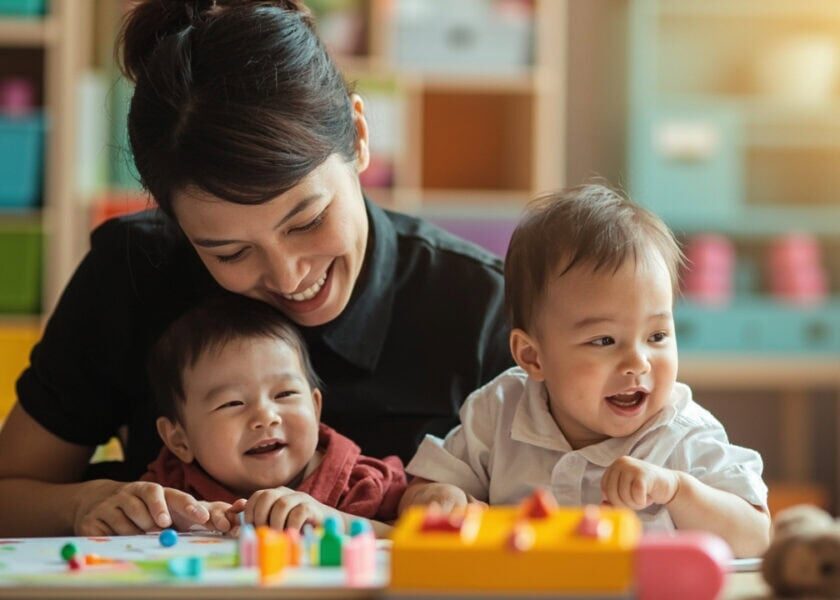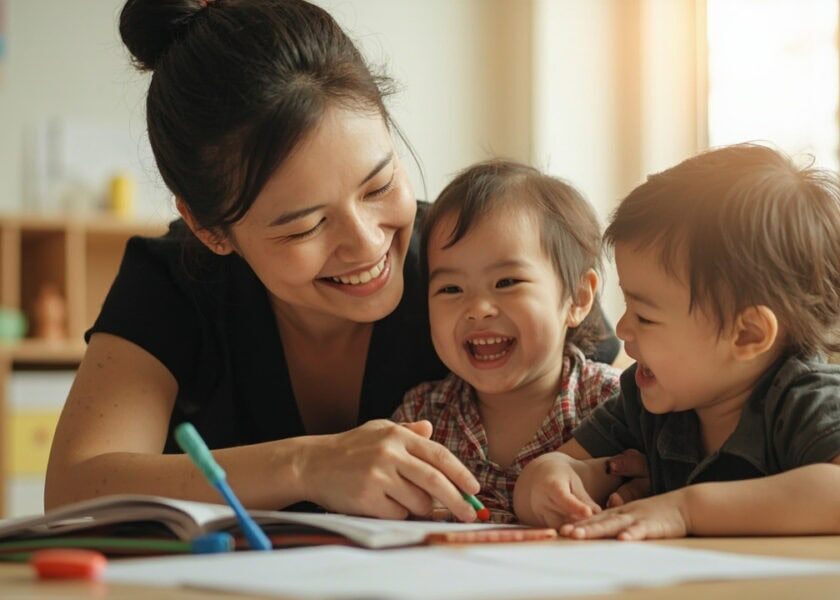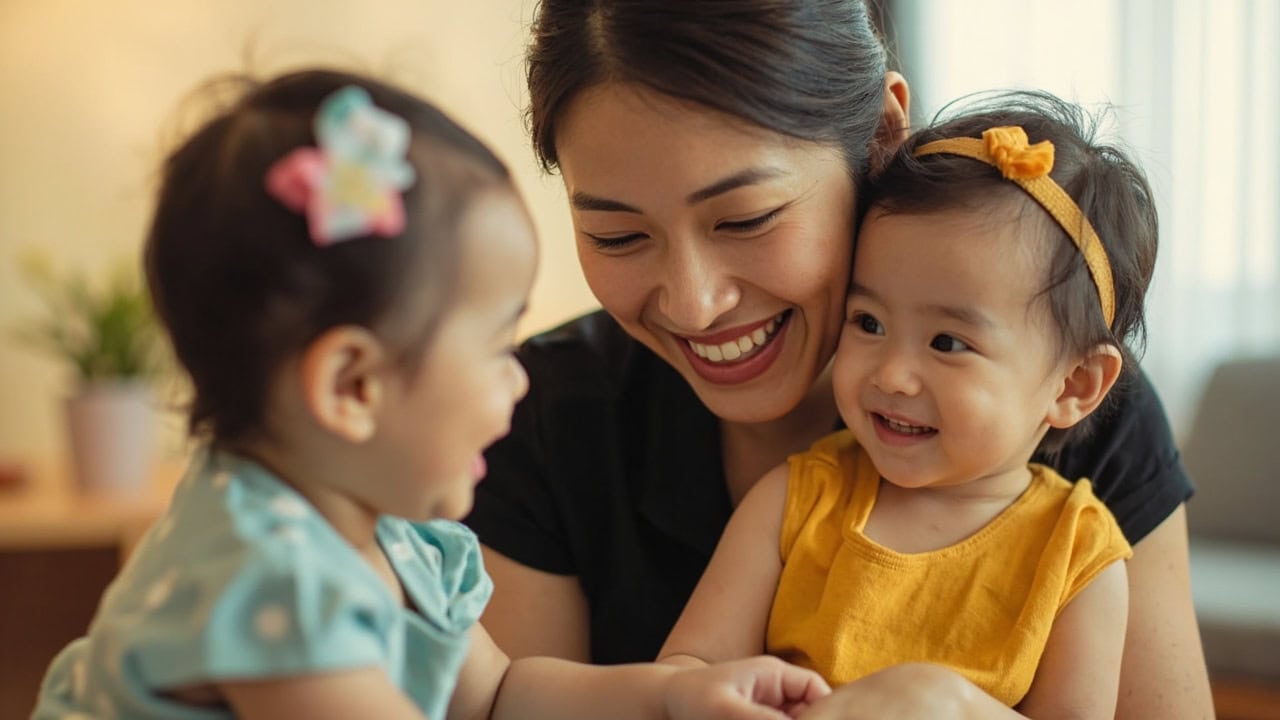
The Quiet Work Building Your Child’s Inner Strength Every Day
The Quiet Moment Every Singapore Parent Will Recognise
There is a moment that happens quietly, without fanfare, in the months after a child begins quality childcare. You are at home, perhaps at the dinner table, and your three-year-old drops a spoonful of rice on the floor.
The old response would have been a wail, a full collapse into tears and frustration. But instead, your child pauses. Takes a breath. Says, “It’s okay, I can pick it up.” And moves on.
You watch this unfold and something in your chest shifts. When did this happen? How did this happen? Where did your child learn to do that?
That moment, that small and ordinary moment, is the reason we want to speak with you today. Because what it represents is not a trick your child learned or a reward chart working. It is something deeper, something invisible, something that has been quietly building inside your child every single day in the place you have trusted to care for them.
It is the most important thing Singapore parents need to understand when they make one of the most significant decisions of their early parenting years: who will care for my child, and what will my child actually be learning while I am away?
What This Article Covers
- What matters most in early childcare is not facilities or curriculum—it is whether your child is building the internal foundations for emotional resilience, social confidence, and healthy relationships
- Social-emotional development is the invisible classroom where your child’s capacity to cope, connect, and flourish is being quietly constructed
- You may not see it—the Tuesday afternoon when your child waited without crying, the Wednesday goodbye with a wave instead of a sob—but it is happening every day
- Quality childcare builds this foundation through secure attachment, consistent emotion coaching, guided peer interaction, and intentional environments
- When choosing care, the real question is: Is my child being understood here?
Beyond Safety: What Lies Above the Floor
This is not a question about safety. Of course safety matters. It is the baseline, the floor, the non-negotiable. But safety is what we expect. Safety is what we have a right to.
What we want to talk about today is what sits above that floor. What grows when safety is assumed. What develops when a child feels secure enough to fall apart and be put back together. What emerges when someone trained, patient, and attentive holds your child through their first real disappointments and guides them, gently and consistently, toward a version of themselves that can cope, connect, and flourish.
That is what we call social-emotional development. And we believe it is the invisible classroom where the most important lessons of early childhood are being taught.
What This Looks Like in Practice
A two-year-old in a quality childcare setting is learning, right now, how to exist alongside other small humans. They are learning that another child might take the red truck they wanted. They are learning that this creates a feeling in their body that is uncomfortable, that feels big and unmanageable.
In a setting with a trained caregiver who understands child development, this moment becomes a classroom. Not a classroom with walls or worksheets, but a classroom where a child is learning that:
- They can survive this feeling
- The feeling will pass
- There are words for what they are experiencing
- An adult nearby sees them, understands them, and will help them navigate it
Even infants are building these foundations. A baby in responsive, consistent care is learning that their cries bring comfort. That their needs are met. That the world is a trustworthy place where they matter. This security does not make children soft. It makes them brave. Because a child who trusts that someone will catch them is a child who can afford to explore, to take risks, to fall down and get back up.
The Paradox: Why You Cannot See What Matters Most
Here is what makes this so difficult for parents. You do not see it.
You see the morning handover. The moment when your child reaches for you at the door and your heart breaks a little. You see the photo messages of activities, of crafts, of your child smiling at the camera. You see the end of the day, when your little one runs to you with the particular exhaustion that comes from being fully engaged in the world.
These are real moments. But they are snapshots. They are the highlight reel.
What you do not see is:
- The Tuesday afternoon when your child had to wait for a turn and did not cry
- The Wednesday morning when they said goodbye to their caregiver with a wave instead of a sob
- The Thursday incident with the sandpit that was handled with skill and patience and will never make it into a photo update
These moments are invisible precisely because they are not dramatic. They are small. They are quiet. And they are everything.
The signs of social-emotional development are so subtle, and its fruits are so long-term, that it is nearly impossible for a parent to look at a childcare arrangement and definitively say, “My child is thriving in this way.” And yet it is the developmental domain that will most shape your child’s inner life: their capacity for resilience, their ability to form healthy relationships, their emotional vocabulary, and their sense of self-worth that sits beneath every achievement and every failure they will encounter for the rest of their lives.
How Quality Childcare Builds These Invisible Foundations
1. Secure Attachment: The Cornerstone
When a caregiver in a childcare setting responds to a child consistently, warmly, and with genuine attentiveness, the child develops what psychologists call a secure base. They learn, in their bones, that the world is a place where their needs will be met, where they are seen, where they matter.
In a setting with a low infant-to-caregiver ratio—where one adult is responsible for knowing just one, two, or three children deeply rather than many children superficially—this secure attachment has the space it needs to form.
2. Emotion Regulation: The Capacity to Feel Without Being Destroyed
From that foundation, something remarkable begins to grow. The child starts to develop what we call emotion regulation—the capacity to experience a feeling and not be destroyed by it: to feel anger and not hit, to feel sadness and not collapse, to feel fear and not flee.
This sounds simple. It is not simple. This is one of the most sophisticated human capacities, and it begins developing in the first years of life.
In quality childcare, caregivers are doing this work constantly. They are naming emotions for children who do not yet have the vocabulary:
- “I see you are feeling really frustrated right now.”
- “That made you so angry, didn’t it?”
- “It’s okay to feel sad about that.”
They are modeling calm in the face of storm. They are teaching children that all feelings are acceptable, but not all behaviors are. They are sitting with a crying infant and offering comfort not to stop the crying, but because the crying deserves to be heard.
3. Peer Interaction: Where Social Competence Is Built
Children in quality childcare are learning to be humans among humans. They are learning the complex choreography of sharing and taking turns, playing alongside someone without destroying their creation, navigating the desire to be near someone and the desire to be independent, negotiating when wants conflict, apologising and being forgiven.
They are learning that other children have wants too, and that those wants sometimes conflict with their own. They are learning that they can find solutions, that they can handle some things themselves, and that sometimes they need an adult to help.
These are not small skills. These are the skills that will determine whether your child is the kind of person others want to be around. The kind of person who can work in a team, who can manage conflict, who can show empathy, who can lead and follow. And the only place to learn them is in the messy, unpredictable, gloriously imperfect world of playing with other children.
4. The Difference Between Being Entertained and Being Engaged
There is something else that happens in quality childcare that we underestimate. Children learn the difference between being entertained and being engaged, between having something done to them and being an active participant in their own learning.
In a setting where the environment is intentionally designed to provoke curiosity, where caregivers understand child-led play and guided discovery, children are not passive recipients. They are architects of their own learning, problem solvers, decision makers, people who fail and try again. They are building the internal narrative that says, “I am capable. I can figure things out. Mistakes are part of learning.”
What to Look For: Reading the Invisible
When you evaluate a childcare arrangement, what are you really evaluating? Most parents, understandably, focus on the tangible: the facilities, the curriculum, the food menu, the teacher qualifications, the safety protocols, the ratios.
These things matter. They are part of the picture. But they are not the whole picture.
The whole picture is this: Is my child being understood here? Is my child learning to understand themselves?
Questions to Ask and What the Answers Reveal
Notice the caregivers’ faces
Not just when they are speaking to you, but when they are with the children. Do they seem genuinely interested in what the children are doing? Do they kneel down to a child’s level, or do they speak from above? When a child is upset, how does the caregiver respond?
Ask about their approach to emotional development
Not “do you teach feelings?” but “what happens when my child has a big tantrum?”
A quality caregiver will not say, “We don’t allow that.” A quality caregiver will say something like, “We stay calm, we help the child feel safe in their big feeling, and we stay with them until they are ready to move through it.” This is the difference between managing behavior and nurturing emotional development.
Look at the children themselves
Are they engaged, or are they just occupied?
- Engaged children are focused, curious, involved
- They are making choices
- They are talking to each other, or absorbed in solitary play with intention
- Occupied children are just passing time—they may be physically safe and even entertained, but they are not building anything internally
Watch how the children handle small frustrations
Watch a child drop something. Watch a child be told no. Watch a child not get what they wanted. Is there patience? Is there modeling? Is there an environment where small failures are treated as opportunities rather than crises?
The Skills That Serve a Lifetime
When you are evaluating childcare options, we want you to ask not just “Is my child safe here?” and “Is my child learning here?”—but this:
- “Is my child being understood here?”
- Is there an adult who notices when my child is frustrated before my child even knows they are frustrated?
- Is there an adult who will name my child’s feelings when my child cannot?
- Is there an adult who will sit with my child in their hardest moments and help them learn that hard moments pass?
- Is there a place where my child is learning, quietly and consistently, that they are capable, that they are lovable, that they can cope?
Because if the answer to those questions is yes, then you have found something precious. You have found a place where your child is not just being kept. They are being built. They are becoming.
The skills your child is building now, in these invisible classrooms, will serve them when they are three and when they are thirty. They will serve them in their friendships, their marriages, their careers, their relationship with themselves. They will serve them in ways you cannot imagine and will never fully see.
That is what quality childcare gives your child.
Not a head start on academics. Not a portfolio of achievements. Something more fundamental. The internal architecture of a person who can feel deeply and manage those feelings. A person who can connect with others and maintain those connections. A person who knows their own worth not because they have been constantly praised, but because they have been truly seen.
The child who handled that spilled rice at dinner with grace and resilience? They did not learn that in a lesson. They learned it because somewhere, in the hours you were away, a caregiver held their hand through a disappointment and taught them that they could survive it. They learned it because they had been given the space to feel frustrated and the support to move through it. They learned it because they were in an environment where they were not just supervised, but known.
That is what you are choosing. Not a service. A partnership in your child’s becoming. And we believe, with everything we know about early childhood development and everything we understand about the heart of Singapore parents, that this is the most important decision you will make in these early years.
The invisible classroom is real. It is at work every day, in every moment of responsive care, in every gentle redirection, in every time a caregiver kneels down and says:
“I see you. I hear you. You are going to be okay.”
Your child is in that classroom. And the person who sits with them in it is one of the most important people in your child’s life. Choose accordingly. Choose deeply. And trust that the quiet transformation happening inside your child—the one you will only glimpse in small ordinary moments like the one we described at the start—is the most valuable thing anyone could give them.
EduNanny Singapore: Built Around What Children Actually Need
Choosing childcare is hard. It is hard in a way that is different from most other decisions you will make as a parent. It requires you to place your absolute trust in someone you do not fully know, to leave your most vulnerable person in their care, and to do this repeatedly, daily, without being able to fully verify what is happening in those hours.
If you are carrying guilt about needing help, let us be clear: you are not a bad parent because you need to work. You are not a bad parent because you need help. You are a parent who loves your child enough to find the very best care you can. And that care does not diminish your role. It partners with it.
The child who runs to you at the end of the day, exhausted and full of stories, who has been held by someone else in your absence, is not confused about who their parent is. That child knows. That child has been building the secure base that allows them to venture into the world and come back to you, again and again, more whole each time. That is what quality care does.
The ECDA Childminding Pilot: A Philosophical Commitment
EduNanny by BUTLER operates within the ECDA Childminding Pilot, and what this means is important. The childminding pilot exists because Singapore recognises that families need options that are not one-size-fits-all. Some families need home-based care, where a trained childminder comes to the family’s home and the child is cared for in familiar surroundings. Some families prefer a community or centre-based pathway, where children benefit from peer interaction in a dedicated space designed for their development.
EduNanny offers both pathways, because different families have different needs, and good care must be flexible enough to honour that.
Why Low Ratios Matter
The pilot structure allows for something precious: low ratios. In infant care, this means up to one caregiver to three infants. Your infant is not a unit in a system. Your infant is a specific human being with a specific temperament, specific needs, specific rhythms.
When one caregiver is responsible for three or fewer infants, they can learn these specifics, notice when your baby is not quite themselves, build the responsive relationship that becomes the foundation for secure attachment, and offer comfort in the way your baby needs it, not in a generic way. This is not a luxury. This is the work.
Making Quality Accessible
The pilot fee structures are designed to make quality care accessible to families across Singapore, not just those who can afford premium pricing. Monday to Friday care blocks. CDA and Baby Bonus usability. These are not just financial mechanisms. They are acknowledgments that parents need childcare to fit into the rhythm of their working lives and to be financially sustainable.
Communication: Bringing the Invisible Into View
When you choose EduNanny, you are choosing transparency. Updates. Genuine dialogue. In placements where CCTV measures are deployed, this is offered as an additional layer of trust for families who find it reassuring—not as a surveillance mechanism, but as an open door.
What matters most is that you feel connected to your child’s day, even when you are not in the room. Because the fear that parents carry is not just, “Is my child safe?” It is: “Is my child okay? Is my child happy? Is my child growing in ways I cannot see?” Communication addresses that fear.
Begin the Conversation
EduNanny Singapore is here to build alongside you. To honour this sacred, unrepeatable time in your child’s life with everything we know about what they need to become who they are meant to be.
If you are researching infant care or childminding options in Singapore, we invite you to speak with us. Let us share what our approach looks like in practice, answer your questions, and help you think through what matters most for your family.
Because your child is being built every day. The question is whether they are being built in the way that will serve them for a lifetime.
We would be honoured to be part of that building.
Learn more about who we are and the values that guide our approach to childcare. Or explore our homepage to understand the full scope of what we offer.