The Quiet Signs Your Child Is Thriving Every Parent Should Notice
What This Article Will Give You
If you’re short on time, here’s what matters most:
- The signs of genuine thriving are different from milestones—they live in your child’s emotional world, not a checklist
- You are already reading your child more accurately than you realise; you just need permission to trust yourself
- Quality care makes flourishing visible—not through reports alone, but through observable emotional and social signs
- The right environment gives you conditions where these signs become clear to any attentive parent
Keep reading for the full guide to reading your child’s wellbeing at every stage.
You Are Already a Better Reader Than You Think
Let me start by naming something that doesn’t get said enough. Singapore parents are extraordinary readers of their children.
You notice the pause before a meltdown. You know the difference between your child’s tired cry and their frustrated cry. You read their face in a half-second and know whether to intervene or wait. This is not a small thing. This is deep, attuned attunement—the very skill that forms the foundation of everything we call healthy development.
And yet, after the moment you drop your child into someone’s care, something shifts. That confidence dims. You hand over a piece of your certainty along with your child at the door, and you find yourself waiting. Waiting for the report. Waiting for the photo. Waiting for someone else to tell you what you already want to know: Is my child okay? Are they more than okay? Are they thriving?
The waiting isn’t weakness. It’s love doing what love does—it wants reassurance. But the trap, the one we want to help you step out of, is that you have been waiting for someone else to tell you what you are already capable of seeing.
What Reports Don’t Capture
When you look at what most childcare environments offer as evidence of your child’s wellbeing, it tends to come in one of two forms: developmental milestones and activity logs. Today your child stacked three blocks. Today she played with the playdough. Today he sat through circle time.
Milestones and activities tell you what your child did. They do not tell you how your child was. And the difference between those two things is the difference between knowing your child was present and knowing your child was flourishing.
Flourishing is quieter. It lives in the texture of a child’s emotional world. It shows up in the way a toddler walks into a room—checking whether the familiar face is there before turning to the toys. It shows up in the way an infant, after being soothed, settles not just their body but their gaze, their breathing, their entire posture returning to a state of open engagement. It shows up in the way a two-year-old, after a conflict over a toy, finds their way back to play not because an adult fixed it but because they have within them the beginning of something extraordinary: the capacity to regulate, to recover, to reconnect.
The Reunion: Reading What You Already See
When you pick up your child and they come to you easily—not rushed, not reluctant, not robotic, but with a kind of ease that says I was fine and now I’m glad you’re here—that is a sign.
When your child, after a day apart, shows no visible distress upon your return, this is not a sign that they didn’t miss you. It is a sign that their attachment system is healthy enough to tolerate temporary absence, because it trusts—deeply, fundamentally—that your return is guaranteed.
This is what security looks like in a young child. It is not dependence. It is the quiet confidence to let go and the quiet confidence to come back.
The Signs of Thriving at Every Stage
Let me be specific, because specificity is what makes observation possible.
In the First Year: Building the Foundation
In the first year, the signs of emotional and social thriving are often written in the body’s language. You will notice your baby developing what researchers sometimes call a social smile—not the reflexive one, but the intentional, responsive one that appears when they see your face.
You will notice them watching you with a quality of attention that suggests they are building something. They are building the knowledge that their presence matters, that they can affect another person, that the world is responsive to them.
Later in the first year, you may notice your baby beginning to use you as a reference point—not out of dependency, but out of security. They look at you in a new situation, and if your face says this is okay, they venture forward. If your face says wait, they hesitate.
This is not clinginess. This is the most sophisticated learning system ever devised by human development. Your child is using you as a map for the world, and the map is working beautifully.
In the Second Year: Social Curiosity Emerges
In the second year, watch for social curiosity. The toddler who approaches another child not to take a toy but to stand beside them—to be in proximity, to observe, to participate in the mystery of another person—this is a child whose social world is expanding from a base of trust.
Watch for the child who begins to notice emotions in others, who brings you a book when they’re distressed not because they want the story but because they want you. Watch for the moments of reparation after a tantrum—a hand reaching out, a body leaning back in, a tentative smile that says I’m back, I’m still here, we’re still okay.
Into the Third Year and Beyond: Emotional Complexity
By the third year and into early preschool, the signs become more layered and more beautiful. You will see children who can hold competing emotions at once—the frustration of losing a game and the joy of having played it.
You will see emotional complexity emerging: the child who says I’m angry but I don’t want you to go away. You will see warmth in peer relationships—not the absence of conflict, but the presence of care, of shared laughter, of the early, tentative architecture of friendship.
These are not achievements to be ticked. They are signs of a child who is genuinely flourishing—not because someone graded them on it, but because the conditions in their life have allowed something deep to unfold.
Quick Reference: Signs of Thriving Across Ages
| Age Stage | Key Signs of Flourishing |
|---|---|
| 0-12 months | Social smile (intentional, responsive), watching with focused attention, using caregiver as a secure base, body language that shows openness and engagement |
| 12-24 months | Social curiosity (proximity-seeking), noticing others’ emotions, seeking caregiver for comfort not just tasks, reparation after distress (reaching, leaning back, tentative smile) |
| 24-36+ months | Emotional complexity (holding competing feelings), warmth in peer relationships, independent and imaginative play, capacity to regulate and recover from conflict |
These are not checkboxes. They are windows into your child’s inner world—and you are already watching through them.
What Quality Childminding Actually Looks Like
Now, I want to talk about the environment that makes this kind of flourishing possible, because this is not an abstract ideal. It is a practical matter of ratios, of attention, of the daily architecture of care.
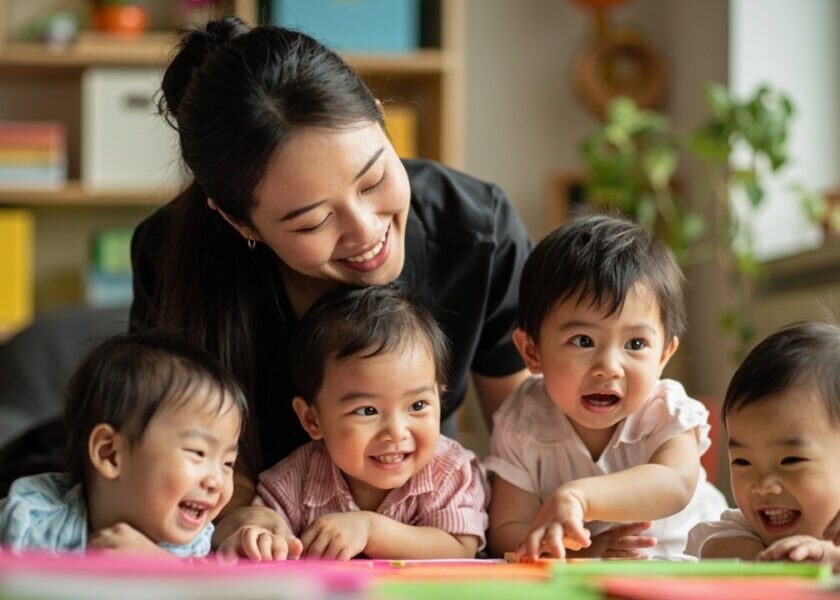
When an infant is in an environment where the caregiver-to-child ratio is small—where one attuned adult can truly observe, respond, and attune to the signals a baby is sending—something remarkable happens. The baby does not just receive care. The baby receives communication.
Every feeding, every diaper change, every moment of being lifted and held becomes a conversation. The baby learns that their signals matter. The baby learns that they are not alone in making meaning of the world.
With ratios that allow for genuine attentiveness—up to one to three infants in home-based settings—caregivers are not managing logistics. They are reading children. They are noticing the subtle shift in a baby’s cry that tells them something has changed. They are tracking the slow emergence of a toddler’s independence in play and creating the space for it to grow.
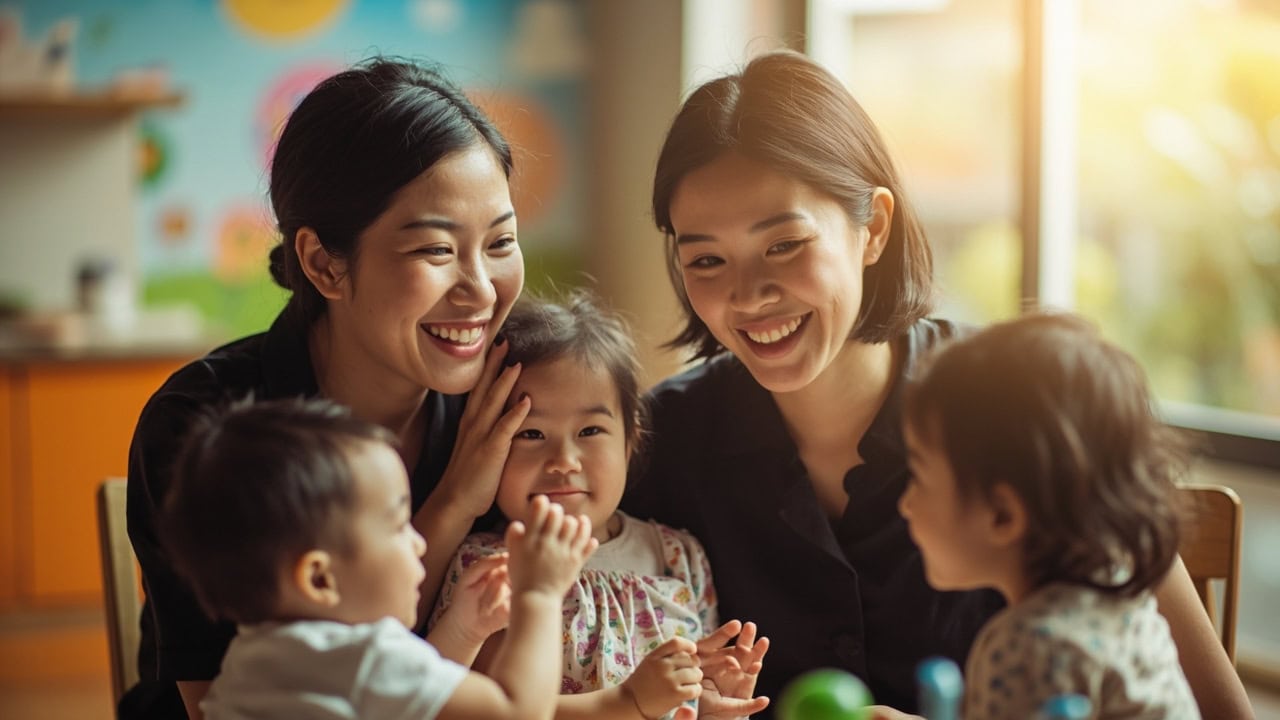
This is the condition that makes the signs of flourishing visible to you. Because when a caregiver can truly observe your child, your child can truly be observed. And when your child can be observed, you can see them. Not the summarized version. Not the checklist version. The real version—the one who is learning, right now, to regulate their emotions, to reach for connection, to explore the world with increasing confidence.
The Role of the Childminder: Seeing and Being Seen
In Singapore, as in many places, the word “childminder” can sometimes carry a shadow—a sense of being a fallback, a concession, a lesser substitute for a parent’s care. I want to turn that shadow into light, because nothing could be further from the truth.
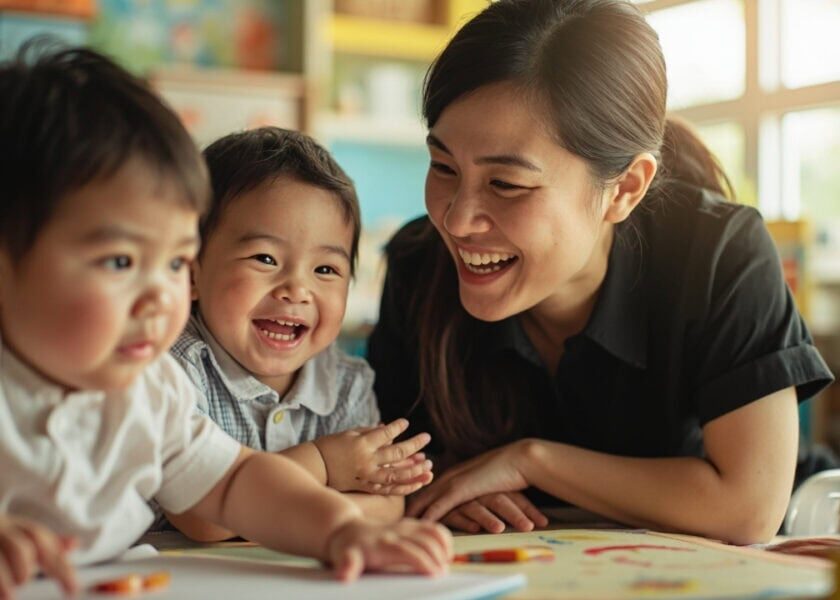
The childminder—your childminder, the one who knows your child’s sleep cues, who notices the way they hold a crayon before anyone else does, who can tell from a single sound that something has shifted in your child’s mood—that person is not a substitute for you. They are an extension of the environment your child needs to flourish.
They are, in the deepest sense of the word, a caregiver: someone who gives care that attunes, that observes, that responds to the individual child rather than the category of child.
This is work of extraordinary dignity. And the children know it. Long before they can say it, they know who sees them. And the signs of that being-seen—the emotional regulation, the social curiosity, the security-based exploration—become the proof that you chose well. Not because someone told you so. But because you can see it.
Addressing the Real Concerns Singapore Parents Carry
For some of you, this is your first time navigating formal care in Singapore. For others, the arrangement is more nuanced—you’re balancing work in the city while someone you trust cares for your child in the neighbourhood you chose for its warmth and its community.
The Financial Reality
Some of you are navigating the logistics of CDA and Baby Bonus, figuring out how to make quality care not just emotionally right but financially feasible. Quality childminding should not be a privilege of the financially comfortable, but a genuine option for families across Singapore.
Fee structures that are accessible, payment pathways that include CDA and Baby Bonus usability—these are not afterthoughts. They are deliberate choices that reflect a commitment to making quality care available.
Home-Based Care: A Worthy Choice
For those of you whose children are in home-based care, I want you to understand what that arrangement represents. It means your child is in a home, in a neighbourhood, in a setting where the rhythms of daily life—meal times, play times, rest times, the small dramas and comedies of a household—become the curriculum.
This is not a lesser form of care. For infants and young toddlers especially, this is in many ways the most natural, most attuned form of care available. It mirrors, in important ways, the conditions under which human development evolved: a small number of trusted adults, a consistent environment, a pace that can match the child’s own rhythm rather than forcing the child to match an institutional schedule.
The Trust Factor
There is also something worth saying about trust between the caregiver and the parent. Communication practices that keep you informed about your child’s day, and measures that support openness and accountability—these matter.
But the kind of trust we’re talking about goes beyond a communication app or a daily log. It goes beyond CCTV and check-ins. It is a trust that develops over time, through repeated observation, through seeing your child’s growth and knowing, with increasing certainty, that the person caring for them is attuned to who they are.
That trust is not built by systems alone. It is built by the signs. By the daily evidence that your child is not just safe, not just supervised, but genuinely thriving.
How to Choose Infant Care With Confidence
For parents actively researching childcare in Singapore, here is what to look for beyond the brochure:
- Observe the reunion. When you pick up your child, notice how they respond. Ease, warmth, a natural gladness to see you—these are signs of a secure, attuned day.
- Ask about ratios. Smaller numbers mean more individual attention, more observation, more of the communication that builds security.
- Notice consistency. Does your child have the same caregiver over time? Consistency is not a luxury—it is the condition for the signs of flourishing to emerge.
- Watch for warmth in the caregiver-child interaction. Not just tasks completed, but attunement. Does the caregiver read your child’s cues? Does your child seek them out?
- Trust your read. You are the expert on your child. If something feels off, it matters. If something feels right, trust that too.
Your Child Is Not Just Safe. Your Child Is Flourishing.
Let me return to that moment. The quiet doubt after pick-up. The question you almost didn’t ask because asking it felt like doubting something you couldn’t quite name.
Here’s what I want you to take with you. The signs that your child is thriving are not locked in a report waiting on a parent’s portal. They are not hidden in a milestone checklist that someone else fills out. They are in your child’s face when you pick them up. In the ease with which they walk toward you or reach for you. In the way they talk about their day—or don’t need to, because the security of it is already showing in their body, in their voice, in the simple fact that they are relaxed, curious, and present.
They are in the way your toddler brings a book to the caregiver not to be read to but to be with someone. In the way your infant settles into sleep knowing they are held. In the way your preschooler comes home and plays—independently, imaginatively, with the kind of focus that only a child who feels safe enough to let their mind go somewhere else can sustain.
These are not small things. These are the earliest, most fragile, most important signs of a human being building the capacity to be in the world.
And you—yes, you—are the one who can see them. You always have been. You just needed someone to tell you that your noticing was valid, that your intuition was calibrated, that the art of reading your child is a skill you are already practicing every single day.
Quality childminding exists to give you the conditions in which those signs become visible. A ratio that allows a caregiver to truly see your child. An environment that allows your child to truly grow. A structure that allows you, as a parent, to see what is actually happening—daily, clearly, with growing confidence.
Your child is not just safe. Your child is not just growing. Your child is flourishing.
And the signs are all around you, every day, waiting to be read.
Explore EduNanny Singapore
Finding care that allows these signs to flourish is not always straightforward—but it is possible. At EduNanny Singapore, we believe that every family deserves to see their child thriving, and every child deserves to be truly seen.
As a licensed childminding service operating under the ECDA Childminding Pilot, EduNanny is built on the principles that make flourishing visible: small ratios, attuned caregivers, and environments where development unfolds naturally.
If you’re ready to explore what quality, development-focused childminding can look like for your family, we’d love to hear from you. Or learn more about our approach and the standards we hold ourselves to.
Every flourishing child starts with someone who knows how to read them. That someone is you.