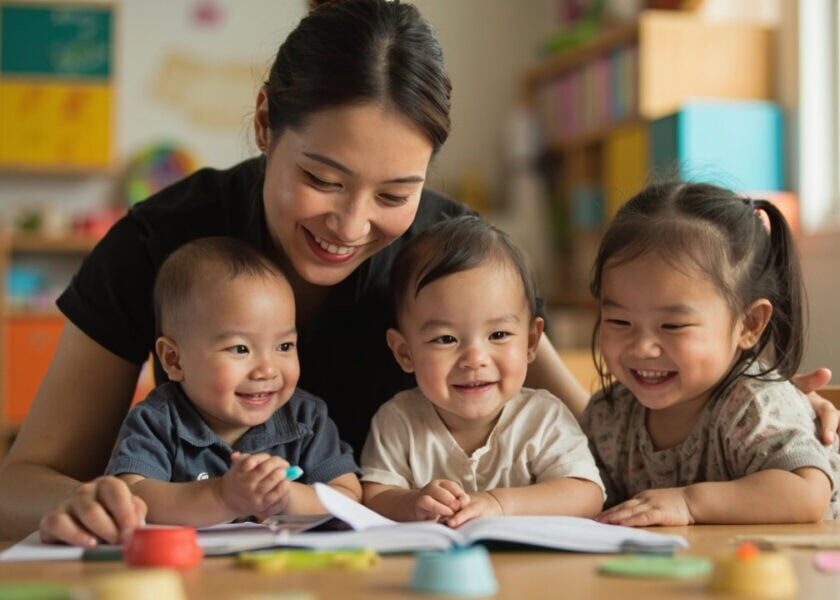
The Quiet Architecture of Your Child’s Early Years
What Quality Childcare Is Actually Building
When you choose childcare, you are making one of the most consequential decisions of early parenthood. The research is unambiguous: the early years are not merely preparation for later. They are, in themselves, a foundational architecture.
The brain is building itself at a speed it will never again achieve. Neural pathways are forming that will later determine how your child responds to challenge, how they form relationships, how they sit with uncertainty, how they reach for curiosity or retreat from it. What happens in these years matters not because it predicts a future outcome, but because it is, in many ways, the outcome itself. The child your son or daughter becomes is being built now, in moments you are and are not present to witness.
Here is the quiet tension: you are the one who chooses, but your child is the one who lives the experience. You cannot be inside the room. You can only infer, interpret, and hope.
We spend so much time telling parents to trust the process. To have faith in their choice. But trust built only on hope is fragile trust. What parents deserve is not reassurance without understanding, but understanding that makes trust possible.
In quality care, your child is quietly building four essential inner dimensions:
- Security that becomes exploration — learning that the world is safe enough to venture into
- Social intelligence — discovering how to navigate relationships with peers
- A learning identity — developing the internal sense that they are capable of figuring things out
- Emotional regulation — building the capacity to manage big feelings without being overwhelmed
These are not visible in daily reports. But they reveal themselves over time — in the child who negotiates instead of demands, who tries new things without collapsing at failure, who kisses a younger sibling not because you taught them to, but because they have felt tenderness and are practising it.
Once you understand what is actually being built, the choice you make transforms from an act of faith into an act of informed confidence.
Security: The Foundation for Exploration
The first thing that happens in quality care is something that does not look like learning at all. It looks like crying at the gate. It looks like reaching for a caregiver with uncertain arms. It looks, to an outside observer, like distress.
But inside that distress, something else is happening. The child’s nervous system is asking a question: Is this place safe? Are these people safe? Will I be protected here?
In quality care, the answer comes not in words but in consistency. It comes in the same caregiver greeting the same child at the same time each morning. It comes in a voice that is warm but not performative. It comes in arms that hold with genuine intention. It comes in the slow, patient work of earning a child’s trust one reliable moment at a time.
This is the foundation of everything else. In developmental psychology, we call it secure attachment. In simple terms, it is the quiet knowledge that forms inside a child: I am held. I am known. When I am upset, someone will come. When I am scared, someone will stay.
Over days and weeks, something begins to change. The child at the gate stops crying — not because they have forgotten you, but because they have begun to trust the transition. They have learned, through experience, that goodbye is not abandonment, and return is not uncertain.
A child who feels secure is a child who can look outward. A child who trusts that their base is safe is a child who can venture into the room, touch the texture of a new material, approach another child, try something that might not work. Security is not the destination. It is the launchpad.
What you will notice: Your child chooses to play alone in their room for the first time. They attempt a puzzle they have struggled with before and persist rather than abandon it. They walk into a birthday party and, after a moment of hesitation, walk toward the other children. These are not coincidences. These are the outward expressions of an inner foundation that was built in the hours you were not there to see.
Social Intelligence: Learning to Navigate Others
The second inner dimension has to do with how children begin to understand themselves in relation to others.
In quality care, children encounter something they cannot encounter at home, no matter how much parents wish they could provide it: a peer world. Other children who are their age, their size, their developmental level. Other children who want the same toys, occupy the same space, have their own needs and feelings and desires.
A child in quality care is learning, for the first time, that other people have perspectives different from theirs. That a toy does not belong to them just because they want it. That a game has rules. That when they push, someone falls, and that someone else feels pain. That when they share, something shifts in the room.
These are not small lessons. They are the earliest foundations of empathy, of cooperation, of moral reasoning.
In quality care, trained caregivers do not simply supervise these interactions. They facilitate them. They model. They narrate what they see: “I see that Mei Ling is holding the truck and Jin Wei wants a turn. Let’s think about what we can do.”
They create environments where cooperative play is possible. They step in when escalation threatens — not to resolve every conflict for the children, but to ensure that the conflict remains productive rather than destructive. They give children the language for what they are feeling: “You’re frustrated because it’s your turn and you want more time.”
What you will notice: Your child begins to negotiate rather than demand. Your child notices when another child is upset. Your child uses words like “take turns” and “together” with genuine meaning. Your child kisses a doll not because you taught them to, but because they have seen tenderness modelled in care and are now practising it in their own world. This is social development made visible.
A Love of Learning: Building a Learning Identity
The third inner dimension is perhaps the one most parents are most consciously hoping for, even if they cannot always name it: the foundations of a learning identity.
Singapore parents are ambitious for their children. They want their children to do well, to be capable, to love learning. But here is what many parents do not realise: the love of learning is not something you can teach a child directly. It is something that develops inside a child when certain conditions are present.
These conditions are not complicated, but they are precise:
- Safety — When the environment is not punitive, when questions are welcomed, when curiosity is met with interest rather than impatience
- Struggle without rescue — When children are given the freedom to persist at something difficult without being immediately rescued from the struggle
- Genuine recognition — When their small discoveries are noticed and celebrated, not with excessive praise that creates dependency on external validation, but with genuine interest that communicates: what you noticed matters. What you are curious about is worth exploring.
In quality care, this happens through the design of the environment itself. Through open-ended materials that invite investigation rather than dictate outcomes. Through caregivers who are trained to observe a child’s interests and build on them — who notice that a child is fascinated by how water flows and create an invitation to explore that curiosity further the next day.
What develops inside the child: Not a set of facts. A disposition. A way of being in the world that says: learning is possible here. I can figure things out. I am capable. The unknown is not frightening; it is interesting.
What you will notice: In the questions your child begins to ask — not just “why” questions, though those too, but a quality of curiosity. A willingness to try. A resilience in the face of something that does not work the first time. Your child says “I can’t do it” less often. When they do say it, they say it with a question mark rather than a period. They approach new situations not with “I don’t know how” but with “let me see.”
Emotional Regulation: Managing Big Feelings
The fourth dimension is one that is often overlooked in conversations about childcare, but that may matter most of all: emotional regulation.
Emotional regulation is the capacity to feel an emotion without being overwhelmed by it. To experience frustration and not destroy. To feel fear and not freeze. To feel anger and not attack.
This capacity does not come naturally to young children. It is built over time, through repeated experiences of having big feelings witnessed, named, and soothed.
In quality care, children are in an environment where their emotional world is taken seriously. Where a tantrum is not seen as bad behaviour but as a signal: something is too much, too hard, too frightening.
Caregivers are trained to stay present with a distressed child — not to fix the emotion instantly, but to be a calm, regulated presence while the child moves through it. To name what the child might be feeling. To offer comfort without judgment. To help the child begin to learn that overwhelming feelings do pass, that they can be survived, that a caregiver will stay with them through the hardest moments.
This is invisible work. It does not produce a painting. It does not generate a report. But it is building something inside your child that will matter every single day of their lives: the internal capacity to manage their own emotional world.
What you will notice: The child who can wait without falling apart. The child who can be told “not now” and not disintegrate. The child who can tolerate disappointment. The child who, when something goes wrong, looks for a solution rather than collapsing into despair. These are not personality traits. They are competencies. And they were built, in large part, in the hours you were not there to witness.
What Quality Care Looks Like in Practice
Now that we have explored the inner dimensions your child is developing, let us address a practical question: what does quality actually look like on the ground?
When you visit a childcare arrangement — whether centre-based or home-based — you will not see the inner work happening. You will see children playing, caregivers moving between activities, perhaps artwork on the walls. The real work is quieter. It is in the:
- Caregiver who notices a child pulling back from a group and gently sits beside them rather than urging participation
- Response to a conflict that ends not with a verdict but with a question: “What do you both need?”
- Caregiver who narrates a child’s emotional state back to them: “I see you’re holding on tight to that. You’re worried someone might take it.”
- Environment designed not for adult convenience but for child investigation — shelves at child height, materials that invite touch and exploration, spaces where a child can retreat and regroup
The signs of quality are often subtle. They are not the flashy activities or the impressive curriculum documents. They are in the micro-moments: how a caregiver responds when a child falls, how transitions are handled, whether a child is truly seen as an individual or managed as part of a group.
Questions to Ask When Evaluating Care
- How long has my child’s primary caregiver been in this role?
- What is the child-to-caregiver ratio?
- How are conflicts between children handled?
- How do you support a child who is struggling emotionally?
- How will I know what is happening during the day?
The answers you receive will tell you something about whether this environment is designed to support the inner development we have described, or whether it is primarily focused on keeping children occupied and safe.
Your Questions, Answered
We understand that choosing childcare for your infant or young child comes with genuine anxiety. Let us speak directly to some of the concerns we know Singapore parents carry.
“How will I know my child is really okay?”
You will not know everything. That is the nature of entrusting your child to others. But you can know more than you think. Look for the signs we have described: the child who runs to you at pickup, the child who mentions their caregiver with familiarity, the child who seems generally comfortable with the routine of drop-off and collection. Ask questions. Request updates. Quality caregivers welcome this engagement, because they know you are not doubting them — you are being a parent.
“Is home-based care as good as centre-based?”
The question is not the setting but the quality within it. Home-based care can offer smaller ratios, a cozier environment, and a more intimate relationship between caregiver and child. Centre-based care can offer more peers for social development and more resources. What matters most is the quality of the caregiver’s training, their attentiveness to individual children, and whether the environment supports the inner development we have described.
“What if my child cries every day at drop-off?”
Separation distress is normal and healthy. It means your child has formed a secure attachment to you and is protesting a disruption to that bond. What matters is how the caregiver responds to that distress, and whether over time — days and weeks — the child begins to develop a secondary trust. If your child continues to be deeply distressed after weeks of consistent care, that is worth discussing with the caregiver and reassessing whether this particular arrangement is the right fit.
“Will my child forget me?”
Your child will not forget you. The secondary attachment your child forms with a quality caregiver does not replace your bond — it extends your child’s sense of security outward. Think of it this way: your child is learning that the world has more than one safe person in it. That is a gift, not a threat.
EduNanny: Designed for the Inner World
For families navigating the childcare landscape in Singapore, there are real choices to make. Home-based care, centre-based care, different pathways with different structures and philosophies. What EduNanny offers is a particular kind of answer to a particular kind of question:
What if the care your child receives is not just safe supervision, but genuine developmental partnership? What if the hours you are apart are hours your child is building the foundations of everything they will become?
EduNanny by BUTLER operates within the ECDA Childminding Pilot. This matters for reasons that go beyond policy. The pilot represents a deliberate investment in the quality of care itself — not just in making care available, but in ensuring that care meets standards that are genuinely developmental, genuinely nurturing, genuinely attentive to the inner world we have been describing.
EduNanny’s approach reflects this commitment. With infant ratios designed to allow for real attention — for the caregiver to notice the small signals, to respond to the individual child rather than simply manage a group — EduNanny creates the conditions for the inner development we have described.
Communication and transparency are built into the model, so that parents are not left guessing. Where deployed, CCTV measures offer additional peace of mind. Caregiver training, environment design, daily rhythms — all of it is oriented not around keeping children occupied, but around supporting their development.
For families navigating the practical realities of childcare in Singapore, EduNanny is also structured to be accessible. Within the pilot fee structures, care is designed to be affordable. CDA and Baby Bonus are usable, reducing the financial weight of quality care for families who want it.
The inner world of quality care should not be available only to those with significant means. Every child in Singapore deserves the chance to build the foundations we have described. EduNanny’s pilot model is designed with this equity in mind.
A Final Word
You cannot see everything that is happening during the hours you are apart. No parent can. The inner world of your child is, by its nature, invisible. You will not always know what they learned today, what they felt, what they are building.
But invisibility is not the same as unknowability. There are signs. There are signals. There is evidence that you can learn to read — not with the clinical precision of a developmental specialist, but with the informed intuition of a parent who understands what quality care is building inside.
When your child walks into a room and looks around with interest rather than fear. When they negotiate with a sibling instead of demanding. When they try something new without collapsing at the first failure. When they kiss a younger sibling or offer comfort to a friend. When they ask questions with genuine curiosity. When they can be told “not now” and integrate it. These are not coincidences. These are the visible expressions of an inner architecture that was built in the hours you were not there.
In quality care, with trained caregivers, in an environment designed for development, your child is building something profound: security, social intelligence, a love of learning, emotional resilience. Your role is not to witness all of this. Your role is to understand it, to trust it, and to continue being the secure base that quality care extends outward from.
When you drop your child at the gate, you are not abandoning them to an unknown. You are placing them in a carefully designed environment where their inner world will be attended to.
You chose this. You chose with care, with thought, with hope.
And the hope was not misplaced. Because now you understand what is actually happening. Now you can trust not because you are asked to have faith, but because you know.
And that is the most powerful gift you can give your child: a parent who understands what they are building inside.
If you are exploring childcare options for your infant or young child in Singapore, we invite you to connect with us to learn more about how EduNanny’s approach is designed to support the quiet, essential work of your child’s inner development.
You can also read more about EduNanny and our commitment to quality, development-focused childminding within the ECDA Childminding Pilot.
#SingaporeChildcare #InfantCareSingapore #QualityChildminding #EarlyChildhoodDevelopment #EduNannySingapore