The Question That Changes Everything for Singapore Working Parents
Quick Summary
- The tension you carry: Singapore working parents often feel quiet guilt about childcare decisions, even when they know they are making the right choice for their families
- The reframe that changes everything: Choosing thoughtfully and researching carefully is not a compromise — it is one of the most loving things you can do for your child
- What quality actually means: Not programmes or facilities, but whether your child is truly seen, known, and attended to
- What EduNanny offers: Home-based and community-based childminding under the ECDA Childminding Pilot, with ratios designed for genuine attention and fee structures accessible to more families
- The outcome: Not just safe care, but peace of mind — the ability to be fully present when you are with your child
Understanding What Working Parents Actually Carry
Let us name what is happening in those early morning moments. There is grief — even when the arrangement is temporary, even when you know it is the right decision for your family. There is a recalibration of identity: you are still a parent, but you are a working parent, and those two roles sometimes feel like they are in conversation with each other rather than alignment.
In Singapore’s high-pressure environment, where expectations on families compound daily and the cost of living often demands two incomes, this tension is not minor. The culture simultaneously whispers that children need constant presence. Parents absorb this message even when they know, practically, that they cannot act on it. And that gap — between what you feel you should do and what you are able to do — is exhausting.
You begin researching childcare the way you approach a medical diagnosis. You read everything. You trust nothing. You second-guess every source. You ask friends, and their experiences contradict each other. You read reviews, and they oscillate between gratitude and regret. You visit centres, and you are simultaneously evaluating the toys, the staff, the smell of the building, the temperature of the interaction between caregiver and child.
You are making a decision about who will hold your child in the way that matters most to you, and the weight of getting it right feels unbearable.
And here is what is rarely acknowledged: the comparison. Not the comparison you consciously make between providers, but the comparison you make between yourself and other family models. The grandmother who is home. The auntie who watches the children for free. The colleague who works part-time. The friend who seems to manage everything without breaking a sweat. Somewhere in the middle of your search, you catch yourself wondering if you are the only one finding this so hard.
Let us be clear: that comparison is not a sign of weakness. It is a sign that you are paying attention. It is a sign that you understand the stakes.
The Turning Point: From Guilt to Purposeful Questioning
Here is the thing no one tells you: the doubt does not end when you choose. It arrives again at the door, at the handoff, at the moment your child cries and you must walk away. It arrives at the first report, when you wonder if the observation was accurate. It arrives when your child acts out and you wonder if something happened, if something was missed, if the bond was strong enough to withstand the hours apart.
You move through your working day carrying a second consciousness — a low-level hum of wondering whether you have made the right choice, whether your child is truly okay, whether the care is what it should be. This is not a failure of character. This is the reality of loving someone completely and entrusting their care to another human being.
And yet, somewhere in that doubt, something important can begin to shift — if you let it. Somewhere in the research and the visits and the conversations, a question starts to replace the worry. It does not happen all at once. It is quiet, like the morning silence in that kitchen.
The old question was: Am I failing?
The new question is: What does it actually look like when this works?
What does it look like when a childcare arrangement is not a compromise, but a genuine act of care? When the provider is not a replacement, but a partner? When your child thrives not despite your working, but alongside it?
This is the turning point. And it is not a dramatic revelation. It is the moment you realise that choosing thoughtfully, researching carefully, and committing to quality is not a concession to circumstances. It is, in fact, one of the most loving things you can do for your child.
Because the truth is: your child does not need your presence every waking moment. What your child needs is your presence when you are present, and a safe, attentive, responsive environment when you are not. What your child needs is for you to be at peace, not fractured by guilt. What your child needs is for you to trust the people you have chosen, so that they can trust them too.
What Quality Childcare Actually Looks Like
Redefining quality in this way matters. Because quality in childcare is not just about programmes or facilities or credentials. It is about attention.
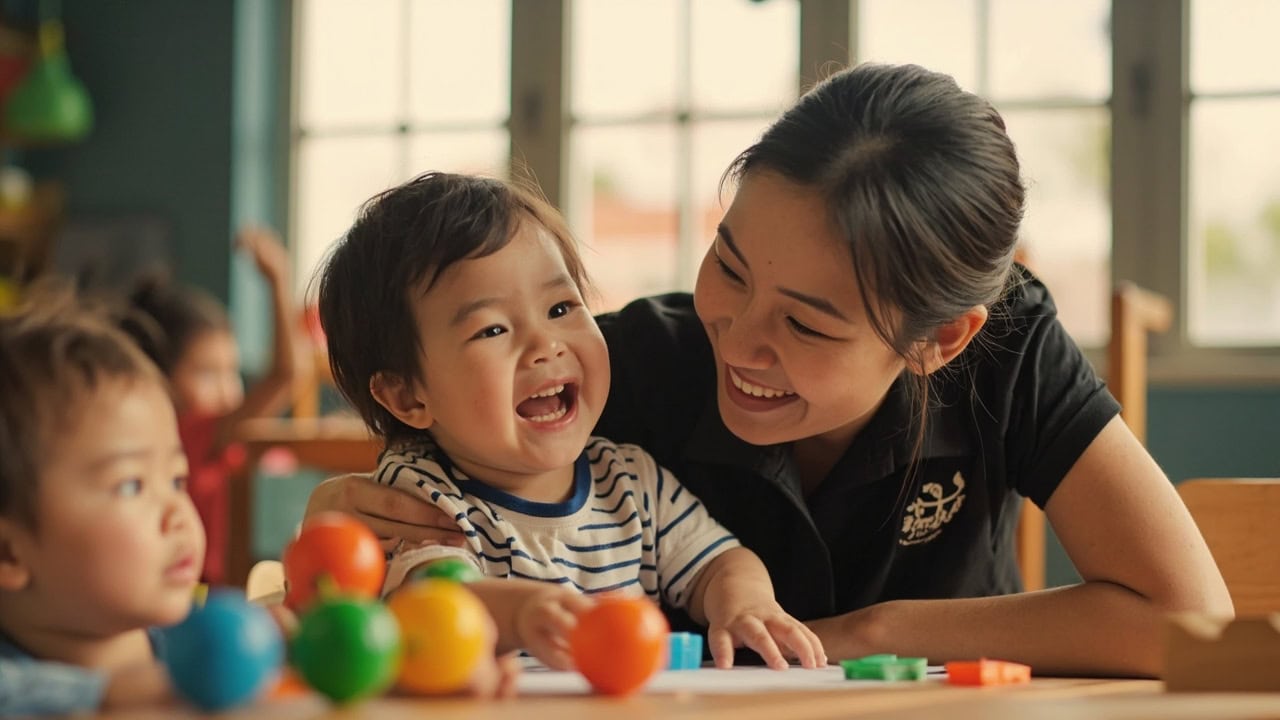
It is about whether your child is seen — not just watched, but seen, understood, known. It is about whether the person caring for your child notices when they are frustrated before it becomes a tantrum, notices when they are tired before they collapse, notices their rhythms and preferences and personality.
Consider what this means in practice:
- Consistency: Your child sees the same caregiver each day, not a rotating cast of strangers
- Observation: Someone is tracking developmental milestones, mood changes, and emerging preferences
- Communication: You receive real information — not just formal updates, but genuine observations about who your child is becoming in your absence
- Responsiveness: Your child’s cues are read and acted upon, not managed through routine alone
Quality care is not a building with excellent facilities. It is a relationship where your child matters as an individual — where their specific needs, temperament, and growth are known and tended to.
EduNanny Singapore: Meeting You Where You Are
EduNanny Singapore is part of the ECDA Childminding Pilot, a programme designed to meet families exactly where they are — in their homes, in their communities, in their real lives.
The pilot offers two pathways:
- Home-based care: A trained childminder comes to you, reducing transition stress for your child and maintaining the familiarity of your own environment
- Community-based care: Smaller, more intimate settings that allow for individualised attention in a group context
The infant ratios — up to one childminder to three children, depending on the arrangement — are not administrative details. They are the architecture of attention. They are what makes it possible for your child to be known, individually, consistently, caringly.
This matters because quality care should not be a privilege reserved for families who can afford premium packages. The pilot fee structures are designed to be accessible, and the usability of CDA funds and Baby Bonus means that families across Singapore — not just those with significant financial resources — can access this kind of care.
That is not a small thing. That is a statement about who deserves peace of mind. That is a belief that every child deserves to be held by someone who has the time and the training to do it well.
Trust Through Transparency
The communication measures — regular updates, transparent reporting, and where deployed, CCTV access — are not there because parents are assumed to be suspicious. They are there because trust is built through transparency, and because parents who feel they can check in, even metaphorically, are parents who can let go.
You should be able to know what your child ate, how they slept, what made them laugh. You should be able to see, if you need to see, that the door is secure and the care is real. These are not luxuries. They are the conditions under which peace of mind becomes possible.
And peace of mind is not a vague aspiration. When your child is in the right environment, you can work without that low-level hum. You can focus. You can be present when you come home. You can stop second-guessing and start connecting.
The Childminder at the Centre
The childminder in this model is not a peripheral figure. She is central.
She is trained, observed, supported — part of a programme that values her professionalism and her humanity equally. She is someone who chooses this work not because it is easy, but because she understands its weight. In a world where the work of caring for children is often invisible, EduNanny makes it seen, makes it dignified, makes it excellent.
That matters — for her, and for you, and for your child, who will feel the difference between being attended to and being truly cared for.
Questions Singapore Parents Ask
“Will my child feel abandoned?”
Your child is more resilient than guilt makes you believe, and more perceptive than you realise. What they need is not your constant physical presence, but the security of knowing that the people caring for them are warm, consistent, and attentive. When children feel genuinely safe in their care environment, they are free to explore, learn, and form healthy attachments — not despite your working, but because your working has led you to choose carefully.
“Is this just for wealthy families?”
No. The ECDA Childminding Pilot was designed with accessibility in mind. CDA fund usage and Baby Bonus integration mean that more families can access quality care without depleting savings or taking on financial strain.
“How do I know I can really trust someone in my home?”
Trust is built, not assumed. EduNanny’s approach includes observation protocols, regular check-ins, and transparent communication channels — so that trust grows through experience, not just faith.
“What if the care does not match what my child needs?”
EduNanny structures its arrangements to allow for observation, feedback, and adjustment. If something is not working, there are mechanisms to address it — because a partnership in care means ongoing communication, not a one-time decision.
Practical Guidance: How to Choose When You Are Overwhelmed
If you are in the thick of researching infant care in Singapore, here is what matters most:
- Start with the feeling, not the checklist: After a visit or interaction, notice how you feel. Ease and trust are data. Discomfort and doubt are also data.
- Ask about ratios: Smaller ratios mean more individualised attention. This is not a luxury — it is the foundation of what makes care work.
- Ask about observation and communication: What will you know about your child’s day? How often? In what format? You deserve real information, not just formal updates.
- Check for transparency: Can you see how the programme works? Are they forthcoming about training, protocols, and how concerns are handled?
- Consider your child’s temperament: Some children thrive in groups. Others need quieter, more individualised settings. The right environment depends on who your child is.
- Factor in your own peace of mind: If you cannot imagine leaving your child there without anxiety, that is information. The best programme on paper means nothing if you cannot trust it in practice.
You will meet parents who seem to have made peace with their choices easily. You will meet grandparents who criticise without understanding. You will meet colleagues who imply you should do more, in one direction or another. Here is what you need to hear: the path you are on is valid. The research you are doing is love in action. The doubt you carry is not weakness — it is the weight of genuine care.
Comparison is natural. But it does not get to define your worth as a parent. Only your child’s wellbeing does that — and you are pursuing that wellbeing with everything you have.
Ready to Explore Your Options?
Let us return, one last time, to that kitchen. The morning light is coming through the window now. The bottles are ready. The bag is packed. Your child is stirring.
In a moment, you will pick them up, and you will carry them to the door, and you will hand them to someone you have chosen because you chose carefully, because you loved them enough to look.
And in that moment, what you will feel is not the absence of love. You will feel the shape of it — this enormous, impossible, beautiful thing that made you ask the questions, do the work, and keep going.
You were not failing. You were choosing.
And choosing well is also an act of care.
EduNanny Singapore is here for the families who are in that kitchen, for the parents who carry the weight and still get up every morning, for the ones who want more than safety — who want their child to be known. We are here for the long term, as your family grows and changes, as your needs shift and evolve.
We are here with training and transparency and attention, with home-based care and community pathways, with communication you can trust and ratios that make attention possible. We are here, and we will hold that door open for you.
This is not the end of the journey. It is the part where the journey becomes easier. It is the part where doubt softens into confidence, not because the questions stop, but because the answers become real. It is the part where you can breathe, knowing that your child is not just cared for, but seen.
If you are researching infant care or childminding in Singapore and want to understand how our approach might work for your family, we would be glad to hear from you. No pressure, no hard sell — just an honest conversation about what you need and how we might meet it.
Get in touch with EduNanny Singapore
EduNanny Singapore is a trusted provider of home-based and community-based childminding under the ECDA Childminding Pilot. Learn more about our approach to thoughtful, development-oriented childcare.