The Quiet Privilege of Letting Your Child Grow
The Quiet Grief of Watching Your Child Grow
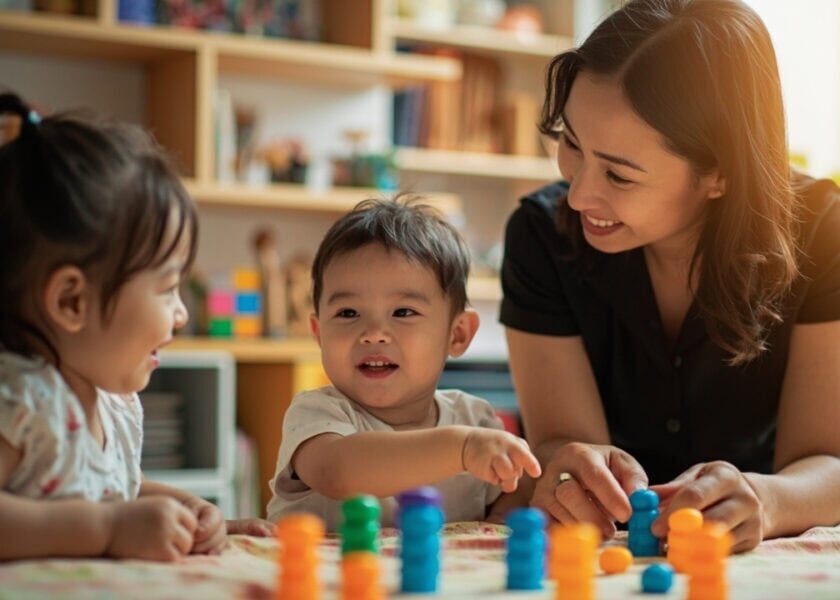
There is a moment — you may not even notice it at first. You are watching your child play in a familiar space, perhaps in a childcare setting that has become their second home, and you see something shift. Your child turns to a caregiver, shares a discovery, laughs at something you are not close enough to hear. For a fraction of a second, you feel like a stranger in your own child’s joy.
And then immediately, fiercely, you feel something else. Pride. But threaded through it, quieter and harder to name, is something like grief.
That grief is not a sign that something has gone wrong. It is a sign that something has gone right. Your child is growing. Your child is thriving. And somewhere in the mathematics of that growth, you have begun to count yourself less and less as the sole answer to every need your child has.
Because no one told you that parenthood would feel like learning to let go of the centre of the universe, one small, beautiful, ordinary day at a time.
If this sounds familiar, you are not alone. And more importantly, what you are feeling is not a failure of love. It is the ache of love growing into something new.
This article is about that feeling — the one you may not have said out loud. And about why choosing quality childcare in Singapore, made with intention and honesty, can be one of the most profound acts of love you offer not just to your child, but to yourself.
The Identity Question No One Handed You a Roadmap For
In Singapore, the conversation around childcare tends to fill with checklists and credentials. What are the teacher-to-child ratios? Is the centre licensed? What do parents’ reviews say? How does the infant care fee structure work? These are important questions, and they deserve careful answers.
But something quieter tends to get left out. The conversation about you. Your identity. Your purpose. The parent you are becoming as your child becomes more and more their own person.
There is a particular kind of quiet grief that comes with early parenthood — one that is rarely acknowledged because it sounds, on the surface, like something it is not. It sounds like ingratitude. It sounds like you do not love your child enough to want them independent.
But what it actually signals is something profound. You entered parenthood assuming that your child’s need for you would be the architecture of your purpose. And for a time, it is. In those early weeks and months, a newborn’s need is total. Consuming. In those early days, you are not just a parent. You are the world.
And then your child begins to grow. The world expands. Slowly, steadily, your child begins to need you differently — not less, but differently. And you are left standing at the edge of a question that no one handed you a roadmap for:
If I am not the world, who am I?
This is where the fear lives. Not in the practical logistics of childcare, though those matter. The fear lives in the identity question. And it is one of the most honest, most human fears a parent can have. It deserves to be met with respect, not dismissal.
The Particular Pressures of Parenting in Singapore
Singapore parents carry a particular weight. You are, by and large, a generation of high-achieving individuals. You have navigated some of the most demanding academic and professional environments in the world. You have learned to be exceptional at your careers, skilled at your responsibilities, capable of extraordinary output under pressure.
And then a child arrives, and you are asked to become something you have no training for — a parent — and suddenly the competencies that have defined you your entire adult life feel not just inadequate but, in some strange way, irrelevant. You are no longer judged by your output. You are judged by your presence. And presence, unlike performance, cannot be optimised.
The expectations on Singapore parents — from family, from schools, from each other, from yourselves — are extraordinary. The competition begins early, sometimes before a child has taken their first steps. There is a culture here of striving, of excellence, of not settling. And that culture has produced remarkable people and remarkable families.
But it also places a particular kind of pressure on parents to be exceptional at something they have never been trained for, in a domain where there is no examination, no benchmark, no performance review — only the silent, relentless inner scorecard that tells you whether you are enough.
You have built careers. You have pursued education at levels that would exhaust most people to contemplate. You navigate the logistics of dual-income households, the complexity of in-law dynamics, the financial planning, the future-thinking that begins before your child is even born. You are managing complexity at a level that would stagger most people.
And yet, when it comes to your own growth as a parent, there is a sense that you should somehow be satisfied with the narrow lane of being available, of being present, of being enough. As if your ambitions — the ones that built your career, that shaped your identity, that made you the capable, clear-thinking person your child will one day look up to — should be set aside now that you are a parent.
This is where I want to pause and offer a different perspective.
Quality Childcare as Liberation, Not Surrender
Quality childcare does not replace your role. It replaces the exhaustion of trying to be your child’s everything. And in that space — the space that opens up when you are no longer running on four hours of sleep and the desperate need to be present for every single moment — something extraordinary can happen.
You can become present in a way you were never able to be before.
Not physically present in the sense of occupying the same room. But intentionally present. Emotionally available. The parent who, when you are with your child, is truly there. Not distracted. Not depleted. Not running on empty and phoning it in. But awake. Warm. Capable of wonder.
That is not a small thing. That is everything.
Two Kinds of Presence
There is a distinction between two kinds of presence, and it is the key to understanding what I am trying to say.
The first kind of presence is physical — the sheer, relentless, exhausting labour of being the person who is always there. The one who gets up at three in the morning. The one who manages every feed, every diaper change, every fever, every sleepless night, alone, because you are the parent and this is what parents do. That kind of presence is an act of love so profound it should be honoured and acknowledged and, frankly, better supported than it often is.
But there is another kind of presence — one that quality childcare makes possible — and it is the kind that your child will remember when they are grown. It is the presence of a parent who has space inside themselves to listen, to engage, to play without agenda, to respond with patience because they are not running on empty. It is the presence of a parent who has been given the room to remain a full, vital, growing human being.
Because a parent who is only a parent is, in the end, giving from a depleted well. And depleted wells run dry.
What the Research Actually Shows
You have read the articles about secure attachment. You know, intellectually, that a child can love their caregiver and love you, that attachment is not a zero-sum game, that a child who feels secure in multiple relationships is richer, not poorer, for the network of care around them. You know all of this.
And still, somewhere beneath the knowledge, a small voice asks: what about me? What is my role when my child no longer needs me to be everything?
That is the fear no one names. Let me name it clearly.
Research on secure attachment tells us something beautiful. A child who feels secure with their caregiver does not love their parent less. A child who thrives in quality care comes home more available for connection, not less. A child who has been held well by many hands carries that sense of being held into every relationship, including the one with you.
The caregiver is not a substitute for you. The caregiver is an expansion of the village your child needs to become the person they are meant to be. And the parent — the intentional, growing, evolving parent — is at the centre of that village, not because they are the only caregiver, but because they are the one who provides the thread of continuity, the emotional through-line, the steady presence that a child carries inside them for the rest of their life.
Growing Alongside Your Child
What does it mean to grow alongside your child? It means, first, acknowledging that the parent you were in the first year — the one who nursed and soothed and held and sheltered — was necessary and beautiful and sufficient. That parent was right for that season.
And it means accepting that the parent you are becoming now, as your child grows, is not a diminished version of that parent. It is a different version. An evolved one.
A parent who can ask better questions. A parent who can model what it looks like to be a whole person — someone with interests and passions and ambitions beyond the identity of caregiving. A parent who demonstrates, not through instruction but through living, that growth is not something that stops when you become a parent.
That it accelerates.
Your child does not need a parent who has sacrificed their entire self on the altar of parenting. Your child needs a parent who shows them what a full, vital, purposeful life looks like. And that requires you to claim space for your own growth.
Not guiltily. Not apologetically. But as an act of parenting as well.
What Quality Childminding Looks Like — and Why It Matters
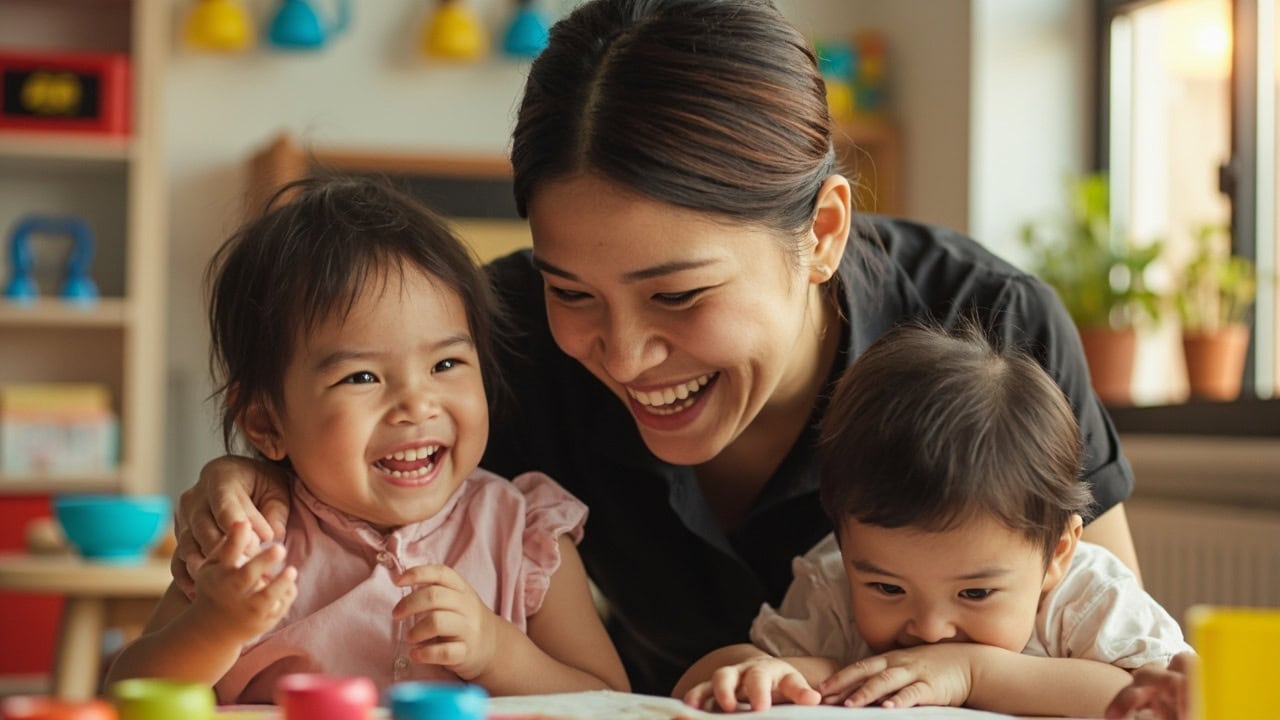
Quality childminding is not about finding someone to supervise your child while you are away. It is about finding a developmental partner who will hold the space for your child’s growth with skill and warmth and genuine care.
Here are the elements that distinguish quality from adequacy:
- Low ratios: In infant care settings, the up to one-to-three infant ratio means your child is not one of many. They are seen, known, and held with attention. Small numbers matter enormously in the first years.
- Trained, intentional caregivers: Childminders within quality programmes are not interchangeable. They are trained professionals who understand that what they do is not babysitting. It is developmental partnership in the truest sense.
- Predictable rhythm: Monday to Friday care blocks provide the kind of reliable, predictable rhythm that children and parents both need to build security and trust. Consistency is not a luxury — it is a developmental necessity.
- Transparent communication: Regular updates, openness about your child’s day, and transparency about how care is delivered. You should never feel that oversight has been surrendered when you hand over care.
- Accessible fees: Quality support should not be available only to families with unlimited resources. Look for arrangements where subsidies, CDA, and Baby Bonus can be applied — so the system works with the financial architecture Singapore has thoughtfully put in place.
The EduNanny Approach
EduNanny was built on a recognition that Singapore families need more than a list of caregivers. They need a partner who understands that choosing childcare is not a concession — it is a decision that reflects the kind of parent you want to be.
Through the ECDA Childminding Pilot, EduNanny makes available a structure that treats the family as a living, evolving unit — not as a static arrangement of needs and services. Home-based and community pathways offer flexibility for families whose needs do not fit a single predetermined shape.
The elements described above — the ratios, the trained caregivers, the predictable rhythm, the transparency, the accessible fee structures — are not aspirational. They are operational. They are what quality childminding offers daily to the families it walks alongside.
When you trust a caregiver who is excellent, you are not admitting defeat. You are not outsourcing love. You are creating the conditions for your child to experience a wider, richer world of care — and for yourself, you are creating the conditions to be the parent your child deserves, the parent you have always been capable of being but may not have had the space to become.
That is what thoughtful, quality childminding offers. Not just care, but permission. Permission to be a whole person. Permission to grow. Permission to trust that your child’s thriving is not a measure of your replacement, but a measure of your wisdom in building a village.
Your Real Questions, Answered Honestly
These are the questions parents ask when they are being honest with themselves. They deserve honest answers.
“Will my child love me less?”
No. Attachment research consistently shows that children can form multiple secure attachments without any attachment to a primary caregiver being diminished. Your child loving their caregiver — and feeling secure with them — does not take anything away from the bond between you. It adds to your child’s sense of being held by the world.
“What is my role when my child no longer needs me to be everything?”
Your role evolves, not diminishes. You become the centre of the village — the thread of continuity, the emotional anchor, the one who provides the through-line of identity and values that your child carries inside them for life. This is not a lesser role. It is a more intentional one.
“Should I not be able to do this myself?”
The belief that you should be able to do everything alone — and that needing support is a failure — is one of the most damaging myths of modern parenting. It is not noble to run yourself into the ground. It is not admirable to sacrifice your wellbeing on the altar of constant availability. The village you are building around your child is not a sign of weakness. It is a sign of wisdom.
“Will I lose connection with my child?”
You will not. What you will gain is the capacity to be more fully present during the hours you do have together. A parent who is rested, growing, emotionally available, and not running on empty is a parent who can truly connect. Quality childcare does not erode your bond with your child. It protects it.
A Practical Path Forward: Choosing Infant Care in Singapore
Here is what to look for, and how to think about the decision, when you are researching infant care options:
- Start with ratios. For infants, lower is better. Understand what the staffing ratio is and why it matters for your child’s development and safety.
- Ask about caregiver training. Not just certifications, but philosophy. How do caregivers understand their role? Do they see themselves as developmental partners or supervisors?
- Observe communication culture. How will you know what happens during the day? Is there regular, proactive communication? Are visits welcome? What does transparency look like in practice?
- Consider the rhythm. Does the schedule align with your child’s natural patterns? Is there predictability that supports security and trust?
- Understand the costs clearly. What subsidies apply? Can CDA and Baby Bonus be used? Get clarity on the full financial picture before you decide.
- Trust your instincts. After your visits, after the research, after the comparisons — pay attention to how you feel. The right arrangement should feel like partnership, not surrender.
You Are Not Being Sidelined. You Are Being Elevated.
When you look at your child — at their curiosity, their confidence, their ability to connect with the world around them — what do you see? Do you see evidence of your absence, of the hours they spent in someone’s care while you were at work or pursuing your own path?
Or do you see, if you look a little more carefully, the evidence of your choice? The choice to seek out care that would nurture rather than merely supervise. The choice to build a team around your child rather than carrying the entire weight alone. The choice to grow alongside them, even when growth is uncomfortable and identity shifts are frightening and the old version of yourself — the version who knew exactly who you were — feels like a person you are slowly, tenderly leaving behind.
That person is not gone. They are becoming. And so is your child. And the beautiful, quiet, honest truth is that both of those becomings can happen in the same household, in the same season, without one diminishing the other.
Your growth is not in competition with your child’s growth. Your flourishing is not at the expense of theirs. They are the same thing.
The parent you become when you stop trying to be everything and start choosing what matters most is not a lesser parent. They are a more honest one. A more sustainable one. A parent who is present not because they are everywhere, but because they have made peace with being exactly where they need to be.
A parent who knows that love is not measured in hours, but in quality, in intention, in the willingness to keep growing even when it is hard.
A parent who trusts — deeply, quietly, without fanfare — that the child they are raising will carry the imprint of their values, not their schedule.
And that is enough. That has always been enough. It is more than enough. It is everything.
So the next time you feel that strange mixture of pride and displacement — and you will, because it comes with the territory of loving someone this much — lean into the pride. Let it be bigger than the displacement. Because your child is not leaving you. Your child is becoming themselves.
And the extraordinary, quiet privilege of that — the wonder of watching a whole human being emerge from the small person you once held in your arms — that belongs to you too. That has always belonged to you. And nothing, no caregiver, no childcare arrangement, no choice you make with love and intention, can take that from you.
You are not being sidelined. You are being elevated. And your child is the one who will benefit most from the parent you are becoming.
EduNanny is here because we believe that families deserve support that honours both sides of this equation — the child’s need to thrive, and the parent’s need to remain whole. Not as a slogan, not as a marketing promise, but as a daily practice of care, transparency, and genuine partnership with the families we are privileged to walk alongside.
We are not here to replace you. We are here because we know that the parent who is still growing, still becoming, still showing up with intention and love and a full heart — that parent is the greatest gift a child can have.
And we are here to make sure that parent has everything they need to keep being exactly that.
Ready to Explore Your Options?
If you are researching infant care or childminding in Singapore and want to understand how quality care can support both your child’s development and your own wellbeing as a parent, we invite you to connect with us to learn more. Find out how the ECDA Childminding Pilot is designed to work for Singapore families — and what it means to build a village around your child with intention.
Your child is becoming themselves. You are becoming too. We are here to support both of those becomings.
Learn more about who we are and what we offer for Singapore families.