Why Your Child’s Tears at Childcare Are a Growth Signal
The Morning Goodbye: What Your Child’s Tears Are Really Telling You
It’s seven-thirty in the morning. You’ve gotten your little one dressed, fed, and out the door — a small feat of logistics and love. You arrive at the childcare or childminding arrangement you’ve spent weeks researching. You’ve toured the spaces, checked the ratios, reviewed the credentials. Intellectually, you know this is the right choice.
And then you kneel down at the door. You kiss your child’s forehead. You say, “Mummy will be back soon,” and your child looks up at you with those wide, unblinking eyes — and something in your chest cracks open.
Not because you’re uncertain. But because you love this small person so completely, and right now, that love feels indistinguishable from doubt.
If you have ever felt that, I want you to know something: you are not doing anything wrong.
That ache at the doorway — that tension between knowing you must leave and desperately wanting to stay — is one of the most honest experiences of early parenthood. Today, I want to sit with you inside that feeling, understand what it really means, and offer you a different way of seeing the morning goodbye. Not as a wound you are inflicting on your child, but as the very first lesson in a lifelong curriculum of trust.
What Your Child Is Actually Learning When You Leave
There is a moment — you have probably seen it — just after you hand your child over. Perhaps the caregiver bends down, warm and unhurried. Perhaps your child reaches for you one last time. And then, something shifts.
Not always. Not immediately. But slowly, across days and weeks, something in your child begins to understand that the person who leaves in the morning always, always comes back.
That understanding does not happen by accident. It is built, painstakingly and beautifully, through repetition. Through the consistent, predictable rhythm of arrival and departure. Through the experience of being handed over to someone who is ready to receive your child with patience and presence.
The Neuroscience Behind the Goodbye
In the early years, the brain is constructing its deepest templates for relationships. When a young child experiences consistent, responsive caregiving — when the adults around them reliably meet their needs, soothe their distress, and return after absence — the child’s developing brain builds what psychologists call an internal working model of security.
This is not a metaphor. It is a measurable pattern of neural pathways that will influence how your child, years from now, forms friendships, navigates intimacy, handles conflict, and ventures into the world with confidence.
John Bowlby and the Secure Base
The psychologist John Bowlby described the secure base as the foundation from which a child can explore the world and return for comfort.
A secure base is not a perfect parent. It is not an absence of struggle. It is a consistent presence — sometimes in the home, sometimes in the arms of a trusted caregiver — that your child knows is there, every single time, without question.
When your child cries at the doorway, when they cling to your leg or reach for your neck in that final moment before you leave — what is happening is not a sign that your child is not ready for childcare. It is a sign that your child has formed a deep, healthy attachment to you.
Separation anxiety is not a failure signal. It is a growth signal. It means your child’s brain is working exactly as it should. It means your child has learned enough about love and trust to know that losing sight of you is significant.
Your child’s tears are not a warning sign. They are a testament. They are proof that you have done the most important thing a parent can do: you have made your child feel deeply, securely loved.
What You Are Feeling Is Also Real
We cannot talk about the morning goodbye from only one side of the door. There is your child’s experience, and there is yours. And yours matters too.
The parent who stands at the doorway, heart in throat, watching their child be led away — that parent is not weak, or overprotective, or needlessly anxious. That parent is experiencing the deepest instinct of caregiving: the drive to protect, to shield, to be the source of comfort.
When you feel that ache, you are not failing as a parent. You are being one.
The question is not whether the feeling is valid. It absolutely is. The question is what you do with it.
Trusting the process does not mean trusting blindly. It means trusting what you have investigated, what you have chosen, and what you have built. It means allowing yourself to believe that the consistent, warm caregiver who greeted your child this morning is not a substitute for you — no one is — but a genuine partner in your child’s life.
It means understanding that the goodbye you are performing is not a betrayal of attachment. It is a teaching moment. You are teaching your child that people leave, and people return. That the world is full of trustworthy people. That love does not require constant physical proximity to remain real.
That is an enormous lesson. And it begins at the doorway, in the space between a kiss on the forehead and the closing of a gate.
What Quality Childcare Really Looks Like
You are navigating a landscape of childcare options that can feel overwhelming. Centre-based care, home-based arrangements, community models — each has its own logic, its own strengths, and its own trade-offs. You are weighing ratios, checking credentials, understanding subsidy structures, figuring out how to use your Child Development Account and Baby Bonus.
You are trying to make a decision that is not just logistically sound but right for your child and your family. That is genuinely hard. And it deserves more than a checklist.
The Principles That Matter Most
When evaluating any childcare arrangement, these principles matter more than others:
- Consistency: The same caregiver, the same environment, the same routines. Repetition is the mechanism through which trust is built.
- Warmth: Is your child received with genuine attention? Does the caregiver meet your child’s eyes at arrival? Is there unhurried presence?
- Attunement: Does the caregiver notice your child’s emotional state and respond appropriately? Can they soothe distress without dismissing it?
- Small ratios: In infant care, smaller numbers mean more individual attention, more responsiveness, more genuine familiarity.
- Trained caregivers: Understanding child development is not optional — it is the foundation for managing separation anxiety well.
Signs of Healthy Adjustment
One of the most valuable things you can learn is what to look for at pickup time. After the day, when you arrive, pay attention to these recovery signals:
- Child reaches for you immediately. This reflects healthy attachment — you are the primary secure base.
- A moment of reunion and comfort-seeking. This is normal processing of the day’s separation.
- Return to playfulness and ease within reasonable time. The separation was distressing but manageable.
- Child mentions caregiver or the day’s activities positively. The environment is becoming a familiar, trusted part of their world.
If those recovery signals are present, trust them. They are the evidence that your child is building exactly the kind of resilience you want — not the resilience of being without a parent, but the resilience of knowing that love endures through distance.
The EduNanny Approach: Built Around This Reality
What EduNanny by BUTLER offers, within the ECDA Childminding Pilot, is a model designed with this exact emotional and developmental reality in mind.
A model where infant ratios can be as intimate as one to three — small enough for your child to be genuinely known, not just supervised. A model built around home-based care, where your child can be in a familiar environment, and where the caregiver is not just a name on a roster but a consistent presence who builds real familiarity over time. A model that also connects to centre-based pathways where appropriate, giving your family flexibility without sacrificing quality.
Designed for Working Families
Because this is a pilot programme, it is structured to be accessible. Monday through Friday care blocks, designed around the rhythms of working family life. Subsidised fees within the pilot framework. CDA and Baby Bonus usability built into the arrangement so that you are not spending energy navigating a financial maze while also processing the emotions of your morning goodbye.
What It Feels Like From the Inside
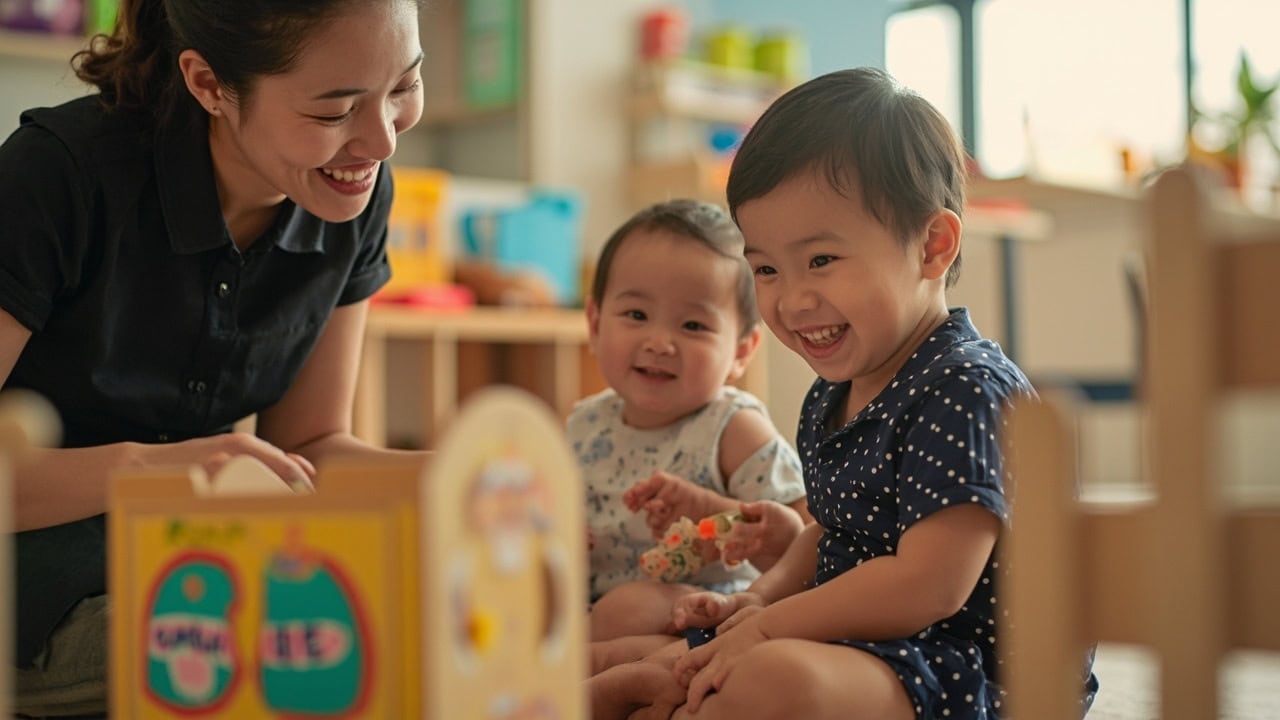
Imagine a morning where the caregiver is already warm and present before you arrive. Where the transition is not rushed, where your child is received with genuine attention, and where you can take one last look back and see that your child is not just settled but curious — reaching for a toy, glancing around, beginning to engage.
That moment — the moment you see your child’s attention begin to turn toward the world again — is one of the most quietly powerful experiences of early parenthood. It tells you that the secure base is holding. That your child is using that security to do exactly what securely attached children do: explore.
The childminders within the EduNanny programme receive your child every morning with patience and warmth. They manage the tears, soothe the distress, redirect attention toward play and discovery. They sit with a child until the moment they look up and begin to engage. When we talk about what EduNanny offers Singapore’s families, we are talking about the quality of those human relationships at the heart of the system.
A Practical Guide to the Morning Goodbye
The morning goodbye is not just an emotional experience — it is a ritual, and rituals can be done well or done poorly. Doing them well makes a measurable difference.
What Helps
- Keep the goodbye short and certain. Lingering — and I know this is hard — actually increases distress for most children.
- Deliver your goodbye with calm confidence. A firm, loving goodbye tells your child that you trust the caregiver and that there is nothing to worry about. Your calm is not a performance. Your child reads it.
- Walk away steadily. When you do, you are giving your child permission to settle.
- Establish a consistent routine. Same words, same actions, same sequence every morning. Repetition builds predictability. Predictability builds trust.
- Create a special goodbye ritual. A special handshake, a rhyme, a specific way of giving a kiss. Something your child can look forward to and hold onto.
What to Avoid
- Slipping away without saying goodbye. This may feel easier in the moment, but it breaks trust. Your child needs to learn that you always say goodbye — and that you always come back.
- Drawn-out emotional farewells. Your distress is valid, but expressing it extensively can heighten your child’s anxiety.
- Returning once you’ve left. If you’ve committed to leaving, follow through. Coming back signals that leaving is something to be feared.
- Dishonest framing. Avoid “Mummy is just going to be right outside” if you’re heading to work for nine hours. Honest, age-appropriate communication builds more trust than gentle white lies.
Common Concerns, Directly Addressed
“Is my child too young for childcare?”
Research has consistently shown that the brain is most capable of building the neural pathways that support secure attachment in the earliest years. What your child needs is not necessarily staying home exclusively, but consistent, warm, responsive caregiving. That can come from a parent, a caregiver, or both. The key is the quality of the relationship, not the location.
“What if my child never adjusts?”
Adjustment takes time. In the early weeks, your child’s distress may be real and raw. That is not a sign to quit — it is a sign that your child is processing something significant. Over time, with consistency, the goodbye typically becomes a ritual rather than a rupture.
“Will my child love me less?”
Your child cannot love you less because of childcare. Attachment is not a finite resource that gets divided. Quality childcare often reinforces attachment by giving your child additional experiences of warm, consistent adults — adults who reinforce the same message: you are loved, you are safe, and the people who care for you will be there tomorrow.
Your Child Flourishes Because of Quality Care, Not Despite It
The emotions of the morning goodbye may never fully disappear. There may be days — especially in the early weeks — when your child’s distress is raw, and your own response is equally real.
That is not a flaw in the system. That is what it means to love someone whose world is still small, and to be gently, persistently enlarging that world anyway.
But here is what changes, over time, with the right support and the right framework. The anxiety begins to soften. The goodbye becomes a ritual rather than a rupture. You begin to notice your child’s growing confidence, their willingness to engage with new people and new experiences.
When you choose a childcare arrangement that is consistent, warm, and developmentally informed — when you choose caregivers who are trained, attuned, and present — you are not outsourcing your parenting. You are expanding your child’s world in the safest possible way.
That is not a compromise. That is a gift.
EduNanny exists to walk this road with you. Not to take your place, not to diminish what you bring as a parent, but to be the steady, trained, genuinely warm presence on the other side of the door. To receive your child with the same seriousness and tenderness that you would. To build, day by day, the foundation of trust from which your child will, eventually, run toward the world with open arms.
EduNanny by BUTLER is a trusted, development-oriented childminding service for Singapore families. Learn more about our approach, or connect with our team to explore whether EduNanny is the right fit for your family.
You are not doing it alone. And you were never meant to.
Thank you for trusting this conversation, for sitting with these ideas, and for the extraordinary, exhausting, deeply meaningful work of raising the next generation.