The Measurable Difference Quality Childcare Makes in Early Development
What Quality Childcare Actually Produces
Child development is not a mysterious or unknowable thing. It is a field built on decades of research, on careful observation of how children change and grow across the early years of life.
We know, with considerable precision, what developmental progress looks like at different ages. We know the sequences. We know the windows. We know what tends to emerge when children are in environments that support and challenge them appropriately.
And we know—perhaps most importantly for the purpose of this conversation—that the quality of those environments makes a measurable difference. This is not ideology. This is the consistent finding of developmental science across cultures and contexts: children in high-quality care settings show accelerated development across multiple domains.
Children in settings that provide responsive interaction, appropriate stimulation, consistent relationships, and safe exploration develop differently than children in settings that provide adequate supervision without intentional developmental support. The difference between these two things is the difference between spending money and making an investment.
The Four Developmental Domains: What to Watch For
Parents need specific knowledge, not general reassurance. Developmental science has identified four key domains where quality care makes its most observable impact.
Cognitive Development
In the earliest months, cognitive development shows up in ways that might surprise you if you are not looking for it. It is not about flashcards or academic content. It is about:
- How your baby learns that the world is a predictable place
- Object permanence—the understanding that things exist even when they cannot be seen
- Cause and effect
- The beginnings of problem-solving: how your infant figures out how to move a blanket to get to a toy underneath
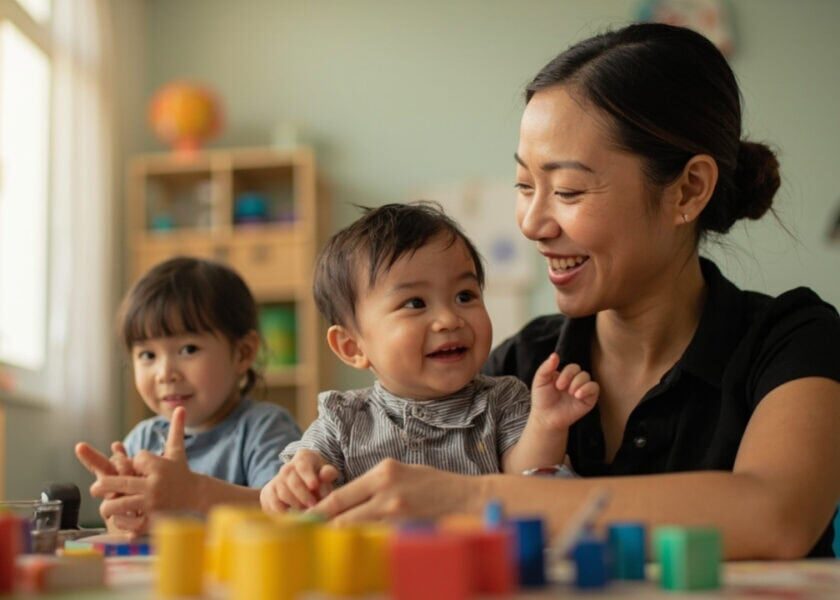
In quality infant care settings, you will see this as babies who are engaged with their environment, who are given toys and objects that encourage exploration, who are talked to and with, who are allowed to experiment and discover.
Language Development
Language development is closely related and equally important. Infants are listening long before they are speaking. They are absorbing the rhythm and sounds of language from the people around them.
In a quality infant care environment, you will hear caregivers narrating actions, responding to baby sounds with words, reading books even to the youngest infants, and engaging in the back-and-forth of early communication that researchers call “serve and return.”
By the toddler years, language development becomes more visible:
- New words appearing regularly
- New combinations and two-word phrases
- The emergence of sentences
- Attempts to tell stories
- Questions—so many questions—that emerge from months of being in a language-rich environment
Social and Emotional Development
This is perhaps the domain where quality care makes its most profound contribution—and also the domain where parents most need guidance to observe accurately.
Young children are learning how to be in relationship with others. They are learning that other people have feelings, how to manage their own big emotions, the basics of social negotiation—how to share, how to take turns, how to express needs—and what it means to feel safe with someone outside their family.
In a quality care setting, you will see caregivers who respond sensitively to children’s emotional states, who help children name and regulate feelings, and who create an environment where social exploration is supported but not forced.
Motor Development
Motor development—gross and fine—also unfolds in measurable ways across the early years.
Gross motor skills progress from the earliest head control to rolling to crawling to walking to running and climbing.
Fine motor skills develop alongside: the grasp, the pincer release, the ability to manipulate objects with precision, the satisfaction of building with blocks or feeding oneself.
In quality care settings, children have space and opportunity to practice these skills. They are not confined to seats or containers for extended periods. They are allowed and encouraged to move, to explore, to build the physical competence that underpins so much of later development.
How These Domains Work Together
These domains do not develop in isolation. They interact with each other: language supports cognitive development, motor exploration enables cognitive discovery, social-emotional regulation makes learning possible, and physical confidence emboldens social exploration.
A quality childcare environment understands this integration and creates experiences that support growth across domains simultaneously. You are not watching separate skills develop in separate boxes. You are watching a child become more capable in every dimension.
Signs of Quality You Can Observe Daily
How do you know if the environment your child is in is doing this work? There are observable signs—not as a checklist to fuel anxiety, but as tools for understanding what you are seeing.
You should see engaged children, not just occupied children. Engaged children are absorbed in what they are doing, focused, active in their own learning. Occupied children are merely passing time.
You should hear language. Lots of it—from caregivers and, as children grow, from children themselves. Conversation, narration, response, the sound of early dialogue even before words are fully formed.
You should see children moving. Not just sitting. Physical exploration, gross motor play, the freedom to move and discover through their bodies.
You should see children in interaction. With each other and with caregivers—not just in proximity to each other. Real engagement, real response, real relationship.
You should see evidence of growth at pick-up. When you collect your child at the end of the day, not just a child who is fine, but a child who seems to have been enriched by the day:
- A new skill attempted
- A new word used
- A new way of relating
- A story to tell
Why Caregiver Ratios and Continuity Matter
The Ratio Question
The ratio of caregivers to children matters enormously. When we talk about operating with ratios of up to one caregiver to three infants in infant care programmes, we are not giving you a statistic. We are telling you something about the quality of attention your child receives.
In a one-to-three ratio, a caregiver can respond to your baby in real time, engage in the serve-and-return interaction that builds neural pathways, and notice developmental nuances that a caregiver with six or eight infants simply cannot see.
This is not a luxury. This is the mechanism by which developmental support actually happens. The research is consistent: caregiver-child ratios directly predict developmental outcomes.
The Continuity Question
Consistency of care matters in ways that research has consistently demonstrated. When children have consistent caregivers over time—not a rotating cast of strangers—attachment relationships deepen.
Children feel safe enough to explore. They develop the confidence to try new things. They show less separation anxiety because they have built genuine trust with the adults who care for them.
Your child’s caregiver is not just someone who watches your child. Your child comes to know this person. This person comes to know your child—their rhythms, their preferences, their developmental trajectory. This knowledge is not sentimental. It is functional. It is the foundation of quality care.
The Compounding Effect: Why the Early Years Matter Most
Quality childcare is not an expense that buys you time at work, with no residual benefit. It is an investment with interest.
Because child development builds on itself:
- What a child learns at six months enables what they learn at twelve months
- What they develop in their second year creates the foundation for their third year
- Early language growth enables later literacy
- Early social confidence enables later school readiness
- Early trust enables later independence
A child who has had consistent, quality care from infancy enters preschool with advantages that are observable and meaningful: more comfort with separation, stronger language skills, more experience with peer interaction, greater confidence in new environments, and more natural school readiness—not because they were drilled, but because they were supported in developing naturally and fully.
This is what we mean when we say the first thousand days matter. It is not a marketing phrase. It is a scientific finding.
The early years are not merely a prelude to real life. They are when the architecture of the brain is being built most rapidly. They are when the patterns for learning, for relating, for moving through the world are being established. A child in a quality environment during these years is not just having a pleasant early experience. They are building the capacity for everything that follows.
Addressing Real Concerns: Cost, Trust, and Communication
We know that choosing childcare in Singapore involves real practical considerations. The cost matters. The location matters. The hours matter. We do not believe in asking parents to pretend that logistics do not exist.
The Financial Question
Quality childminding has historically been inaccessible to many Singapore families. The ECDA Childminding Pilot changes this equation.
The pilot fee structures have been designed to make quality childminding accessible to more families. For families eligible to use the Child Development Account and Baby Bonus funds, these resources can be applied, which meaningfully reduces the financial burden.
Care is available across Monday to Friday blocks, with home-based pathways for families who prefer care in their own environment, and community or centre-based pathways for families who prefer a different setting. These are not abstract options. They are real arrangements designed to fit the real lives of Singapore families.
The Trust Question
Trust is not automatic. When you are leaving your child with someone, you need more than good intentions. You need transparency, communication, and the ability to know what is happening during the day.
Where measures like CCTV in appropriate spaces are in place, this is about giving parents the visibility they need to feel confident. Where communication protocols are in place, this is about keeping you informed about your child’s day—not just that they ate and slept, but how they were, what they did, what you might notice at home. This is what trust looks like in practice: not blind faith, but verified confidence.
The Caregiver Quality Question
We believe in the dignity and purpose of the childminder. This is not merely a philosophical stance. It is a practical one.
Caregivers who feel valued, who receive proper training, who operate within supportive structures, provide better care. The quality of attention a child receives is shaped by the conditions under which that attention is given.
When we talk about caregivers, we are not just talking about warm adults. We are talking about trained professionals who understand child development, who can observe and track developmental milestones, who know what they are looking for when they spend the day with your child. This expertise is not a bonus. It is the point.
Making the Choice: A Framework for Parents
When you choose childcare, you are not just choosing a place to leave your child while you work. You are choosing an environment that will shape your child’s brain, relationships, and capacities for years to come.
This is not a decision to make lightly, and it is not a decision that should be made on the basis of surface impressions alone. It is a decision that deserves the same rigour you would bring to any significant investment.
Before committing, ask yourself:
- Do I understand what quality actually looks like—not just clean facilities, but engaged children and responsive caregivers?
- Do I know what to observe—the signs outlined above, present in my daily drop-off and pick-up visits?
- Will I see visible results—my child demonstrably growing, not just being adequately maintained?
- What are the ratios—how many children per caregiver, and does that allow for genuine responsiveness?
- What is the continuity arrangement—will my child have consistent caregivers, or a rotating cast?
- How will I stay informed—how will I know what my child is doing and how they are developing?
You deserve to see returns on this investment. You deserve to see your child growing in the ways that quality care makes possible.
What to Expect at Each Stage
Developmental expectations shift as your child grows. Here is what quality care should produce at each stage:
| Stage | What You Should Be Seeing |
|---|---|
| Infant (0–12 months) | Growing curiosity about environment; early cause-and-effect understanding; response to voices and faces; beginning to babble; physical control progressing steadily |
| Toddler (1–2 years) | New vocabulary regularly emerging; beginning sentences; parallel play evolving toward interactive play; walking confidently, beginning to run and climb; problem-solving visible in play |
| Preschool (2–3+ years) | Conversational language; stories and narrative; genuine social play with peers; emotional vocabulary; physical confidence; school readiness signs emerging naturally |
Your Next Step
You came to this search with a question. It was the question you carry on the commute, the one that surfaces when your phone lights up, the one that sits with you at your desk while you try to focus.
Is my child actually growing here?
That question is not neurotic parental anxiety. It is good parenting. You are making a significant investment—in money, in trust, in your child’s early years. You deserve to see returns.
The children in quality care are not waiting passively to be watched. They are growing. They are developing language and motor skills and social competence and cognitive curiosity. They are building the foundations for everything that comes next.
Because we believe in transparency, in communication, in the observable evidence of developmental progress, you will be able to see this too. When you pick up your child at the end of the day, you should see growth. Not just a child who is okay. A child who is thriving. A child whose world is getting bigger, whose capabilities are expanding, whose developmental trajectory is visibly ascending.
That is what quality childcare produces. That is what it makes possible. And that is what your child deserves.
If you are ready to move from wondering to knowing—if you want to see evidence of developmental growth rather than simply accepting reassurances—we would welcome the conversation.
Explore our infant care and childminding options. Ask the questions that matter to you. Request to see not just the facilities, but the interactions. Ask what you should be watching for at home.
Your child deserves more than supervision. They deserve developmental partnership—environments that see them, that know them, that actively support everything they are becoming. You deserve to witness this happening. To trust it. To know.
Because you asked the right question. Now you deserve the right answer.
At EduNanny, we are committed to thoughtful, development-oriented childminding rooted in trust, standards, and genuine care for every child’s early years.