The Longest Relationship Your Children Will Have Starts With Your Childcare Choice
The Most Important Relationship Your Children Will Ever Have
There is a photograph that lives in most Singapore households. It sits in a frame on the mantelpiece, or more likely now, in a folder on someone’s phone where it gets scrolled past a hundred times a week without really being seen. In it, two children sit side by side—sometimes mismatched in size, sometimes wearing clothes that don’t quite match, sometimes not even looking at the camera. What they are looking at, most of the time, is each other.
That photograph captures something that Singapore parents understand in their bones long before anyone explains it to them: siblings are not just family members. They are, for most of us, the longest relationships we will ever have.
Your children will know each other for sixty, seventy, perhaps eighty years. They will be there for graduations and weddings and difficult phone calls at midnight. They will remember the same grandmother, the same holidays, the same car rides to nowhere in particular. They will argue about inheritance and reconcile over coffee. They will be the only people alive who share the specific texture of your family’s life—the inside jokes, the shared grievances about Saturday morning chores, the way your mother always made that particular dish nobody else can quite replicate.
Siblings are the only people your children will ever know this completely.
And yet, when it comes to choosing childcare, something remarkable happens. We become extraordinarily focused on one child at a time. We research infant care ratios for our firstborn with meticulous attention. We visit centres, ask about curriculum, check reviews. We agonize over whether this caregiver will understand our particular child.
We are doing important work. We are doing necessary work. But somewhere in that careful process, we are often making decisions for one child while inadvertently shaping the relationship between children. We are choosing—or not choosing—something that will touch the most important bond our children will ever form with each other.
Why Sibling Bonds Deserve More Than an Afterthought
This is not a criticism of parents. It is an observation about something most of us have done without realizing we were doing it.
We treat childcare as a series of individual decisions because, in many ways, our systems are designed to treat children as individuals. You have a one-year-old? Here is infant care. You have a four-year-old? Here is preschool. You have two children of different ages? Here are two different arrangements, perhaps in two different places, run by two different teams.
This is not malicious. It is simply how childcare has conventionally been organized—around developmental stages rather than family systems, around individual children rather than the web of relationships they are growing up inside.
But families are not collections of separate children. Families are ecosystems. And in that ecosystem, the sibling relationship is not incidental. It is load-bearing.
What Research Tells Us About Sibling Attachment
Children form attachments to their siblings that, in neurological terms, activate many of the same pathways as attachments to parents. The sibling bond is not a pale imitation of the parent-child relationship—it is something distinct and deeply important in its own right.
Siblings teach each other things that no adult can teach them. They teach each other compromise and conflict, patience and fury, how to apologize and how to forgive. They teach each other what it feels like to be known completely by someone who did not choose you but chose to stay anyway.
When siblings grow up with a strong bond, they carry resilience into the world that buffers them against loneliness, against failure, against the ordinary cruelties of growing up. When that bond is weak or fractured, children lose something they will spend their adult lives trying to recover.
The good news: the sibling bond is not fixed at birth. It is not purely a matter of personality or temperament. It is profoundly shaped by experience—by the environments we place our children in, by the adults who care for them, by the rituals and rhythms of their daily lives.
What Happens When Siblings Are in Separate Care
Consider what actually happens in the first few years of a sibling pair’s life together. When two children are in separate care arrangements, something subtle but significant begins to happen.
Their daily lives diverge. They develop different social circles, different rhythms, different ways of being in the world that their caregiver understands. They come home at different times, eat at different tables, have different stories to tell about their day.
The physical separation becomes a psychological separation. Their sense of themselves as a unit—as the Lee siblings, as the Tan girls, as the two who share a room and a history—weakens in ways parents often don’t notice until years later, when their children are teenagers who seem to have little in common beyond shared DNA.
This is not inevitable. But it is common, and it is real, and it deserves to be part of the conversation when families make childcare decisions.
What Shared Care Makes Possible
Now consider the alternative. When siblings share a care arrangement—when they are known by the same caregiver, cared for in the same space, included in the same rhythms of the day—something different takes root.
They learn that their relationship is valued by the adults around them. They learn that being siblings is not just a fact of birth but a thing that matters, a thing that is worth nurturing.
They learn to share attention, to negotiate, to take turns being the younger one who needs help and the older one who can offer it.
When a quality caregiver understands sibling dynamics—which is not as common as it should be, but which marks genuinely excellent care—they actively create moments for sibling connection. They notice when siblings are gravitating toward each other and give them space. They narrate sibling interactions in positive ways. They help children resolve the inevitable conflicts that arise in ways that strengthen rather than undermine the bond.
This is not about siblings never being separated. That is neither possible nor necessary. It is about intention. It is about recognizing that the sibling relationship is a resource you are either investing in or neglecting, whether you mean to or not.
Why This Matters More in Singapore
For Singapore families, this question carries particular weight. We are a society that has historically valued sibling bonds deeply, and this is true across our diverse communities.
- In Chinese Singaporean families, the sibling relationship often carries expectations of mutual support, of elder siblings caring for younger ones, of family loyalty that extends far beyond the nuclear unit.
- In Malay Singaporean families, the sibling bond is frequently woven into a broader fabric of kinship and community, with cousins and siblings moving through daily life as a collective.
- In Indian Singaporean families, the sibling relationship—particularly between brothers and sisters, marked by Raksha Bandhan and its cultural significance—carries layers of protection, respect, and lifelong responsibility.
- In expatriate families building a life far from extended family networks, siblings become even more essential to each other—the primary witnesses to each other’s Singapore childhood, the ones who will remember this place together long after parents are gone.
These cultural dimensions are not abstract. They shape what Singapore parents actually want for their children.
When a mother in Tampines thinks about her daughters growing up together, she is thinking about something more than logistics. She is thinking about the woman her eldest will become, and who will stand beside her.
When a father in Tiong Bahru thinks about his two boys, he is thinking about what it will mean for them to have each other when he and his wife are no longer there.
These are not sentimental fantasies. These are the actual hopes parents carry into childcare decisions, even when the conversation focuses entirely on curriculum and ratios.
The Real Tension: What Modern Singapore Life Makes Difficult
And here is the tension that every parent with more than one child eventually feels: the logistics of modern Singapore life are not designed to make sibling bonds easy.
When your eldest is in primary school and your youngest needs infant care, you are managing at least two separate systems, two pickup schedules, two sets of expectations. When your children are different ages with different developmental needs, finding a single arrangement that serves both can feel like searching for a unicorn.
When both parents work demanding jobs in a city that does not slow down for family life, the path of least resistance is often separate arrangements with separate benefits and separate costs.
Convenience pulls siblings apart. The sibling bond requires something more deliberate—something that most conventional childcare options do not actively support.
Questions Worth Asking Before You Choose
- Am I choosing childcare for my child as an individual, or am I considering how this choice affects my children’s relationship with each other?
- Do I have a clear picture of how much time my children currently spend together versus separately?
- Have I asked any childcare provider how they handle sibling dynamics?
- What does my ideal outcome look like for my children’s relationship—not just now, but in ten or twenty years?
- Can siblings of different ages be cared for together in this arrangement?
- Is there actually time in the daily schedule for genuine sibling interaction, or is everyone just being managed?
What Quality Childminding That Supports Sibling Bonds Looks Like
Not all childcare that includes multiple children is the same. Here is what to look for if you want care that actively supports sibling bonds rather than simply managing siblings in the same space.
Signs of Genuine Sibling Support
- The caregiver knows both children as siblings, not just as separate individuals with separate developmental profiles. They understand how your children relate to each other—the patterns, the tensions, the affection underneath.
- The caregiver creates shared experiences—rituals and jokes and ways of being together that belong only to your children. These become the inside language of the sibling bond.
- The caregiver notices dynamics—when one child is dominating, when one is retreating, when they need space to work things out themselves and when they need adult intervention.
- The caregiver holds the sibling relationship as important—they communicate to your children that being siblings is something that matters to the adults in their lives.
- Communication includes sibling dynamics—updates mention how siblings are doing together, not just separately.
Red Flags to Watch For
- Caregivers who treat siblings as completely separate cases with no awareness of their relationship
- Environments where siblings are deliberately kept apart “for fairness” or operational simplicity
- No thought given to how siblings might benefit from shared care experiences
- Ratios so stretched that any genuine attention to sibling dynamics is impossible
Childminding as a Distinct Approach
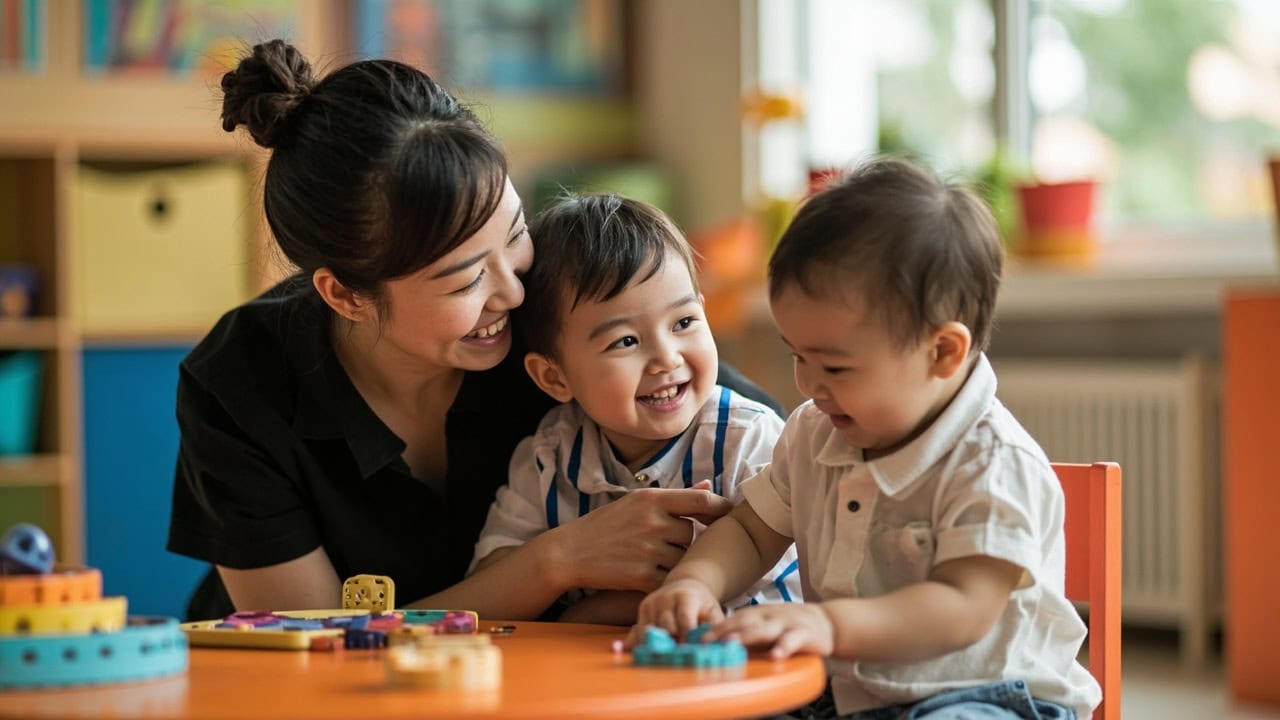
Part of what makes home-based and community-based childminding distinct from centre-based care is its natural alignment with family systems. In settings where ratios allow for genuine attention to each child—including arrangements serving up to three infants alongside older siblings—sibling bonds have room to breathe. Siblings can be siblings, not just co-present children being managed by a single overstretched adult.
For families navigating budget considerations, some childminding arrangements—including those connected to the ECDA Childminding Pilot—are designed with accessibility in mind, with fee structures and subsidy options that make quality care available to ordinary families.
Your Children Will Grow Up Together. The Question Is How.
When your children are small, it is easy to think of sibling relationships as something that will sort itself out. They are so young. They have so much time.
But childhood moves faster than any of us expect, and the sibling bond that is nurtured in the early years becomes the foundation for everything that comes after.
The children who learn in the first thousand days of their shared life that their sibling is a safe harbor, a trusted companion, a fellow traveler on the long road of growing up—those children have something that no amount of academic enrichment can buy. They have a relationship that will sustain them through every difficulty, celebrate every joy, and witness their lives with the kind of intimacy that only shared childhood can create.
The question every parent with multiple children should be asking is not just whether this childcare is good for my child. It is whether this childcare is good for my children—their relationship to each other, their sense of themselves as siblings, the bond they will carry into every phase of their lives.
May every Singapore family find the support they need to nurture it well.