Different Hands, Shared Rhythm: Personalising Infant Care Across a Small Team
Two caregivers can respond to the same signal in different ways and still offer dependable care. Their common thread is a shared ability to notice, adapt and pass on useful infant context.
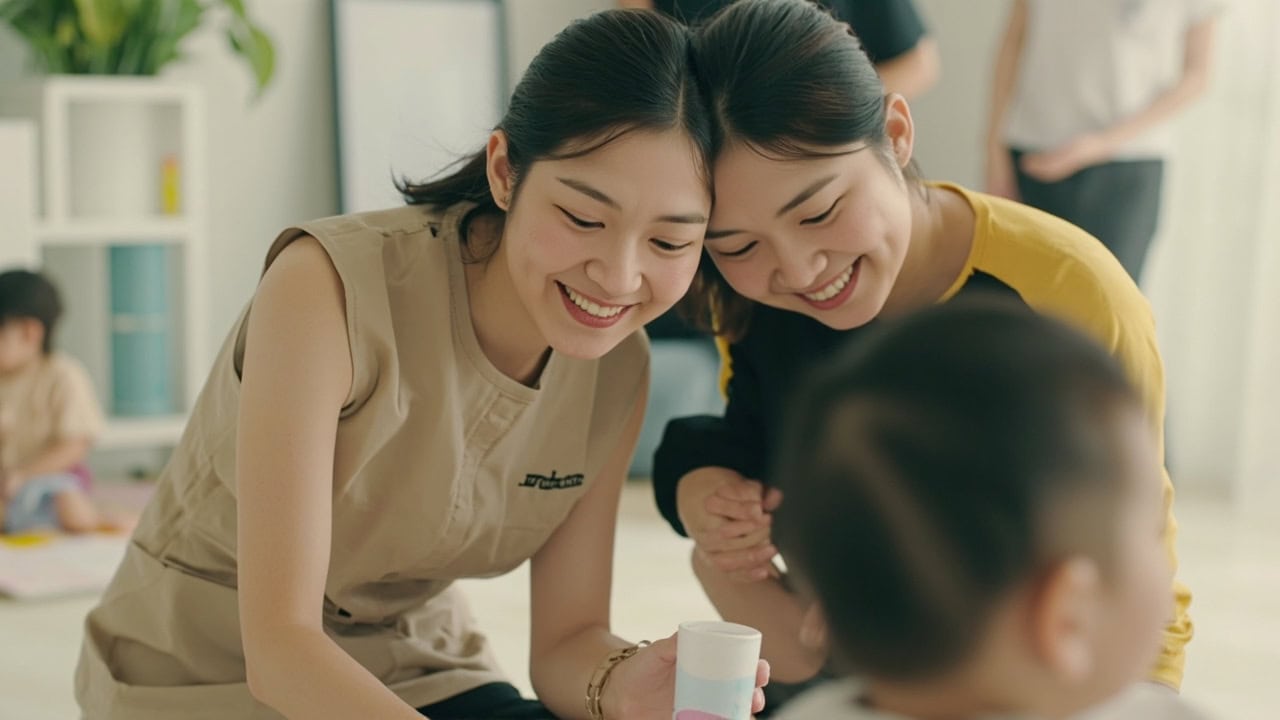
In a hypothetical moment, one childminder answers an infant’s reach with a familiar song. Another names the cup in the infant’s hands, then pauses. The responses are not identical, but both can be responsive if each adult attends to what the infant does next and adapts.
Consistent responsive care is best understood as dependable attention rather than a uniform performance. In a small infant-care team, that can mean shared principles for noticing cues, flexible responses and useful handovers. The cited guidance supports responsive back-and-forth; it does not show that a staffing number, handover format or mix of caregiver personalities produces a developmental advantage.
Responsiveness starts with a signal, not a script
Harvard’s guide to serve and return explains that when caregivers respond to a young child’s signals and needs, they create an environment rich in back-and-forth exchanges. In practical terms, an adult can treat a look, sound, reach or shift in attention as a possible signal, offer a suitable response and use the infant’s next behaviour to decide what follows. The cue is a starting point, not a command.
The Center on the Developing Child at Harvard University’s overview of serve and return says responsive exchanges play a key role in shaping brain architecture. That supplies the developmental rationale for attending to reciprocity. It is not a prescription to use the same words, objects, songs or gestures with every infant.
The cited guidance does not establish a hierarchy among musical, verbal, quiet or physically demonstrative caregiver styles. A familiar song can support an exchange, but it remains responsive only if the adult stays alert to the infant’s answer. The same principle applies when an adult names an object, shares a gesture or changes an activity.
A shared response logic, not a shared personality
Consider two hypothetical styles. A musical caregiver might repeat a phrase, add a gesture and wait. A conversational caregiver might name an object or describe the action. Either can be responsive when the infant’s answer shapes the next step. Familiarity alone does not make a song responsive, and adding a word does not make an interaction responsive if the adult remains fixed on the plan.
A practical way for families to assess coherence is to ask whether each adult can explain what they noticed, what they tried and how the infant responded. That is more informative than asking whether everyone uses the same manner. It also allows a caregiver’s natural voice to remain part of care rather than being replaced by a compulsory script.
Family context can travel across a team without dictating every interaction. Parents can share useful phrases, songs, objects and routines; caregivers can respond to immediate signals rather than treating a family routine as fixed. The aim is continuity of attention, not uniformity of personality.
Handovers should transfer context, not labels
In a hypothetical handover, one adult might write: “After the cup moved left, the infant reached; the infant looked when the adult said ‘cup’; the infant turned away when the same song continued.” The sequence gives the next adult something to consider without claiming a fixed cause.
A useful note distinguishes observation from interpretation. It can record what happened immediately before, what the adult did, how the infant responded, any family phrase or routine involved and whether follow-up is needed. Details concerning safety, feeding or rest should be distinguished from provisional impressions and checked for accuracy. An impression such as “does not like music” should remain open to revision.
A handover is a starting point rather than a script. The next adult might bring the cup into view, repeat a phrase or wait for a fresh cue, then make a new observation. A single moment may not establish a fixed preference: an infant could respond to a familiar song on one morning and turn away on another. Shared, provisional language gives adults a way to record that change without converting it into a label.
What a one-to-three ratio can—and cannot—mean
A staffing ratio is one indicator of intended capacity, not a description of every interaction. With fewer infants to attend, an adult may have more opportunity to remain at eye level, answer a vocalisation or adapt before an exchange ends. That is an opportunity, not an automatic result. Several infants’ needs can change at once, and a one-to-three arrangement does not mean uninterrupted one-to-one attention.
EduNanny’s pilot information states that the maximum is three infants per childminder. This is a first-party service fact, not a research finding or a promise of uninterrupted individual attention. The practical question is how adults use the available capacity: do they notice changes, respond without rushing and share useful context?
The official ECDA Childminding Pilot for Infants page states that the pilot runs from 1 December 2024 to 31 December 2027 for Singapore Citizen infants aged two to 18 months. Those details establish the programme’s scope, not proof that a staffing or coordination model causes developmental gains.
A ratio can therefore inform a parent’s questions, but it is not a developmental scorecard, a measure of caregiver warmth or evidence that one team model produces better outcomes.
Learning moments without milestone theatre
Responsive care can be rich without inflating what an infant has done. During a familiar song, an infant may look, vocalise or reach. Those actions can form an exchange, but they should not be described as singing words or producing speech. Looking at a colour is not the same as naming it, and looking at or matching pictures is not independent reading.
In an ordinary floor-play moment, an adult can place a familiar object within reach, pause and follow the infant’s pace. This offers opportunities to explore, reach and practise; it does not prove a new milestone or faster development. The same EduNanny pilot page describes its early-step examples as individual observations, not a typical timetable or guaranteed programme result.
Milestones describe individual development; they are not a contest between caregivers or a valid measure of care quality. Precise language protects both the infant and the adults: it recognises an interaction for what it is without turning an ordinary moment into a promise.
Questions that reveal a shared method
Parents can move beyond a broad claim of consistency by asking how a team works during an ordinary interaction:
- How do caregivers describe an infant’s signal before assigning meaning to it?
- How do they decide to continue, pause or change an interaction?
- Which family phrases and routines matter, and how are they used?
- What context passes between adults, and what is marked as provisional?
- How are changes in feeding, rest and engagement communicated to parents?
Useful answers should contain examples rather than slogans. A parent should be able to hear what an adult noticed, what the adult did, whether the infant had room to answer and what happened next. If an interaction did not work, an explanation of adaptation is more informative than a claim that one fixed approach always succeeds.
EduNanny’s pilot information describes a “Know Your Child” conversation covering routines, feeding, sleep and development goals, an opportunity to explore a care match, and daily updates about the child’s day. These are concrete first-party service practices that illustrate how context may be shared. They are implementation details, not measured evidence of developmental benefits.
Continuity is recognisable, not identical
A coherent small team is not one in which every adult performs the same song or uses the same words. It is one in which each person can notice a possible signal, respond, pause, check the infant’s answer and adapt when needed. A handover preserves that logic by giving the next adult context rather than a command.
Families need not choose between personal warmth and dependable follow-through. Different caregivers can keep their own voices while sharing a recognisable commitment to responsive attention. That is a practical meaning of consistent responsive care: different hands can be coordinated by shared attention, flexibility and thoughtful follow-through.
Sources and further reading
- A Guide to Serve & Return · Center on the Developing Child at Harvard University
- Serve and Return: Back-and-forth exchanges · Center on the Developing Child at Harvard University
- EduNanny ECDA Childminding Pilot · EduNanny
- Childminding Pilot for Infants · Early Childhood Development Agency
The images in this article were generated with AI for illustration. They do not show actual EduNanny staff, children or facilities.
Every family has different care needs. Speak with EduNanny to discuss care that is right for your child.