The Invisible Architecture of Your Child’s First Years
The Architecture Beneath the Surface
When a child is born, they arrive into the world unfinished in the most literal sense. Their brain is not a smaller version of an adult brain. It is a living architecture under construction, and the blueprints for that architecture are not written in genes alone. They are written in experience.
Every touch, every sound, every moment of being soothed or stimulated or simply held with presence — these are the materials being used to build the person your child will become.
Here is what makes this so difficult for parents to see: that construction happens invisibly.
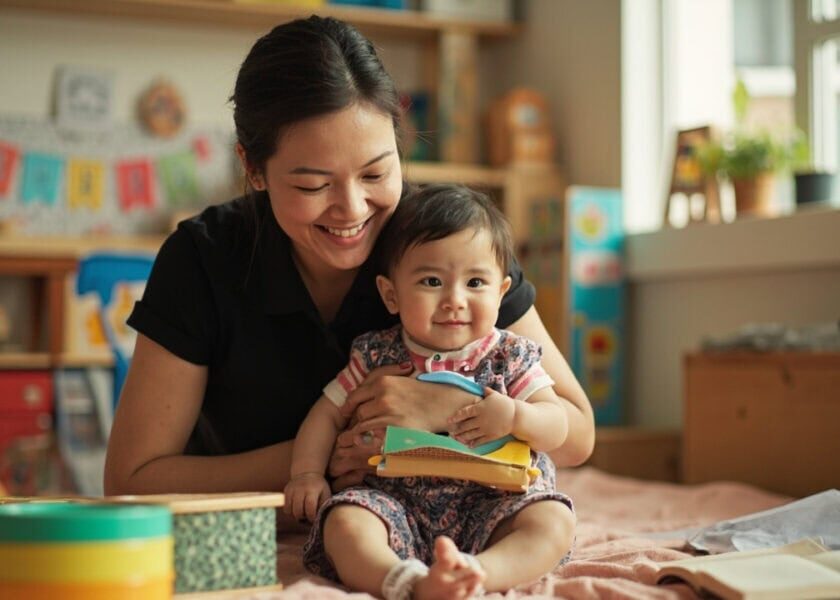
A nine-month-old reaching for a block is not just reaching for a block. They are building the neural pathways that will one day enable focused attention in a Primary One classroom.
A toddler having a meltdown over a broken biscuit is not just being difficult. They are exercising, for the first time in their young lives, the muscles of emotional regulation — and the caregiver who responds with calm, boundaried presence is teaching that child’s nervous system how to calm itself.
A two-year-old who plays alongside others and then shares a toy has been slowly, invisibly, building the capacity for social intelligence that will make collaboration possible in Primary 3 group work.
None of this looks like school readiness. Not yet. It looks like play. It looks like the ordinary business of a small child in the world. But beneath the surface of every seemingly simple day, an enormous amount of development is happening — and it is happening in the direction you are pointing it.
Why Child Development Compounds
This is not a metaphor. It is the way the nervous system works.
When a caregiver consistently responds to a child’s needs in the first year, that child develops a sense of security that becomes the foundation for all future exploration. When a toddler is given a rich sensory environment — different textures, sounds, temperatures, spatial arrangements — they are not just being entertained. They are building the cognitive scaffolding that will later support abstract thinking.
When a three-year-old experiences the steady, predictable rhythm of a quality care environment where transitions are managed with care and emotions are named and honored, they are not just having a pleasant time. They are developing the emotional regulation capacity that will determine whether they walk into Primary One ready to learn or overwhelmed by the demands of a new environment.
Each day of quality care does not simply add a fixed amount of development. It multiplies.
- The secure attachment built in infancy makes the toddler more confident in exploration.
- That confident exploration builds neural pathways that support attention and curiosity.
- That attention and curiosity make the preschool years richer.
- Richer preschool years make school readiness emerge more naturally.
Imagine two children arriving at Primary One. Both are bright. Both are loved. But their first thousand days were different.
One child enters the classroom and something is already in place. When the teacher speaks, they can listen. When another child takes their pencil, they can navigate the frustration without collapsing. When the lesson becomes difficult, they can stay with it. When they do not know the answer, they can raise their hand anyway.
This child did not learn these things at Primary One orientation. They learned them over years, through hundreds of small moments of being seen, being responded to, being helped to understand and regulate their own inner world.
The other child arrives just as bright, just as capable — but the demands of the classroom feel enormous. Sitting still requires tremendous effort. Sharing space with twenty other children is overwhelming. The emotions that arise feel unmanageable. Learning becomes associated with stress rather than curiosity.
The gap between these two children was not created on the first day of Primary One. It was built quietly, daily, through the quality of early caregiving over years.
What Quality Childminding Actually Looks Like
Understanding the invisible nature of early development raises an important question: how do parents know whether the care their child receives is the kind that compounds?
Quality childminding is not about elaborate programs or impressive facilities. It is about the quality of presence, attunement, and response that a child experiences throughout their day.
It looks like this:
- Responsive caregiving. A caregiver who notices when a child is becoming dysregulated before the meltdown happens, and intervenes with calm, boundaried presence.
- Rich sensory environments. A space that offers different textures, sounds, temperatures, and spatial arrangements — not as entertainment, but as building materials for cognitive architecture.
- Predictable rhythms. Steady transitions, named emotions, honored feelings. A child who knows what comes next develops the internal regulation to handle what does not.
- Individual attunement. Understanding that this particular child, right now, in this moment, needs something specific to feel safe and engaged.
- Developmental observation. Noticing patterns, tracking progress, understanding what each seemingly simple interaction is building.
When care environments maintain lower ratios — one caregiver to fewer infants — that is not just a compliance measure. That ratio is what makes genuine responsiveness possible. It is what allows individual attunement: the moment-to-moment reading of what this particular child needs right now.
That attunement is not a nice-to-have. It is the mechanism through which secure attachment is built, and secure attachment is the foundation upon which everything else is constructed.
EduNanny: Building the Foundations
What EduNanny caregivers are doing, every day, is laying the foundations that will one day be visible as your child’s readiness for the world. They are not babysitters. They are developmental architects working with the most important material there is — the architecture of a human being’s early nervous system, emotional regulation, and capacity to learn.
What EduNanny brings to this work:
- Professional framework. As part of the ECDA Childminding Pilot, EduNanny operates within a framework that recognizes childminding as a professional practice — one that demands specific knowledge of infant and early child development, sensory integration, nervous system regulation, and the developmental sequences that make authentic school readiness possible.
- Selected and supported caregivers. Caregivers are not randomly assigned. They are selected and supported to understand the work they are doing at this foundational level.
- Intentional ratios. Care environments with fewer infants per caregiver enable the genuine responsiveness and individual attunement that makes compound development possible.
- Transparent communication. Daily updates, shared photographs, and documented observation of your child’s day — so you can see what is being built, even when the building is invisible.
For Singapore families, EduNanny offers:
- Monday to Friday care blocks designed around real family rhythms
- Utilization of CDA and Baby Bonus funds
- Pathways available for home-based care and community or centre-based environments
- CCTV deployment where arranged, for additional parental assurance
What remains constant across these pathways is the developmental philosophy — the understanding that quality care builds something invisible that will one day become visible in your child’s capacity to move through the world with confidence, curiosity, and resilience.
Addressing Your Concerns
“Am I failing my child by going back to work?”
You are not absent from your child’s development because you return to work. You are not failing to build a bond because someone else holds your child during the hours you cannot be there.
You are making a choice — hopefully, an informed one — to place your child in an environment that is actively, intentionally, knowledgeably building the architecture of their future.
And that is not something to feel guilty about. That is something to feel purposeful about.
“How do I know if the care is actually good?”
The question is not whether your childcare choice matters. The question is whether the care your child receives is operating at the level where it can compound in the way described above.
Look for evidence of:
- Caregiver understanding of developmental sequences
- Environments designed for sensory richness and responsive interaction
- Communication that shows your child is being observed and understood
- Caregiver ratios that enable genuine attunement
- A philosophy that sees your child as a whole person being built, not a schedule being managed
“What questions should I ask?”
When researching infant care and childminding in Singapore, consider asking these questions:
- What does the caregiver understand about developmental sequences? Are they aware that a toddler’s meltdown is an opportunity for emotional regulation learning? That a baby’s reaching for a block is building attention pathways?
- What is the caregiver-to-infant ratio? Lower ratios enable the attunement that makes compound development possible.
- How is the environment designed? Is it rich in sensory opportunities? Does it support predictable rhythms and transitions?
- What does communication look like? Will you know what your child is experiencing, observing, and learning?
- What is the care philosophy? Do the caregivers see themselves as developmental architects, or as supervisors managing schedules?
- How are caregivers selected and supported? Are they equipped with knowledge, or simply assigned?
The answers to these questions will tell you whether the care you are considering is the kind that compounds — or the kind that merely occupies time.
“What if something goes wrong?”
No parent has certainty that nothing could ever go wrong, and any service that promises that is not being honest with you.
What quality care offers is not a guarantee — it is a framework. A set of knowledgeable hands, a developmental philosophy, an intentional approach to building the foundations that will serve your child for decades.
You are not looking for perfection. You are looking for understanding, attention, and care that knows what it is building.
The Investment You Are Making
Your child will not remember most of these early years. But their nervous system will remember everything.
The regulation they are developing now will be with them in Primary One, in secondary school, in relationships, in their capacity to handle life’s inevitable difficulties.
The curiosity being sparked now will shape their approach to learning for decades.
The security being built in these relationships will determine how safe they feel in the world.
You are making an investment whose returns you will not see for years. That is not a weakness in the choice. That is the nature of the most important investments.
Like all wise long-term investors, what you need is not blind faith. You need a framework for understanding what you are actually purchasing. You need to know that the compounding is happening. And you need to trust the people who are managing that compounding on your behalf.
The invisible becomes visible. The unmeasurable becomes the foundation. The small, daily moments of responsive, quality care compound into the kind of person your child will become.
This is not hope. This is developmental science, observed across thousands of children over decades. And this is what EduNanny caregivers do, day after day, with patience and precision and care.
EduNanny exists for families who want to make that choice with confidence — the confidence that comes from understanding what is being built, and trusting that the right hands are building it.
One day, it will show — in your child’s confidence, in their curiosity, in the way they move through the world as if it is a place where they belong and have something to offer.
And you will remember these years, not as the years you were away, but as the years when everything important was quietly, invisibly, and expertly being built.
If you are ready to explore what quality, knowledge-based childminding looks like for your family, EduNanny is here to answer your questions and help you understand the investment you are making in your child’s foundations.
Learn more about what EduNanny stands for or get in touch to begin a conversation about your family’s needs.