The First Three Years That Shape Your Baby’s Brain
When You Walk Through the Door
There is a moment, familiar to every parent who has left their infant in someone else’s care, that arrives quietly at the end of the workday. You walk through the door. Your child looks up. And in that fraction of a second before recognition becomes delight, before the reaching arms and the gurgling laughter, there is a pause—a window into something you cannot quite name.
Your child seems different in a way that has nothing to do with size or appearance. Something has shifted. Something has grown. And in that moment, unbidden, comes the question that follows you through every handover: What happened in there today? What did my child learn about the world? How did those hours shape the person they are becoming?
You are not alone in carrying that question. It lives in every parent who watches their child wave goodbye at the gate, who reads the daycare report with the intensity usually reserved for quarterly financial statements, who lies awake wondering whether the choice they made was the right one—not just practically, not just logistically, but at the level of the cells and synapses and neural architecture that will determine so much of what follows.
Here is what science is now telling us, in terms that could not be clearer: those early hours matter more than any of us once believed. Not because we doubted their importance, but because we did not yet understand the depth of it.
The Science in Brief
For parents who want the key points before diving deeper, here is what the science of early brain development has established beyond reasonable doubt:
- The brain builds itself fastest in the first three years. Infants generate approximately one million new neural connections per second—a rate unmatched at any other life stage.
- Early experience literally shapes brain architecture. The circuits being built are not predetermined; they are shaped by every interaction, every response, every moment of connection or its absence.
- Responsive care calibrates the stress response system. When caregivers respond to distress with warmth and consistency, they are teaching the developing brain how to regulate itself—a lesson that echoes forward for decades.
- Language development is most efficient in the early years. The richness of caregiver speech directly predicts language outcomes years later, as the brain builds and prunes circuits based on what it hears.
- Emotional memories from early care leave lasting traces. Even when specific memories fade, the emotional tone of early experiences shapes how the brain approaches relationships and manages stress for a lifetime.
- Executive function foundations are laid early. The self-control, working memory, and cognitive flexibility that matter so much in school and beyond begin developing in toddlerhood through the quality of caregiving relationships.
- Quality care makes a measurable difference. Not all childcare is the same at a neurological level. The warmth, consistency, and attunement of the care environment shapes which neural pathways strengthen and which fade.
Understanding this is not about adding to parental anxiety. It is about replacing generalized worry with specific clarity—helping you see what you are already sensing when you look at your child’s face and wonder what is happening inside that developing mind.
Building the Architecture of a Human Mind
When neuroscientists talk about brain architecture, they are not speaking metaphorically. The brain literally builds itself, circuit by circuit, in response to experience. In the first three years of life, the infant brain generates approximately one million new neural connections per second—a rate that far exceeds anything that will occur in later childhood or adulthood.
These connections, called synapses, are the pathways through which information flows. They are the infrastructure of thought, feeling, and behavior. And the remarkable truth is that this infrastructure is not predetermined. It is built from the inside out, shaped by everything the child sees, hears, feels, and experiences in those critical early windows.
This means the early years are not merely a time of waiting for the “real” development to begin. They are the time during which the very foundations of cognitive, emotional, and social capacity are laid. Every interaction, every response to a cry, every game of peekaboo and every quiet moment of eye contact is contributing to the architecture of a human mind. The brain is not passively awaiting instruction. It is actively, constantly building itself in response to the world it encounters.
The timing of these building processes is not negotiable. Language acquisition follows a trajectory that is steepest in the first year and gradually narrows through toddlerhood. The neural circuits that enable social-emotional regulation are most malleable in the earliest years. The stress response system, which governs how a child learns to manage fear and uncertainty, calibrates itself in the first few years of life in ways that will echo forward for decades.
The Use-It-or-Lose-It Brain
In those early years, the brain does not merely add connections. It also subtracts them. This process is called synaptic pruning, and it is one of the most important and least understood aspects of early brain development.
Synaptic pruning eliminates unused or underused neural connections, allowing the brain to become more efficient, more specialized, and more tailored to the environment in which the child is developing. The connections that are activated repeatedly—through interaction, through stimulation, through the repetitive experiences of daily care—are strengthened and retained. The connections that lie dormant are pruned away.
By the end of the second year, the brain has begun to specialize, tuning itself to the specific sounds of the languages it regularly hears and pruning away the sensitivity to sounds it does not need. This is adaptive—it makes the brain more efficient—but it also means that the opportunity to establish a broad foundation for language is concentrated in these early years.
What does this mean in practical terms? The early environment is not just influencing the brain—it is actively sculpting it. Every moment of engagement, every conversation overheard, every song sung, every gentle touch and responsive look is contributing to the neural architecture that will remain. A responsive, enriching environment—one in which a child is engaged, spoken to, comforted, challenged, and delighted—activates a wide range of neural circuits and supports their healthy development.
Why Attunement Is a Neurological Necessity
Consider, for a moment, what happens when an infant cries and someone responds.
This is such an ordinary moment that it barely registers as significant. A baby fusses. A caregiver attends. The fussing subsides. Life continues. But inside the developing brain, something profound has just occurred.
When a caregiver responds to an infant’s distress with consistency and attunement—when the response is not merely competent but warm, not merely present but genuinely connected—the infant’s brain is receiving its most fundamental lesson about the world. The lesson is this: distress is manageable. Comfort is available. The world is responsive.
The stress response system, which is still under construction in the early years, is learning to calibrate. It is learning the difference between danger and ordinary frustration. It is learning that distress has an endpoint, that it does not have to become overwhelming, that the people who care for you will show up.
The stress response system, centered in structures like the amygdala and the hypothalamic-pituitary-adrenal (HPA) axis, is one of the most ancient and powerful systems in the human brain. In its mature form, it enables us to respond to genuine threats with appropriate vigilance and action.
But when this system is dysregulated—when a child repeatedly experiences unmitigated stress without the buffering presence of a responsive caregiver—its set point can shift. The child becomes more reactive, more anxious, more likely to perceive threat in ambiguous situations. The neural pathways that support this hypervigilance become strengthened through use. They become the default.
The simple, repeated act of a caregiver comforting a distressed infant is not merely a kindness. It is a biological intervention. It is literally teaching the developing brain how to regulate itself. It is laying down the circuits that will allow that child, years later, to manage the inevitable stresses of school, of friendship, of adolescence, and of adult life with greater resilience and less reactivity.
This is why attunement is not a soft concept or a nice-to-have. It is a neurological necessity. The infant brain is building its stress response architecture, and that architecture is shaped by the quality of care it receives.
Language, Memory, and the Foundations of Self-Regulation
In the first year of life, the infant brain is remarkably prepared for language. Neural circuits in the auditory cortex, in Broca’s area, and in regions throughout the brain are ready and waiting for the input they need to develop. But they need that input. They need to hear language, repeatedly, in the context of relationship and meaning. They need the cadence of a caregiver’s voice, the back-and-forth of early conversation, the naming of objects and the sharing of attention.
Research has consistently shown that the quantity and quality of caregiver speech in the first three years predicts language development outcomes years later. Children who are spoken to frequently, who are engaged in genuine conversation rather than merely exposed to television or ambient speech, who hear a rich and varied vocabulary in the context of responsive interaction—these children build stronger neural foundations for language.
Their brains develop more robust circuitry in the regions that support comprehension and production. They enter school with larger vocabularies, stronger narrative skills, and greater facility with the symbolic thinking that underpins literacy. The window for this process is not closed at age three, but its efficiency narrows significantly.
What does this look like in practice? It looks like a caregiver who narrates the day, who names what the child is looking at, who responds to babbling as if it were genuine conversation, who reads books not as a bedtime ritual but as an ongoing dialogue about pictures and stories and ideas. It looks like language as a medium of connection, not just instruction.
The Emotional Traces of Early Care
There is a moment that parents sometimes describe, usually somewhere around the child’s second or third year, when the child begins to remember things. Not just immediate things, not just what happened five minutes ago, but events from days or weeks before. The child recalls the visit to the zoo, the birthday party, the day it rained and they jumped in puddles.
These memories are not yet stable or reliable—research tells us that childhood amnesia typically lifts somewhere between ages three and four, and the memories formed before that are often not retained into adulthood—but they signal that the hippocampus, the brain’s memory center, is beginning to come online in a new way.
The memories encoded in early childhood are often more emotionally saturated than those formed later. A child’s memory of being comforted after a fall, or of the feeling of a particular caregiver’s presence, can be vivid and lasting even if the specific details are not retained. These early experiences are not merely stored; they are felt.
This matters because the emotional tone of early care experiences can shape the child’s developing sense of the world as a safe or unsafe place, as a welcoming or hostile environment, as a context in which needs are met or neglected. Even if the child cannot articulate this, even if the memories themselves fade into the fog of early childhood amnesia, the emotional traces remain. They become part of the unconscious architecture that shapes how the child approaches relationships, manages stress, and interprets social signals for decades to come.
Scaffolding for Self-Control
As the first three years unfold, another class of capacities begins to emerge—capacities that will later be recognized as executive function, the set of mental skills that enable self-control, working memory, cognitive flexibility, and the ability to pursue goals in the face of distraction. In these early years, these capacities are not yet fully developed, but the foundations are being laid.
Consider a toddler who is learning to wait. A caregiver has asked the group to pause before leaving the playground. One child fidgets and whines. Another sits with visible effort, controlling the impulse to run. The difference between these responses has roots in executive function—but executive function is not a fixed trait. It is a capacity that develops, and its early development is shaped by the environment.
In a setting where children are given appropriate opportunities to practice self-regulation—where they are asked to wait sometimes, but supported in that waiting by warm and consistent guidance—the neural circuits underlying self-control are activated and strengthened. In a setting where frustration is routinely ignored or overridden by force, these circuits may develop differently, or may not develop as robustly.
The best early care environments are neither laissez-faire nor authoritarian. They are warm, consistent, and responsive. They set limits with empathy. They give children the support they need to manage their impulses while gradually expecting more independence. They treat the child as a developing person whose capacities are emerging and deserving of respect.
What Quality Care Actually Looks Like
By now, a picture is emerging. The first three years are not a passive waiting period. They are a period of intense, experience-dependent construction. Every interaction, every response, every moment of attunement or its absence is contributing to the brain that the child will carry forward.
So let us translate this into something you can actually look for, because understanding the science is only half the work. The other half is knowing how to recognize quality when you see it.
Observe the Language Environment
Notice how caregivers speak to children. Is the language rich and responsive? Do they narrate what is happening? Do they name objects and events? Do they respond to the child’s attempts at communication with interest and elaboration? When a child points at something, does the caregiver follow the child’s attention and talk about it? These are the micro-moments that build language circuits.
Watch How Distress Is Met
Notice how caregivers respond to distress. Is there patience? Is the child’s feeling acknowledged before the problem is solved? Is comfort offered genuinely, or is distress met with impatience or dismissal? Remember what we discussed about stress response calibration: these moments of attunement or its absence are teaching the child’s brain how to regulate itself.
Notice the Emotional Climate
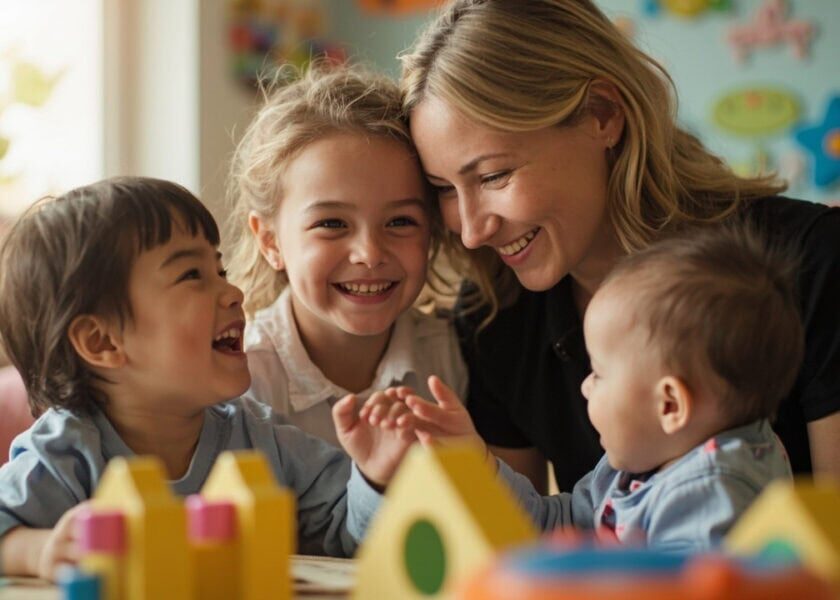
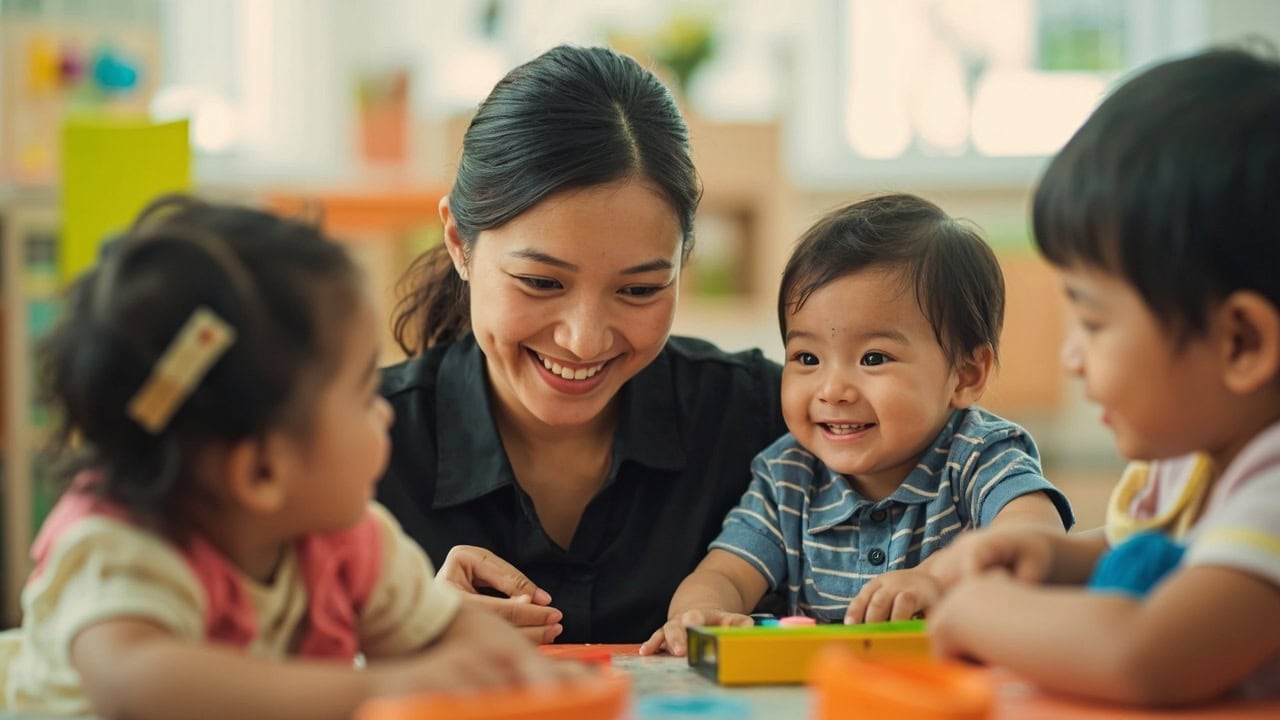
Notice the emotional climate of the room. Is there warmth? Is there laughter? Are children met with genuine delight when they arrive? Are they treated as individuals, with names and preferences and personalities recognized and respected? Or is the atmosphere perfunctory, impersonal, focused on compliance rather than connection?
Observe Children’s Movement and Engagement
Notice how children move through the space. Do they seem comfortable? Are they engaged, or are they withdrawn and watchful? Are there signs of the play and exploration that support cognitive development? Or is there a pervasive listlessness that suggests children are merely being warehoused?
Watch How Limits Are Set
Notice how caregivers handle transitions and limits. Is there empathy? Is the child’s perspective acknowledged? When a child resists a transition, is the resistance met with understanding or with force? These are the moments when scaffolding for self-regulation is either provided or withheld.
Watch Your Child
And notice your child. How does your child respond to the caregiver? Is there genuine warmth, or merely tolerance? Does your child seek out the caregiver, or avoid them? When you arrive to collect your child, what is the emotional tenor of the goodbye? Does your child seem happy to see you, but also happy to have been there? These are signals that cannot be quantified, but they are among the most important data points you have.
Ask Meaningful Questions
Ask questions, too. Not just “what did you do today?” but “how did my child respond when they were frustrated?” “What did you notice about their language today?” “What was hard for them, and how did they handle it?”
A caregiver who thinks developmentally—who understands that their role is not just to keep children safe and fed but to support the construction of a human mind—will have something to say. They will have observations. They will have a language for what they are doing and why. If they do not, that is worth noting.
For Singapore Parents: Why This Understanding Matters Now
In Singapore, where childcare costs can feel overwhelming, where dual-income households are the norm rather than the exception, and where the pressure to “have it all sorted” can feel relentless, the question of what happens during those early hours carries particular weight.
Many parents feel caught between the economic realities of raising a family in one of the world’s most expensive cities and the deep, instinctive knowledge that their child’s earliest years matter in ways they cannot fully articulate. They want reassurance that their childcare arrangement is not just adequate, but genuinely good for their child’s developing brain.
This is not about guilt. The science does not demand perfection, nor does it demand that parents sacrifice their livelihoods to be present every waking moment. Parents are human. They are tired. They are doing their best under conditions that are often exhausting and isolating. What the science demands is understanding—and it demands that the childcare choices parents make be informed by this understanding.
Not All Care Is the Same at a Neurological Level
Here is the truth that follows from everything we have discussed: not all childcare is the same. Not because some settings are unsafe or unsanitary—they should all be safe and clean—but because the quality of the care being provided at a neurological level varies enormously. And that variation has consequences.
When a child is in an environment that is warm, consistent, and attuned, the brain processes we have discussed are supported. The stress response system calibrates toward regulation. The neural circuits for language are activated and strengthened. The foundations for executive function are laid. The emotional memories being encoded are positive. The child is building a brain that is prepared for the challenges ahead.
When a child is in an environment that is neglectful, chaotic, or chronically stressful, these processes are disrupted. The stress response system may become dysregulated. Language exposure may be impoverished. The emotional memories may carry traces of fear or confusion. The developing brain may be learning that the world is unreliable, that needs go unmet, that attachment figures are inconsistent.
Neither of these outcomes is deterministic. Human beings are remarkably resilient, and later experiences can still matter. But the asymmetry is real: it is easier to build strong foundations than to remediate weak ones. The cost of early adversity is not easily undone.
The EduNanny Approach
Understanding the science of early brain development led us to a specific conclusion: the childcare model that Singapore families deserve is one designed around these realities, not in spite of them.
EduNanny was created with this understanding at its center. We are part of the ECDA Childminding Pilot, and we believe in the importance of home-based and community care pathways that allow infants to grow in environments that are warm, consistent, and attuned to their developmental needs.
Our approach begins with ratios that allow for genuine attention—with small groups and dedicated caregivers who can attune to each child as an individual, not a number on a daily report. When a caregiver can notice that a child is approaching frustration before it escalates, when they can follow the child’s lead in conversation, when they can respond to distress with genuine connection rather than efficient triage—those are not luxuries. They are the conditions under which healthy brain architecture is built.
Our caregivers are trained to understand what we have been discussing today. They know that attunement is not a soft concept but a neurological necessity. They know that the language they use matters, that their responsiveness shapes the developing stress response system, that the micro-interactions of daily care are building the architecture of the minds entrusted to them. They are not just childcare providers. They are partners in development.
We know that for parents, the question “what happened in there today?” deserves more than a vague answer. That is why we have built communication into the fabric of our model. Where deployed, CCTV measures provide an additional layer of assurance. Regular updates, meaningful observations, and genuine dialogue between caregivers and parents are not add-ons but standard practice.
We also know that for many families in Singapore, finding care that meets these standards has felt out of reach. That is why our pilot fee structures are designed to be accessible, and why we have worked to ensure that CDA and Baby Bonus funds can be used to offset costs. We believe that quality early care should not be a privilege reserved for families with means. Every child in Singapore deserves the opportunity to build a strong neural foundation.
Addressing the Concerns You Carry
Before you make any childcare decision, it is worth addressing directly the concerns that most Singapore parents carry.
Am I doing the right thing for my child? This question is not a sign that you are failing. It is a sign that you are paying attention. Every parent who has left their infant in someone else’s care has asked this question. The science confirms that your instincts are worth trusting—and it gives you the vocabulary to ask better questions of the people caring for your child.
How do I know if the care is actually good? Look for what we have described: warmth, attunement, responsive language, scaffolding for self-regulation, genuine engagement. Ask questions that go beyond logistics. Notice how your child responds to the caregiver and to the environment. Trust what you observe.
Is it selfish to focus on my career while my child is young? The science does not support a model in which children thrive only with parental presence at all times. What the science supports is quality: warm, consistent, attuned care that meets the child’s developmental needs. Whether that care comes from a parent, a grandparent, a family childminder, or a centre-based caregiver, what matters is the quality of the relationship and the environment—not the label on the arrangement.
What if I made the wrong choice? Human beings are resilient. Later experiences can still matter. If your current arrangement is not ideal, the path forward is not guilt but assessment: Is this serving my child’s development? What would need to change? Sometimes change is possible. Sometimes the best path is accepting what is while building in other supports. The science is not a verdict; it is a guide.
Building Together: An Invitation
Here is what we want you to carry forward above all else, beyond any specific programme or model: the knowledge that you already possess more wisdom than you may realize.
Every time you have paused to wonder, “Is this right for my child?” you have been asking the right question. Every time you have lain awake considering whether your child is getting what they need, you have been attuned to something that matters profoundly. Every time you have looked at your child’s face and wondered what was happening inside that developing mind, you have been engaging with the most important science there is—the science of a human being becoming themselves.
The first three years are fleeting. They pass with a speed that still astonishes parents who have lived through them. And in the midst of the exhaustion and the logistics and the endless negotiations of modern life, it can feel as if those years are simply a blur to be survived.
But they are not a blur. They are a construction. And the architects of that construction are the people who love and care for that child—parents and caregivers together, building something that will last.
Trust What You Know
Trust that intuition. Trust the science, yes, but trust also the quiet knowledge that lives in you about your own child. When you see warmth in your child’s face as they run toward their caregiver, when you hear the language growing richer day by day, when you notice your child managing frustration with increasing skill, when you sense that your child feels safe—know that these are not coincidences. These are signs of healthy development. These are signs that the architecture is being built well.
And when you are making choices about who will share in that building work, carry this understanding with you. You are not merely choosing a childcare arrangement. You are choosing an environment that will shape a human brain. That choice deserves the seriousness you are already giving it.
Our Commitment
We are honored to walk alongside you in that work. We know that the trust you extend to us is not given lightly, and we do not take it for granted. Our commitment is to be worthy of it—not through promises, but through practice. Through the quality of the care we provide, the depth of our understanding, and the transparency of our partnership with you.
The first three years matter. You already knew that in your bones. Now you know it in your mind as well. And with that knowing, you are better equipped to build well.
Your child’s brain is waiting to be built. Let us build it together.
Ready to learn more about how EduNanny applies the science of early brain development to everyday care? Reach out to speak with our team, or schedule a visit to see our approach in practice.
#EarlyBrainDevelopment #SingaporeChildcare #InfantDevelopment #ChildmindingSG #EduNannySG