The Honest Truth About Re-Entry and Childcare Partnership in Singapore
The Morning of Re-Entry: Understanding This Pivotal Moment in Singapore Family Life
There is a particular morning that every Singapore parent comes to know intimately. It arrives after the school holidays have ended, after extended parental leave has drawn to its quiet close, after the family trip when weeks blurred together in a foreign city or a grandmother’s home. It is the morning when the familiar weight of the work bag returns to your shoulder, when the familiar protest begins in your child’s throat, when the familiar question surfaces in your own chest: Can this still work? Have we lost what we built?
Most providers treat this moment as a simple logistics problem—a matter of settling a child back into routine. But this morning deserves something different. It deserves recognition. It is one of the most honest, revealing tests of partnership in childcare, and understanding it properly changes everything about how you choose and trust the people who care for your children.
The Rhythm of Modern Singapore Family Life
To understand what happens at re-entry, consider what has been happening in your child’s inner world during the separation.
Think about the calendar of a Singapore family. There is the initial adjustment when a caregiver enters the home or the family enters a centre. Then comes the period of comfortable routine—the mornings that become predictable, the goodbyes that become brief, the homecomings full of stories. Then the break arrives. A long weekend. A school holiday. Perhaps parental leave that extended beyond the usual, as Singapore’s generous provisions allow.
For many families, this cycle repeats four, five, six times a year. The school holidays alone bring three or four significant breaks. Add annual leave, family commitments, travel, the seasons when grandparents visit or when a parent simply needs to be home. Each break is a small departure from the childcare relationship. Each return is a small test of its resilience.
The families who navigate this rhythm most successfully are not those who never feel uncertainty. They are the families who learn to interpret that uncertainty differently—families who come to understand that the anxiety they feel on re-entry morning is not a warning sign about their childcare partner. It is simply the shadow cast by love.
What Separation Actually Does to a Child
When a child has been home with a parent for an extended period, something precious and necessary occurs. They consolidate. They grow in ways that feel dramatic to a parent who sees them every day—the words that arrive suddenly, the fears that surface, the new preferences, the sleep patterns that shift, the appetite that changes.
The child who returns from six weeks of school holiday is not the same child who left. None of us are the same after six weeks of living.
Here is the gentle, difficult truth that every parent must eventually accept: your child does not need you to be present for every moment of their growth. This is not a rejection of attachment. It is, in fact, the very proof of secure attachment.
A child who feels secure explores further, returns more confidently, trusts more deeply—because their base camp, their home, their parent, is reliable. The separation and return cycle teaches your child something essential: that people leave and come back, that the ones who love you hold you in their hearts even when they are not beside you, that the world is reliable enough to venture into.
The resistance you may see on re-entry day is not evidence of a broken partnership. It is the sound of a child’s heart negotiating a more complex understanding of where they belong.
A trained, attuned caregiver understands that the child who returns from a long break is not starting over. They are starting forward—from a new vantage point, with new capabilities, with the added security of having been home. The re-entry is not a return to where they were. It is the beginning of something that could not have existed without the separation.
Your Anxiety on That Morning Is Yours
Let us speak directly to you, the parent, on that morning.
You have been home with your child for weeks. You have watched them grow in real time. You know, in your bones, every new expression, every new word, every small shift in their temperament. And now you are watching them look at the caregiver with uncertainty, and a question forms: Does she still know him? Does she see who he is now? Can she meet him where he is?
This question reveals how deeply you have invested in this relationship. The parent who feels no uncertainty about re-entry may be the parent who has not yet truly partnered—truly trusted another adult with the full complexity of their child’s emotional life.
But here is what the re-entry moment teaches us: your anxiety is yours. It belongs to you. It does not need to become your child’s anxiety, and it does not need to become the measure of your caregiver’s capability.
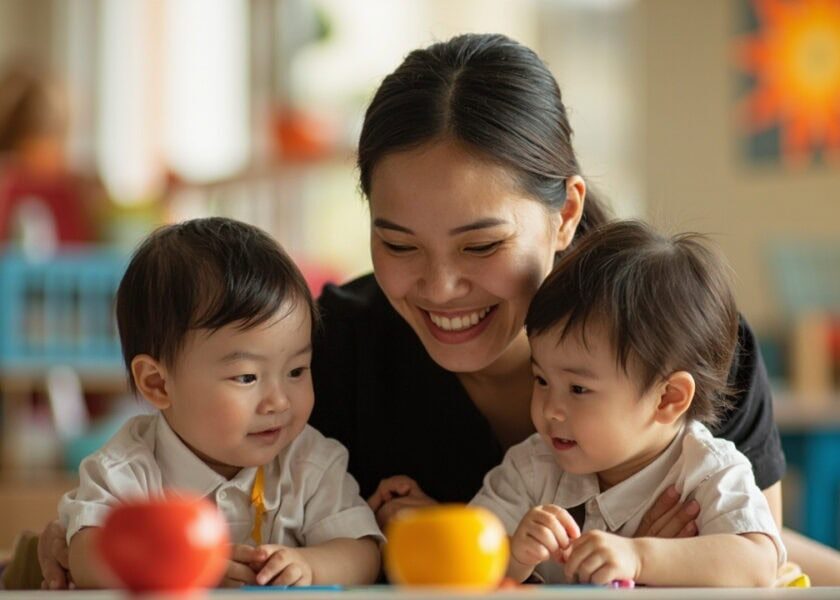
What you are witnessing in those first moments—the child’s hesitation, the caregiver’s patient crouch, the small negotiation—is not a crisis. It is a conversation conducted in glances and postures and gentle voices. It is your caregiver demonstrating, in real time, that they are paying attention, reading your child’s changed signals, meeting this child, this morning, exactly where they are.
You have a choice. You can fill that moment with your own worry, which your child will feel like weather in the room. Or you can take a breath, trust what you are seeing, and let your confidence be the quiet foundation beneath your child’s uncertain exploration.
What Genuine Partnership Looks Like Versus Routine-Based Care
In a routine-based arrangement, the caregiver manages the child’s return by re-establishing the schedule. Activities resume. Expectations reset. The child is integrated back into the program with efficiency and care, but the care is oriented toward group dynamics and keeping the day moving. There is nothing wrong with this—it is professional and competent. But it is not partnership.
In a genuine partnership, you can observe the difference in small behaviors:
- Unhurried presence: Does the caregiver take time in those first hours to simply be near your child without agenda—not to teach, not to guide, but to notice? To notice that your child’s walking pattern has changed, that their voice sounds different, that they are gravitating toward different toys.
- Genuine inquiry: Does the caregiver ask you, quietly, what the break was like—not as small talk, but as authentic curiosity? This question, asked with real interest, is a signal of partnership. It tells you your caregiver sees your child as a continuous story, not a series of disconnected days.
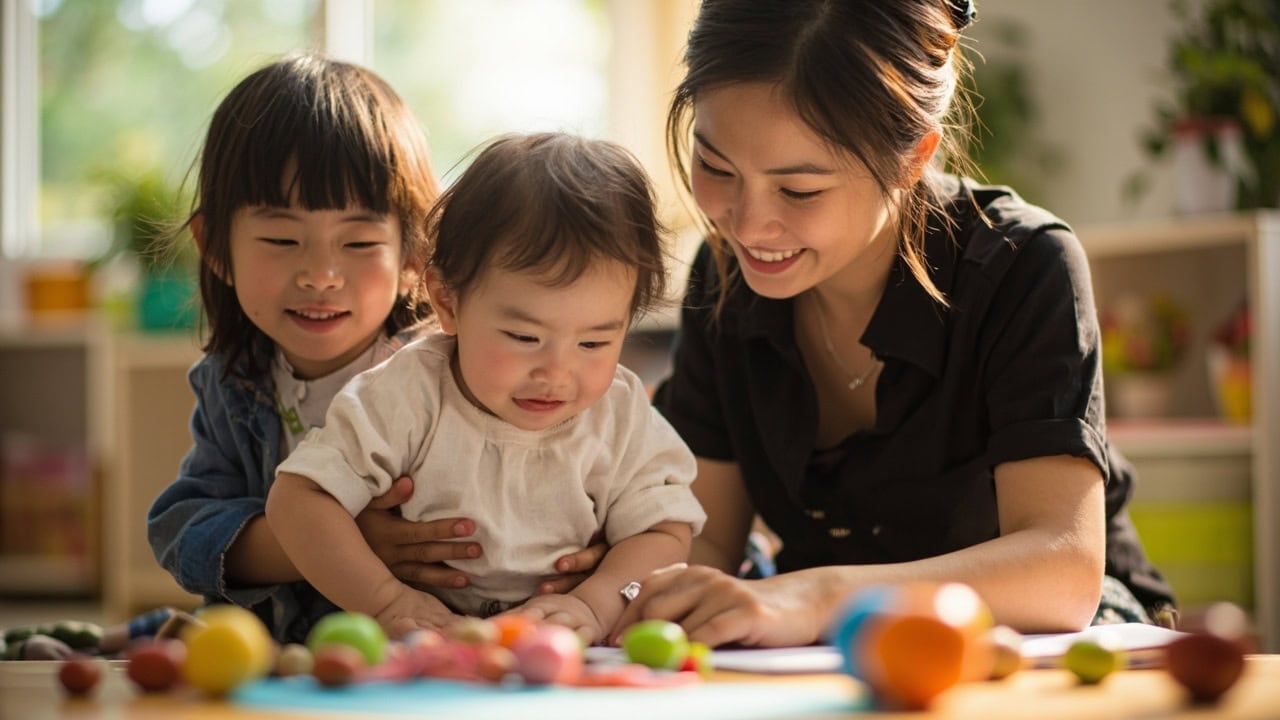
- Bridging narration: Does the caregiver narrate the return? “I missed you. You grew so much. Look, the playdough is still here. Remember when we made that together?” This is the caregiver weaving your child’s home experience into the childcare narrative so your child understands these are not two separate worlds. This is one continuous life, with trusted people in every part of it.
- Storytelling, not checklists: Does the caregiver give you a window into your child’s day—not as a checklist of activities, but as a story? “When he arrived, he went straight to the corner with the books. He spent twenty minutes there. He pointed at a picture of a bird and said ‘bird’ three times.” This is the language of partnership. This is your caregiver saying: I see your child. I see who he is becoming. I am holding that knowing with care.
These behaviors reveal whether your childcare partner has been holding space for your child’s growth during your absence—or whether your absence has created a gap in attention. A genuine partner maintains continuity even in your physical absence.
How EduNanny Singapore Approaches Re-Entry
EduNanny Singapore was built for exactly this kind of partnership. When the approach to infant care and childminding was designed, the understanding was clear: Singapore families are navigating something complex and beautiful—building careers, raising children, weaving both together daily—and they need partners who can weave with them.
EduNanny Singapore is part of the ECDA Childminding Pilot, grounded in standards that take seriously the developmental science of the first thousand days. Small caregiver-to-infant ratios allow for the individualized attention that re-entry demands. When a child returns after a school holiday, there is capacity to notice what has changed, to adapt to their new developmental stage, to hold the relationship with continuity even across weeks of family time.
EduNanny offers both home-based and centre-based pathways. Some families thrive with a dedicated caregiver in the home who becomes part of the household rhythm. Others find that the community environment of a centre best supports their child’s development. Both pathways carry the same commitment: partnership that persists across the rhythm of separation and return.
Singapore parents need more than excellent care. They need transparency—knowing what happens in the hours when they are not present. Where measures have been deployed to support documented continuity of relationship, they serve not as surveillance but as reassurance. On a difficult day when re-entry anxiety is high, this transparency allows you to see: they are safe, they are engaged, they are known.
Addressing the Concerns You Actually Have
“What if my child has regressed?”
Regression after extended time at home is normal and expected. Your child has been in a home environment with full parental attention, likely more attached to home routines and certain comforts. This is not damage—it is the natural result of being deeply loved. A skilled caregiver expects regression and meets it with patience, not impatience. They do not rush your child back to where they were before the break. They meet them where they are today.
“What if the caregiver can’t connect with my child anymore?”
Connection is not about physical familiarity—it is about sustained attention. A caregiver who has been genuinely attuned to your child will have developed what developmental psychologists call a mental model of your child. They carry that model forward through absences. When your child returns, they update it—your child is taller, more verbal, more complex—and they adjust accordingly. This is not a断裂. It is a continuation.
“How do I know if this partnership is strong enough?”
Look at the first week. Look at whether your caregiver seems genuinely interested in your child’s time away—whether they ask, whether they notice, whether they adjust. Look at whether your child seems, by the end of the week, to have found their footing again—not necessarily to have forgotten home, but to have remembered that home and childcare can coexist, that both are real, that both are safe.
Look at whether you, the parent, feel by Friday afternoon a quiet settling in your chest. Not the absence of love—that love is eternal and unchanged—but the absence of dread about Monday morning. The sense that you can hand your child over and trust that they will be held.
If these signals are present, you have what you came for. You have a partner. And if they are not—if the caregiver seems indifferent to your child’s changes, if the routine resumes without acknowledgment, if your child seems to merely endure rather than settle—then you have information. And information is a gift. It allows you to make a different choice, to find a partner who can meet you and your child at this new stage.
A Quiet Invitation
There is a moment, in the first week of re-entry, when a parent often realizes something has shifted. Your child, who clung and cried on Monday morning, walks into the centre with something like acceptance—something like: I know this place. These people know me. I can be here for a few hours and then go home to the people I love most.
And you realize, watching from the gate or the doorway or the car that has not yet pulled away, that the partnership you trusted has been holding up. The relationship did not erode during the weeks apart. It did not reset to zero. The thread held.
Genuine childcare partnership is not about physical proximity. It is about sustained attention—an adult who carries your child’s knowing forward through absences, who updates their understanding as your child grows, who approaches each return not as a fresh start but as a continuation of an ongoing conversation.
When you chose your childcare partner, you may have thought you were choosing someone to supervise your child during work hours. In time, if the partnership is genuine, you realize you have chosen someone to journey alongside your child through the seasons of their growth—through separations and returns, through changes that seem dramatic and changes that are almost invisible, through every small evolution that adds up to a person.
The rhythm of separation and return that Singapore families navigate is not a problem to be solved. It is a feature of contemporary life—perhaps even a gift, in disguise. It teaches our children that the world is large and that they can venture into it. It teaches parents that love does not require constant physical presence to endure. And it teaches caregivers that their work is not merely supervisory but relational, not merely present but continuous, not merely attentive in the moment but attuned across time.
The morning will come again—the school holiday will end, the leave will conclude, the trip will be packed away. When that morning arrives, EduNanny Singapore will be here. Holding your child. Noticing their changes. Waiting to welcome them back.
Not because we are perfect. Not because your child will never resist, never cry, never need time to settle. But because we have committed to the kind of partnership that holds across separations, that updates across seasons, that proves itself not in the easy days but in the returning days.
That is what we are building here. That is what we are honored to walk alongside you in, one small morning at a time.
EduNanny Singapore offers infant care and childminding pathways designed for families navigating the beautiful, complex rhythm of separation and return. Learn more about our approach or connect with our team to explore what intentional partnership could look like for your family.