The Gentle Shift from Grandparent to Professional Childcare
The Beginning: When Grandparents Step In
You bring your newborn home from KK or Mount Elizabeth. You are exhausted, exhilarated, terrified, transformed. Within days or weeks, your parents arrive. Or your in-laws. They fold themselves into your home and do what Singapore families have always done—they step in. They hold your baby. They soothe crying at three in the morning. They make ginger chicken soup and fold tiny onesies and tell you, again and again, that you are doing well.
In Singapore, we do not always have the extended-family structures that once cushioned parenthood elsewhere. What we have built, through necessity and culture, is remarkable: a childcare system held together by love. By mothers and fathers who became grandmothers and grandfathers. By older women who gave up their retirement to hold someone else’s infant because that infant’s parents needed to return to work, to contribute, to build the lives they are trying to give their children.
This is not nothing. This is everything. And it deserves to be honoured before anything else is said.
Understanding What Children Actually Need as They Grow
But here is what we also know, if we are willing to look honestly at developmental stages.
The Newborn Stage: Presence and Attachment
A newborn requires presence. Attachment. The steady, loving voice of someone who responds when they cry. Grandparents excel at this. A grandmother’s arms have a particular quality of comfort that no amount of professional training can replicate. The smell of her. The particular lullaby she sings. The way she holds a baby like she has done this a thousand times, because she has.
The science of attachment tells us that what infants require is not a specific person, but consistent, responsive care from someone who loves them. By this measure, grandparents are extraordinary in the first year.
The Toddler Stage: Exploration and Challenge
Around the age of one, something shifts. The infant who could be held begins to want more. She pulls herself up. She walks. She drops things on purpose and looks to see what happens. She points at everything. She wants to touch, to taste, to climb, to explore.
Her world, which once fit within the circle of someone’s arms, suddenly requires an entire room. And then an entire playground. And then a world of objects, textures, sounds, other children.
Toddlers need to explore. They need to be challenged. They need sensory experiences that stimulate their rapidly developing brains—sand and water and paint and music and movement. They need environments designed for curiosity, not just comfort.
And they need something else that becomes increasingly important: other children. Other children teach toddlers things that adults cannot. How to share. How to negotiate. How to feel frustrated and recover. How to notice that another person has a different perspective.
A grandparent, however loving, is not a peer. A grandparent is a wonderful anchor—but an anchor is not a sailing ship. And the toddler’s developmental imperative at this age is to set sail.
The Preschool Stage: Structured Learning Readiness
By the time a child reaches three or four, the gap between what home-based care can offer and what the child actually needs has often widened considerably. This is not a failure of the grandparent. It is simply the nature of developmental stages.
A four-year-old is thinking in more complex ways. She is asking questions that require accurate answers. She is beginning to understand sequences, patterns, cause and effect. She is ready—neurologically, emotionally, developmentally ready—to begin the work of structured learning.
Not rigid schooling. Not flashcards or worksheets. But the kind of learning that happens when a skilled teacher introduces a concept at exactly the moment a child is ready to absorb it. The readiness to learn how to learn. To be curious. To persist when something is difficult. To be in an environment where learning is the air everyone breathes.
Recognising the Signs: When Your Child Is Ready for More
How do you know when the time has come? When the shift from grandparent care to professional childcare is not just an abstract idea but a felt sense that something is ready to change?
Social Hunger
Some parents notice it first in their child’s social hunger. “She comes home from time with my mother,” one mother told me, “and the first thing she says is ‘I want to play with other kids.’ Not once. Every time. She is asking for something her grandmother cannot give her.”
Developmental Boredom
Others notice it in what can only be described as developmental boredom. “My son knows every corner of my mother’s HDB flat. He has exhausted its possibilities. He is looking for more. He is ready for more.”
Behavioural Signals
Some parents notice it in behaviour. A child who was easy-going becoming difficult. A child who was curious becoming passive. Not because of some inherent flaw in the grandparent arrangement, but because a child who is not being sufficiently challenged will often communicate that through behaviour. The message is: I need more.
Your Own Readiness
And some parents notice it in themselves. In the growing realisation that what they once felt grateful for has started to feel like compromise. That they are staying in an arrangement not because it is working but because leaving it feels too hard.
If any of these resonate with you: you are not imagining this. You are not being too demanding. You are simply paying attention to what your child actually needs. And that is the most important kind of attention a parent can pay.
Navigating the Transition with Honesty and Care
Speaking to the Guilt
I know some of you are feeling something right now. A recognition. A relief, perhaps, that someone is saying what you have been thinking in private. And alongside that relief, perhaps, a flicker of something sharper: guilt.
You love your parents. Or your in-laws. You see the way they look at your child. You know what this arrangement has meant to your family. And the thought of moving beyond it feels, in some confused and guilty corner of your heart, like a betrayal.
The guilt you feel is not evidence that you are doing something wrong. It is evidence that you are a person who cares deeply about your family. It is the weight of being caught between two genuine goods: the love of grandparents and the evolving needs of your child. Both are real. Both matter. And the fact that you feel tension between them does not mean you have to choose the one that harms the other.
What if the transition you are contemplating is not a rejection of your parents’ contribution? What if it is the natural and healthy evolution of a family care system that has done its job beautifully—and is now making space for what comes next?
This is the frame shift I want to offer you. Not guilt-free, because that phrase does not capture what is actually happening. But guilt-relieved. Recognising that you are not abandoning what came before. You are completing it.
Having the Conversation with Grandparents
There is another conversation that needs to happen, and it is one that many parents dread: the conversation with the grandparents themselves.
How do you tell someone who has given so much that their role is naturally evolving? How do you honour their contribution while also making clear that the next chapter requires something different?
The key is honesty, spoken with love. Not the dishonest kindness that avoids the truth, but the honest love that trusts the relationship to hold the truth.
You might say: “Mum, Dad—thank you. What you have given our child is irreplaceable. The love, the stability, the hours you have given us. We do not take that lightly. And because we respect what you have done, we want to be honest with you: our child is growing in ways that require new things. We are thinking about what comes next, not because we are unhappy with what you have provided, but because we are paying attention to what our child needs as she develops.”
Include them in the process. Ask for their thoughts. Let them know that they remain grandparents—central, beloved, present—just as the nature of that presence begins to shift. Frame it not as replacement but as expansion. Grandparent love does not diminish when professional care begins. It simply has a new shape.
Some families find that grandparents continue to play an active role, just different. One or two days a week, perhaps, rather than five. School runs. Weekend visits. The joy of being a grandparent without the weight of being a primary caregiver.
What Quality Childminding Actually Looks Like
When we talk about professional childcare, it is important to be clear about what that actually means—not just the supervision of children, but genuine developmental care that meets them where they are.
Developmentally-Informed Environment
Quality childminding means your child is in an environment designed for her developmental stage. Not the stage she was at two years ago. Not the stage she will reach in three years. The stage she is at now. With activities, interactions, and scaffolded experiences that meet her exactly where she is and gently, joyfully extend her capabilities.
Peer Socialisation in Small Groups
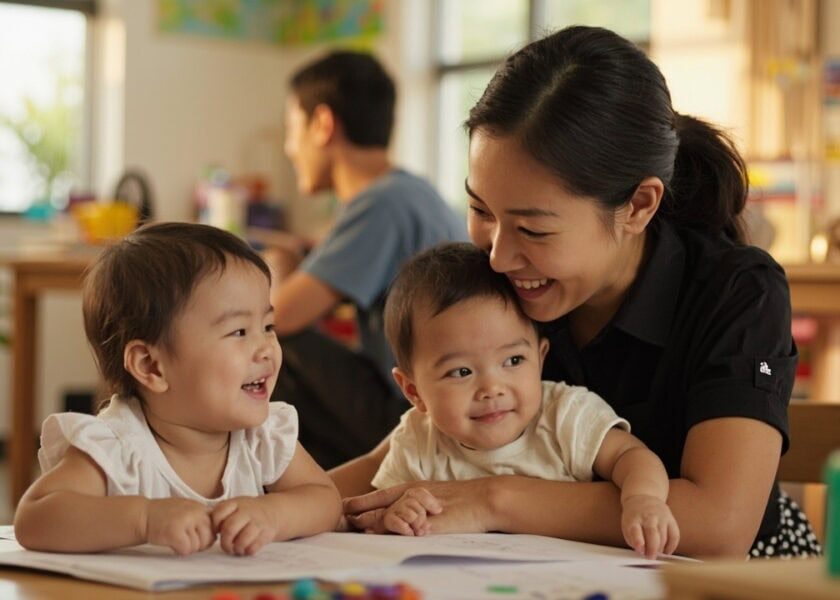
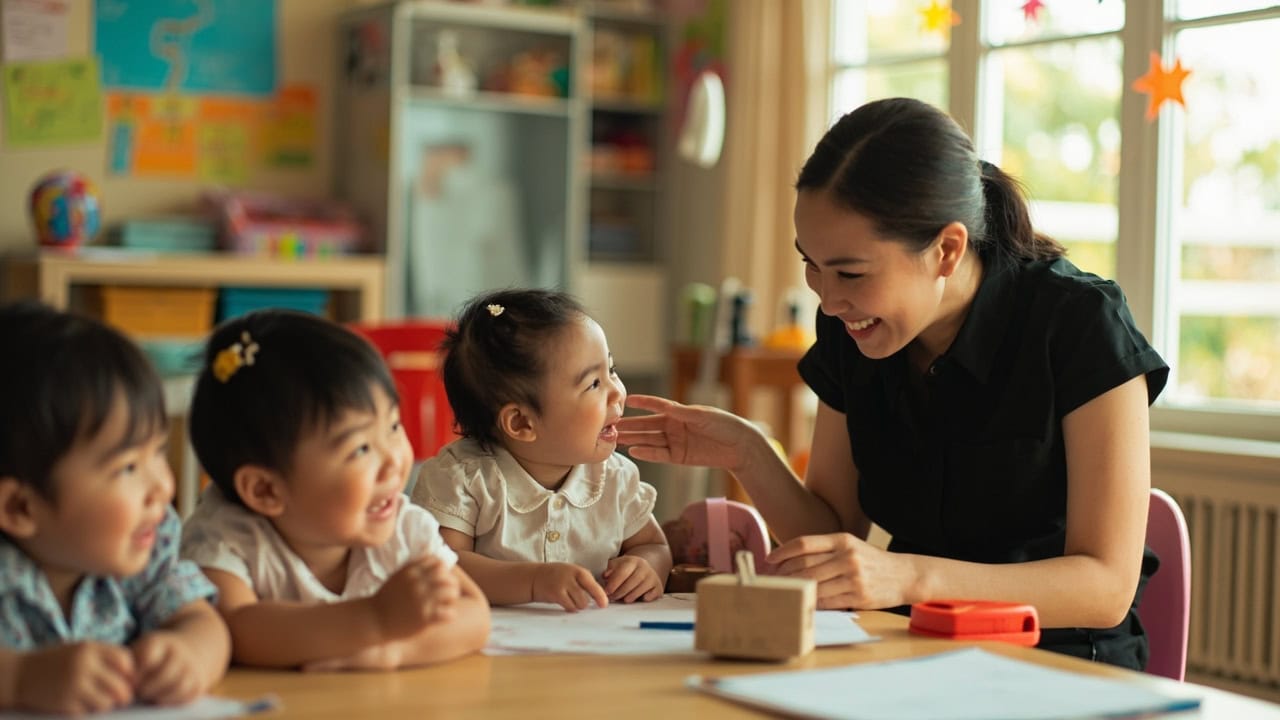
Your child is with other children. Not in a large centre with forty other toddlers, but in a smaller group setting where she can learn the social skills of sharing and negotiation and frustration and recovery in an environment that is still intimate enough to feel safe. These peer experiences prepare children for the larger social world of preschool and beyond.
Trained, Observant Caregivers
Caregivers who are trained not just to supervise but to observe, to notice, to respond to developmental cues. To introduce language at the moment a child is ready for new words. To offer a puzzle that is just challenging enough to require persistence. To understand that a tantrum at this age is not bad behaviour but an overwhelmed nervous system that needs co-regulation, not punishment.
Transparent Communication
Parents need to feel connected to their child’s day, even when they are not physically present. You have jobs. Responsibilities. Lives that require you to be somewhere other than in the room with your child. Quality childminding includes transparent communication practices—daily updates, photos, written reflections on the child’s day. You are not handing your child to a black box and hoping for the best.
Addressing Common Concerns
Will my child miss out on grandparent bonding? The transition to professional childcare does not mean grandparents disappear. Many families find that when grandparents are no longer the primary caregivers five days a week, the time they do spend together becomes more joyful, more present, less burdened. The grandparent-grandchild relationship can deepen precisely because it is no longer also carrying the weight of a childcare arrangement.
Is home-based care as safe as centre-based care? EduNanny operates within the ECDA Childminding Pilot framework, which includes standards for safety, caregiver ratios, and quality assurance. Parents can expect structured vetting, training requirements, and ongoing oversight—without the institutional feel that larger centres sometimes carry.
What if my child struggles with the transition? Adjustment takes time, and some separation anxiety is normal and healthy—it actually indicates secure attachment. Quality childminding settings understand this and work with families to create gradual, supported transitions. The goal is not to rush separation but to make it thoughtfully, at a pace that respects both the child and the family.
How do I know if my child is ready for preschool, or if she needs more time in this kind of setting? Preschool readiness is not about age alone. It is about whether a child has developed the foundational skills—curiosity, persistence, social comfort, language confidence—that allow her to thrive in a group learning environment. Quality childminding observes and supports these foundations, helping parents make informed decisions about timing rather than following arbitrary timelines.
EduNanny: A Natural Evolution
EduNanny operates within the ECDA Childminding Pilot, and this matters practically for Singapore families.
The pilot represents Singapore’s official recognition that home-based and community-based childcare pathways deserve support, resourcing, and quality standards. This is not fringe care. This is a legitimate, endorsed option within Singapore’s childcare ecosystem—one that complements, rather than competes with, centre-based services.
For families, this means EduNanny operates within a framework designed to ensure safety, quality, and accessibility. Infant ratios are capped at one to three, ensuring that every child receives the attention and responsive care that infants and young toddlers require. Care operates Monday through Friday, in structured blocks that give families predictability and routine.
For those concerned about cost—and in Singapore, who is not concerned about cost?—EduNanny’s fees are structured to be accessible within the pilot framework. Many families find that their Child Development Account and Baby Bonus can be used to offset costs significantly. This is not a luxury service for the wealthy. It is a thoughtful, accessible option for working families navigating the real economics of childcare in Singapore.
This is not about replacing what grandparents do. It is about doing something that grandparents, by the nature of their role, are not positioned to do. Professional care that is developmentally informed, not just lovingly present. Built on the same love. Informed by professional knowledge. Designed for the child you are paying attention to, who is changing in real time, who is ready for more than she could have needed two years ago.
The Path Forward
Singapore has made childcare a national priority. We have expanded centre-based options, subsidised fees, extended leave provisions. These are real, meaningful improvements to the infrastructure of parenting in this country.
But infrastructure is not experience. A childcare slot is not the same as a childcare arrangement that genuinely fits your family, your child, your values.
What EduNanny offers is a recognition that Singapore families are diverse, that their needs are not uniform, and that some families need something that sits between full centre-based care and full family-based care. Home-based. Community-connected. Small-scale. Human-scale.
You love your parents. Your child loves them. The relationship between grandparents and grandchildren is one of the great gifts of Singapore family life, and it is worth protecting, nurturing, and honouring in the years ahead.
The transition described here does not have to threaten that. It does not have to be a rupture. It can be a graduation. A beautiful, healthy, natural step forward in a story that began with love and is now expanding into new chapters.
Your child is not asking you to forget where she came from. She is asking you to see who she is becoming. And to provide, with courage and clarity, the care that matches that becoming.
This is the work of parenting: to keep adjusting, keep observing, keep responding to who your child is becoming. And when the old arrangement no longer fits, to have the courage to choose something new—not out of ingratitude, but out of love.
That is not a betrayal. That is evolution.
And evolution, in the end, is what families in Singapore have always done best.
If you are ready to explore what comes next for your family, we invite you to connect with EduNanny and learn more about how we walk this road alongside families who, like you, are paying attention.
Learn more about who we are and what makes EduNanny different.