The Readiness That Changes Everything for Singapore Parents
The Question Nobody Asks You About Childcare
You have toured the centres. Read the reviews. Asked the questions every parent asks: Is my child ready? Will they adapt? Are they comfortable? Will they thrive?
These are important questions. They matter. But they represent only half of what actually shapes your child’s experience in those first years of care outside your home.
The question that deserves equal weight—the one you may find yourself returning to long after enrollment—is simpler and harder: Are you ready?
Not your child. You.
Are you ready to become something more than the person who drops off and picks up? Are you ready to show up for the partnership that makes quality childcare extraordinary?
Rethinking Readiness: The Question That Changes Everything
For too long, the narrative around childcare enrollment has treated you as someone who has finished their most important work once the decision is made. You have found the right place. You have done your research. You have visited and observed and weighed your options.
And then you hand over your child, and the story is told as though you step back into the role of spectator while the professionals take over.
But that is not what the best childcare experiences are built on. And it is not what Singapore parents, when they are honest with themselves, actually want.
What you want—what parents who feel most confident and most connected tell us they want—is to remain present. Not hovering. Not anxious. Present. Involved. Thoughtful.
You want to understand the world your child is inhabiting while you are building the life that supports them. Not because you distrust what is happening, but because your child is the most important person in your life and you deserve to be more than a spectator in their earliest, most formative years.
What Partnership Actually Looks Like
Partnership is a word that gets used often in discussions about childcare, but it is rarely examined with the care it deserves. What does it mean in the daily reality of a working Singapore parent whose mornings are rushed, whose evenings are shared with tired children and quick dinners, whose weekends are precious and few?
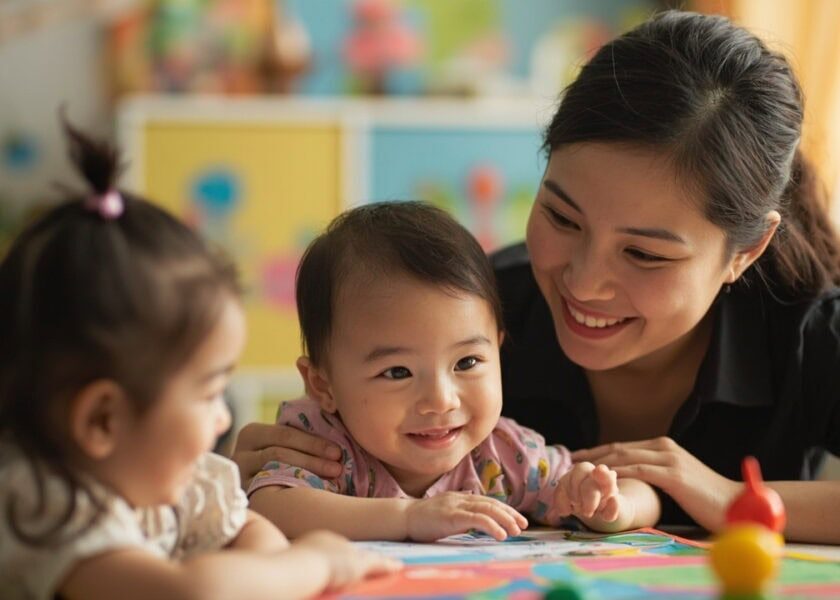
It looks like this: you arrive at pickup, and instead of the brief, transactional exchange many parents describe—my child ate well, they napped okay, see you tomorrow—you find yourself in a conversation.
You have a question. Maybe it is about something specific you noticed at home this weekend. A new sound your baby made. A change in how your toddler responded to a situation. You mention it casually, and the caregiver pauses, nods, and tells you that they noticed the same thing beginning to emerge at care this week.
You exchange a look. Something is connecting. You are beginning to build a shared understanding of who this small person is becoming.
This is what becomes possible when both parent and caregiver are operating as active participants in a child’s development rather than one watching and one working.
The Compounding Power of Shared Knowledge
The parents who feel most connected to their children’s lives—even while working full weeks and navigating the pace of Singapore—are the ones who have stopped asking only whether their child is thriving and started asking what they themselves can bring to the relationship with their caregiver.
They share observations. They ask questions. They are curious about developmental milestones not because they are anxious but because they understand that knowledge is power and that their awareness enriches the care their child receives.
How Knowledge Builds Over Time
In the first weeks of enrollment, you are building baseline. You are learning the names of the caregivers. You are learning the rhythms of the day. The caregivers are learning your child’s cues—the particular way your baby signals hunger or tiredness, the sounds that mean contentment versus distress. This is foundational work, and it takes time.
But then something shifts.
The caregiver mentions that your child has been particularly interested in a certain texture or activity during sensory play. You go home and find yourself noticing the same interest emerging in different contexts. You mention it the next morning. The caregiver has an idea about how to extend that interest. You try something at home. The caregiver picks it up at care. The loop continues. The knowledge grows.
Over months and years, this compounding creates something remarkable: a deep, shared understanding of your child that neither you nor the caregiver could have developed alone.
- You know your child as parent.
- The caregiver knows your child as trusted observer and companion through the hours of your workday.
- Together, you know your child in a way that is richer than either knowledge could be in isolation.
This is what we mean when we talk about the parent as active developmental partner. It is not about being an expert in child development. It is not about second-guessing professional caregivers. It is about recognizing that your knowledge of your child is unique and irreplaceable, and that when you share it generously, you are contributing to a picture of your child’s growth that no one else can provide.
What Quality Childminding Actually Looks Like
In Singapore, the childcare landscape offers different pathways—centre-based care, home-based arrangements, and community-based options. Each has its place. What matters most is not the format but the quality of relationship the environment makes possible.
Quality childminding is not merely supervision. It is developmental partnership from the very beginning of life.
The Signs of a Partnership-Oriented Environment
When you visit a potential childcare arrangement, look for these indicators that partnership is genuinely valued:
- Communication flows both ways. Updates are not one-directional reports but invitations to conversation.
- Questions are welcomed. No question is too small or too naive. Caregivers expect parents to ask.
- Observations are exchanged. You share what you notice at home; they share what they observe during the day.
- Trust is built through transparency. You feel you can ask anything because the relationship is built on openness, not performance.
- Low ratios allow for depth. When caregivers have time to truly know each child, they can share meaningful observations rather than generic updates.
Moving Beyond Monitoring
Some parents equate engagement with surveillance—checking cameras, requesting constant updates, measuring their child’s experience in data points. This is not partnership. It is monitoring.
Partnership is different. It asks more of you, but it also gives more. It asks you to be curious. To share what you know. To trust that your attentive presence is making a difference even when you are not watching.
The parents who thrive in quality childcare arrangements are not the ones who monitor most closely. They are the ones who engage most thoughtfully.
EduNanny’s Approach: Partnership Built Into Daily Rhythm
EduNanny by BUTLER was built with a specific belief at its centre: childcare is not just a service for your child. It is an environment that can support your growth as a parent alongside your child’s growth.
Our participation in the ECDA Childminding Pilot reflects this conviction. The pilot pathways—whether home-based, community, or centre-based—share a common thread: they are designed around the recognition that quality care is relational.
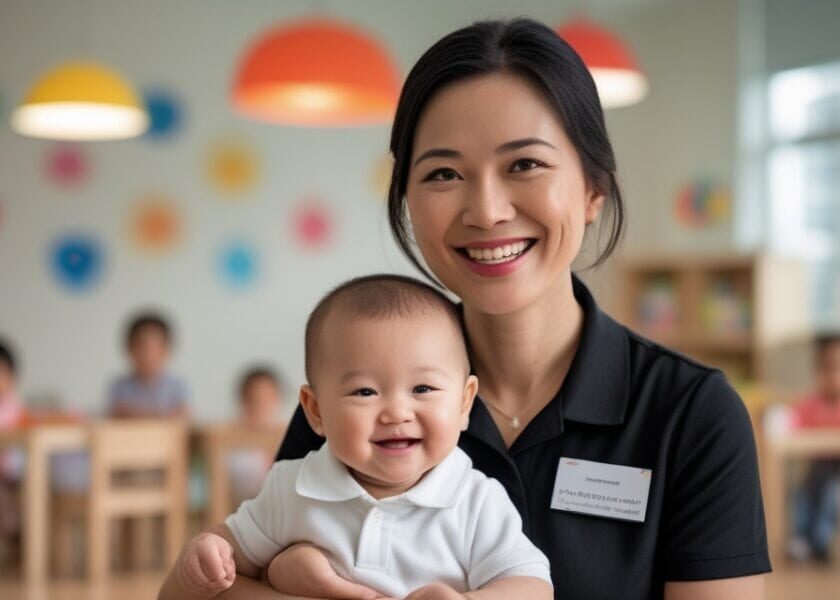
The low infant ratios we maintain mean that caregivers can truly know the children in their care. They can observe. They can remember. They can notice the small shifts that signal growth or the need for support. And they can share those observations with parents in ways that invite conversation rather than simply reporting.
We have thought carefully about what it means to build a childcare environment that supports parental partnership rather than undermining it. Trust is foundational, and it is built through transparency and consistent communication. Where deployed, our communication measures and CCTV access exist not to surveil but to reassure, not to replace human connection but to support it.
Affordability and Access
We know that for many Singapore families, affordability is not an abstraction. The CDA transfers, Baby Bonus applications, and pilot fee structures are real considerations that affect whether quality care is accessible.
We have worked to ensure that the partnership model we believe in is not available only to those for whom cost is no object. The design of our offerings reflects a genuine belief that every child deserves to be known deeply, and that every parent deserves to be a true partner in that knowing.
Growing Alongside Your Child: The First Thousand Days
The first thousand days of a child’s life matter enormously. This is well documented and widely understood. But what is less often discussed is that the first thousand days of a parent’s engagement with quality childcare also matter.
They are the days when habits form. When the template for partnership is set. When parents either begin to see themselves as observers or as active participants in their child’s developmental journey.
The parents who emerge from those first thousand days most confident and most connected are not the ones who had all the answers. They are the ones who kept showing up with questions. Who remained curious. Who treated the relationship with their child’s caregivers as something worthy of their attention and care.
Questions to Open Deeper Partnership
Readiness is not a prerequisite. You do not need to arrive at your first day of childcare already equipped with the knowledge, the confidence, and the communication skills of an expert parent. Those things grow through the relationship itself.
Here are some questions that can open the door to deeper partnership:
- What am I curious about in my child’s development right now?
- What does my child do at home that I wonder about?
- What behaviours or developments have I observed that I have not yet found the right moment to share?
- What did my child enjoy most about their day? What seemed challenging?
- What new skill or interest am I seeing emerge at home that might be worth mentioning?
These questions, asked with genuine curiosity and openness, are the beginning of meaningful partnership. They cost nothing but attention. And attention is exactly what your child needs from you—not perfection, not expertise, just your thoughtful, engaged presence.
Addressing the Mental Load
We know that for many Singapore parents, the idea of adding anything more to the mental load feels impossible. The logistics of childcare already represent significant administrative and emotional labour.
So let us be clear: we are not saying that if you are not asking your child’s caregiver three thoughtful questions every day, you are failing as a parent. We are not suggesting that engaged partnership is a performance or a checklist. We are not adding to the endless list of ways modern parents are told they are falling short.
Partnership grows naturally when you find the right place—a place where your curiosity is welcomed, where communication is genuine, where caregivers see themselves as collaborators rather than service providers. You begin to trust your instincts more. You begin to ask better questions. You begin to understand child development not as abstract theory but as something alive and observable in the daily evolution of the small person you know best in the world.
You Were Always Ready
Here is the truth that many parents discover only later, sometimes much later: the readiness that matters is not readiness at the beginning. It is readiness to grow. Readiness to learn alongside your child. Readiness to partner with the caregivers who have made it their vocation to nurture the young.
Readiness to trust that your curiosity and your questions and your attention are gifts, not burdens.
You were always ready. You just needed a place that knew how to receive that readiness and make it matter.
EduNanny is here for that partnership. We are here for the small morning exchanges and the detailed pickup conversations. We are here for the questions you bring and the observations we share. We are here for the long arc of years in which your child grows from infant to toddler to preschooler, and in which you grow from uncertain new parent to confident, knowledgeable partner in their development.
Are you willing to stay curious? Are you willing to share what you know? Are you willing to ask the questions that matter to you, even when they feel small or uncertain?
The answer, we believe, is already yes. It has always been yes.
If you are a parent considering childcare, or a parent already enrolled, we want you to know: your readiness is not a question of preparation. It is a question of willingness. And if this vision of childcare resonates with you—if you are ready to be more than a spectator in your child’s early years—we would welcome the conversation.
Because quality childcare is not just about where your child goes during the day. It is about who you become as a parent during those years. It is about the relationship you build with the people who care for your child alongside you. It is about the small, daily acts of communication and curiosity that, over time, become the foundation of everything that follows.
Are you ready?
At EduNanny, we believe that great childcare is built on partnership—on the quiet, daily exchanges between parent and caregiver that compound into something profound over time. Learn more about who we are or begin a conversation with our team.