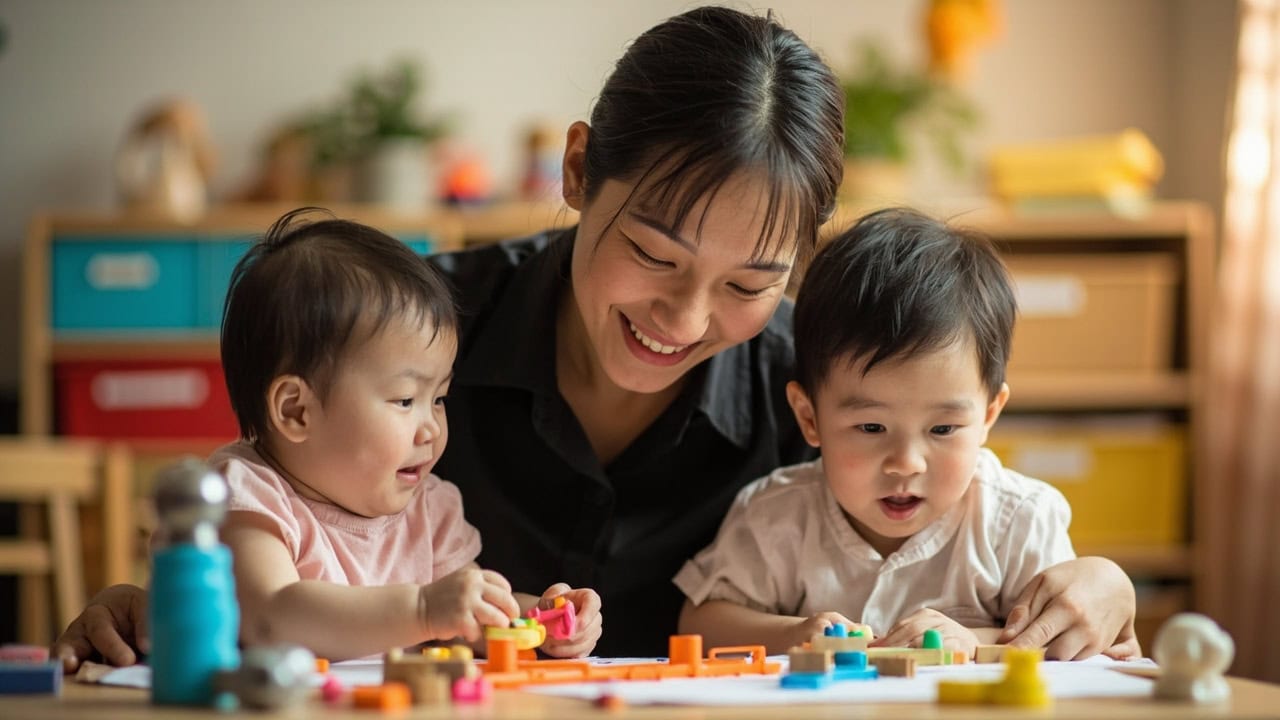
The Foundation Years That Prepare Your Child for Primary School
These Years Are Not a Holding Pattern
The years between toddlerhood and primary school are not a placeholder. They are not the administrative prelude to the real event. These years—all three or four of them—are the most developmentally active and relationship-rich phase of your entire childcare journey.
This runs counter to a subtle cultural narrative that frames childcare as something you need most when your child is helpless and small, and less and less as they grow capable, verbal, and ready for school. That narrative is wrong. Understanding why changes everything about how you experience this period as a parent.
Consider what is actually happening in your child between the ages of two and six:
- At two, your child is learning to communicate desire, to assert autonomy, and to test the boundaries of the physical world.
- At three, they are discovering cooperation, learning to see themselves through the eyes of others, and beginning to construct a moral imagination that distinguishes between mine and yours.
- At four, they are ready for genuine complexity: narrative thinking, imaginative play with elaborate rules, and the capacity to hold an emotional experience and describe it.
- At five, they are preparing for the cognitive demands of formal education: sustained attention, working memory, the ability to delay gratification, and the emotional regulation to sit with frustration rather than flee it.
These are not natural progressions that simply unfold because a child grows older. They are built, layer by layer, through relationships, environments, and experiences that the child moves through over time. The quality of care, the consistency of relationships, and the intentionality of programming during these years determine how well that construction proceeds.
What Quality Childcare Looks Like as Your Child Grows
Many parents feel uncertain about what they should be noticing and expecting. Here is what age-appropriate care looks like across these pivotal years.
At Two: Building Security
Your child is still learning the basics of social existence: how to be near other children, how to share space and toys, how to communicate needs without aggression, and how to trust that caregivers will return after absences.
Quality care at this stage is warm, responsive, and focused on building security and basic social competence. You might see parallel play, simple language modeling, and plenty of caregiver scaffolding for emotional regulation.
At Three: Intellectual Stimulation
The environment should feel more stimulating, more intellectually alive. There should be opportunities for pretend play, problem-solving, and early literacy experiences that are playful rather than prescriptive.
Your three-year-old should be encountering stories that build empathy, songs that develop phonemic awareness, art activities that develop fine motor control, and social experiences that teach turn-taking and cooperation. The caregiver should be a facilitator of discovery—asking open-ended questions and extending your child’s thinking rather than simply directing it.
At Four: Readiness Without Pressure
Quality care begins to introduce the academic readiness that will serve your child well in primary school, but it should do so in ways that feel engaging rather than pressured.
You should see evidence of early writing attempts, letter recognition, number sense, and conceptual thinking. But you should also see equal attention paid to the skills that schools do not teach but desperately need:
- The ability to focus for increasing stretches of time
- The capacity to manage transitions between activities
- The social intelligence to navigate a classroom of thirty peers
- The emotional vocabulary to express frustration appropriately
At Five: The Bridge to School
The environment should feel like a genuine preparation for school, grounded in warmth rather than anxiety. Your child should be learning to follow multi-step instructions, work collaboratively on projects, handle feedback without defensiveness, and sit still for periods that mirror a typical school day.
The caregiver’s role is no longer primarily nurturer, though warmth remains essential. The caregiver is now also a teacher, a coach, and a bridge between the secure world of childcare and the more structured world that awaits.
If this evolution is not happening—if the care your child receives at five looks and feels identical to the care they received at two—that is a red flag. It may not mean the care is bad. But it does mean the relationship has not matured. A maturing child needs a maturing arrangement.
The Partnership That Grows With Your Child
EduNanny Singapore speaks about childcare as a partnership that evolves. In the first year, partnership looks like frequent communication, photo updates, and detailed daily reports. Parents want to know that their infant was fed, slept, had a diaper change, and was soothed when crying.
In the middle years, partnership looks different. It looks like a caregiver who can tell you that your child resolved a conflict on the playground today without adult intervention—using language they must have heard modeled in class. Partnership looks like a nuanced observation of your four-year-old’s growing capacity to persist at a difficult puzzle, to include a hesitant peer in a game, or to express disappointment without escalating into a full collapse.
Partnership looks like a caregiver who knows your child well enough to notice when something is different, and confident enough to raise it with you before it becomes a concern.
Over years, you and your caregiver develop a shared language for your child’s development. You learn to trust her observations because you have seen them proven accurate over and over. She learns to trust your instincts about your child because you have demonstrated, consistently, that you know your child better than anyone.
This is not a vendor relationship. It is not a transactional arrangement that ends when the invoice is paid. It is a collaborative investment in a human being who is in the middle of becoming someone.
Your Role Has Evolved Too
In the early months, your involvement was intense: daily check-ins, detailed handover conversations, perhaps anxious texts about your infant’s wellbeing.
As your child grew older and more verbal, that intensity naturally decreased. Your child can now tell you what happened at childcare. The daily reports may be less clinical, more anecdotal. And you find yourself with less to discuss during pickup, more trusting of the arrangement, and perhaps less certain about what you are still contributing.
This is not a sign that your role has diminished. It is a sign that your role has evolved. You are no longer the anxious manager of a fragile situation. You are now a mature partner in a longer relationship.
You can contribute by staying engaged without being intrusive—asking thoughtful questions during handover like What did she seem most engaged by today? How did she handle the transition to outdoor time? These are not the questions of a worried parent. They are the questions of an invested co-pilot. Share insights about your child’s emotional life at home that enrich the caregiver’s understanding, and follow up at home on the social and emotional lessons being learned at childcare.
You can also notice when something feels off. These are early signals that the partnership has become stagnant:
- Your five-year-old stops talking about her caregiver with affection
- She begins to show signs of boredom or restlessness at pickup
- The communication from the childcare arrangement becomes sporadic or surface-level
- The caregiver’s observations feel generic rather than specific to your child
Stagnation, in a relationship that should be growing, is a reason to pause and re-evaluate.
Continuity, Stability, and Genuine School Readiness
You may be tempted, as your child approaches school age, to begin making changes: to switch arrangements, reduce hours, or gradually transition out of childcare in preparation for the big shift. Resist this temptation unless there is a compelling reason.
Continuity of care—the consistency of relationships and environments over time—is one of the most robust predictors of positive developmental outcomes in the research literature. A child who has been in a stable, quality childcare arrangement for three or four years has built a foundation of security, social competence, and cognitive engagement that serves as a springboard for formal learning.
Disrupting that continuity in the final year before school, when your child most needs the stability and confidence that come from knowing their world well, can introduce unnecessary stress and regression.
What Real Readiness Looks Like
Singapore parents are not naive about the demands of primary school. You have seen the workload that children as young as seven are managing. You know that the transition to formal education is a significant adjustment, and you want your child to be prepared.
But preparation does not mean acceleration. Preparation does not mean replacing play with worksheets, or hiring tutors before your child has even begun Primary One.
Genuine school readiness—what EduNanny Singapore is designed to cultivate—is about readiness in the broadest sense. It is about a child who:
- Can focus for sustained periods
- Can follow multi-step instructions
- Can manage the social dynamics of a large group
- Can recover from disappointment and continue trying
- Has a vocabulary for emotions and the self-regulation to use that vocabulary before acting on impulse
- Is curious about the world and confident that adults can help them learn about it
These are not skills that appear on a test. But they are the skills that determine whether a child thrives or struggles once formal learning begins. And they are built, painstakingly and joyfully, in the years before school, by caregivers who are attentive, intentional, and responsive.
As your child approaches the final year before primary school enrollment, your EduNanny caregiver should begin to introduce more structure, more explicit learning activities, and more practice with the skills that will serve your child in a classroom setting. This is appropriate. This is what quality care looks like at this stage.
But it should always be grounded in warmth, in relationship, in the understanding that your child is a whole person who is learning how to be a student—not a vessel that needs to be filled with information.
What Sustains Your Child Through the Transition
When your child walks through the gates of their primary school on the first day, they carry with them everything they have learned, felt, and become during these years.
They carry their capacity to trust adults, to make friends, to persist when things are hard, to ask questions, and to believe that learning is exciting rather than frightening.
They carry the invisible curriculum of the preschool years: the emotional vocabulary, the social competence, the resilience, the curiosity. And they carry the relationship they built with their caregiver, which taught them that adults can be trusted, that growth is possible, and that they are worthy of attention and care.
The caregivers you work with through EduNanny Singapore—whether in the home-based pathway of the ECDA Childminding Pilot or in centre-based arrangements—are trained to adapt their approach as your child grows. They do not apply the same methods to a five-year-old that they would use with a two-year-old.
They notice development. They adjust their language, their expectations, their programming, and their relational style. And they do this in partnership with you—communicating observations, celebrating milestones, flagging concerns, and working together to ensure that your child arrives at the doorstep of primary school not just academically ready, but emotionally secure, socially capable, and genuinely curious about learning.
The children who arrive at primary school most ready are not necessarily the ones who were drilled on academic content. They are the ones who arrived secure, curious, capable, and confident. They are the ones who had caregivers who noticed them, who adapted to them, who grew with them, and who treated these years not as a waiting period but as what they truly are: the most important developmental chapter in your child’s life so far.
To the Parent Still Asking That Question
So when that quiet question surfaces again—the one that asks whether this is still right, whether this still matters, whether you should be doing something more or something different—remember this:
The fact that you are asking the question at all is a sign of how much you care. And the answer, if you are with EduNanny Singapore, is almost certainly yes. This still matters. This still serves your child. And the partnership you have built is not winding down. It is entering its most rewarding and consequential phase.
Your child is not becoming ready for school despite your childcare arrangement. They are becoming ready for school because of it.
And that is something worth celebrating.
Whether you are just beginning to research childcare options or you are deep in the partnership years, EduNanny Singapore is here to walk this journey with you—from those first uncertain weeks of enrollment through the confident, excited child who is ready for everything that comes next.
Reach out to learn how our approach adapts to your child’s evolving needs, because these years matter, and so does every decision you make within them.
About EduNanny Singapore · ECDA Childminding Pilot · Contact Us