Protecting the Grandparent Grandchild Bond in Singapore Families
The Living Architecture of Singapore Family Caregiving
Let us begin where every honest conversation must begin: with what is actually true.
In Singapore, the extended family is not a relic. It is a living architecture. The four-room flat where grandparents live three stops away from the preschool. The grandmother who picks up the child at 6:30 every morning so both parents can get to work by eight. The grandfather who manages the household while the children are at childcare because that is simply what he does, what he has always done, and what he believes his family needs from him.
This is love in its most practical form. It is Singapore love—unsentimental, efficient, deeply felt. It is the love that says, I will be there. I will show up. I will do this because you are mine and this is what family does.
And this love has sustained us. It has allowed Singapore to have one of the highest female workforce participation rates in Asia. It has allowed families to navigate the crushing expense of raising children without the devastating choice between career and childcare. It has allowed grandparents to be present in their grandchildren’s lives in a way that generations before us could only dream of.
We do not take this lightly. We cannot.
But here is the truth we need to say aloud: the grandparent-grandchild relationship is not the same as it was thirty years ago. It cannot be. The demands are different. The expectations are different. The physical and emotional weight of daily caregiving for a toddler or infant—day after day, week after week, year after year—is different from what our parents experienced when they were the ones raising us.
We are asking them to do more, for longer, with bodies that are not the same, in a world that moves faster and demands more of everyone.
There is a concept in child development called emotional availability—the capacity to be truly present with another person, to respond with warmth and attunement, to be a steady and responsive presence rather than a depleted one.
Emotional availability is what makes the grandparent-grandchild bond so valuable. It is not just supervision. It is not just feeding and diaper changes and keeping a child safe. It is the quality of presence that grandparents offer, the accumulated wisdom of a life lived, the unconditional love that comes from someone who has no agenda except to witness and cherish this small person.
But emotional availability is not infinite. It is a resource that can be replenished or depleted. And when grandparents are caregiving every single weekday, from early morning until the parents return home, the resource is being drawn upon constantly without adequate time to recover.
What does that look like in practice?
- It looks like grandparents who are physically exhausted but push through because they do not want to burden their children.
- It looks like grandparents who love their grandchildren deeply but find themselves counting the hours until nap time—not because they do not adore the child, but because they are depleted in ways they cannot articulate.
- It looks like emotional unavailability wearing a mask of availability—the smile that does not quite reach the eyes, the attention that is partly elsewhere, the presence that is body without full spirit.
This is not a failing. This is human limitation honored honestly. Our parents are not superhuman. They are aging. They have earned the right to rest. And yet the cultural architecture of our families often does not make space for that rest, because the assumption is that family will step in, that family does not charge money, that family simply helps because that is what family does.
The tragedy is that this daily caregiving—well-intentioned, freely given, deeply loving—can erode the very bond it was meant to nurture. The relationship that should be pure presence becomes weighed down by logistics. The visits that should be relaxed become another item on the to-do list.
Children feel this. They may not have the words for it, but they sense when an adult’s presence is full or when it is depleted. They know the difference between being looked after and being truly seen.
The Ripple Effects Through the Family System
When grandparents are exhausted, when they are carrying the weight of daily childcare, when their own marriage and personal life and health are quietly suffering under the demands of helping their children—that strain does not stay contained. It ripples. It moves through the family system like water finding cracks in stone.
It affects the marriage.
The parent who sees their own parent struggling carries a particular kind of guilt—not the guilt of a bad parent, but the guilt of a child watching their parent age and realizing they are the reason the aging is hard. That guilt is complex and often unexpressed, and it sits in the body and the relationship in ways that create distance rather than closeness.
It affects the parenting.
Parents who know their own parents are exhausted often make choices from a place of anxiety rather than clarity. They second-guess their decisions about childcare because they feel they owe their parents gratitude, even when the current arrangement is no longer working for anyone. They stay in arrangements too long because the alternative feels disrespectful, disloyal, economically impractical.
It affects the child.
Children are exquisitely attuned to the emotional weather in the rooms they inhabit. They know when adults are stressed. They absorb the unspoken tension. And the relationship they form with their grandparents—the one that should be their birthright, their heritage, their foundation of being loved unconditionally—is shaped not only by the love in that relationship but by the context in which that love is expressed.
A grandparent who is present from a place of fullness, who shows up because they want to, who has the energy to play and laugh and be fully there—that grandparent offers something irreplaceable. A grandparent who is present from a place of obligation, who shows up because they feel they must, who is depleted and tired and doing their best under difficult circumstances—that grandparent offers love too, but a different kind.
Both are love. But one sustains, and one merely endures.
What Quality Childcare Actually Looks Like
I want to be clear about what I am not saying. I am not saying that grandparents should not be involved in their grandchildren’s lives. I am not saying that family care is inferior or that loving grandparents cannot be great caregivers.
What I am saying is this: the question is not whether grandparents love their grandchildren. Of course they do. The question is whether the current arrangement allows that love to be expressed in the way it was meant to be. The question is whether the infrastructure of family caregiving we have inherited—the assumption that grandparents will simply figure it out, will simply do what needs to be done—is actually serving the relationship we claim to care about most.
Because here is what matters: the thing many Singapore parents want most for their children is not just supervision or safety or even education. What they want is for their children to have a relationship with their grandparents that is joyful, warm, full of presence and patience and the kind of love that only comes from someone who has nothing to prove and everything to give.
Quality childcare—when done right—creates the conditions for exactly that kind of relationship to flourish.
So what makes childcare truly quality?
- Emotional availability: The capacity of the caregiver to be truly present with the child, not just physically present but mentally and emotionally engaged. This requires that the caregiver themselves is rested, resourced, and not depleted.
- Appropriate ratios: For infants, the number of children per trained caregiver directly affects the quality of attention each child receives. Lower ratios mean more responsive caregiving, more attuned interaction, more of the attention that developing brains need.
- Trained and vetted caregivers: Professional childcare means caregivers who understand child development, who know how to support infants’ emerging skills, and who are supported themselves within a structure that prioritizes quality over convenience.
- Consistency and continuity: Children thrive when they can form secure attachments with their caregivers. This requires consistent, reliable care relationships over time.
- Developmentally appropriate environments: Spaces designed for infants and young children that support exploration, safety, and growth.
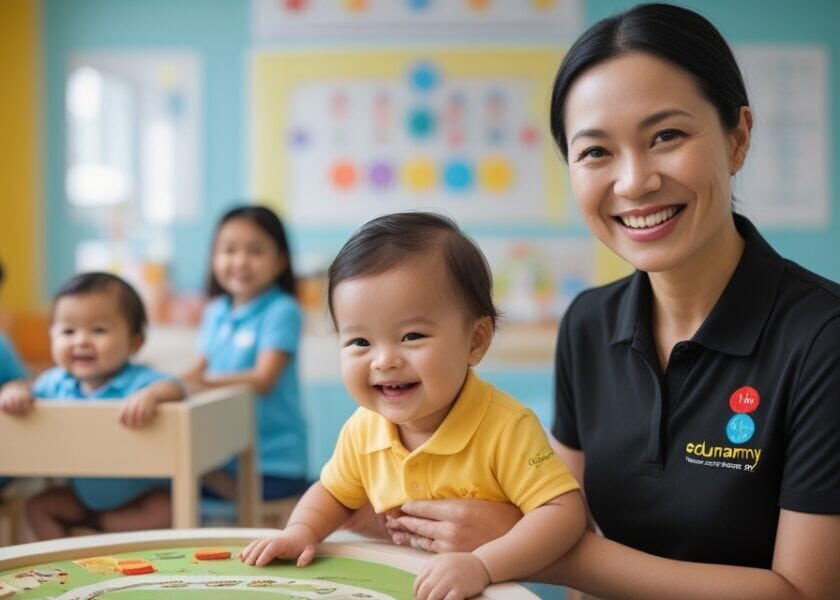
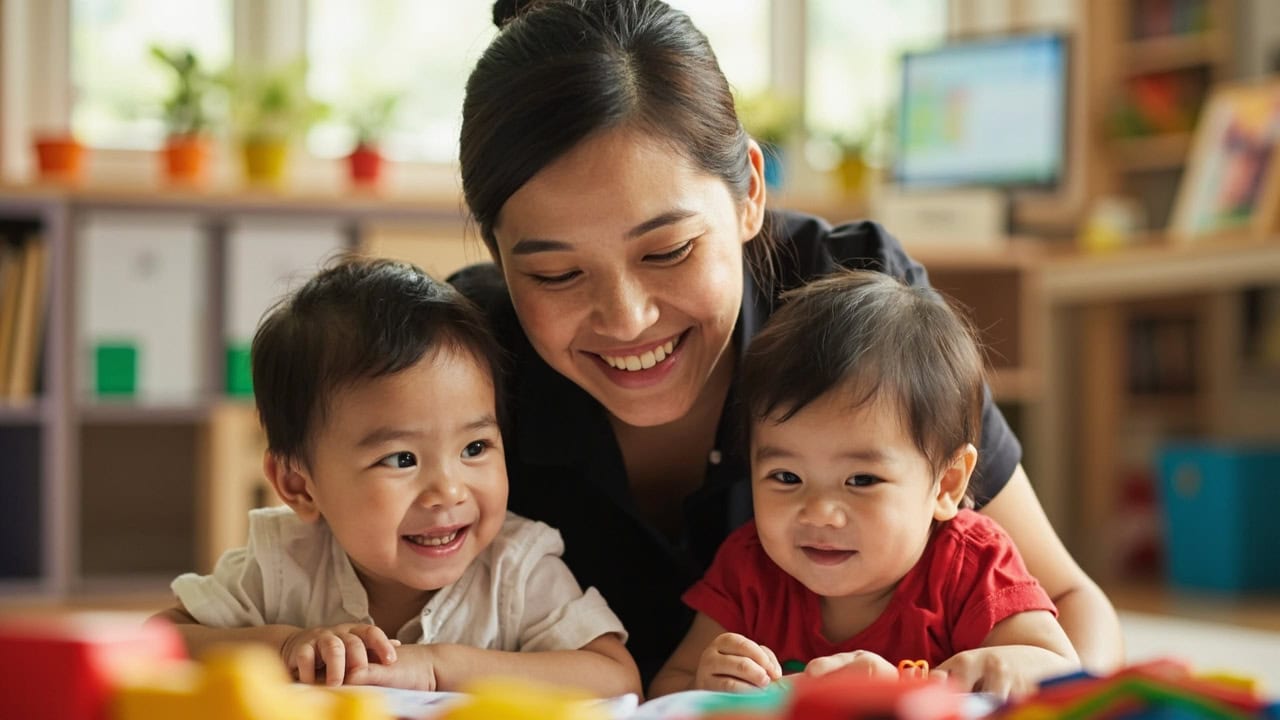
The childminder who welcomes your child into a quality care setting holds your child with professionalism and care. She offers your child the gift of full, attentive, developmentally rich presence—which is exactly what you would want for your child if you could be there yourself.
And critically: she is not a replacement for family. She is an ally in your family’s wellbeing. She holds your child while giving your parents back their role as grandparents.
EduNanny Singapore: Infrastructure for Protecting the Bond
This is where EduNanny enters the picture—not as a replacement for family, but as an infrastructure for preserving it.
EduNanny is built on a premise that is both simple and radical: that the grandparent-grandchild bond is worth protecting, and that protecting it requires intentionality. It requires us to make choices based not on what is cheapest or most convenient, but on what serves the relationship we claim to value most.
Operating as part of the ECDA Childminding Pilot, EduNanny provides quality, accountable, professional childcare that meets the developmental needs of infants and young children while acknowledging the unique cultural context of Singapore families.
What EduNanny offers
- Home-based care: A trained childminder comes to you, offering continuity and comfort in familiar surroundings.
- Centre-based options: Community settings where children benefit from social learning alongside their peers.
- Quality ratios: Up to 1-to-3 for infants, ensuring every child receives the attentive, responsive care that developing brains require.
- Structured care blocks: Monday to Friday schedules that align with the rhythm of working family life.
- Accessible fees: Quality care that is thoughtfully priced for Singapore families.
- CDA and Baby Bonus applicable: Families can direct existing resources toward professional childcare rather than relying solely on grandparent caregiving.
How trust is built
Parents need more than philosophy. Parents need practical trust—confidence that their children are safe, known, and cared for by qualified, attentive professionals.
- Where CCTV measures are deployed, parents have visibility into their child’s day—not because anything is assumed to be wrong, but because modern parents should not have to wonder.
- Communication is ongoing, regular, and meaningful—not just a daily note but a genuine partnership in the child’s development.
- Childminders are trained, vetted, and supported within a structure that prioritizes quality care.
Addressing the Fear Beneath the Decision
I want to take a moment to speak directly to the fear that sits underneath this conversation for many parents.
The fear that choosing professional childcare means you do not trust your parents. The fear that it means you are ungrateful. The fear that it means you are failing your children or your parents or some cultural standard that you have never quite been able to name but feel the weight of every time you make a decision about your child’s care.
That fear is reasonable. And it deserves a gentle answer.
The answer is this: Choosing quality childcare for your child is not a rejection of your parents. It is a declaration of love for them. It is saying:
- I see you. I see what this has cost you. I see that you are tired in ways that are not just physical.
- I see that you became grandparents not to become substitute parents again, but to love a new generation from the vantage point of someone who has already done the hard work of raising children and can now simply enjoy them.
- I want you in my child’s life. I want you there when you are rested, when you are joyful, when you can simply play and laugh and be present without the weight of daily responsibility.
- I want Sunday dinners where you are not too tired to enjoy your grandchildren.
- I want my child to know the grandparent you actually are, not the exhausted version of you that caregiving has sometimes created.
This is not abandonment. This is protection. And it is one of the most loving things you will ever do for the people who have done so much for you.
What Becomes Possible When You Choose Differently
Let me paint a picture of what this looks like in practical, everyday terms.
Imagine a week where, instead of dropping your child at your parents’ flat at 6:30 every morning, you prepare your child for EduNanny—a warm, qualified childminder who welcomes them with attention and care. The mornings are different. The goodbye is not rushed. The child settles into a space designed for their development, with appropriate ratios, with routines that nurture rather than merely supervise.
Your parents wake up that first morning and do not have a child to care for. They have time. Time for exercise, for breakfast eaten slowly, for the grandchildren they will see in the afternoon when energy and joy are plentiful rather than scarce.
By Wednesday, the pattern is becoming familiar. Your mother texts you mid-morning: she went to the park with her friends. She has not done that in months. She sounds lighter. She sounds like herself again.
By Friday, you collect your child from EduNanny and drive to your parents’ flat for dinner. The child runs to grandmother, who sweeps her up with energy and laughter, who plays on the floor, who reads three stories without checking her phone or glancing at the clock.
Your child experiences the grandmother she deserves to know—not the tired woman who was also doing dishes and managing naps and cooking lunch and feeling guilty about being tired.
On weekends, when you have your children home, your parents visit. Or you visit them. The time together is quality—not because you are rationing it, but because it is no longer weighted with obligation. Grandparents and grandchildren play. They laugh. They build the bond that will carry them through the years.
For many Singapore parents, the decision to move away from full-time grandparent childcare is not primarily about the child. It is about the grandparent. It is about looking at their own mother or father and seeing, with painful clarity, someone who has given so much and asked for so little.
Someone who is aging. Someone whose health is not what it was. Someone who deserves, at this stage of life, the freedom to travel, to rest, to enjoy their grandchildren without the responsibility of daily care.
Here is the beautiful, difficult truth: choosing to protect your parents is also choosing to protect the relationship your child will have with them for decades to come.
The grandparent who is not burned out, who is not resentful, who is not quietly suffering under the weight of obligation—this grandparent will be present in your child’s life for years and years. Birthday after birthday. Graduation after graduation. The difficult adolescent years. The challenging teenage transitions. The emergence into adulthood.
This grandparent will be there—rested, joyful, present—because you made a choice today that preserved their capacity to be there.
The alternative is harder to imagine but important to name. The grandparent who is depleted by daily caregiving, who ages faster under the strain, who eventually can no longer keep up—this grandparent may not be there for the years that matter most. Not because they do not want to be. Because the well ran dry.
When we choose quality childcare, we are not choosing between our children and our parents. We are choosing to invest in the relationship between our children and our parents in such a way that all three generations flourish.
Practical Guidance: Making the Choice That Serves Everyone
If you are considering your childcare options, here are some questions worth sitting with:
- Who is actually doing the caring? If it is your parents, ask yourself honestly: are they doing this from a place of joy or obligation? Would they tell you the truth if they were struggling?
- What does the current arrangement cost? Not just money, but energy, health, time, and the quality of the grandparent-grandchild relationship itself.
- What would it mean for your parents to be fully present as grandparents? Imagine them without the weight of daily responsibility. What becomes possible?
- What professional options exist? Explore home-based care, centre-based care, and understand the ratios, training, and support structures that quality providers offer.
- What resources are available to you? CDA funds, Baby Bonus, pilot programmes—these can make quality care more accessible than you might assume.
The goal is not to find the cheapest option or the most convenient one. The goal is to find the arrangement that serves your child’s development, your parents’ wellbeing, and the long-term relationship you all share.
Conclusion: Letting Your Parents Come Home
We raise our children in the context of family because family is where we belong. It is where our identities are formed, where we learn what love looks like, where we inherit the stories and values and ways of being that shape us for our entire lives.
The grandparent-grandchild relationship is one of the oldest and most beautiful of these inheritances—a thread that connects generations, that carries memory and wisdom and the simple, profound truth that we are not alone.
But inheritance requires stewardship. And stewardship sometimes means making hard choices. It means looking at what we have been given and asking: how do I protect this? How do I ensure that what is precious remains precious? How do I make decisions that serve not just today but the decades ahead?
Choosing quality childcare for your infant is not a rejection of family values. It is the fullest expression of them. It says: I believe the grandparent-grandchild bond is so important that I will invest in it. I will build structures that support it. I will create the conditions in which it can flourish.
There is one more photograph I want to leave you with.
It is a photograph I hope you will take someday.
A grandmother and granddaughter, sitting together on a park bench. No rush to be anywhere. No list of tasks. Just two people, present with each other, laughing about something only they understand.
The grandmother’s eyes are bright. Her shoulders are relaxed. She has the kind of energy that comes not from obligation but from joy.
And the child—your child—is held not just in the grandmother’s arms but in the full weight of her attention, her love, her presence. The child is known. The child is cherished. The child is experiencing the grandparent she deserves.
That photograph is not a fantasy. It is not an impossible dream. It is a future that becomes possible the moment we make a choice in its direction.
Grandparents are not backup caregivers. They are your child’s living heritage. And living heritage must be protected—not with guilt, not with obligation, but with the same intentional love that built it in the first place.
Choose well. Choose boldly. And know that in choosing quality childcare, you are not turning away from family.
You are letting your parents come home.
If you would like to learn more about EduNanny and how we support Singapore families, we invite you to visit our website or reach out to us directly. You can also read more about who we are and our commitment to quality, development-oriented childminding.