The First Thousand Days Why Infant Care Matters More Than Enrichment
“`html
The Question Every Singapore Parent Asks
If you are a parent in Singapore, there is a question you have probably already asked yourself — perhaps while scrolling through enrichment brochures at midnight, or during a conversation with another parent at the playground: Is my child ready for school?
It is one of the most charged questions any parent in this country can carry. We ask it with love, with hope, and often with a quiet undercurrent of worry. We imagine primary one classrooms, new environments, the academic demands that will be placed on our children — and we want desperately to know that they will not just cope but truly thrive.
So we do what Singapore parents do best. We research. We compare. We enroll our children in phonics programmes and mathematics enrichment. We visit kindergartens and scrutinize their curricula. We want to feel, by the time our children turn seven, that we have done everything we could.
But here is what most parents have not yet considered — and this is the question worth sitting with:
What if the most important school readiness decision you will ever make is not the enrichment centre you choose when your child is four, but the quality of care your child receives right now — perhaps before they can even speak in full sentences?
What if the foundations of school readiness are not built at five, or four, or even three — but in the daily rhythms of an infant’s life, in the consistency of a warm and responsive caregiver, in the quiet accumulation of trust and curiosity that happens when a child feels truly held?
Understanding School Readiness: It’s Not What You Think
This is not a comfortable idea for many parents. It shifts the timeline. It expands the stakes. It asks us to look at infant care not as a logistics solution but as the earliest, most formative educational environment our children will ever experience.
And yet the developmental evidence is unambiguous. The early years are not simply a warm-up act for the real education to come. They are the stage on which the most critical capacities for learning are being assembled, neuron by neuron, interaction by interaction, day by day.
When educators and developmental psychologists talk about school readiness, they are not primarily talking about whether a child knows their letters or can count to twenty. They are talking about a cluster of capacities that researchers call executive function — the mental skills that allow a child to regulate their attention, manage their impulses, hold information in mind while working on a problem, adapt when plans change, and persist in the face of difficulty.
In short, executive function is what allows a child to be a learner.
What Executive Function Actually Includes
- Attention regulation — the ability to focus on a task even when other things are happening around them
- Impulse control — pausing before acting, waiting when asked, managing immediate wants
- Working memory — holding information in mind while using it to solve a problem
- Cognitive flexibility — adapting when plans change, seeing situations from different angles
- Persistence — continuing to try when something is difficult, tolerating frustration
These are not fixed traits. They are built — through the quality of relationships a child experiences in their earliest years, through the back-and-forth of a caregiver responding to a baby’s coos, a toddler’s frustration, a preschooler’s big emotions.
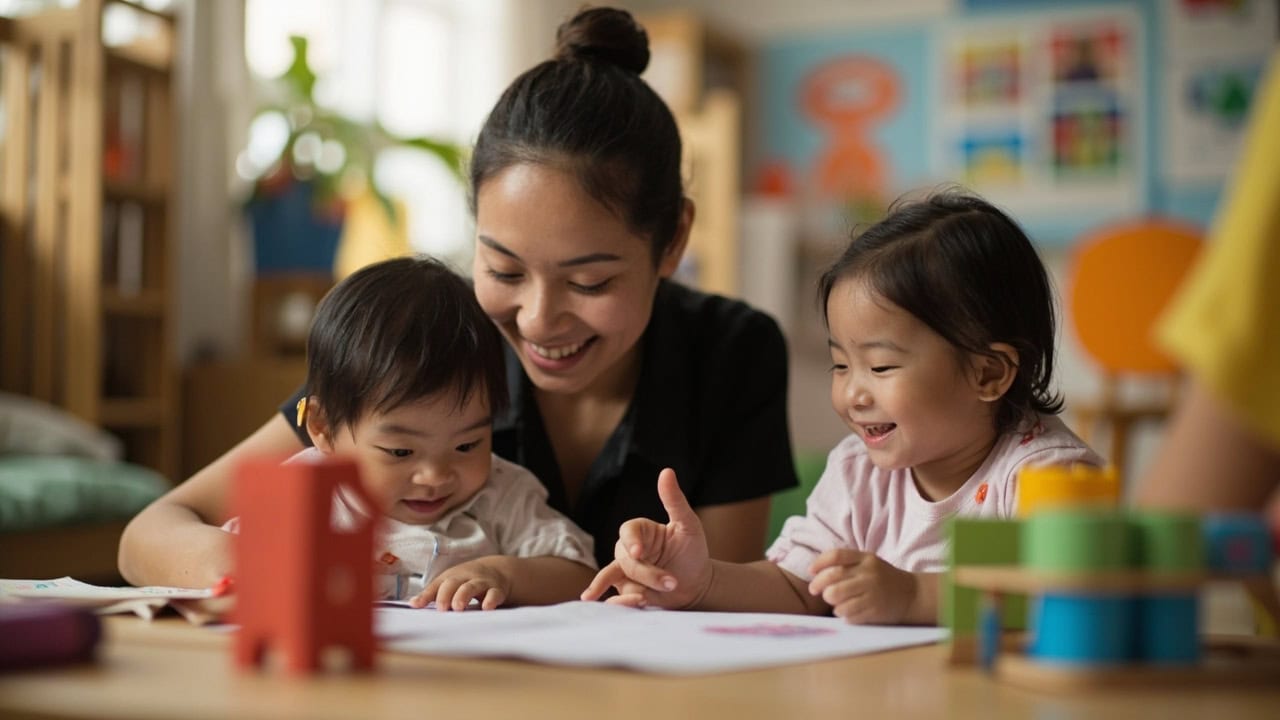
Executive function is not taught through worksheets or flashcards. It is absorbed through hundreds and thousands of small interactions over years of consistent care. A caregiver helping a child name what they are feeling. Teaching them how to wait. Showing them that effort leads to reward. Giving them the security to explore because they know someone reliable is watching over them.
These Micro-Moments Build Neural Architecture
- A baby coos and a caregiver coos back, building the neural circuits for social engagement
- A toddler struggles with a shape-sorter and a caregiver offers just enough help to keep them trying — not so much that the child gives up, not so little that they become frustrated
- A preschooler hits another child in frustration and a caregiver helps them name the feeling, think about the other child’s perspective, and find a better way
- A child is anxious about a new activity and a caregiver offers reassurance, allowing them to take a small risk and discover they can cope
Each of these moments is building something. Every day that your child spends in an environment of consistent, warm, developmentally attuned care is a day when these capacities are either strengthening or weakening.
A child who has learned, in their infant and toddler years, that their needs will be met — that a trusted adult will respond when they call, comfort them when they are upset, and encourage them when they try — that child has internalized something profound: they have learned that the world is a place where effort matters, where persistence leads to results, and where they are capable.
Why the First Thousand Days Shape Primary School Success
We know that Singapore’s education system is demanding. We know that our primary schools place significant cognitive and social demands on young learners. What we sometimes forget is that the children who navigate those demands most successfully are not always the ones who arrived with the most academic preparation.
They are the ones who arrived with the strongest foundations of self-regulation, curiosity, and social confidence.
- They are the children who can sit and attend when instruction begins
- They are the children who can manage the disappointment of getting an answer wrong and try again
- They are the children who can navigate a new social environment, form friendships, and recover from conflict
These are not innate talents. They are learned capacities — and they are learned best in the earliest years, in the context of warm and responsive caregiving.
A child who has internalized these lessons walks into their primary one classroom with something that no amount of academic drilling can replicate: the belief that they are a learner, that they can figure things out, that struggle is not a sign of failure but a normal part of growth.
This is what executive function looks like in practice. It is not the ability to memorize facts. It is the willingness and the capacity to keep trying, to think flexibly, to manage frustration, to engage deeply.
What Quality Infant Care Actually Looks Like
You may be wondering: what does quality infant care look like in practice? How does it differ from adequate care? How do I know if I am making the right choice for my child?
Caregiver-to-Child Ratios
Quality infant care is characterized first and foremost by the ratio of caregivers to children. In the earliest months and years, babies need not just supervision but engagement — the back-and-forth that builds neural pathways, the responsiveness that builds trust, the attention that builds safety.
When a caregiver is responsible for too many children at once, this quality of engagement becomes impossible. The difference between care that builds executive function and care that merely keeps a child safe can often be traced to this single factor: the ratio that allows for genuine, individualized attention.
Consistency of Caregivers
Quality infant care is also characterized by consistency. Infants and toddlers are not abstract learners processing information in a vacuum. They are human beings who form deep attachments and who build their sense of security through predictability.
When a child sees the same trusted faces day after day, when their routines are consistent, when their caregiver knows not just their name but their preferences, their rhythms, their particular ways of expressing joy and distress — that child is building something invaluable.
They are building the neural architecture of trust, which is the foundation upon which all future learning rests.
Developmental Intentionality
Quality infant care is characterized by intentionality. It is not accidental. It is not simply a matter of having kind people in a room with children. It is a purposeful approach to early development — one that understands:
- How language is acquired through rich conversation
- How persistence is built through supported challenge
- How social confidence grows through guided peer interaction
- How emotional regulation develops through consistent, empathic responses
The best infant care environments are microcosms of the kinds of experiences that build executive function — not by accident but by design.
What to Look For When Evaluating Childcare
- Observe interactions, not just environments. A beautiful room means less than a caregiver who is genuinely engaged with the children in it. Watch how caregivers respond to children’s cues.
- Ask about consistency. Will your child have a primary caregiver who stays with them over months and years? Or will they be passed between different faces?
- Understand the ratios. Ask specifically: How many children is each caregiver responsible for? Can they maintain responsive engagement at those ratios?
- Look for intentionality. Is there a documented approach to language development, social-emotional learning, and developmental support? Or is the philosophy simply “we keep children safe and happy”?
- Trust your instincts. If something feels off during a visit, take it seriously. You know your child best.
How EduNanny Singapore Supports Your Child’s Foundations
EduNanny by BUTLER is part of an ECDA Childminding Pilot, and this matters. We are not simply another childcare option. We are operating within a framework designed to raise the standards of infant and childminding care in Singapore, and to make quality care accessible to families across the country.
Our Approach
We offer home-based and community-based pathways, recognizing that every family has different needs and different contexts. Whether your child is cared for in a home setting that feels familiar and personal, or in a centre-based environment with small group sizes and structured learning opportunities, the principles of quality remain the same: consistent warm care, responsive caregivers, and developmentally intentional environments.
Our Ratios
Our infant ratios are up to one to three, and never more than one to four. This is designed to ensure that every child receives the individualized attention that builds executive function and school readiness. This is not a marketing claim. It is a structural commitment that reflects our belief that quality cannot be achieved without the conditions that make it possible.
Our Accessibility
Because we are part of an ECDA pilot, our fee structures are designed to be affordable and accessible. For families using CDA and Baby Bonus funding, these payments apply directly, making premium-quality infant care a realistic option for parents across the income spectrum.
We believe that the foundations of school readiness should not be the exclusive province of families who can afford the most expensive options. Every child deserves a start that sets them up for success.
Our Transparency
We understand that for Singapore parents, trust is not an abstract concept. You are entrusting your child — your most precious, irreplaceable responsibility — to someone else.
We take that responsibility seriously. For families who wish, CCTV measures are available to provide additional reassurance. Our caregivers are trained, vetted, and supported. We believe that the relationship between a family and their child’s caregiver should be a partnership, not a handoff.
Thomas AI Chatbot
We also offer Thomas AI Chatbot, a supportive tool designed to make parenting and childminding easier. Raising a young child is demanding under the best of circumstances. For parents navigating work, family, and the complex decisions that come with early parenthood, having a resource that answers questions, offers guidance, and connects you to support can make a meaningful difference.
The Choice That Builds Your Child’s Future
If you are a parent in Singapore, you are likely making choices right now that feel overwhelming. The childcare landscape is crowded. The options are varied. Everyone has a pitch, a promise, a different philosophy. It can feel impossible to know what truly matters.
Here is what we want you to take away from this conversation.
The decision about who will care for your child in their earliest years is not a logistical decision. It is a developmental one. It is not just about where your child will be while you are at work. It is about who will be building the executive functions, the emotional resilience, the social confidence, and the love of learning that will carry your child through primary school, secondary school, and beyond.
This does not mean that choosing EduNanny is the only right choice. It means that choosing wisely — with attention to quality, consistency, caregiver ratios, and developmental intentionality — is one of the most consequential decisions you will make as a parent.
We understand the weight of what you are entrusting to us. We are not just a service. We are a partner in your child’s development.
Every conversation we have with a parent. Every interaction our caregivers have with a child. Every routine we build into our day. All of it is oriented toward a single goal: giving your child the foundations they need to walk into their first classroom not just prepared, but curious, confident, and ready to learn.
Because it is in being seen that a child learns they are worthy of attention. It is in being responded to that a child learns their actions matter. It is in being cared for consistently that a child learns to trust the world enough to take risks — to try, to fail, to try again, to learn.
Your child’s future as a learner is not waiting to be purchased at a kindergarten or an enrichment centre. It is being built right now, in the quality of care they receive today.
When you think about school readiness, think about the first thousand days. Not as a period to simply get through, but as an opportunity to build something extraordinary.
To learn more about how EduNanny Singapore supports your child’s school readiness foundations, we invite you to connect with our team or learn more about our approach.
“`