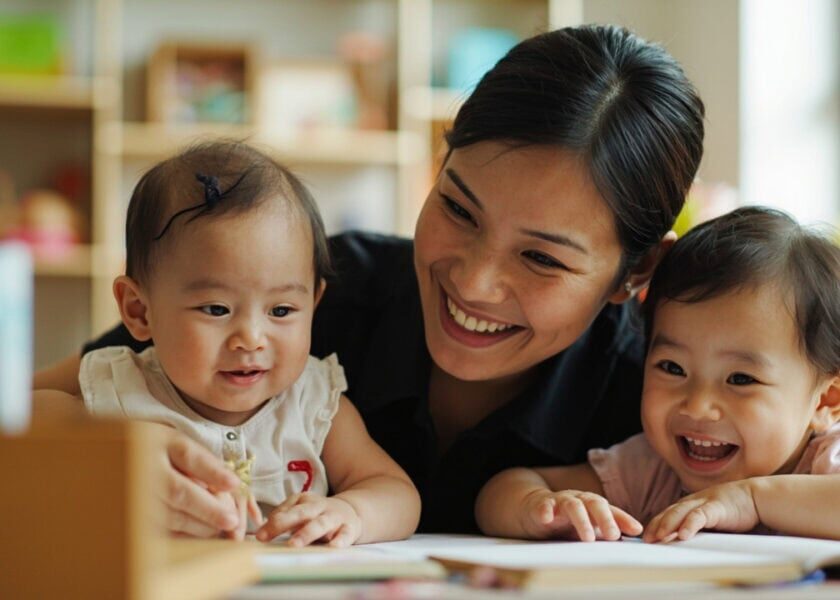
The Daily Moment That Shapes Your Child’s Emotional Future
The Moment at the Door: What Is Really Beginning When You Drop Your Child at Childcare
There is a moment, quiet and unremarkable to most observers, that happens every morning in childcare settings across Singapore. A small hand loosens, reluctantly, from a parent’s finger. A face turns toward the door that just closed. For a breath or two, the child is still — not yet sure what the next moment holds.
And in that pause, before the day has properly begun, something of enormous consequence is already taking place.
What happens next is not supervision. It is not daycare in the way that word gets used to describe a service parents grudgingly accept because the alternative is impossible. What happens next, in a setting where the conditions are right, is the quiet, daily construction of your child’s inner emotional world. It is the laying of foundations so deep and so fundamental that most parents will never see them, never be told about them in any way that captures what they actually mean, and yet will spend years marvelling at the results without fully understanding why their child grew into someone who trusts, who connects, who explores, who recovers from disappointment, who reaches for other people.
This is the story that quality childcare is building, brick by invisible brick, in the hours you are not there.
What Your Child Actually Needs to Feel Safe Enough to Grow
To understand what quality childcare gives your child, you first have to understand what a young child actually needs in order to feel safe enough to grow. Not safe in the physical sense alone — though that matters — but safe in a way that is deeper, harder to measure, and far more consequential.
The safety a child needs is the felt sense that:
- The world is predictable
- The people around them will respond when they signal distress
- The rhythm of the day has a shape they can rely on
- When something goes wrong, someone will be there who truly notices
This is not an abstract idea. It is a biological requirement.
The Building of a Brain’s Operating System
In the early years, your child’s brain is building its operating system — the circuits that will govern how they experience emotion, how they relate to others, how they handle stress, and how capable they feel of engaging with a complex world. That construction happens not in a vacuum but in relationship.
Your child’s brain reads the environment constantly. It reads faces, tones of voice, the pace of movement, the consistency of responses. And from all of that reading, it draws conclusions — conclusions the child will carry forward long before they have the language to articulate them.
In a consistent, attuned environment — one where a caregiver notices your child’s hunger cues before the cry escalates, where a caregiver names your child’s frustration with calm accuracy — something remarkable happens. The child’s brain learns that its signals matter. That reaching out produces a response. That the world is, by and large, a place where reaching out is worth the risk.
This is not a small thing. This is the beginning of everything we later call confidence, curiosity, resilience, and the capacity for genuine connection.
The Conditions That Make This Possible
Emotional attunement — the quality of being genuinely present with a child’s emotional experience — requires specific conditions to exist consistently. It is not enough to want to provide it. The environment must allow for it.
Why Ratio Matters for Your Infant
In home-based settings with a caregiver-to-child ratio as attentive as one to three for infant care, the conditions for genuine attuned responsiveness become genuinely possible. Your child is not one of fifteen. Your child is one of one, or two, or three.
In that intimacy, the architecture of trust takes hold in a way that large group settings, however well-resourced, find difficult to replicate.
But the ratio is a structural condition — necessary but not sufficient. What actually builds trust is not the number alone but the quality of presence within that number. A caregiver who is physically present but emotionally elsewhere does not give a child what they need. A caregiver who is distracted, rushed, or operating on a checklist of tasks will not produce the felt safety we are describing.
What your child requires — and what quality care is designed to provide — is a caregiver who is genuinely there. Not supervising. Not managing. Present.
This is a high standard, and it is why the conversation about childcare cannot begin with fee structures or operating hours, however important those practicalities are. It has to begin with what is actually happening inside your child during those hours, because that is what determines whether the hours are well spent or simply survived.
When Your Child Feels Safe: The Extraordinary Becomes Possible
When a child feels safe — truly safe, in the way we have been describing — something extraordinary becomes possible. The child begins to look outward.
They begin to read the room, not in the figurative adult sense but in the literal developmental sense. They watch the caregiver’s face when a new object appears. They notice how the caregiver responds to another child’s tears. They begin to map the emotional landscape around them with a precision that most adults would find humbling.
The Development of Emotional Intelligence
This is emotional attunement — not as a technique applied by caregivers but as a skill developing in the child. And it develops because the child has first experienced attunement themselves.
A child who has been accurately mirrored — who has had their internal states reflected back to them with understanding rather than dismissal, distraction, or overreaction — develops the capacity to do the same for others.
They begin to recognize that other people have internal states. That other children cry for reasons that make sense. That a caregiver’s tone shifts when the noise level rises. That different emotions belong to different moments.
This is the beginning of empathy. Not the taught version, not the one that comes from being told to share, but the felt version — the one that comes from having been genuinely understood first, and therefore having a reference point from which to understand others.
Navigating Peers: The Raw Material of Social Development
In quality childcare, in an environment where the caregiver is attuned and the group is small, children also begin to navigate something enormously important: the presence of peers. They learn, sometimes in real time and with genuine difficulty, that other children want things too.
That sharing is not instinctive. That waiting is hard. These are not problems to be eliminated. They are the raw material of social-emotional development, and they are best met in a setting with enough attention to go around — a setting where a caregiver can intervene with language and calm guidance rather than simply managing a conflict.
What You Cannot See at Pickup: Transparency and Trust
There is a question that sits underneath much of what we have been exploring, and it is one that deserves a direct answer. How do you know whether this is actually happening? You cannot see inside your child’s inner world during the hours you are apart.
You can watch what happens at pickup — and parents are remarkably observant of those small signals, the ones that tell them whether their child had a good day or a hard one. But the deeper construction, the building of trust architecture, the growth of emotional vocabulary, the strengthening of the circuits that will govern self-regulation for the rest of your child’s life — none of that is visible at pickup. Much of it will not be visible for years.
This is precisely why transparency matters so much. It is not a nice-to-have feature of a childcare service. It is the thing that allows a parent’s natural, reasonable need for assurance to coexist with the reality that the most important work is happening out of sight.
When quality childcare implements communication measures — including transparency tools such as CCTV in applicable settings — it is not about surveillance. It is about bridging a gap that no parent should be expected to simply accept without support. You deserve to know not just that your child is safe, but what the quality of their day looked like. What they explored. How they engaged. What seemed to delight them and what frustrated them.
The Partnership Between Home and Care
This kind of communication does more than reassure parents. It actually strengthens the partnership between home and the childcare setting in a way that benefits your child enormously.
When a caregiver and a parent share observations about a child’s emotional states, social preferences, and developing capacities, they create a consistent emotional environment across both settings. Your child does not have to compartmentalize, to behave one way at home and another at childcare. The adults around them are reading from the same page.
That consistency, that coherence, is itself a source of felt safety for the child.
The Long View: What Your Child Is Building Today and Why It Matters
When a child spends their early years in an environment of consistent attunement — where their internal states are noticed, named, and met with thoughtful responses — they build something inside themselves that has no visible form and yet shapes everything.
They build:
- Confidence to explore because the exploration feels safe
- Emotional vocabulary to say “I am angry” instead of hitting, because someone once said it for them and it was received with understanding
- Trust that reaching out will not always result in disappointment
- The quiet, foundational knowledge that they are held — not just physically, but in the deeper sense of being genuinely attended to
These are not small achievements. They are not the things that show up on a report card. But they are the things that determine:
- Whether your child walks into their first Primary One classroom with curiosity or with fear
- Whether they can navigate the social complexity of a new school with resilience or with anxiety
- Whether they can recover from the ordinary setbacks of childhood — a friendship that ended, a mistake that was noticed, a disappointment that felt enormous in the moment — or whether those setbacks calcify into something more lasting
The child your infant is today is building the person your teenager will become. Not through worksheets or academic drills, which belong to a different and later stage of development, but through the quality of the emotional experiences they are having right now, in the years before they can articulate what those experiences are teaching them.
Choosing Quality Infant Care in Singapore: What to Look For
If you are researching childcare options, here are the questions that actually matter:
Questions to Ask a Potential Provider
- What is the caregiver-to-child ratio, especially for infants?
- How do caregivers respond when a child signals distress?
- What does communication with parents look like on a typical day?
- How would you describe your approach to a child’s emotional experience?
- How do you handle conflict between children?
- What does a typical day’s rhythm look like for toddlers and infants?
What Quality Care Looks Like in Practice
- Warm, unhurried interactions between caregivers and children, not just when parents are watching
- Children who appear comfortable rather than merely quiet — comfort means exploration is possible
- Caregivers who name emotions and describe what they observe in children, not just what children do
- A predictable rhythm to the day that children can anticipate
- Communication that goes beyond “everything was fine”
Red Flags to Notice
- Caregivers who seem task-focused rather than child-focused
- Children who appear watched but not engaged with
- Resistance to questions about emotional development approach
- Ratios that make attuned attention structurally impossible
Is Quality Care Accessible?
Quality should not be reserved for families who can afford premium pricing. Through frameworks like the ECDA Childminding Pilot, thoughtful ratios, intentional caregiver selection, and structured training are available without the premium cost tags. Support mechanisms like the Child Development Account and Baby Bonus can be used, and fee structures are designed to be affordable within the pilot framework.
The Moment at the Door, Revisited
Let us return, one last time, to that moment. The one at the door. The small hand loosening its grip. The face turning away.
What is actually beginning is this: a day in which your child will learn, in ways you will not see and may not hear about in any detail that captures its true significance, that the world is a place where they can be known.
Where their feelings make sense.
Where someone is paying attention.
Where their reaching out is met with reaching back.
This is what quality childcare exists to provide. Not just care. Not just supervision. An environment built with the full understanding that what happens inside a child in these early years is the most important thing that will ever happen to them — and that it deserves to happen in the presence of people who take that seriously.
People who bring intention, skill, warmth, and the kind of steady, genuine presence that tells a child, every single day, without words: you are safe here, you are held here, and the person you are becoming matters.
That is not a small promise. And we believe that every parent in Singapore deserves to find a place that makes it and means it.
EduNanny Singapore is committed to thoughtful, development-oriented childcare that takes the early years seriously. Through our participation in the ECDA Childminding Pilot, we offer families in Singapore access to quality childminding pathways built around your child’s developmental needs. Reach out to our team to learn more about what quality care looks like in practice.