The Architecture of Who Your Child Is Becoming
The Question No Brochure Can Answer
You already know something about the weight of choosing childcare in Singapore. The research, the visits, the spreadsheets. The sleepless worry about whether the place you choose will truly see your child.
Not see them the way a facility sees a headcount, but see them the way a parent does. See their moods and their fears and the particular way they light up when they discover something new.
You are not looking for a holding pen. You are looking for an environment that understands what it is shaping. Because every childcare environment is shaping your child—whether consciously or not, whether well or poorly. The rhythms and relationships of those early years are writing something into your child’s character. They are building the architecture of who this person will become.
The question is not whether your child’s character is being formed. It is whether it is being formed with intention.
What Singapore Parents Are Really Asking
In conversations with parents across Singapore, the same underlying anxiety surfaces again and again. They want to know: will my child be okay? Not academically—they know that will come. But at a deeper level. Will they grow up feeling secure? Will they be someone who can handle disappointment? Will they be kind? Will they believe they are capable?
These are the questions that matter most. And they are the questions that quality childcare can answer—not through lessons or curriculum, but through the daily, patient work of relationship.
What Quality Childcare Builds in Your Child
Research and experience consistently show that the early years are shaping five foundational qualities. These are not soft outcomes. They are the character dispositions that predict long-term wellbeing, relationship quality, and the capacity to persist through life’s inevitable challenges.
Curiosity: The First Great Gift of Childhood
Every child arrives in the world with curiosity burning inside them. They reach for every object, taste every surface, ask about every shadow. But curiosity is not simply born. It is cultivated. It either grows stronger in the presence of an environment that honors it, or it slowly dims in the face of one that does not.
Curiosity requires a child to feel safe enough to not know. It requires time and space to wander, to wonder, to follow a thought down a path that leads nowhere productive and find that nowhere productive is still somewhere worth being. It requires adults who do not rush to answer, who wait, who let the question breathe before offering the solution.
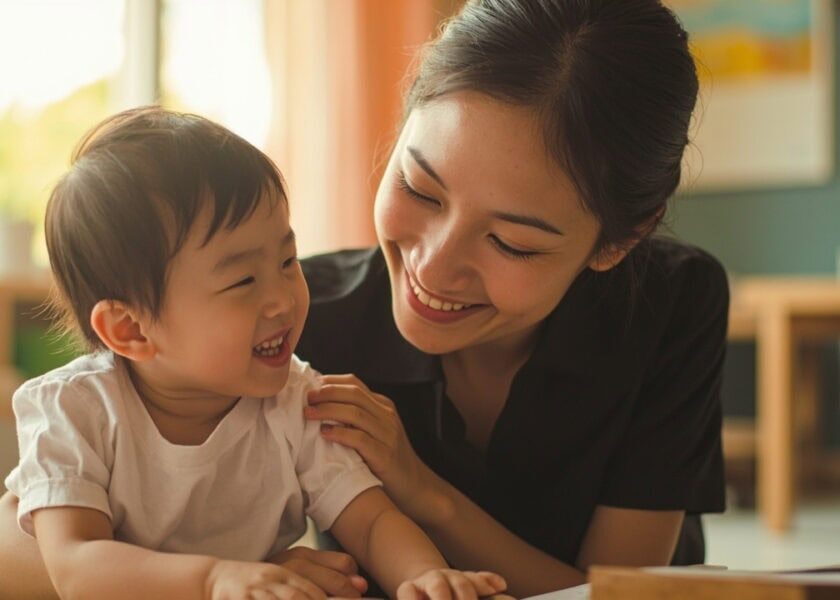
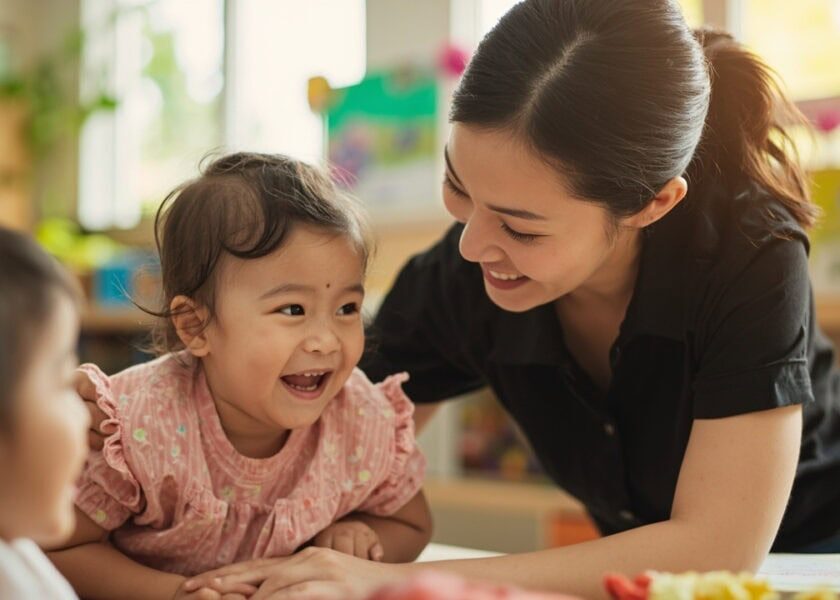
What this looks like: A toddler is fascinated by how an ant carries a crumb. The caregiver does not redirect to the scheduled activity. She sits nearby, attentive but unhurried, allowing the discovery to unfold. A child asks why the sky is blue. The caregiver responds with a question of her own: “What do you think?” This is not avoidance. It is an invitation to stay in the wonder a moment longer.
In a childcare environment where ratios allow for this kind of unhurried attention, curiosity takes root. It becomes a disposition—a way of being in the world that says: I am not afraid of what I do not know. I believe there is more to discover.
Resilience: What Remains After the Struggle Has Passed
Resilience is so often misunderstood. We speak of it as though it were a shield, something that protects a child from difficulty. But resilience is not the absence of struggle.
Resilience is what remains after the struggle has passed and the child is still standing. It is the inner knowledge that comes from having been comforted, having survived a fall, having been met with patience when the world felt too large.
A child builds resilience not through adversity alone, but through the knowledge that someone is with them in it. In quality childcare, this happens a thousand times a day in small ways:
- A toddler falls and looks up to find a familiar face that does not rush in to rescue or scold, but simply acknowledges the hurt and offers a steady presence
- A child struggles with a puzzle and grows frustrated. A caregiver sits beside them, not solving it for them, but naming the frustration honestly: “This is hard, and you are working through it.”
- A baby cries and is held, not to be silenced, but to be heard
These moments do not make the news or earn special recognition. But they are the building blocks of a child who will one day face disappointment, and setback, and the ordinary cruelties of growing up, and will know in their bones that they are not alone.
Resilience is not something you teach in a lesson. It is something you build in a relationship.
Empathy: The Most Quietly Radical Quality
Empathy begins—as so many things do—with being the object of it. A child who is seen, who is responded to with sensitivity and care, who has their cries met with comfort and their joy met with shared attention, begins to understand that other people have inner lives too.
But empathy does not grow in isolation. In childcare, children encounter peers daily. They learn that other children have needs, desires, fears, and joys. They negotiate over toys and discover that words can resolve conflict better than pushing. They experience what it feels like to be on both sides of kindness: the giver and the recipient.
This is where environment quality becomes so important. In a crowded room with too many children and too few attentive eyes, empathy is missed—or worse, punished. The child who pushes is scolded rather than guided toward understanding. The child who shares is overlooked rather than celebrated.
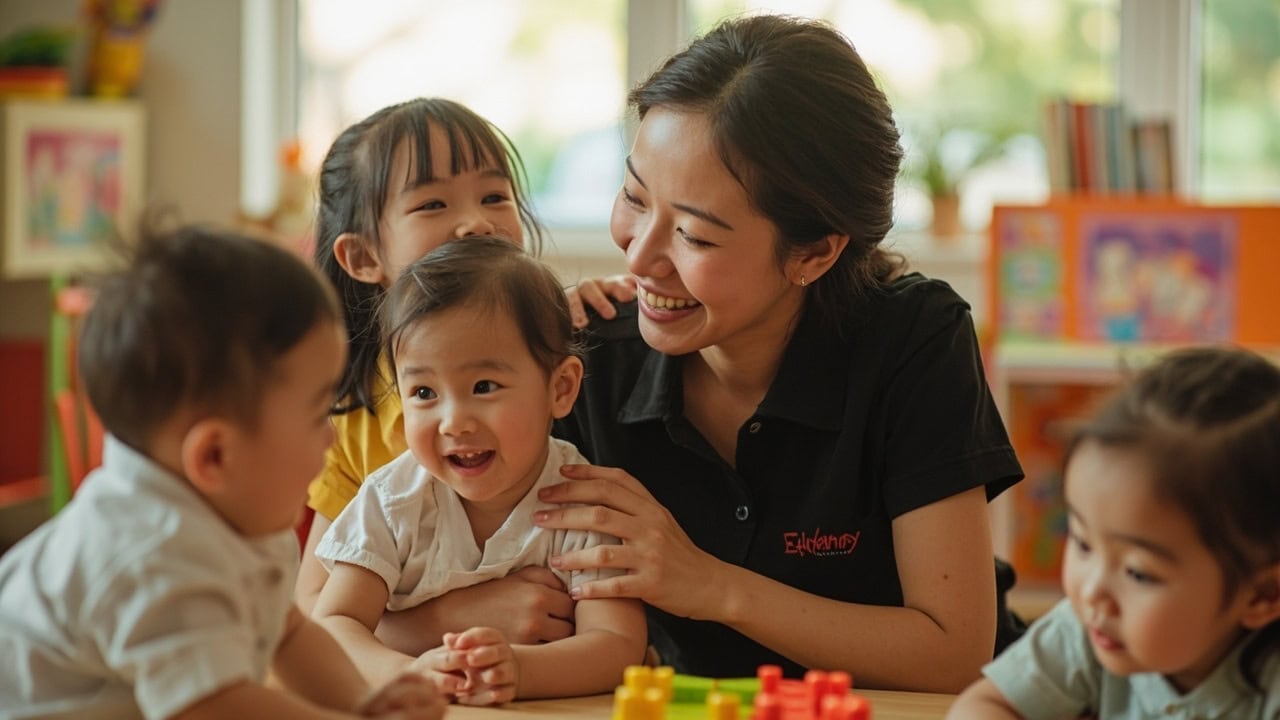
In an environment where caregivers can truly see, where ratios allow for observation and gentle guidance, empathy has room to flourish. Children learn to read others not because they were told to, but because they were given the space and the modeling to develop this most human of capacities.
Confidence: The Quiet Knowledge of Capability
Confidence is not arrogance. It is not the absence of doubt or the performance of certainty. True confidence is the quiet knowledge that you are capable, that you are worthy of attention and care, that the world is a place you can navigate.
This confidence is built, stone by stone, in the accumulation of small experiences where a child discovers their own competence:
- I can pour water from one cup to another without spilling
- I can climb that ladder, though it is high
- I can tell the caregiver that I am hungry, and she will bring me food
- I can ask for help, and help will come
The environment that produces this confidence is one where the caregiver knows the child, where she has been present enough to read their signals, responsive enough to meet their needs, and patient enough to let them try before stepping in to help. This is about calibrated trust—knowing when to step back and when to step in. Understanding that confidence is built not by doing everything for a child, nor by abandoning them to figure it out alone, but by being present, attuned, and willing to follow the child’s lead.
Security: The Quiet Foundation
Security is the quiet foundation that makes all other growth possible. It is the thread that runs through curiosity, resilience, empathy, and confidence. A child who feels secure can afford to be curious. A child who feels secure can weather frustration. A child who feels secure can reach out to others and trust that they will be reached back.
When children are comforted consistently, they internalize the knowledge that the world is a place where they can take risks, ask questions, try again, and belong.
Why Character Matters More Than Content
You may have noticed something in the qualities we have explored: none of it is about academics. None of it is about school readiness in the conventional sense. There are no flashcards in the vision we have painted, no drilling of letters or numbers.
And this is not an oversight. The early years are not primarily about preparation for what comes next. They are about the formation of who your child is right now. The cognitive capacities will develop. The academic skills will come. But what will determine whether your child approaches learning with joy or anxiety, whether they persist through difficulty or collapse under it—whether they become a person of integrity and warmth or someone who has succeeded in the world but lost themselves along the way—these are the questions that the early years are quietly answering.
Character is the vessel that holds everything else. A curious, resilient, empathetic, confident child will learn. They will adapt. They will become whatever the world requires of them, not because they were trained to perform, but because they were shaped into someone capable of growing.
The Qualities That Predict Long-Term Flourishing
Research into human development consistently identifies the same core traits as predictors of long-term wellbeing—not academic achievements, but character dispositions:
- The ability to regulate emotion
- The capacity to persist
- The willingness to try again after failure
- The sense that one is worthy of love and capable of giving it
These are what we are building when we build with intention in the early years.
What Quality Childminding Looks Like in Practice
For families navigating childcare options in Singapore, the abstract qualities we have discussed need to become concrete. What does quality actually look like on a Tuesday morning? What should you be watching for when you visit a centre or meet a childminder?
Signs of a Quality Environment
Caregiver-Child Interaction
- Caregivers get down to the child’s level when speaking with them
- Responses to children’s needs are warm and timely
- Caregivers narrate what they observe rather than constantly directing
- There is unhurried time—not constant rushing from activity to activity
Physical Environment
- Children are engaged in meaningful play, not passively entertained
- Materials are accessible to children, not locked away
- The space feels calm, not chaotic
- Outdoor or active play is part of the daily rhythm
Ratio and Attention
- Caregivers know each child’s preferences, routines, and cues
- Infants and toddlers receive individual attention throughout the day
- Caregivers are not so outnumbered that they can only manage safety, not development
Communication with Families
- Updates are regular and substantive, not just “they had a good day”
- Caregivers share observations and milestones
- Parents feel comfortable asking questions
The EduNanny Difference
For families in Singapore seeking an environment where these character qualities can genuinely flourish, the question becomes: what makes one childcare arrangement different from another? The answer is not found in curriculum or branding. It is found in structure—the structural conditions that either allow or prevent the quality of care we have been describing.
EduNanny operates within the ECDA Childminding Pilot, and this matters. The Childminding Pilot represents a recognition, at the policy level, that families need more than one pathway to quality care. It offers both home-based arrangements and community or centre-based options that provide flexibility without sacrificing the quality of attention.
The Structural Precondition: Ratios That Allow Real Connection
EduNanny maintains infant ratios of up to one caregiver to three children. This is not a marketing point. It is the structural precondition for everything we have discussed in this article.
When a caregiver can give real attention, your child receives real attention. When a caregiver must divide herself among too many, all children receive less. Human connection requires the time and space to develop, and that space must be structurally provided.
Transparency and Partnership
EduNanny is committed to transparency because parents cannot have peace of mind without it. Where CCTV measures are deployed, families have the ability to see into the environment where their child spends the most important hours of their day.
Communication is not a once-a-month update but an ongoing practice. Parents deserve to know what their child is experiencing—what they are discovering, what they are struggling with and triumphing over. This is not about surveillance or micromanagement. It is about recognizing that parents and caregivers are on the same side, working toward the same goal: the flourishing of this child.
Financial Accessibility
Quality care should not be determined by the size of your paycheck. EduNanny integrates with the tools Singapore provides: Child Development Accounts can be used, and Baby Bonus benefits apply. Monday to Friday care blocks offer the reliable rhythm that working families need.
Addressing the Concerns Parents Actually Have
“Will my child feel secure away from me?”
This is often the first and deepest concern. The answer lies in the caregiver relationship. A child does not need their parent to be the only source of security—they need a source of consistent, responsive, warm care. When caregivers are attuned and present, children develop what attachment researchers call “secondary attachment”—the ability to feel secure with multiple trusted adults. This is healthy development, not a betrayal of the parent-child bond.
“How do I know what is really happening when I’m not there?”
Ask about communication practices. Ask whether there are ways to see into the environment. Ask for regular updates that go beyond “napped well, ate lunch.” The best childcare providers welcome these questions because they know that parent-provider trust is essential to a child’s wellbeing.
“The costs feel overwhelming. Is this really worth it?”
Childcare costs are real, and Singapore families deserve support in managing them. Explore the Baby Bonus, CDA, and subsidy schemes available. The question is not just whether you can afford quality care, but whether you can afford not to invest in the years that will shape your child’s approach to learning, relationships, and life itself.
“My child seems so young for this to matter.”
The early years are not a waiting room before the real work begins. They are the real work. The neural architecture for emotional regulation, stress response, and social connection is being built right now. The dispositions your child is forming now will influence every chapter of their lives.
The Long View of Childhood
Children remember how they were made to feel.
They may not remember the specific activities or the songs or the routine of the day. But they will carry in their bodies, in their nervous systems, in the architecture of their relationships, the imprint of how it felt to be in the world during those earliest years.
Did it feel safe? Did it feel curious? Did it feel like the people around them were trustworthy and kind? Did it feel like they were capable of trying and failing and trying again?
We do not get to choose everything that shapes our children. Life is too various and too unpredictable for that. But we do get to choose the environments we place them in, and we do get to choose the people who will walk alongside them during the most formative years of their lives.
Your child is becoming someone. Someone curious, perhaps, and resilient, and kind, and confident. Someone who will face a world we cannot fully imagine and meet it with the strengths you are helping to build right now, in these very years, in these very choices.
If you are exploring childcare options in Singapore and want to understand how EduNanny can support your child’s character development—not just their supervision—during these crucial early years, we invite you to reach out to learn more.
Every family deserves to have peace of mind. Every child deserves to be seen. And every parent deserves a partner who understands that who your child is becoming matters more than anything else.
Learn more about EduNanny and how we walk this journey with families across Singapore.
Explore more about who we are and the standards we hold ourselves to.