The Cultural Question Every Singapore Parent Asks About Childcare
The Question That Keeps Parents Up at Night
There is a moment I want you to imagine. It is late afternoon. Your child has been in care since morning, and you are finishing a work call or preparing dinner when they come through the door.
Without prompting, without any sign it was coming, they say something. A phrase in your mother’s language. A song from a festival your grandmother used to celebrate. A word for a dish on the table that you did not teach them this week — maybe not even this month.
And in that moment, something inside you unclenches. Not because you doubted your child was capable. But because you realized, suddenly and completely, that the care you chose did not take something from your family. It gave something back.
That moment is not imaginary. For many Singapore parents, it is the moment that finally answers a question they have been carrying for months, sometimes years. A question they rarely say aloud because it sounds almost too specific to be real, too personal to bring up at playdates or in parenting forums.
Will my child still know where they come from?
This is the quiet fear beneath the practical questions about childcare in Singapore. It is not about safety, or stimulation, or whether the teachers are qualified. Those questions matter, and they deserve serious answers. But underneath them is a deeper one — one that keeps parents awake not because they chose to work, but because they wonder what their choice might cost.
Raising children in Singapore is an act of cultural navigation that no previous generation of parents had to do quite this way. We are raising bilingual children in a country where three major languages and countless family traditions interweave. We are raising children who will move between cultural worlds — the one their grandparents built with sacrifice and memory, the one their parents are building with ambition and adaptation, and the one they will build themselves with choices we cannot yet imagine.
Most of us did not set out to become cultural negotiators when we became parents. We set out to love our children, to keep them safe, to give them opportunities we may or may not have had ourselves. But somewhere between the first pediatrician visit and the first week of childcare, a new anxiety crept in.
When I am not with my child for eight, nine, sometimes ten hours a day, who is shaping the person they are becoming? And does that person still know who they are?
This fear is remarkably consistent across communities in Singapore. It is there in Chinese families who worry their children will answer them only in English. It is there in Malay families who want their children to feel the warmth of communal traditions, the language of intimate affection. It is there in Indian families across all the beautiful diversity of heritage and faith, hoping their children will know not just the festivals but the meaning behind them. And it is there in mixed-heritage families who are navigating multiple inheritances, sometimes without a roadmap.
The fear looks different in each home, but it has the same root: that choosing to return to work, or simply needing support, might cost your child something you cannot afford to lose.
Cultural Inheritance Is Not Passive
Here is a truth that does not get said enough in conversations about early childhood care: cultural identity is not automatic. Understanding this — truly understanding it — can set you free from a lot of worry, and help you make a much better choice.
Heritage is often thought of as something that just happens. As if exposure is enough. As if living in a multicultural country means your child will absorb their heritage naturally, the way they absorb language from television or manners from strangers. But families who have navigated this path know a different story.
Heritage is not passively received. It is actively transmitted.
And in the earliest years, when your child’s sense of self is being formed with extraordinary speed, the difference between a childcare arrangement that honors your family’s culture and one that simply coexists with it is not a small one.
The First Thousand Days
In the first thousand days of life — from conception to roughly age three — your child’s brain is building the architecture for everything that comes after. Language pathways are being carved. Emotional associations are being formed. The question of who they are, where they belong, what feels like home — these are not abstract concepts being stored for later. They are neural connections being laid down right now, in every interaction, in every song sung over them, in every phrase heard repeated with love.
This is why cultural intelligence in childcare is not a nice-to-have. It is a fundamental aspect of whether care is truly supporting your child’s whole development — not just their cognitive scores, not just their motor skills, but the person they are growing into.
Language as Living Inheritance
Consider what research and family experience both tell us about language. A child who hears their mother tongue only at home, and only for a handful of hours each day, may develop it as a second language with limited fluency. A child who hears it in care — who hears it from caregivers who speak it with warmth and correctness, who are celebrated for knowing it, who are read to and sung to in that language — that child carries something different. They carry a living inheritance, not a fading one.
The same principle applies to everything cultural. The way children learn that respect for elders is not just a word but a practice, demonstrated in small courtesies and gestures. How they learn that family is not a nuclear unit alone but an extended network of belonging. How they learn that celebration is communal, that food carries memory, that festivals are not just holidays from school but meanings worth understanding.
These are things that can be woven into the fabric of daily caregiving — or they can be absent from it, leaving a child to piece together their cultural self later, sometimes with gaps they cannot fully explain.
Tolerance vs. Nurturance in Daily Care
Most childcare conversations in Singapore focus on the right questions: Is the care safe? Is it stimulating? Are the caregivers qualified? Is the environment clean? These matter enormously, and quality providers take them seriously.
But beneath those questions is another one. A quieter one. It is not about whether your child is safe. It is about whether your child is seen.
Seen, specifically, in the fullness of who they are — including where they come from, the language their grandmother speaks, the festivals their family gathers for, the values your home holds.
This is the question that most childcare content in Singapore does not address at all. And it is the question that truly differentiates care that merely tolerates cultural difference from care that actively nurtures it.
Tolerance is passive. It says, we will not interfere with your traditions. We will allow your child to eat their cultural food at lunch and wish them happy holiday when the season comes.
Nurturance is active. It says, we understand that these traditions are essential to your child’s wellbeing, and we will tend to them alongside you.
Nurturance looks like this in practice:
- Language woven throughout the day — not just in designated language lessons, but in comfort, in play, in the small moments of the morning and afternoon. Because language lives in context.
- Songs that carry meaning — festive songs sung as genuine celebration, not as classroom exercises.
- Food as cultural content — not just what is served, but how it is talked about, where it comes from, what it means.
- Names with weight — understanding that for some families, a grandparent’s presence is sacred. When a child mentions grandmother or nenek or paatti, that name deserves a response that reflects its importance.
- Values enacted daily — respect for elders demonstrated in small courtesies, family understood as an extended network, celebration understood as communal.
This is what makes the difference between care that erodes your child’s cultural foundation and care that reinforces it.
Reclaiming the Narrative: From Guilt to Partnership
There is a particular tension that comes with being a working parent in a culture that simultaneously expects professional achievement and reveres family tradition. You are told, sometimes implicitly and sometimes explicitly, that your child’s cultural upbringing is your responsibility — and then you are also told, or made to feel, that your place of work expects your full presence for the hours when your child is in care.
These two expectations are not always reconcilable without support.
The guilt you may feel is not irrational. It is not something to simply dismiss or reframe. It is a real tension born of real love and real responsibility.
But I want to suggest something that changed my perspective — and may change yours.
Instead of asking, how do I do this alone — how do I preserve my child’s heritage while also meeting the demands of my career, my family, my own need to grow and contribute — try asking this:
What would it look like to choose childcare that treats cultural inheritance as its work, alongside me?
This is the reframe that changes everything. You are not choosing between your child’s heritage and your own life. You are choosing a partner in your child’s cultural life.
And the right partner does not merely refrain from eroding what you are building — it actively builds alongside you.
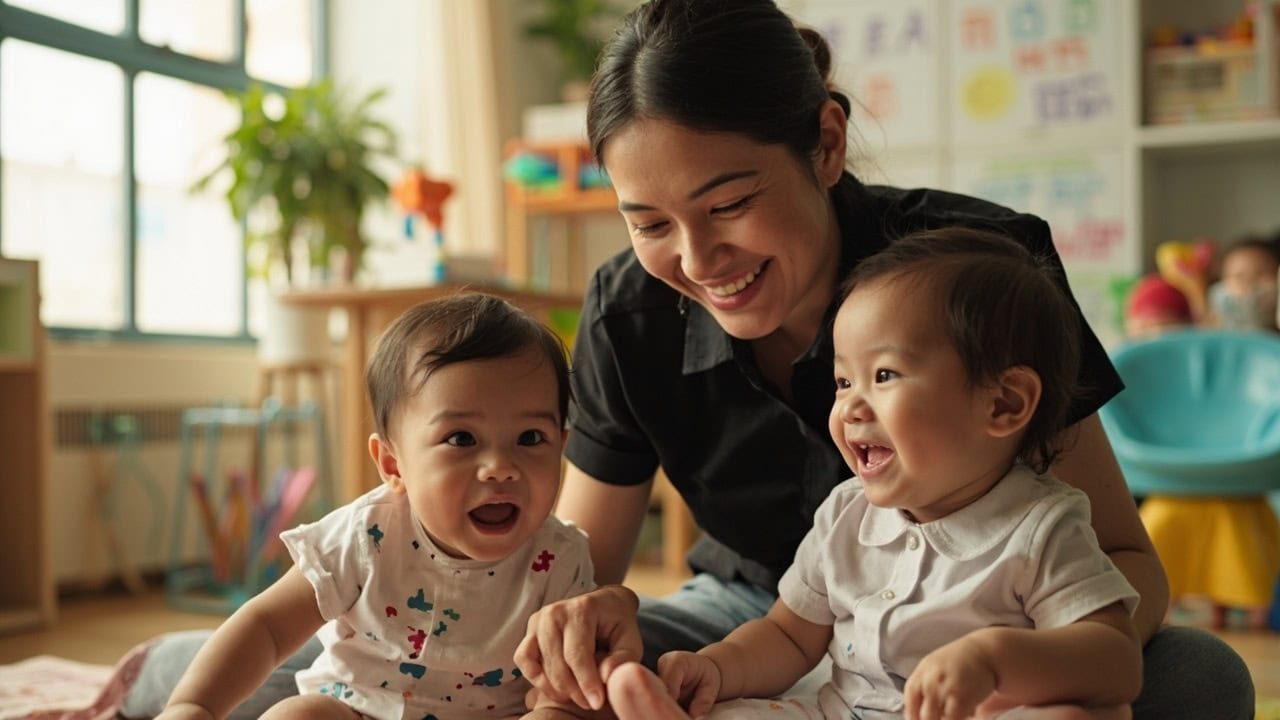
When your child’s caregiver sings festive songs with them not as a classroom exercise but as genuine celebration, when they use your mother tongue to comfort your child the way you would, when they speak to your child about their family with interest and respect — that is not a compromise. That is an extension of your family’s love into the hours you cannot be there.
When cultural continuity is being actively nurtured in care, the time you do spend with your child often becomes richer. Because your child is not coming home to a place where heritage is absent and then trying to recreate it in the evenings and weekends. They are coming home to a place where the foundation has been reinforced, where the language has been practiced, where the values have been gently modeled — and then you build on that together.
The parent-child bond does not weaken when you work. It can strengthen — when the pieces are in place, when your child feels secure in both worlds.
EduNanny Singapore: What to Look For
What I have been describing is not a philosophy alone. It is a practice, and it needs to be lived out in the specifics of how care is structured and delivered.
EduNanny Singapore operates under the ECDA Childminding Pilot, which means it is part of a deliberate effort to bring quality, regulated childminding to families across Singapore — not as an afterthought, but as a recognized and supported form of early childhood care. This matters because it means caregivers are trained, standards are audited, and the framework is built around what children actually need.
The pilot structure also makes this care accessible. Fee structures are designed with affordability in mind. CDA and Baby Bonus funds can be used, which means the financial logistics of quality care are not an additional source of stress. Care blocks run Monday through Friday, providing the consistency that children thrive on and that working parents depend on.
The EduNanny approach positions the caregiver within your child’s life in a particular way. This is not a transactional arrangement. You are not simply purchasing hours of supervision. You are inviting someone into your family’s cultural world — someone who will know your child’s name in your home language, who will understand what your family celebrates and why, who will treat your child’s heritage as something to be honored rather than something to be worked around.
The caregiver ratios — up to one caregiver for three infants — mean that this kind of attention is actually possible. It is not an ideal. It is the structure of care.
Trust in childcare is built not on promises alone but on visibility. EduNanny includes transparency measures where deployed, including communication systems that keep you informed and, in some settings, arrangements that allow you to see into your child’s day. This is not because parents are suspicious. It is because knowing is different from hoping. And for parents navigating the emotional terrain I have described — parents who are trusting someone else with their child’s sense of self — knowing is not a luxury. It is a need.
A Parent’s Checklist for Cultural Resonance
If you are researching childcare in Singapore and cultural resonance matters to you, here are the questions worth asking:
Language and Communication
- How does the caregiver use language throughout the day? Is heritage language present in play, in comfort, in casual conversation — or only in formal lesson time?
- Is the caregiver genuinely fluent in your home language, or are they learning alongside your child?
- How are names and family references handled? Does your child hear their grandmother’s language when they mention her?
Cultural Values in Daily Life
- How are respect for elders demonstrated in practice, not just discussed?
- How are festivals acknowledged — with meaning and context, or with surface-level decoration?
- Is food treated as cultural content, with conversation about origins and significance, or simply as sustenance?
Family Partnership
- Does the caregiver show genuine interest in your family’s traditions, or do they treat cultural practice as something separate from the care itself?
- Can you see into your child’s day? Not because you doubt, but because knowing matters when you are entrusting someone with your child’s identity.
- Is there communication about cultural moments — festivals approaching, songs learned, phrases your child used that showed their growing heritage knowledge?
Structural Support
- Are ratios low enough for this kind of individualized attention to be possible?
- Is care flexible enough to accommodate your family’s specific schedule and cultural calendar?
- Are caregivers trained not just in child development, but in cultural intelligence — understanding that heritage is developmental content, not an add-on?
Your Child’s Heritage Is Not a Compromise. It Is a Gift.
Let me circle back to something I said at the beginning, because I think it is the heart of everything else.
Cultural inheritance is not passive. It is not absorbed. It is actively transmitted, day by day, in the small moments of a child’s life. And in the early years, when the foundations of identity are being laid with extraordinary speed and precision, those small moments matter more than they have any right to, given how small they are.
This is why choosing childcare is not just a logistical decision. It is a cultural decision. It is a decision about what your child will know about themselves when you are not in the room. It is a decision about whether your family line continues to speak in the language your mother spoke to you. It is a decision about whether the festivals your grandparents marked with joy and ritual will mean something to your grandchildren.
These are the stakes. And if they seem high, it is because they are.
But here is what gives me genuine hope: when you choose care that understands cultural inheritance as part of its work, those stakes become manageable. Not because the responsibility is shared away, but because it is shared with people who take it seriously. Because they understand that a child’s heritage is not a barrier to quality care. It is not an obstacle to be accommodated. It is a gift to be tended — and when tended well, it grows stronger rather than weaker.
Carrying It Forward
There is a word in Chinese that I love. It is shōu, written with a character that depicts an elder with a child on their back. It means to receive, to inherit, to take into oneself the legacy of those who came before.
In Malay, there is pusaka — inheritance that passes through generations, not just of objects but of identity.
In Tamil, there is the concept of varam — blessing received and passed forward.
In every language spoken across Singapore, there are words for this. The passing down. The holding forward. The keeping alive.
This is what you are doing, whether you are working or not. This is what every parent does when they choose to care about these things, when they choose to ask the hard questions, when they refuse to accept that childcare is only about safety and stimulation and educational outcomes.
You are asking the real question. The one that matters most.
Will my child know who they are?
And the answer, when you have found the right partner in care, is yes. Not because you never worried. Not because it was easy. But because you chose care that sees your child as a whole person — a person shaped by language and memory and tradition and family, a person who deserves to know where they come from so they can decide who they want to become.
EduNanny Singapore is not offering you a service that happens to include cultural understanding. It is offering you a partnership in cultural inheritance. In the rhythms of daily care, in the language spoken with warmth, in the festivals celebrated with meaning, in the respect shown for the family your child comes from — in all of these things, EduNanny builds something alongside you.
You are not choosing between your child’s heritage and their future. You are choosing both.
And the choice, made thoughtfully and with the right support, is not a compromise at all.
It is an act of love. It is the quiet, daily work of making sure your child carries within them everything they need to know about who they are — and the freedom, because of that deep knowing, to become anyone they choose to be.
That is what quality childcare can be. That is what EduNanny Singapore believes it should be.
And that is the question you have already answered, simply by caring enough to ask it.
If this article resonates with you, we invite you to learn more about EduNanny Singapore and explore how we might walk this path alongside you.