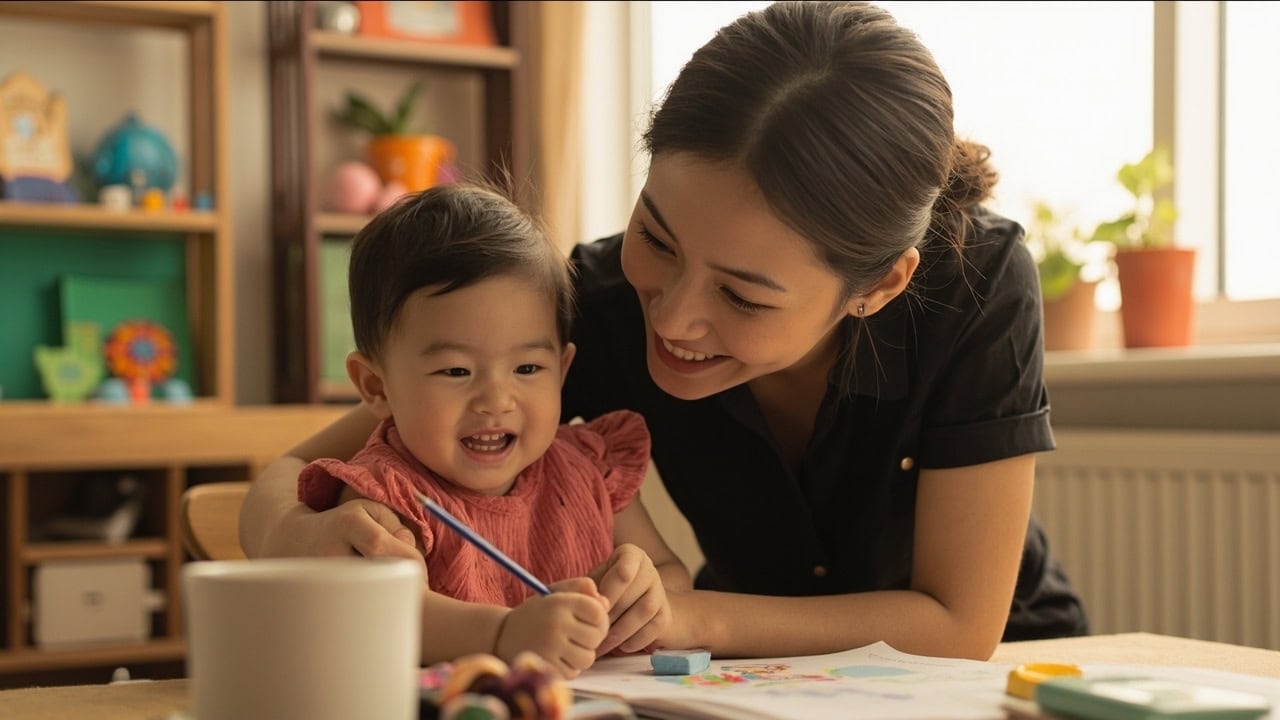
The Art of Partnering With Your Child’s Caregiver
What a Co-Parenting Alliance Actually Means
A co-parenting alliance is an intentional, daily partnership between you and your child’s caregiver — not a service transaction, but a shared commitment to understanding and raising your child together. Your child is watching how you relate to your caregiver. When that relationship is warm, respectful, and substantive, your child learns profound lessons about trust, cooperation, and how the world holds her.
It looks like this: meaningful information exchange at pick-up. Mutual observation of your child’s development. Aligned responses to milestones and challenges. A consistent relational environment that your child experiences as one coherent world, not two separate ones.
What the Alliance Looks Like When It Works
You arrive at pick-up, and your child’s caregiver meets you at the door with something specific. Not a generic “she ate well today.” Something observed and thoughtful.
“She spent most of the afternoon building towers with the blocks, and I noticed she keeps testing how high she can go before they fall — she seems to be working something out about control and consequence. She didn’t get frustrated when they toppled. She laughed and started again. I wondered if she’s been doing that at home too.”
You stand there, keys still in your hand, and you realise you have just received a window into your child’s interior world that you would never have had on your own. You have been given a piece of the story of her day that belongs to you now.
This is the daily practice of the co-parenting alliance. Not the log sheet that gets initialled and forgotten. This is the kind of exchange where two adults who know the same child take what they each see and lay it together, like puzzle pieces, to reveal a fuller picture than either could see alone.
Your child’s caregiver has been with her for six, seven, eight hours. In that time, she has watched her navigate a conflict with another child. She has noticed that your daughter is currently fascinated by the sound of the tap in the sink. She has seen her reach a milestone you haven’t seen yet — because she has been watching differently, with the fresh eyes of someone who encounters your child not as a continuation of yesterday’s bedtime routine, but as someone meeting this particular Tuesday morning in full.
She brings a perspective you cannot have. And when that perspective is shared with care and intelligence, it changes what you understand about your child.
The Courage to Build a Real Partnership
There is a quiet courage required to do this well. It is hard to actively partner with someone you pay. The act of paying introduces a power dynamic that can make genuine intimacy feel inappropriate or even threatening. You hired this person. You can end the arrangement. And that reality can sit in the room between you like a third presence.
The old models of childcare — and many approaches in Singapore still operate from these models — treat this tension as something to be managed through professionalism and boundaries. Polite distance. Clear roles. The parent does the parenting, the caregiver does the caregiving, and never the twain shall meet in any way that feels too intimate or too real.
This approach is comfortable. It is safe. But it protects your child from nothing, because it leaves her with two separate, unintegrated adult worlds rather than a coherent relational environment in which she can flourish.
The co-parenting alliance requires something more demanding. It requires you to treat your child’s caregiver as a professional whose judgment you respect, whose observations you value, and whose role in your child’s life you honour — not despite the fact that you pay her, but through an understanding that the payment enables a relationship of a particular kind.
You are not hiring someone to replace you. You are inviting someone into a shared enterprise. And that enterprise deserves the same intentionality you bring to your marriage, your friendships, your own parenting.
This is not one-sided. A genuine alliance is reciprocal. It also requires your caregiver to meet you there — with the willingness to observe deeply, to share what they see with honesty and care, to receive your perspective without defensiveness, and to grow alongside your child and alongside you.
What Your Child Learns From Watching You
Children are not passive in these arrangements. They are active, sophisticated observers of adult relationships, and they triangulate trust with remarkable precision. From the earliest months, your child is watching how you are with your caregiver.
She watches the way you greet each other at drop-off. She notices whether the greeting is warm or perfunctory, whether you make eye contact with the caregiver or look past her, whether your voice softens or sharpens, whether you hand your child over with the quiet confidence that says this person is safe or the anxious lingering that says something else entirely.
And here is what your child does with those observations. She internalises them.
- If she sees you treat your caregiver as a respected partner — someone you speak to with warmth and substance, someone whose observations you take seriously, someone you thank genuinely and whose expertise you acknowledge — she learns something profound about trust. She learns that the adults in her world can cooperate. That people who are different from each other can be aligned in their care for her. That love is not a finite resource divided between caregivers, but a capacity that grows when it is shared.
- If, on the other hand, she senses that you view the caregiver as an interruption to your parenting, a necessary convenience, someone to be managed rather than partnered with, she takes that in too. She learns that trust is conditional. That adult relationships are transactional. That the people who care for her are not full participants in her life but peripheral figures, interchangeable and separate.
What children learn about relationships from seeing their parents and caregivers aligned is not small. It is the first lesson in how the world holds them. And it is entirely in your hands.
Reframing This Choice as an Act of Vision
Many Singapore parents carry a sense of guilt about childcare. The belief that using childcare — particularly in the early years — is somehow a compromise, a lesser choice, a concession to circumstance. And there is an entire genre of parenting content designed to reassure these parents, to tell them that childcare is fine, that children are resilient, that it will all be okay.
I am not interested in that kind of reassurance. Here is what I believe instead.
The choice to place your child in quality infant care, and to engage with that care as a co-parenting alliance, is not a compromise. It is an act of vision. It is a recognition that your child’s relational world was always going to extend beyond you — that this is not a failure but a feature of human development, and that the question was never whether that extension would happen, but whether it would happen by default or by design.
Children have always been raised in relation to more than their parents. In Singapore’s multigenerational families, that often means grandparents. In other contexts, it means extended family, community, neighbours. What quality childminding offers is the possibility of extending that relational world with the same intentionality you bring to your own parenting — with trained caregivers who are not just present but present with skill, with observation, with commitment to your child’s development.
This is not a lesser arrangement. This is a more complete one.
What Quality Looks Like in Practice
For parents researching options in Singapore, here are the markers that distinguish genuine co-parenting alliances from ordinary childcare arrangements:
At Drop-Off and Pick-Up
- Caregivers who engage with you directly, not just with the child — making eye contact, using your name, acknowledging the transition you are making
- Pick-up conversations that go beyond food and sleep logs to share observations about your child’s social interactions, emerging interests, and developmental moments
- Caregivers who ask questions about your child — who want to understand what you are seeing at home to build a fuller picture
In Daily Care
- Caregivers who narrate the day to your child — not silent caretakers but active, verbal partners in your child’s experience
- Caregivers who respond to your child’s distress with the same attunement you would hope for at home
- Caregivers who notice patterns — who can tell you that your child tends to act differently during certain times, who can flag developmental shifts before parents notice them
Over Time
- Consistent caregivers who stay — the single most important predictor of whether a true alliance can form
- Mutual growth — you find yourself becoming more confident as a parent because you have a partner to think with
- Your child demonstrates security — confidence in a relational environment that holds her consistently
EduNanny Singapore: Built for the Alliance
Which brings me to what EduNanny Singapore is, and what it is built to do.
EduNanny, a service under BUTLER, is part of the ECDA Childminding Pilot — a government-recognised initiative that offers Singapore families access to quality, home-based infant and child care through trained and supported caregivers. It operates within a framework that prioritises something we have been talking about throughout this article: the relational quality of care.
In the EduNanny model, the caregiver is not selected for availability alone. She is supported through training, connected to a broader system of quality standards, and integrated into a care environment that treats her role as skilled, purposeful, and worthy of respect.
The infant ratios — up to one to three, depending on the arrangement — mean that your child receives the kind of focused, attentive care that the early years demand. The Monday-to-Friday care blocks offer the consistency that builds trust over time, rather than the fragmented, unreliable patchwork that leaves children and parents alike in a state of perpetual adjustment.
The pilot fee structures, combined with the usability of CDA and Baby Bonus schemes, mean that quality infant care is not reserved for families with significant disposable income. This is a service that recognises every child’s right to secure, high-quality care in the earliest years, and every parent’s right to access that care without choosing between their financial reality and their child’s developmental needs.
EduNanny provides communication and transparency measures so that parents have the information they need to feel connected to their child’s day and to maintain the kind of ongoing dialogue that is the foundation of the co-parenting alliance. These are not add-ons or marketing features. They are the connective tissue of the relationship between parent, caregiver, and child.
What EduNanny offers, in essence, is a pathway — both home-based and, where applicable, through community or centre-based arrangements — that is built on the understanding that quality infant care is relational before it is logistical. That the caregiver is not a service provider but a co-parenting partner. That the parent’s role does not diminish when they engage a caregiver — it expands, because they now have an ally in the daily work of understanding and raising their child.
Your Questions, Honestly Answered
Will my child be confused by multiple caregivers?
Children are remarkably sophisticated at holding multiple relationships — and they are particularly good at distinguishing between different types of care when those relationships are warm, consistent, and aligned. What creates confusion is not multiple caregivers but inconsistent caregivers. What creates security is the quality of the relational environment your child experiences, including the quality of the communication between the adults who hold her.
I feel guilty about using childcare. Is that normal?
Many Singapore parents carry this guilt, and it is worth sitting with rather than dismissing. That feeling is a sign of how much your child matters to you. But guilt about childcare is often based on a false premise — that children should be raised exclusively within the immediate family. In reality, children have always been raised in relation to more than their parents. Choosing quality care and engaging with it as a co-parenting alliance is not a compromise. It is a choice to build a richer relational environment for your child.
How do I know if a caregiver is right for this kind of partnership?
Look for caregivers who demonstrate relational capacity, not just technical competence. During tours or initial meetings, notice whether they ask questions about your child. Notice whether they seem curious about your family’s values and routines. Notice whether they offer observations, not just assurances. The best caregivers are those who see themselves as partners in your child’s development, not as service providers executing a checklist.
What if the relationship with my caregiver doesn’t feel natural?
Genuine partnership takes time to develop, and it requires vulnerability from both sides. It is normal for the early weeks to feel awkward — you are building a relationship with an adult you pay, and that dynamic can make authentic connection feel strange at first. What matters is your intention to move toward genuine alliance over time. Start with small acts of warmth and respect. Acknowledge your caregiver’s observations. Ask questions about your child’s day. The relationship will deepen as both of you commit to it.
Building Your Alliance Day by Day
Here is what active co-parenting looks like in the daily texture of your life:
At Drop-Off
- Greet your caregiver warmly and by name — your child is watching this exchange
- Share one thing from home — a mood, a development, a question you have about your child
- Hand your child over with confidence, not anxiety — your child reads your body language
At Pick-Up
- Ask one specific question beyond “How was her day?”
- Listen as if you are building a puzzle together, not receiving a report
- Share something from home that connects to what you are hearing
- Thank your caregiver genuinely — name what you appreciate
Ongoing
- Text or note observations from home that might help your caregiver understand your child better
- Receive feedback without defensiveness — your caregiver sees your child in situations you don’t
- Respect your caregiver’s professional knowledge and experience
- Remember that the alliance is reciprocal — you both bring expertise to the relationship
What This Makes Possible
Here is what I have seen, in the years I have spent thinking about and working with families in Singapore’s early childhood landscape. I have seen what happens when parents take the co-parenting alliance seriously — not as a nice idea, not as an aspiration, but as an actual, daily, intentional practice.
They become different parents. Not perfect parents. Not parents without doubt or worry or the ordinary failures of human caregiving. But parents who are more present, because they have learned to lean into a relationship rather than manage it at arm’s length. Parents who know their child better, because they have been given information and perspective from a trusted other. Parents who feel less alone, because they have built a genuine partnership in the most important work of their lives.
And their children — those children are not confused by multiple caregivers. They are not insecure because they love more than one adult. They are secure, because they have been given a relational environment that is coherent, consistent, and held together by adults who respect each other and who respect the child’s need to be known fully by the people who love her.
This is what the first thousand days are for. Not the accumulation of stimulation or the optimisation of developmental milestones. The building of an inner world sturdy enough to hold the complexity of being a person in relationship — with all its risks, its rewards, its inevitable disappointments and its extraordinary capacity for growth.
You are not just choosing a childcare arrangement. You are building a relational architecture that will shape your child’s understanding of how the world holds her. And that architecture is built not in a single decision but in the daily, ordinary, extraordinary acts of showing up, of sharing what you observe, of listening to what the other adult has seen, of aligning your responses, of treating your caregiver not as someone separate from your parenting but as someone essential to it.
This takes courage. It takes humility. It takes the willingness to be in an ongoing, imperfect, deeply human relationship with another adult, in service of a child who is watching both of you with more attention than you know.
And it is, I believe, one of the most meaningful things you will ever do.
Whether you are exploring home-based childminding, comparing infant care options across Singapore, or looking for a caregiver who will be a genuine partner in your child’s first thousand days — know that the relational foundation you build today will shape your child’s understanding of trust, cooperation, and belonging for years to come.
Choose with intention. Partner with courage. And trust that the alliance you are building is one of the most meaningful acts of parenting you will ever undertake.
If you would like to explore how EduNanny approaches the co-parenting alliance — or to begin a conversation about your family’s childminding needs — you are welcome to get in touch.