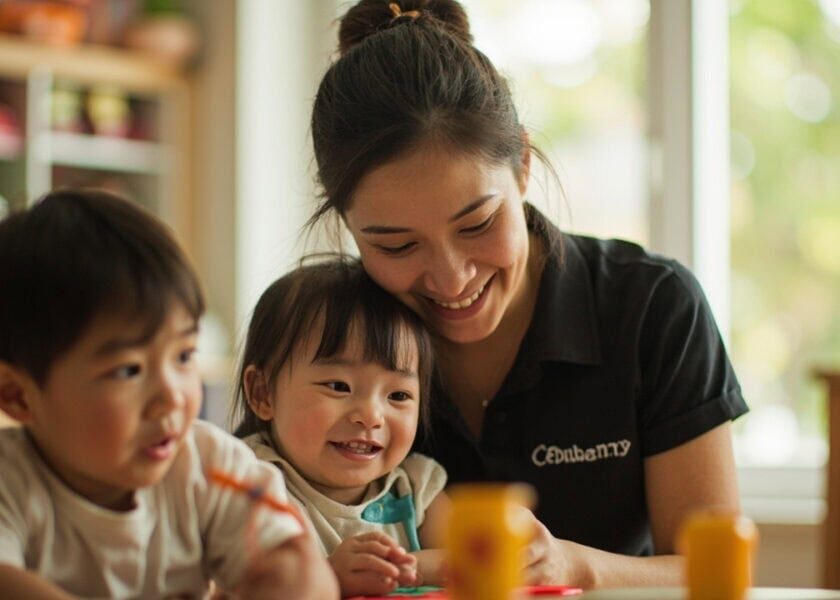
Singapore Parents Reveal Why They Chose Childcare That Grows With Their Child
Understanding the Transitions Every Singapore Child Makes
Singapore parents are remarkably thoughtful. In conversations with families across the island — in HDB living rooms and condominiums, during school pickups and at community centres — we have learned that Singapore parents do not simply want good childcare. They want childcare that makes sense. They want care that responds to where their child is right now, and that can honestly say: I see where your child is going.
That second part is what sets apart a truly developmental approach to infant care and childminding. It is easy to provide care for the child in front of you. It requires foresight, intentionality, and genuine structural design to provide care for the child that child will become — in three months, in six months, in the year ahead.
The Four Transitions Parents in Singapore Most Often Navigate
1. The infant to toddler shift. The baby who needed consistent, individual responsiveness begins to crave social interaction, peer engagement, and new forms of stimulation. The home-based arrangement that served her as a newborn now has different requirements.
2. The home-based to centre-based move. A family begins with the intimacy of home-based care and reaches a point where their child’s social and developmental needs point toward a richer, more communal environment. This shift, when made well, is a continuation — not a rupture.
3. The toddler to preschooler readiness transition. A child approaching three begins developing vocabulary at a remarkable pace, asking questions that require more structured engagement, and beginning to understand concepts of sharing, fairness, and collaboration in ways that demand new kinds of facilitation.
4. The school entry preparation. A child who has never been in formal care — perhaps cared for by grandparents, by a domestic helper, or by a parent at home — now prepares for the demands of primary school. Social expectations are different. The ability to separate from primary attachment figures for extended periods is not a given; it is a skill that must be developed gradually and with support.
Each of these moments is a transition. And each carries with it a very particular emotional weight for parents who have done the hard work of building trust — trust with a caregiver, trust with a routine, trust with the knowledge that their child was safe and known and loved in that care arrangement.
The Deeper Fear Beneath the Transition Question
Here is what we have observed: the anxiety that lives deepest in Singapore parents is not really about logistics. It is not primarily about whether the caregiver is qualified or whether the environment is safe, though both matter enormously.
The deeper anxiety is this: What happens when my child outgrows this arrangement? Do I have to find someone new? Do I have to explain everything all over again? Does my child’s sense of security, built carefully over months of consistent care, have to be disrupted because the system was not designed to keep up with her?
This anxiety is real, and it is reasonable. For many families, the answer to those questions has historically been yes. You find a new arrangement. You start over. You hope the next caregiver is as capable, and that your child adapts quickly, and that the transition is not harder than it needs to be.
The fear is not irrational. The fear is grief. It is the recognition that something good is ending, or at least changing, and that the path forward is uncertain. It is the caregiver who has been part of your family’s daily life for over a year — someone you have trusted with your most precious responsibility, someone who shared the first smiles, the first steps, the first words with you — and now your child is moving into a new environment where she will not be the primary presence.
This is a loss. We do not diminish it by pretending otherwise. What we offer is a framework for honouring that loss while recognising that it is also a gain — for your child, who is growing; for the caregiver, whose work has contributed to this growth; and for your family, which is entering a new phase with the foundation intact.
What Quality Childminding Looks Like Across Developmental Stages
Not all childcare is designed with the same intentionality. Understanding what quality looks like at different stages can help you evaluate whether a care arrangement is truly meeting your child’s needs — today and as they grow.
| Developmental Stage | What Quality Care Provides | Signs the Arrangement May Need Review |
|---|---|---|
| Early infancy (0–6 months) | Consistent responsiveness, secure attachment foundations, individualised attention, calm and predictable routines | Caregiver seems rushed or unable to meet individual cues; limited communication about baby’s day |
| Mobile infant (6–12 months) | Safe exploration opportunities, growing social responsiveness, language-rich interactions, continued attachment security | Baby shows signs of under-stimulation or excessive frustration; caregiver not documenting developmental milestones |
| Toddler (12–24 months) | Peer interaction opportunities, language facilitation, autonomy support, structured activities matching developmental readiness | Child appears bored or under-challenged; caregiver not communicating about emerging social needs |
| Preschooler (2–4 years) | School readiness preparation, collaborative play facilitation, emotional regulation support, age-appropriate cognitive challenges | Child shows anxiety about separation or regresses in previously mastered skills; caregiver not preparing family for school entry |
The key question is not simply whether your child is safe and happy today. It is whether the care arrangement is designed to recognise and respond to developmental shifts before they become problems — and whether it has a clear pathway forward when those shifts arrive.
EduNanny’s Approach: Built Around Growth, Not Fixed Enrollment
The question is not whether transitions will happen. They will. The question is whether your childcare system is designed to follow your child through those transitions, or whether it asks your child and family to adapt to its fixed structure.
This is where EduNanny’s approach diverges from convention. We are not a single enrollment point with a single service offering. We are a care ecosystem thoughtfully designed around the developmental stages children actually move through — from the earliest weeks of infant care, through toddlerhood, into the preparation years before primary school.
When a family enters the EduNanny by BUTLER programme, they are not simply securing a place for their child today. They are entering a relationship with a care system that understands where their child is developmentally and where that child is heading.
Our caregivers are trained not only to meet the immediate needs of the infant or toddler in their care, but to recognise the developmental milestones that signal readiness for the next stage. Our communication with parents is designed to make those signals visible — so that when a transition becomes appropriate, it does not arrive as a surprise. It arrives as a prepared moment.
Continuity Is Not Just the Same Organisation — It Is the Same Knowledge
Consider what this means concretely: A family begins with home-based infant care — perhaps because they want the intimacy and individual attention that a small-ratio environment provides for those crucial first months. The caregiver knows this child. The family knows this caregiver. Trust has been built carefully, over time.
At around twelve to fifteen months, the child begins to change. She wants to interact with other children. She is developing language and wants peers to speak with. The home-based environment, so perfect for the infant, is beginning to ask different things of its structure.
This is not a failure. This is development.
For a family in a rigid system, this would be the moment of rupture — the search for a new arrangement, the disruption of established trust, the anxiety of wondering whether the next setting will be as good.
For a family in the EduNanny ecosystem, this is the moment when the transition we have been preparing for becomes visible. Our caregivers are trained to observe and document these shifts. Our communication with parents — through regular updates, through developmental reports, through the transparency measures built into our programme — makes these observations shared knowledge.
When the time comes to discuss a move from home-based care to a community or centre-based pathway, that conversation is not a surprise. It is a continuation.
EduNanny’s caregivers are part of a team, not a revolving door. When transitions happen within our ecosystem, they happen within relationships that have continuity. The new environment your child enters is staffed by professionals who have received handover from the caregivers who knew your child before, who understand her preferences and patterns, and who are prepared to receive her with the consistency she needs.
There is a moment — and we have heard this from families in our programme, in their own words — when a parent realises that their childcare provider saw the transition coming before they did. When the conversation about moving from home-based to centre-based care is initiated not by the parent, who has been worrying about the right timing, but by the caregiver who has been observing the child’s readiness and has prepared the family for this discussion.
At that moment, something shifts. The anxiety that has been quietly present — the worry that you would have to figure this out on your own, that the system would not be there when you needed it, that your child’s development would outpace the care arrangement you had chosen — that anxiety dissolves.
What replaces it is something rarer and more valuable than peace of mind. It is trust in the future. It is the recognition that you have found a partner who will not abandon you when things change, because change is precisely what they have been designed for.
Addressing the Real Concerns Singapore Parents Have
“What if I commit to a care arrangement and my child outgrows it?”
This is the right question to ask — and it is the question EduNanny was designed to answer. Our model does not ask you to find a fixed solution for a child who is constantly changing. It asks you to enter a relationship with a care system that grows alongside your child. When your child’s needs shift, the system shifts with them — not by disrupting what has been built, but by building upon it.
“Will my child be okay with multiple transitions?”
Children are remarkably resilient when transitions are handled with care, continuity, and preparation. What children struggle with is not change itself, but abrupt, unexplained, unsupported change. The EduNanny model ensures that every transition is prepared — the family is involved in conversations before decisions are made, the child is introduced to new environments gradually, and the knowledge of previous caregivers carries forward into new settings.
“What about the emotional cost of leaving a caregiver we love?”
We do not pretend this is easy. The relationship between a family and a caregiver who has been part of their daily life is real and meaningful. When transitions happen within the EduNanny ecosystem, they happen in a way that honours that relationship. The caregiver who knew your child in the early months is part of a team that continues to be part of your family’s journey. Your child is not losing a caregiver; she is gaining access to a broader community of care that is informed by everything that came before.
“Is EduNanny affordable for the long term?”
EduNanny by BUTLER operates within the ECDA Childminder Pilot, offering pathways designed to be accessible within the pilot framework. Where applicable, families can utilise CDA and Baby Bonus schemes to support their care arrangements. These are not merely administrative details. They are the practical foundations that allow families to commit to quality care without bearing an unreasonable financial burden.
How to Evaluate Whether Your Current Arrangement Is Keeping Up With Your Child
If you are currently in a care arrangement and wondering whether it still fits, here are some questions worth asking:
- Does my caregiver communicate about developmental milestones? A quality care arrangement should be observing and sharing information about your child’s emerging skills, not just reporting on daily activities.
- Have I been told about any concerns, or do I have to ask all the questions? Proactive communication is a sign of a system designed around your child’s development.
- Does my child seem genuinely engaged, or merely occupied? Contentment is the baseline. Enthusiasm, curiosity, and growth are the markers of care that is keeping pace.
- Has anyone talked to me about what comes next? If you are approaching a developmental threshold and your provider has not mentioned it, that may be a sign the system is not designed for continuity.
- Do I feel like I am managing the childcare relationship mostly on my own? Quality care should feel like a partnership, not a transaction you have to monitor.
If these questions raise concerns, that is not a reason for guilt — it is a reason for conversation. A good care provider will engage with your questions openly and work with you to think about what your child needs next.
Moving Forward With Confidence
Your child will grow. She will change, and change again, and change once more before she enters primary school. That is not a problem to be managed. That is the work of childhood, magnificent and irreversible.
If you are a parent who has felt the weight of that noticing — who has lain awake wondering whether your childcare arrangement will be enough for the child your baby is becoming — we want you to know that your concern is valid, and that it comes from a place of love. You are paying attention. You are doing your job.
What EduNanny offers is not a promise that transitions will be effortless. They will not be. Growing up is hard work, for children and for families. What we offer is the assurance that you do not have to navigate those transitions alone. That when your child signals readiness for what comes next, there will be a team of trained, attentive, genuinely committed caregivers waiting to receive her — with knowledge of who she is, with respect for the relationship you have built, and with a clear plan for making the next stage a continuation rather than an ending.
EduNanny was built for this. Not as an afterthought, not as a marketing angle, but as the core organising principle of everything we do. We designed this model because we believe children deserve continuity of care as they grow. We believe parents deserve partners who anticipate what is coming, not just respond to what has arrived. And we believe that the anxiety of childcare transitions — so pervasive, so rarely addressed — deserves a genuine answer.
EduNanny is here for all of it.
If you are considering your childcare options in Singapore and want to understand how a system designed around your child’s developmental journey might work for your family, we invite you to connect with us or learn more about the EduNanny by BUTLER programme.
At EduNanny Singapore, we believe thoughtful childcare is not just about where your child is today — it is about where they are going. Explore how EduNanny supports your child’s full developmental journey.