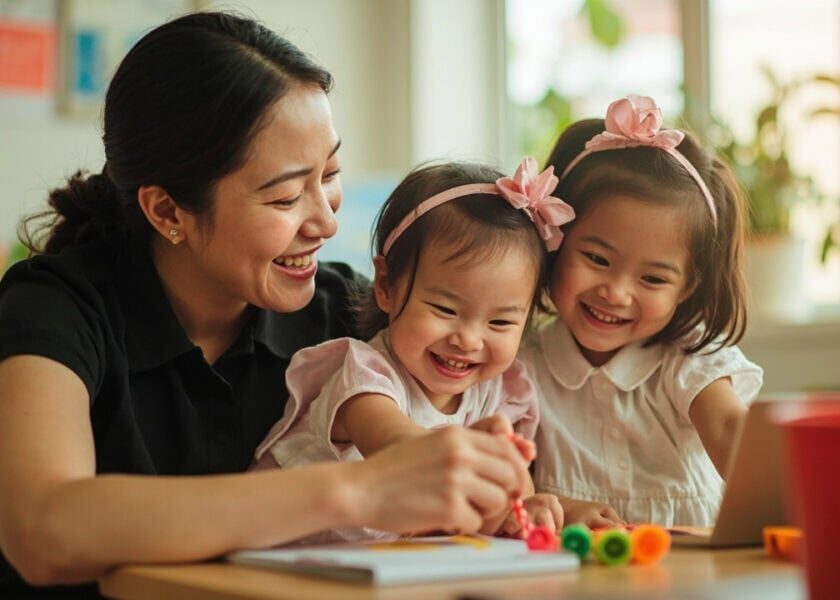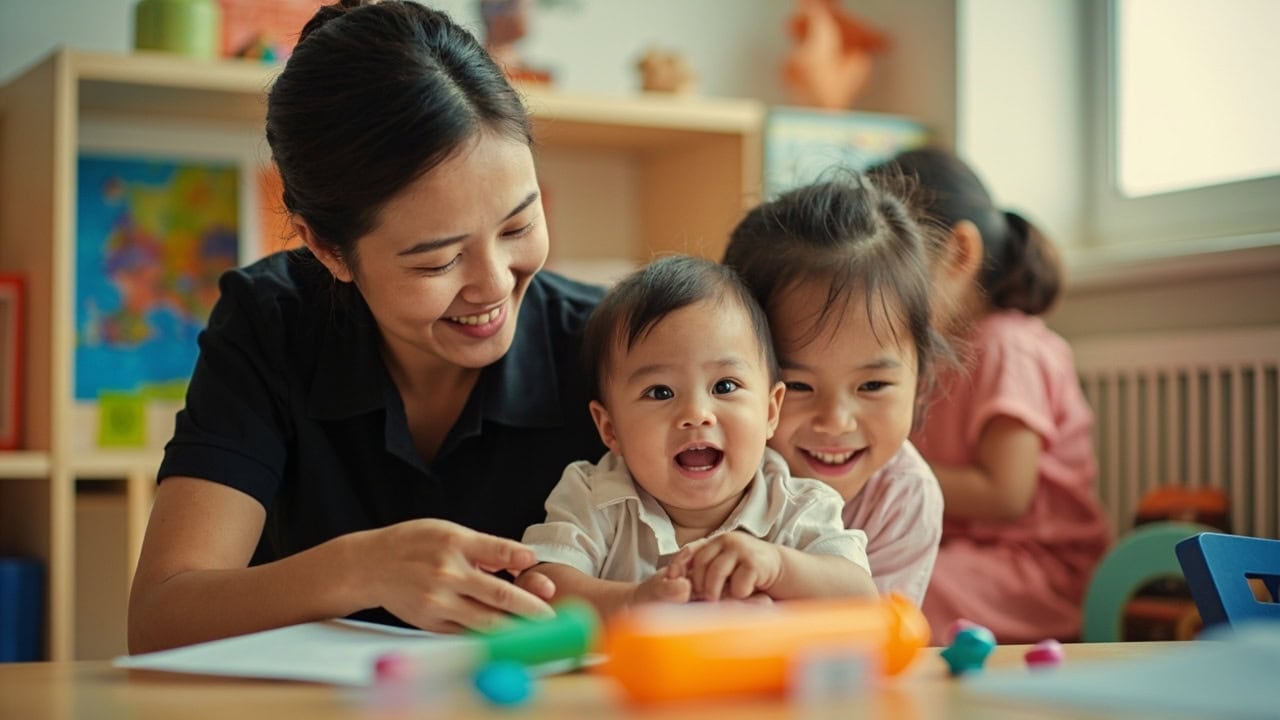
Singapore Parents Are Learning to Read Their Child’s Growth at Pickup
The Quiet Question Every Singapore Parent Carries at Pickup
There is a particular quiet that settles over a childcare setting in those last minutes before pickup. The morning’s activities have wound down. The toys are being gathered. And then—through the door, through the gate, through whatever threshold separates your morning from your afternoon—there you are. Your child sees you.
What happens next, in the span of those ten or fifteen seconds, is something you will carry with you for the rest of the day.
Most parents, in that moment, are asking a question. Not the surface question—not “was my child okay today”—but something deeper, something harder to name. You are asking, in your own way: are they growing? Not just fed and rested and uninjured, but growing. Developing. Becoming more of who they are.
Here is what makes this question so particular for parents in Singapore. You are asked to make enormous decisions—about childcare, about development, about who will hold and shape your child during the hours you cannot be there—within a system that is still finding its language. The growth charts at the polyclinic. The milestone brochures. A handful of well-meaning articles. And then you are expected to evaluate, with confidence, whether a childcare arrangement is producing real developmental progress or merely a well-supervised holding pattern.
That is an unreasonable ask. And yet here you are, every morning at drop-off and every evening at pickup, doing exactly that—reading your child’s face, watching how they move across the room, trying to translate a few hours of invisible experience into something you can understand and trust.
You are already an observer of your child’s development, whether or not anyone has given you the vocabulary for it. What we want to offer you today is a clearer lens—not because we doubt your instincts, but because when parents can see developmental progress clearly, they make better choices, they worry less, and they partner more effectively with the people caring for their children.
The Critical Difference Between Entertainment and Engagement
Let us start with a distinction that matters more than most people realize: the difference between a child who is entertained and a child who is engaged.
Entertainment is passive. It asks very little of a child. A screen. A colourful mobile. A toy that plays music when pressed. These things can soothe, can occupy, can fill time. There is nothing inherently wrong with any of that. But entertainment is not development. A child can be entertained for six hours and emerge at pickup no different than when they arrived. Dazed, perhaps. Pleasantly overstimulated, maybe. But not changed.
Engagement is something else entirely. Engagement is a child who is reaching for something just beyond their current ability—not frustrated by the distance, but intrigued by it. Engagement is a child who watches another child stacking blocks and then immediately tries it themselves, not because anyone told them to, but because something inside them has said: I want to know if I can do that.
When you watch your child at pickup and see them reach for a toy they have never quite managed to grip before, and grip it successfully—that is not luck. That is a series of small, purposeful experiences, repeated across days and weeks, that have built the neural pathway and the motor confidence for that single moment of success. You are watching the visible tip of an invisible process.
Quality childcare is not about flashy curricula or impressive-sounding programmes. It is about creating the conditions that allow engagement to happen. Those conditions have specific, observable features:
- Responsive caregiving—a caregiver who notices what your child is reaching for before your child finishes reaching, who reads frustration before it becomes a meltdown, who celebrates effort before celebrating success.
- Appropriate ratios—in home-based and community pathways, quality settings maintain up to one-to-three infant ratios. This means when your child reaches for something, there is a caregiver close enough to notice, to respond, to scaffold.
- Intentional environment—every surface a child touches, every material within reach, every transition between activities designed to create moments of challenge just slightly beyond where your child currently is. Not frustrating. Intriguing.
- Relationship continuity—your child forms a bond with someone who knows their rhythms, their preferences, their particular way of expressing curiosity or distress.
The Six Developmental Domains That Signal Real Growth
One of the greatest sources of parental anxiety in Singapore is not the fear that something is wrong—it is the fear that nothing is happening at all. That the days are passing and the child is merely aging, not advancing. Here are the domains to watch for, with real behaviors you can look for at pickup.
Independence: Emerging Selfhood
A child who arrives at a setting and cannot feed themselves at all, who needs to be held constantly, who cannot tolerate even brief periods of autonomous play—that is a child at a starting point.
A child at a quality setting, six months later, who is picking up a spoon with intention, who is reaching for their own cup, who is exploring a shelf of toys and selecting one without being guided—these are not trivial things. When your child walks toward the handwashing basin without being told and holds their hands out, ready, they are showing you that they have internalized a routine, that they understand sequence and anticipation, that they trust the world enough to expect what comes next.
Emotional Regulation: What Your Child Does Not Do
This one is harder for parents to see because it lives in what your child does not do. It is the absence of a meltdown that would have happened six months ago. It is the child who can wait—not happily, perhaps, but without completely falling apart—when the sand timer runs and the turn is not yet theirs.
Emotional regulation is one of the most sophisticated achievements of early childhood, built entirely through relationship—through thousands of small, consistent experiences of being soothed, of seeing others soothed, of learning that big feelings come and go and that the world does not end when things are frustrating or frightening.
Social Curiosity: The Beginning of Social Intelligence
The moment to notice is when a child looks at another child not to take a toy but to watch. To study. To wonder: what are they doing, and why?
That is social curiosity—the beginning of true social intelligence, the capacity to be interested in another human being’s experience, not just your own. In a quality childcare setting, you will see children at various stages of this trajectory: some still in the parallel phase, others tentatively offering a toy, others navigating their first small conflict over a preferred item and beginning, in a fumbling but genuine way, to negotiate.
Communication: More Than Words
Language development in the first thousand days is nothing short of astonishing, and it happens fastest in environments that treat communication as a whole-body experience, not just a verbal one.
Watch for this: a child who, at pickup, points to a drawing on the wall and looks at you, then looks back at the drawing, then at you again—expecting you to understand what they are trying to share. That is communication in its fullest form. It is not about vocabulary size alone. It is about the intention behind communication—the desire to connect, to be understood, to bring someone else into an experience that mattered.
Motor Confidence: Visible Growth in Every Movement
This one is often the most immediately visible at pickup. Watch how your child moves through a space. An infant or toddler in a quality developmental environment moves with increasing authority—they pull themselves up and look around with a kind of quiet pride, they navigate a low obstacle with purpose rather than panic, they pick up small objects between finger and thumb rather than raking with the whole hand.
These are not just physical achievements. They are statements of growing competence. Every time a child successfully masters a physical challenge, something in their brain rewires itself to say: I can do hard things. That is the foundation of resilience.
Cognitive Engagement: The Deepest Work
Cognitive engagement looks like curiosity that persists past the first few seconds. It looks like a child who does not just bang a shape-sorter once and abandon it, but who turns it over, who tries the square hole again after the circle went in, who looks frustrated not because they want to quit but because they want to understand.
It looks like a child who, when read a story for the hundredth time, leans closer instead of tuning out—because the environment has taught them that familiar things contain depths you can return to again and again. Cognitive engagement is the difference between a child who has had a day full of activities and a child who has had a day full of thinking.
What Quality Childcare Looks Like in Practice
These are not aspirational qualities. They are the natural, observable outcomes of environments that understand what infants and toddlers actually need to grow. And they are visible to parents—especially parents who have been given the tools to recognize them.
EduNanny operates within the ECDA Childminding Pilot, which means our approach is not improvised—it is grounded in a framework that Singapore’s own educational authority has examined and supported. But beyond structure, we are committed to closing the gap between what is happening in our settings and what you can see and understand at pickup.
That is why communication is woven into everything we do. Transparent updates. Documented observations. Structured sharing of what your child explored and discovered and struggled with and mastered. We do not want you to take our word for quality. We want you to have the framework to see it for yourself.
Our caregivers are not interchangeable workers. They are educators in the deepest sense—people who understand that the way they hold a frustrated child, the way they narrate a moment of discovery, the way they step back and let a child struggle productively before offering help—these are not small decisions. These are the decisions that shape a child’s understanding of themselves and the world.
When your child, over weeks and months, becomes more settled, more curious, more confident—not just in the environment, but specifically with that caregiver—you are seeing evidence of a bond that is an extension of the relational world you are building with your child. Secure attachment to caregivers expands a child’s world rather than contracting it. When your child knows they are loved and held at childcare, they are freer to explore, to grow, to take the risks that development requires.
What to Watch For at Your Next Pickup
Here is what you can start looking for, whether your child is in a centre-based programme or a home-based childminding setting:
- Movement through space: How does your child navigate from where they are to where you are? Tentatively? With purpose? Do they pause to show you something on their way?
- Response to caregiver: Do they acknowledge leaving? Is there warmth in the goodbye? Does the caregiver offer you a specific observation about your child’s day?
- New behaviors: Is there something your child is doing today that they could not do last week? A word, a grip, a social gesture?
- Energy and ease: Is your child genuinely happy to see you, or is there something guarded or dysregulated about their demeanor? Both tell you something.
- Signs of engagement: Are they pointing at something they want to show you? Trying to narrate their day? Reaching for a toy they played with and want to share?
These are not tests. They are invitations to see what is already there.
The Answer to That Quiet Question
As we close, we want to return to that moment at pickup. The quiet question.
You are standing at the door. Your child has seen you. And in those next few seconds, you are reading everything—their energy, their ease, the way they move toward you or hesitate or run with purpose across the room. You are asking: are they okay? Are they more than okay? Are they growing?
Here is what we hope you will carry with you from today. That question is not a sign of uncertainty. It is a sign of love. And it is a question that deserves an answer—not a vague reassurance, but a real, specific, observable answer.
Because your child is not a black box. Between drop-off and pickup, they are not just being kept. They are being shaped. They are reaching and grasping and speaking and negotiating and falling and getting up and trying again. They are becoming.
You, watching at pickup with the particular attention that only a parent carries, can see it. You always could. What we are offering you today is the language and the confidence to name what you are already seeing—to trust that your observations are valid, that your instincts are well-founded, and that when your child is in the right environment, their growth is not invisible.
It is right there. In their hands. In their words. In the way they look at the world and lean toward it, curious and unafraid.
This is what quality childcare produces: a child who, at pickup, runs toward you not just because you are there, but because they have something to show you—something they learned today, something they did today, something they became today—and they cannot wait for you to see it.
If you are currently searching for infant care or childminding in Singapore, EduNanny invites you to learn more about how our approach creates the conditions for genuine developmental growth—and how we keep you connected to what your child is becoming every day.
The quiet question you carry at pickup deserves more than vague answers. It deserves a childcare partner who will help you see the growth that is already happening, and who will walk alongside you as you learn to read your child’s development with growing confidence. We would be glad to hear from you.