The Real Readiness Primary One Teachers Actually Look For
The Question Beneath the Question
I want to tell you something that may reframe everything you have been doing. The doubt you are feeling is not a sign of failure. It is a sign of wisdom.
Because the truth is that the question you are asking is a profound one, and most of the preparation you have been offered does not answer it. The question is not whether your child can write their name. The question is not whether they know their colours or can count to twenty. The question is deeper, and the answer matters far more than any worksheet can show.
Here is what you need to know: your child’s readiness for Primary One—and for life—begins in their nervous system. Not in their mind, exactly. Not in their academic knowledge. In the architecture of their body, in the intricate dance of their stress response, in the capacity of their brain and nervous system to stay calm, to adapt, to absorb, and to recover.
This is what Primary One teachers actually look for. This is what determines whether a child thrives or struggles in those first weeks. And this is what quality infant and childcare builds—not through curricula, not through early academics, but through the daily, careful construction of emotional regulation from the inside out.
Why Academic Preparation Falls Short: The Neuroscience
When a child walks into a classroom for the first time, something extraordinary is happening beneath the surface of their small, apparently composed body.
Their nervous system is processing sounds, lights, the proximity of twenty-three other children, the unfamiliar smell of a new room, the absence of the familiar face they have learned to trust. Their brain is asking: Is this place safe? Can I manage this? What happens if I need help?
If the answer is yes
If their nervous system has learned through thousands of hours of consistent, attuned caregiving that the world is manageable and that adults can be trusted, then learning is possible.
- The teacher speaks, and the child hears.
- The lesson unfolds, and the child follows.
- A frustration arises—a wrong answer, a toy taken, a mistake made—and the child recovers.
- They bounce back. They try again. They stay in the room, emotionally and cognitively present, available for the next thing.
If the answer is no
If their nervous system is dysregulated, then something else happens.
- The sounds become overwhelming.
- The social complexity becomes threatening.
- The smallest frustration—a forgotten pencil, a correction from the teacher, a conflict with a classmate—becomes unbearable.
The child’s whole system shifts into protection mode. And in protection mode, learning is not possible. The prefrontal cortex, the part of the brain responsible for attention, for problem-solving, for social behaviour, goes offline.
The child may appear defiant, or withdrawn, or frozen. They may cry, or hit, or flee. They are not being difficult. They are being neurological.
You cannot pour academic knowledge into a dysregulated child and expect it to land. The knowledge becomes inaccessible the moment the nervous system moves into survival mode.
Academic content is learnable. Your child can learn letters and numbers at any point. But emotional regulation is built slowly, over time, through consistent experience, through a hundred small moments of being soothed, of learning that frustration is survivable, that change is manageable, that they can bounce back.
Is my child’s nervous system developing the capacity to regulate, to adapt, to recover, to trust?
The answer to that question is built in the first thousand days and beyond—in the daily rhythms of feeding, sleeping, playing, and being held. In the consistency of a caregiver who notices when a child is upset and responds with warmth. In a sensory-rich environment where a child can run, climb, jump, and explore.
Three Signs Your Child’s Nervous System Is Developing Readiness
Now, I want to speak directly to what this looks like in practice, because as a parent, you need something concrete to hold onto. You need to know what to look for—not in a brochure, but in your own child.
1. Observe their state when you pick them up
When you collect your child at the end of the day, observe them. Not their worksheets. Not their vocabulary. Not their ability to recite nursery rhymes.
Observe their state.
- Are they regulated? Do they emerge calmly, perhaps tired but settled, able to greet you with genuine connection?
- Or do they emerge dysregulated—collapsed, cranky, overstimulated, unable to organise themselves?
The regulated child is the one whose nervous system has been supported all day. The dysregulated child is telling you something important about what their day has been like.
2. Watch how they handle small frustrations
A toy taken by a sibling. A forgotten snack. A bumped elbow. A wrong answer on a game.
- Can they recover? Can they cry, express their distress, and return to equilibrium within a reasonable time?
- Or does the frustration dominate them, pulling them into extended distress that they cannot self-soothe?
The capacity to recover is not a personality trait. It is a nervous system skill—and it is one of the most powerful predictors of success in Primary One.
3. Watch how they adapt to change
A new route to the playground. A different caregiver picking them up. An unexpected schedule change.
- Does your child move through these disruptions with flexibility, perhaps with some initial protest but with the capacity to adjust?
- Or does change send them into a tailspin from which they struggle to return?
The adaptive child is the child whose nervous system has learned, through gentle exposure to manageable challenges, that change is survivable. This is not something you can teach from a book. It is something the body learns through lived experience.
Bonus sign: Social confidence
Watch their inner sense of safety in the presence of other children.
- Can they approach a group, join a game, navigate a conflict?
- Or do they hang back, freeze, or become overwhelmed by social complexity?
Social confidence comes from a secure internal working model—a deep-down sense that people are trustworthy and that they themselves are worthy of connection. This, too, is built in relationships, in the quality of care they have received, in whether their cries were met with response, their smiles with warmth, their needs with consistent attunement.
| Commonly Measured (Incomplete) | What Actually Matters (Complete) |
|---|---|
| Ability to sit still on command | Capacity to stay emotionally regulated during age-appropriate challenges |
| Memorisation of sight words | Ability to recover from frustration and try again |
| Recognition of colours and numbers | Adaptability to change and new environments |
| Academic vocabulary | Social confidence and trust in caregivers |
| Motor skill worksheets | Rich sensory and physical play experiences |
These are the signs of genuine school readiness. Not the ability to perform. The ability to be present, to adapt, to recover, to connect.
How Quality Childcare Builds This Foundation
So how does quality childcare build this foundation? This is where I want to speak about the approach EduNanny has developed, because the answer to this question is not abstract for us. It is the work we do every day.
The science behind the ratios
EduNanny operates within the ECDA Childminding Pilot, a framework that recognises something the research has been telling us for decades: that the ratio of caregivers to children matters enormously in the early years.
When an adult is responsible for too many children, attunement suffers. The subtle cues that signal a child’s distress—the tightening of shoulders, the hitch in breathing, the flicker of uncertainty—go unnoticed. The soothing response comes too late or not at all.
But when ratios are low, when there is one caregiver for every three infants, then attunement becomes possible. The caregiver can notice. The caregiver can respond. The caregiver can be present in the way that builds the neural architecture for emotional regulation.
This is why EduNanny maintains infant ratios of up to one to three. This is not a marketing claim. This is a neurobiological necessity.
The training behind the care
Our caregivers are trained not just in safety and logistics, though those matter, but in the science of infant and early childhood development.
- They understand the nervous system.
- They understand attachment.
- They understand that a meltdown is not a behavioural problem but a neurological event.
And they respond with the quiet, regulated presence that communicates safety. They do not shame children for big emotions. They do not demand compliance in moments of distress. They hold the space, and they help the child return to equilibrium, again and again, until the capacity to return becomes internalised—becomes the child’s own.
Pathways that fit families
EduNanny offers pathways through home-based, community, and centre-based care, because families are different and the right fit matters. What matters most is not the setting but the quality of the caregiving within it.
Across all our pathways, we are committed to the same standards: small ratios, trained and reflective caregivers, sensory-rich environments that support motor and sensory development, because the body is not separate from the brain.
Physical development and emotional regulation are intertwined. A child who has climbed and jumped and balanced and run has also built the neural pathways for focus and calm. A child who has had rich sensory experiences—textures, sounds, temperatures, movements—has built a nervous system that can process the complexity of a classroom without becoming overwhelmed.
Transparency and accessibility
Communication matters deeply to us, and I want to be honest about how we approach this. We know that trust requires transparency.
When your child is in our care, you deserve to know what their day has been like. Depending on the pathway you choose, we implement communication practices and, where deployed, transparency measures including CCTV, so that you can feel confident in the care your child is receiving.
This is not about surveillance. It is about partnership. You are your child’s primary attachment figure. We are honoured to be part of the village that raises them. That partnership requires honesty, openness, and mutual respect.
We also understand that cost is a real consideration for many families. EduNanny operates within the pilot fee structures, making quality developmental care more accessible. You can use your Child Development Account and Baby Bonus for eligible fees, and care is available across Monday to Friday in flexible blocks.
This is about removing barriers that should not exist between your child and the care they need.
What to Look for When Choosing Infant Care
When you choose childcare, I invite you to look past the curriculum. Look at the ratios. Look at the caregivers. Look at whether children in that environment seem regulated, curious, and connected.
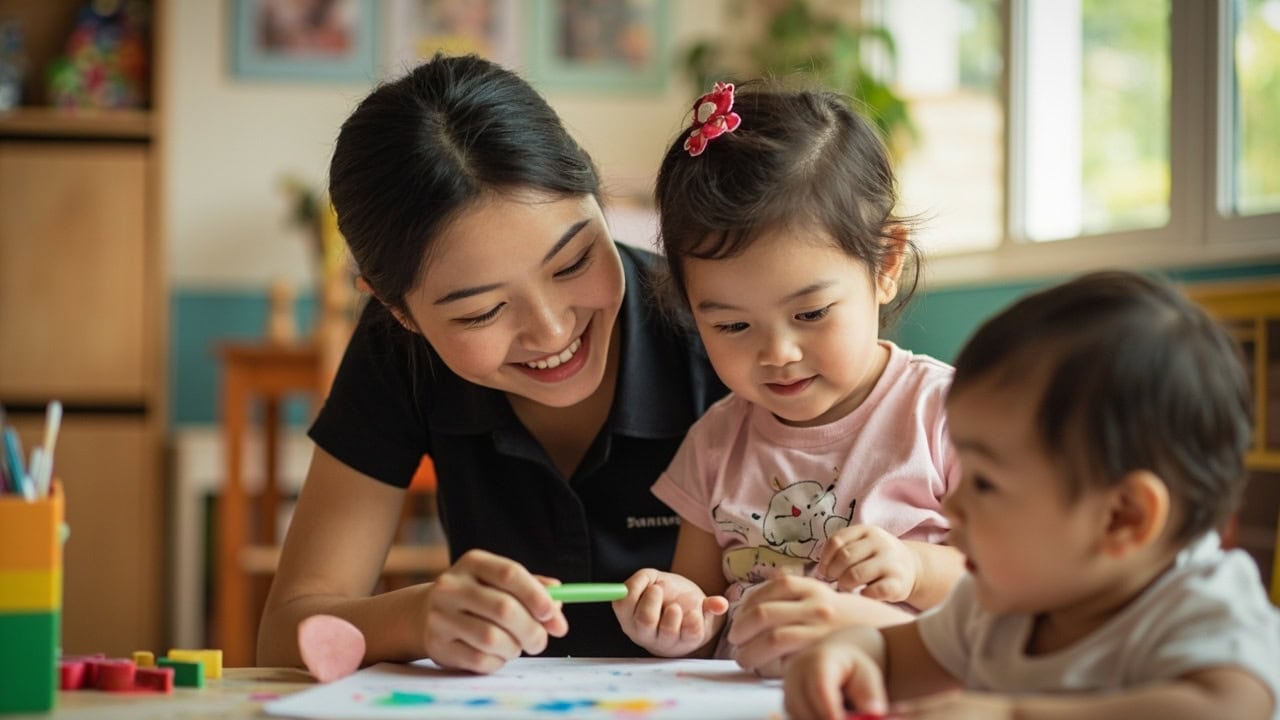
Look at whether the caregivers seem warm, present, and thoughtful. When you pick your child up, observe their state.
Ask yourself:
- Is this a child whose nervous system is being supported?
- Is this a child who is building the capacity to adapt, to recover, to trust, to learn?
Because that is school readiness. Not what they know. Who they are becoming.
A Final Thought
The work we do at EduNanny is not glamorous. It happens in small moments—songs sung during a diaper change, hands held while navigating a stair, tears soothed after a tumble, a caregiver kneeling down to meet a child’s eyes and saying, I see you. I hear you. You are safe here.
It happens in the consistent, patient, attuned presence of adults who understand that they are not just caring for children. They are building futures. They are laying the neurological foundation upon which everything else will be built.
This is the work that matters most. This is the readiness that Primary One teachers actually look for. And this is what we are honoured to do at EduNanny by BUTLER.
Your child’s nervous system is building itself right now. In every moment of their early years, it is learning what the world is like. Is it safe? Is it manageable? Can I bounce back?
The answers to those questions will shape everything that comes next—not just Primary One, but their relationships, their work, their capacity to navigate a complex and changing world.
Let us help you give your child the foundation they deserve.
Not the performance of readiness. The real thing.
At EduNanny Singapore, we believe every child deserves a strong start. If you would like to learn more about our approach to quality infant and childminding care, we welcome you to connect with us or read more about who we are.