Responsive Song Play from Six to Twelve Months
As your baby’s attention and participation change, keep the musical anchor familiar and change only one part of the exchange. A four-box Song Card helps you notice, try one small layer and make the next round simpler.
Does your baby look away during a song that once held their attention? You do not need to abandon the song or immediately add more words, gestures and questions. From roughly six months to one year, keep the tune, main rhythm and overall order familiar, then respond to your baby one cue at a time.
The useful pattern is simple: keep, notice, add one layer and reset. This guide uses responsive song play to make the most of one familiar song as your baby’s attention and participation change. The aim is a shared exchange, not a performance or a test. The examples show possibilities, not deadlines or a required sequence.
Keep the song you already know
A familiar song gives your baby a consistent starting point. You can keep its tune, main rhythm and overall order steady even when your baby’s gaze, movements or sounds change from one day to the next. That stability gives you room to notice how your baby joins the song this time.
HealthHub’s first-year brain development guide gives examples of possible participation at different ages: turning towards sounds around 20 weeks, imitating simple actions around 28 weeks, recognising familiar games and rhymes around 36 weeks and understanding simple questions around one year. These examples can help you recognise a possible response, but they are not deadlines or a checklist.
Your baby may join through looking towards you, making a sound, moving an arm, changing expression or waiting for a pause. These responses do not need to match a checklist. UNICEF’s nine-month milestone guide advises following a baby’s signals and letting the baby lead during playtime. In responsive song play, that may mean repeating what worked yesterday or simplifying today’s exchange.
Add one layer at a time
If you want to introduce a change, make it one visible addition. A layer might be a brief pause while facing your baby, one gentle gesture, one matching sound, one familiar word or one simple question. Leave the song’s main rhythm unchanged while you try it.
UNICEF’s baby talk guidance describes simpler wording, repeated words, slower speech and exaggerated facial expressions in infant-directed speech. During a song, you can adapt those features to the material you already have. Keep your face visible, repeat one familiar word and slow down without adding several new prompts at once.
Adding a gesture, a new word and a question together makes it harder to understand what your baby joined. One change gives you a clearer next decision. If your baby looks, vocalises or moves, repeat that same version once before considering another layer.
You do not need to complete every layer. Your baby may enjoy many rounds of the face and rhythm version. That is still responsive song play because you are following the baby’s lead rather than treating the song as a checklist.
A four-box Song Card for one session
Choose one short, familiar song. Keep its tune, main rhythm and overall order unchanged for this session. Before you begin, complete these four boxes for your particular baby.
| Box | Write it before you start |
|---|---|
| Keep | Which song, rhythm or repeated phrase will stay unchanged? |
| Notice | What might your baby show through gaze, sound, expression or movement? |
| Add one layer | What single change will you try: a pause, gesture, sound, familiar word or simple question? |
| Reset | What will you return to if your baby stops joining or seems less interested? |
The Song Card is a practical prompt for one calm, awake session. It is not a screening or developmental assessment tool. Here is an illustrative three-round example using a short song with a repeated chorus. It shows how the card might work, not what every baby should do.
Round one: face and rhythm
Keep: Sing at the same pace and use the same rhythm throughout. Notice: Face your baby, pause briefly before the repeated chorus and watch for a gaze, sound, smile or small movement. Add one layer: Add only your face and the pause. Reset: If your baby looks away, becomes unsettled or does not re-engage, return to the same song and rhythm rather than adding more.
Round two: one gesture
Keep: Use the same song and rhythm. Notice: Suppose your baby meets your gaze or makes a sound at the pause. Repeat that response once more. Add one layer: Add one gentle gesture, such as bringing your hands together on the word again. Reset: If the response fades, return to the face and rhythm version.
Round three: one familiar question
Keep: Leave the song’s rhythm unchanged. Notice: In this example, your baby repeats the earlier movement after the gesture. Add one layer: Try one brief familiar question, such as More?, without adding another gesture. Reset: If your baby does not renew the interaction, stop adding language and return to the original face and rhythm version.
Afterwards, write one sentence for the Notice box: At the pause, my baby looked towards me and lifted one hand. This records what happened without turning a single response into a conclusion about development.
Let the next round be simpler
At the end of a session, make one decision. Repeat the last version if your baby joined it again. Reset to face and rhythm if the added layer reduced their interest. Stop the activity if your baby has moved on, become unsettled or no longer wants to engage.
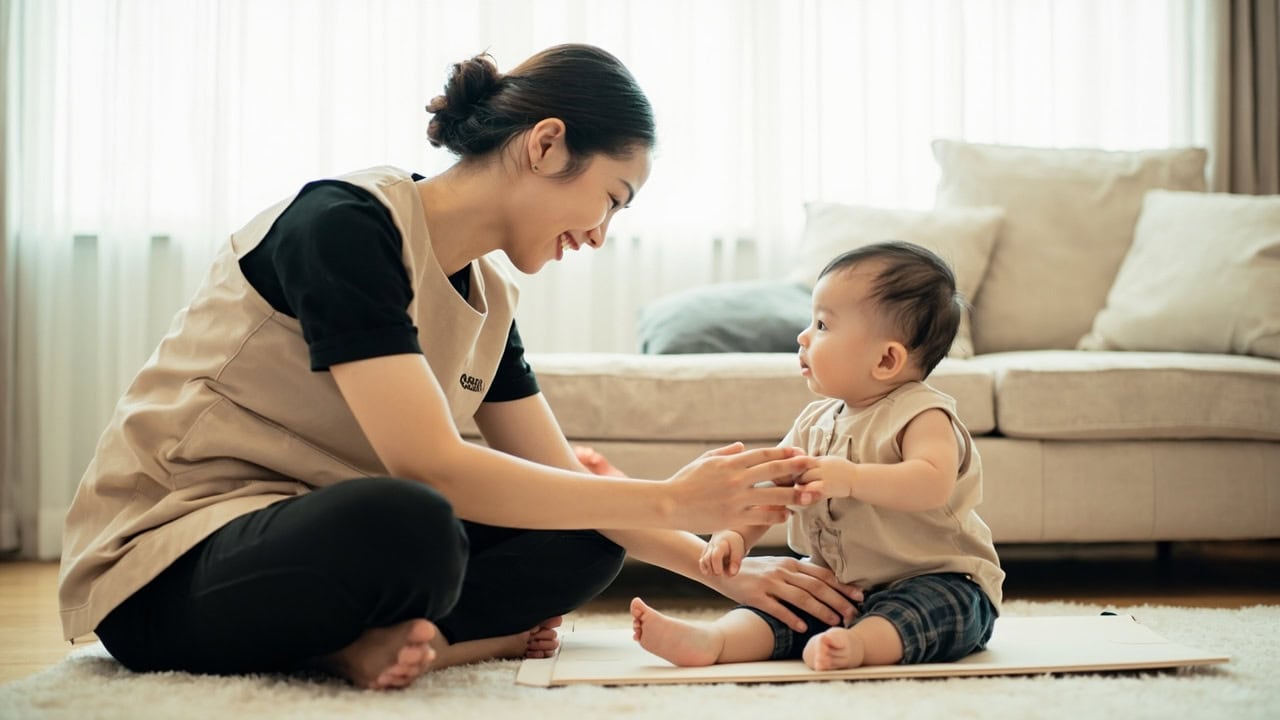
Keep the interaction awake and closely supervised. For floor play, your baby should be within arm’s reach in stable supported sitting. If your baby is not ready for supported sitting, hold them securely in a comfortable position or choose another calm moment. Use a clear floor area and do not introduce small objects into this song activity.
A quieter day does not mean the song has failed. It means the next version can be the face and rhythm you already know, with room for your baby to show what they bring to the exchange.
Sources and further reading
- Baby talk: Mini parenting master class | UNICEF · www.unicef.org
- Your baby's developmental milestones at 9 months | UNICEF Parenting · www.unicef.org
- Stimulate Your Baby's First Year Brain Development · www.healthhub.sg
The images in this article were generated with AI for illustration. They do not show actual EduNanny staff, children or facilities.
After your next familiar song, note one thing your baby did and one thing worth repeating. Keep the next round as simple as needed.