Reading Your Child at Pickup: The Observation Framework Singapore Parents Need
“`html
Observation Is a Skill You Can Develop
Here is what I want you to understand, because it matters more than any list of credentials or centre ratings: observation is a skill. It is learnable. And when you develop it, everything changes.
When your child was newborn, you learned to read hunger in the earliest stirring—a certain restlessness before the cry, a turning of the head. You learned to distinguish the frustrated wail from the I-am-done-crying wail, the tired whimper from the uncomfortable one. This was not instinct. It was accumulated noticing. You became an observer of your own child.
That same capacity can deepen. It can become precise. It can serve you not just at home but in every environment where your child spends their hours, including childcare.
The problem is that most parents stop there. They master the newborn signals and then feel suddenly unprepared when their child enters a new social environment—because the signals change, the context changes, and they have not been given the next layer of observation to work with.
Let me give that to you now.
The Three Levels of Observation That Change Everything
Level 1: Surface Signals at Pickup
These are the immediate observations you make at pickup—your child’s physical state, their emotional tone, the quality of their reconnection with you.
A child who runs to you with open arms and then stops halfway, looking back over their shoulder—that is a signal. A child who melts into you without hesitation, body completely soft—that is a signal too. Neither is necessarily good or bad on its own. But together, over time, they begin to tell you something.
Notice the hands. A child’s hands tell you a great deal. Are they relaxed or fisted? Do they reach for you or do they hold back, keeping one hand near a caregiver or a toy as though they are not ready to fully leave? These are not mysteries. They are information.
Notice the face. Not whether your child is smiling—children learn to smile for caregivers early—but whether the smile reaches the eyes. Whether the face is open and available or performing. A child who has been genuinely engaged looks different from a child who has been managed.
Notice the transition. Does your child transition into your presence smoothly, or is there a moment of recalibration? A brief confusion? Some children take a few minutes to shift gears between environments, and that is normal. Others take much longer, and that is also information.
These are the signals available to you at pickup, and most parents notice some of them instinctively. The challenge is that they notice them without a framework for what they mean. You see your child’s face and feel uncertain. Is this normal? Should I be worried? Without a framework, every observation floats—you have data but no interpretation.
Level 2: Patterns Across Weeks
Observation becomes powerful only in repetition. When you begin to notice your child’s behavior not on a single day but across a span of time, patterns emerge that single observations cannot reveal. Perhaps your child is consistently quieter on Tuesday mornings than on other days. Perhaps they resist the car seat on the way to childcare but settle quickly once they arrive. Perhaps there is a particular caregiver they gravitates toward, or a specific activity that consistently draws them in.
These patterns do not tell you everything, but they tell you something important: they tell you who your child is in that environment. Not the child you imagine or hope for, but the actual child you have, expressed in their actual responses over time.
For Singapore parents, this level of observation addresses a particular kind of uncertainty. We research extensively. We read reviews. We ask friends. We tour centres. And then, after all that research, we are asked to choose, and we still feel uncertain—because all of that external information does not add up to knowing your own child in that specific place.
Pattern observation answers that uncertainty. Not with certainty about the centre, but with certainty about your child. And when you know your child well, the centre question becomes much clearer.
Level 3: Developmental Narrative Over Months
This is the level that separates adequate observation from genuine insight.
At this level, you are not asking what happened today. You are asking who is my child becoming. You are tracking the arc of their development—the expansion of their language, the evolution of their play, the growth of their independence, the deepening of their social curiosity.
In a quality care environment, this narrative becomes visible because the environment is worth watching. The caregivers are responsive in ways that invite your child to grow. The routines support exploration. The interactions are calibrated to your child’s developmental stage.
When you observe at this level, you begin to see your child’s childcare experience not as a series of days but as a developmental journey. And you begin to see yourself as a participant in that journey, not a passive worrier on the outside.
What Quality Childcare Makes Possible
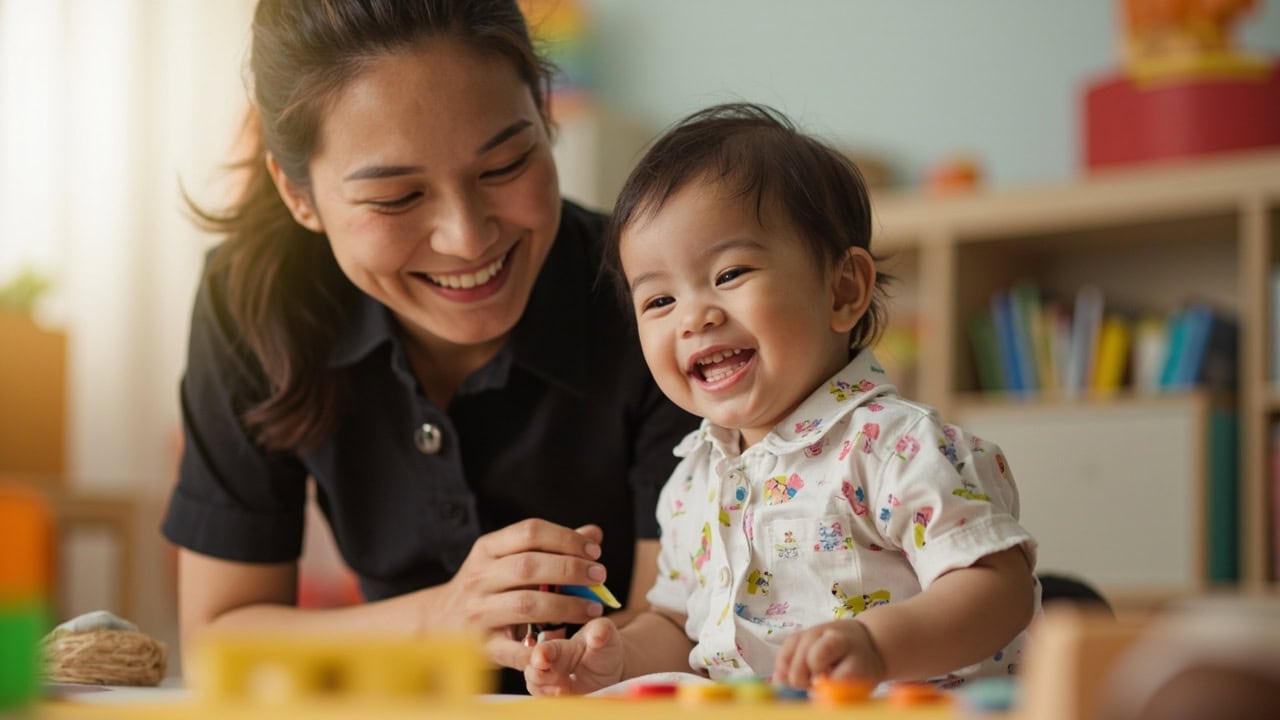
When caregivers are skilled and well-supported—when ratios are small enough that they can actually respond to individual children—children reveal more of themselves. They are not performing for overwhelmed adults. They are not managing in an understaffed room. They are simply being who they are.
This is why the ratio matters so profoundly. In an environment where one caregiver holds three infants, every child gets seen. The signals are not lost in noise. The small moments that reveal a child’s state—the slight furrow, the sudden stillness, the way a hand reaches out to touch a face—these are visible when there is space to see them.
And when you as a parent are watching in that environment, when you have begun to develop your observation skill, what you see is rewarding. You see your child’s emerging self. You see them trying things they could not try at home because there was always a parent there to do it for them. You see them discovering their own competence.
Here is the reversal that observation competence brings. In the beginning, you are watching to check if the care is good. You are scanning for danger, for inadequacy, for reasons to worry. But as your observation skill develops, something shifts. You are no longer watching defensively. You are watching with genuine curiosity and growing confidence. You are seeing your child in a new way.
A child who cries at every pickup is not necessarily a child in distress. A child who does not want to leave a caregiver at the end of the day is telling you something about what they found there. These things are not always what they seem on the surface, and a parent with observation skill can hold that complexity without panic.
This is what trust looks like when it is earned, not imposed. It is not the trust of believing everything is fine. It is the trust of knowing what you are looking at.
What to Look For When You Visit
Think about what this means for the childcare search. You are not looking for the centre with the best reputation or the most impressive credentials. You are looking for the environment where your careful observation will be rewarded. Where what you see when you watch will be worth watching. Where your child can be seen clearly.
Here is what to look for:
- Caregiver responsiveness – Do the caregivers notice individual children, or are they managing groups? Can they name what each child was doing an hour ago?
- Children’s natural behavior – Are the children engaged in meaningful play, or are they being kept quiet? Do they move freely and explore?
- The quality of interactions – Are caregivers talking to children at eye level, responding to their cues, or is the rhythm teacher-directed with little room for child initiation?
- Your child’s response – When you observe your child in that space over time, what do you see? Which caregiver do they gravitate toward? What makes them light up?
EduNanny’s Approach
As part of the ECDA Childminding Pilot, EduNanny operates with ratios that make observation meaningful. When there are up to three infants per caregiver, the kind of attentive responsiveness that reveals a child becomes possible. The environment is designed for this—not to impress parents during tours, but to sustain the kind of care that gives children space to be known.
EduNanny offers both home-based and centre-based pathways, because families are different and needs are different. Whether your child is in a home setting with a trusted caregiver or in a community environment with structured support, the observation principles remain the same. You are watching a child who is being well-watched.
The practical elements are there too. Monday to Friday care blocks, designed for working families. CDA and Baby Bonus usability, because financial clarity matters. Communication and transparency, including CCTV measures where deployed. These are not the story—they are the foundation that allows the story to be visible.
The story is your child. The story is the way they light up when they master something new. The story is the way they have learned to trust certain people. The story is the developmental arc that only becomes visible when the environment is worth watching closely enough to see it.
Addressing Common Concerns
“What if I’m reading too much into everything?”
Parents often worry about becoming hypervigilant or reading meaning into every small behavior. The difference between healthy observation and anxious over-reading is context. When you have a framework—when you understand patterns and developmental arcs—individual moments fit into a larger picture. You are not panicking over one stiff hug at pickup. You are noticing whether that pattern persists across weeks, and whether other signals support or contradict it.
“What if my child seems fine but something is wrong?”
Children are remarkably adaptable, and sometimes adaptation can look like contentment. This is where the three-level framework helps. Surface signals at pickup may not tell you everything, but patterns across weeks reveal the deeper narrative. A child who seems fine daily but consistently loses skills or enthusiasm over months is giving you different information than a child who seems fine daily and continues to grow. The skill is in holding both levels at once.
“How do I know if my observation is reliable?”
Your observation becomes more reliable with practice, just as it did when you learned to read your newborn’s hunger cues. The key is consistency—not watching once and deciding, but returning again and again with the same attention. Over time, you will notice which observations are noise and which are signal. This is not a skill that requires special training. It requires intention and a willingness to trust what you see.
A Practical Starting Point
If you are beginning your childcare search—or if you are already in one and want to deepen your observation—here is where to start:
- At your next pickup, pause before you pick up your child. Take thirty seconds to just watch. What is their body doing? What is their face doing? How do they transition when they see you?
- Notice one thing each day. Not everything. One thing. Maybe it is the hands. Maybe it is the quality of the hello. Over weeks, this accumulates into understanding.
- Look for patterns, not moments. A single observation tells you very little. Three weeks of consistent observations tells you something. Trust the arc, not the data point.
- Ask the caregiver what they noticed. A good caregiver will have observations to share. They will know your child’s rhythms, preferences, and little victories. If they cannot tell you anything specific, that is information too.
The Observation Checklist: Reading Your Child at Pickup
| What to Notice | What It Might Tell You |
|---|---|
| The body (stiff or soft?) | Level of comfort, stress, or genuine relaxation |
| The hands (reaching or holding back?) | Readiness to reconnect, attachment security |
| The face (reaching the eyes?) | Genuine engagement versus performed compliance |
| The transition (smooth or recalibrating?) | How easily your child shifts between environments |
| The eye contact | Availability, security, and presence in the moment |
| The reconnection quality | Whether they seek comfort, play, or independence from you first |
These observations are not diagnostic. They are pieces of a larger picture. Used consistently over time, they build into something powerful: your own growing competence as an observer of your child.
You Are Learning How to Watch
You already know your child better than anyone else in the world. That knowledge is not insufficient—it is incomplete. And incompleteness is not a failure. It is an invitation to grow.
Observation is the skill that fills that gap. Not the skill of watching constantly, anxiously, searching for reassurance. But the skill of watching with intention, with a framework, with the confidence that comes from understanding what you are seeing.
When you develop this skill, something shifts. You become a different kind of parent—not a more anxious one, not a more controlling one, but a more capable one. You are the kind of parent who can look at a childcare environment and know what you are seeing. You are the kind of parent who can read your child’s signals and trust that reading. You are the kind of parent whose trust is earned through their own competence, not borrowed from external authority.
This is what thoughtful, quality childcare makes possible. Not just the care itself, though that matters. But the visibility of that quality. The way a skilled caregiver makes your child visible to you. The way a well-designed environment reveals rather than conceals. The way observation becomes not a burden but a gift—because there is something genuinely wonderful to see.
You are standing at the gate. Your child is inside. You do not know everything that happens in those hours.
But you are learning how to watch. You are developing the eyes that find the right childcare not by searching for perfection, but by learning to see clearly what is actually there.
And what you will find, in an environment worth watching, is your child—becoming, growing, discovering who they are in your absence and in your presence.
That is what observation teaches you. That is what it gives you.
The rest is just watching.
If you are researching infant care or childminding in Singapore and want to explore an environment where careful observation is rewarded, EduNanny welcomes your questions. The best decisions come from parents who know what they are seeing—and a quality care environment gives you exactly that.
“`