From Morning Goodbye to Informed Trust in Singapore Childcare
The Morning Goodbye: When Trust Meets Uncertainty
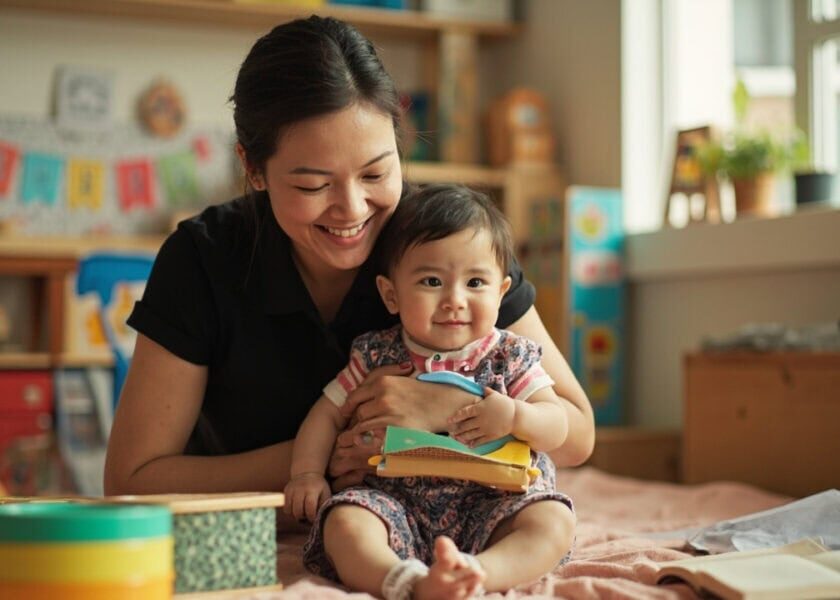
There is a moment every morning that most parents in Singapore know by heart. The bag is packed. The milk bottle is in the fridge. The diaper change is done. And then comes the handoff — that brief, electric window where you look into your child’s eyes, kiss the top of their head, and walk away knowing you have placed them in someone else’s hands.
It is one of the most intimate acts of trust you will ever perform. And for many parents, it is also one of the most agonizing — because the moment that door closes behind you, your imagination takes over.
You are not alone in this. Walk into any childcare setting in Singapore on a weekday morning and watch the parents lingering at the gate, the ones who pause just a little too long before stepping away. It is not that they don’t trust the place. It is that they cannot see inside. And the mind, when it cannot see, fills in the gaps with uncertainty.
You might picture your child wandering aimlessly. Sitting in front of a screen. Crying for you while someone in the background does their best. Or perhaps worse — you picture nothing at all. A kind of holding pattern. Time passed. A day spent.
Here is what this article wants to offer you: a look inside the hours you cannot see. Not because the unknown should be feared, but because understanding what is actually happening transforms anxious unknowing into something else entirely — informed confidence.
Inside the Hours You Cannot See
The day does not begin with a blank slate. It begins with a transition — and transitions, in intentional care, are never accidental.
The caregiver meets your child at the door, at eye level, with their name ready. Not “hello there, little one.” Your child’s name. The difference sounds small. It is not small. It is the first signal that this space sees your child as a person, not a task.
You may have just handed over a tired, clingy, slightly tearful toddler. Here is what happens next. The caregiver does not rush to distract or dismiss. They acknowledge the feeling — “I see you’re feeling a little unsure right now” — and then they offer a bridge. A familiar activity set out on the table. A song the children have already come to associate with this moment. Another child already engaged and laughing nearby. The environment itself does the work of transition, and the caregiver orchestrates it without force.
In infant care settings with ratios reaching one caregiver to three infants, your child’s caregiver has time to notice when one child’s breathing changes before a fever spikes. She has time to narrate what she is doing — “Now I’m pouring the water, watch how it flows” — which plants the seeds of language in a mind that is absorbing thousands of words a day.
She has time to sit on the floor and let a ten-month-old practice pulling herself up using the sofa, stepping back, stepping forward again, the same fourteen seconds of effort repeated until suddenly, triumphantly, she is standing.
You cannot rush that moment. You cannot manufacture it with a lesson plan. But you can create the conditions for it — and a well-trained caregiver does exactly that, every single day, as part of what looks, from the outside, like simple caregiving.
The Morning Rhythm in Quality Childcare
Let me describe what a morning actually contains in a well-designed childcare setting.
Free play — and this is not aimless wandering. In a quality environment, the play space is curated. A basket of wooden blocks is placed beside a child who is discovering cause and effect. A water table is set up for a toddler exploring texture and temperature. A dramatic play corner with soft fruits and small baskets draws a two-year-old into the first foundations of symbolic thinking. The caregiver is not supervising from a chair. She is moving, kneeling, extending.
Group activity — and this is where language development accelerates. A picture book held up so every child can see the illustrations. Not read aloud mechanically, but discussed — “Look, this dog has floppy ears, do you have a dog at home? What does your dog feel like?” Each question is a thread of connection, pulling language out of a child who is just beginning to understand that words are bridges.
Movement and sensory exploration — between ten and eleven in the morning, depending on the child’s age and natural rhythms. A short walk in the compound. A dance circle. A sensory bin filled with dried rice or coloured pasta. Every pour, every scoop, every fingertip tracing a texture is a lesson written in the language the body speaks before words arrive.
Rest — not the kind of rest that happens when a child is simply left alone to sleep. Real rest, in quality childcare, is structured and supported. The room is dimmed. White noise or soft music plays at a calibrated volume. The caregiver moves among sleeping children with the quiet attentiveness of someone who knows that a child’s sleep architecture is not incidental — it is foundational to memory consolidation, immune function, and mood regulation.
She checks breathing patterns. She adjusts a blanket by a quarter inch. She notices when a child is cycling toward waking and intervenes gently with a hand on the back before full distress sets in.
This is professionalism. And it is happening while you are at your desk, in a meeting, on the MRT, doing the work that lets you be a parent at all.
The Professional Standards That Set Quality Apart
Understanding what is actually happening in quality childcare matters because it changes how you relate to the experience of separation. The anxiety of not knowing is not merely about worry. It is about a kind of helplessness — the sense that your child’s most formative hours are passing without you, and you have been asked to simply trust.
Trust is essential. But trust built on understanding is stronger than trust built on faith alone.
What Your Child’s Evening Behavior Is Telling You
Here is one of the most underappreciated gifts that quality childcare gives to families: not just what happens during the day, but the language it gives you to understand your child when the day ends.
Your child comes home. She is tired. She is slightly more clingy than usual. She melts down over something small.
If you do not know what those behaviors mean, you might interpret them as signs of distress — of a day that was too hard or too much. But if you understand what your child has been doing all day — building core muscles through active play, processing new social experiences, consolidating nap cycles — then the tiredness makes sense. The clinginess is a regulatory need, not a failure of the day. The meltdown is the nervous system releasing accumulated stimulation.
You read your child with new fluency, and the evening interaction between you shifts from anxious interpretation to informed connection.
Peer Interaction and Social Learning
Quality group care offers something that home-based care alone cannot fully replicate: a rich peer environment. Children learn, in the earliest years, that they are not the only person in the world. They encounter other children who want the same toy, who have different reactions, who laugh at different things.
This is not always comfortable. But it is foundational. When a two-year-old grabs a toy from another child, it is not aggression — it is a developmental milestone in ownership and social learning. When a caregiver responds with calm, specific guidance — “I see you want the truck. Let’s wait our turn” — that child is learning something that cannot be taught in a lesson. It must be lived.
The social curriculum of quality childcare is written into every interaction, every shared activity, every small negotiation over space and attention. Your child is building the first foundations of empathy, cooperation, and social awareness — and they are doing it alongside peers, in an environment where trained adults help them make sense of what they are experiencing.
The ECDA Childminding Pilot and What It Means for You
In Singapore’s childcare landscape, the terms “infant care” and “childminding” can mean very different things depending on where you go. Understanding the standards behind your child’s care matters.
EduNanny by BUTLER operates within the ECDA Childminding Pilot, which means its caregivers are not just trained in childcare basics. They are part of a structured professional pathway that emphasizes developmental observation, responsive caregiving, and reflective practice.
Having a programme anchored in recognized standards and supported by a pilot framework gives parents a kind of accountability that is rare in this sector. It means the person holding your child is not just experienced. She is continually developing her skills, her observational acuity, and her understanding of how infants and toddlers actually learn and grow.
EduNanny offers both home-based and centre-based pathways, because families have different needs and preferences. Perhaps you prefer the intimacy of home-based care, where your child is in a familiar environment with a dedicated caregiver. Perhaps the community setting appeals to you — the rich peer environment that teaches social negotiation, shared play, and the early textures of friendship.
Either pathway is designed with the same intentionality, the same developmental rigour, and the same professional standards. The choice is about fit for your family, not trade-offs in quality.
Addressing the Concerns Singapore Parents Actually Have
On Cost and Accessibility
Singapore parents are sophisticated. They know that quality infant care comes at a price, and many quietly worry that the kind of care described here — attentive, intentional, professionally staffed — is a luxury reserved for families with significant means.
The ECDA Childminding Pilot operates within fee structures designed to make quality care more accessible. CDA and Baby Bonus funds can be used to offset costs. These are not afterthoughts or promotional incentives. They are structural features of a system that was designed to make premium childcare viable for ordinary Singapore families.
Monday to Friday care blocks, island-wide availability — these details exist so that working parents across Singapore, not just those in certain districts or income brackets, can access a standard of care that genuinely serves their child’s development.
On Transparency and Communication
One of the most common concerns parents express is not knowing what their child did all day. This is not a small thing. It is a legitimate need — and quality childcare providers know it.
When settings deploy communication practices that keep parents informed — whether through daily updates, open dialogue, or structured touchpoints — something shifts. You are no longer imagining what your child’s day looked like. You are coming home with a picture. A real one.
The gap between home and childcare narrows. You become a more confident parent, not because you have stopped worrying, but because your worrying has been replaced by understanding.
Tools That Bridge Home and Care
EduNanny is building tools that reflect how modern parents actually live. The Thomas AI Chatbot is a resource that sits alongside the human care — answering questions, offering guidance, connecting parents to information that helps them make sense of what they are observing at home.
It is not a replacement for professional advice or for the caregiver relationship. It is a bridge. It helps parents carry the understanding they are building about their child’s development into their own home, extending the continuity between the childcare setting and family life.
So much of parenting anxiety comes from feeling fragmented — the child you know at home is not quite the child the caregiver describes at pickup, and you are left in between, uncertain which version is true. When parents are genuinely informed about the childcare day, when tools can help translate a behavior or answer a developmental question, the gap narrows.
What to Look For When Choosing Infant Care
For parents researching their options in Singapore, here are some indicators of quality that go beyond marketing language:
- Caregiver-to-child ratios — especially in infant settings, lower ratios mean more individual attention and observation
- Transition practices — how does the setting handle arrival and departure? Is there a thoughtful, consistent approach?
- Communication systems — what information do parents receive about the child’s day? How is this delivered?
- Professional development — are caregivers engaged in ongoing training and reflective practice?
- Environment design — does the space feel intentional? Are activities set up with purpose rather than just filling time?
- Rest and nourishment protocols — how does the setting support fundamental needs with attentiveness?
- Transparency about daily structure — can you see what a typical day looks like? Does the schedule serve children, or just fill hours?
Ask to observe. Ask questions. Ask what happens when a child is struggling. The answers you receive will tell you a great deal about whether the care is genuinely child-centred or simply professionally managed.
The Evening Return: A Different Kind of Reunion
Let me close by returning to that morning moment, because it deserves a different ending than the one your imagination usually provides.
You hand your child over. You look into their eyes. And this time — if you know what is about to happen — the goodbye is not a cliff edge. It is a doorway.
Behind that door, a carefully designed day is about to unfold. Your child will be seen, by name. Held, when they need holding. Challenged, at exactly the developmental edge where growth happens. Allowed to rest, in a room where someone is paying attention to the rhythm of their breath.
They will play, explore, fail, try again, and succeed at things you have not yet imagined. They will sit near other children and begin to understand that the world contains people who are not them. They will hear thousands of words — narrated, sung, asked, answered — building the architecture of language in a mind that is more hungry for input than we ever fully appreciate.
And at the end of that day, when you pick them up and they come running to you with the particular exhaustion of a child who has lived a full day, you will know what that tiredness means. You will understand the clinginess. You will read the behavior not as a mystery but as a report — your child telling you, in the only language they currently have, what kind of day they had.
That is the gift of intentional childcare. Not that it replaces you. Not that it does what only you can do. But that it holds your child with skill, with warmth, and with purpose in the hours when you cannot be there — and then gives you the knowledge to understand what happened, so that when you come back together in the evening, your connection is informed, your confidence is earned, and your child is met by a parent who is not anxious, but aware.
Ready to Look Inside?
EduNanny Singapore does not ask for your blind trust. It invites you to look inside the hours you cannot see.
What you will find there is not just good care. It is a curriculum, written into every diaper change, every song, every small triumph of a child pulling themselves up to standing — written by people who believe that your child’s hours matter. Every single one of them.
If you are a parent in Singapore researching infant care or childminding, you owe it to yourself to understand what quality actually looks like before you make a decision. The morning goodbye does not have to be an act of faith. It can be an act of informed trust — and that is a far stronger foundation for the partnership you are about to build.
Explore EduNanny Singapore’s infant care and childminding options today, and discover what is actually happening in the hours you cannot see.
Written for parents in Singapore who are navigating the transition to childcare — and are looking for care that earns their trust through transparency, standards, and genuine developmental value.
EduNanny Singapore · About Our Programme · Get in Touch