Reading the Signs: How Singapore Children Show Their True Wellbeing
What Your Child Is Telling You (Even Before They Have Words)
There is a moment, familiar to every parent in Singapore, when you drop your child at a childcare centre or into the arms of a caregiver and your mind runs through the same quiet checklist. Is the schedule manageable? Is the location convenient? Are the credentials in order? Is the ratio right?
These are reasonable questions. These are responsible questions. And they are, by necessity, incomplete.
Because somewhere behind that checklist, deeper than logistics and further than credentials, there is a question you are actually asking—the question that wakes you at 3 a.m., the question that tightens your chest when you think about returning to work, the question that no facility tour can fully answer.
That question is not about schedules or proximity. That question is: Will my child feel it, on the inside, the way I hope they will? Will this place be good for the person they are becoming?
This is the question we do not always say aloud, because it feels too tender, too uncertain, too close to the rawest part of parenting. But it is always there. And it is the right question.
How Children Communicate What They Cannot Say
The only reason that deeper question feels so difficult to answer is that you cannot be inside that room with your child. You cannot feel what they feel. Or so it seems.
But here is what we want to share with you today: your child is not silent about what they experience. Your child has been telling you, every single day, whether the care they receive is nourishing them from the inside out. You have been listening—you just may not have known what you were listening for.
Young children are, by nature, profoundly expressive beings. Long before they have words for complex emotions, they communicate through behavior, through tone, through the way their bodies settle into a space or reach for a particular person.
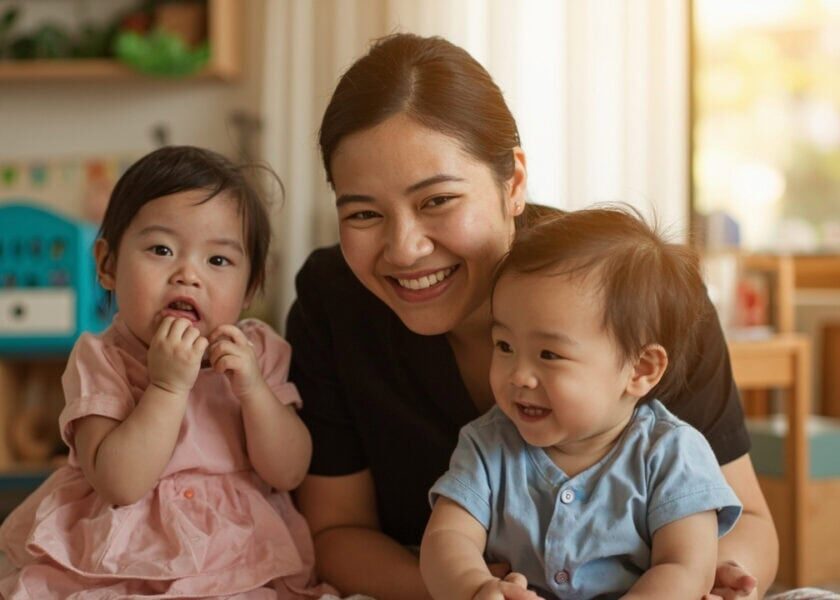
A child who feels genuinely safe does not merely comply with a caregiver’s presence. They lean in. They look for that person across a room. They are not performing comfort—they are experiencing it.
The challenge for parents is that we have rarely been taught to read this language. We live in a world that teaches us to evaluate childcare on external metrics: clean facilities, certified staff, enriching activities on paper. These things matter. But they do not tell us what it feels like to be two years old in that environment. They do not capture the difference between a child who tolerates childcare and a child who flourishes within it.
Recognising a Thriving Child
When a child is in an environment that genuinely supports their inner world, something shifts in how they move through their day. You may notice it in the morning.
Not dread, but a quiet willingness.
A child who feels truly seen by their caregiver does not experience separation as abandonment; they experience it as a pause, not a loss. They know, on a level deeper than reasoning, that the person caring for them understands who they are. That person noticed when they were tired. That person remembered their favourite rhyme. That person helped them find words when they were frustrated.
This is what secure attachment looks like in practice—a child who carries an internal working model of trust, not because they have been told to trust, but because they have felt trustworthy care, over and over, in the small moments that make up a day.
In a genuinely excellent childcare experience, you will also see something remarkable: the coexistence of attachment and autonomy. A child who feels deeply connected to their caregiver does not cling; they explore. They venture away because they know they can return. They take risks—not reckless ones, but the healthy, expanding risks of early childhood—because the internal sense of security is solid enough to support it.
This is the paradox that many parents sense but rarely see articulated: the most independent children are often the most attached. They did not learn independence by being pushed away. They learned it by being held close enough to feel safe taking their first steps away.
Signs That Distinguish Thriving From Tolerating
You see it in the way they come home. Not just calm, but open. A child who has been in an emotionally nourishing environment will often be more themselves after a day at care, not less. They may be tired, yes, but the tiredness is the tiredness of a full day, not the exhaustion of sustained stress. They will be curious, engaged, willing to share pieces of their day, not because they have been prompted to perform, but because they want to.
You see it in the way they speak about their caregiver. Not in scripted phrases learned for politeness, but in the texture of genuine recognition. “My teacher knows I like the red truck.” “She held me when I fell.” These are not trivial details. These are the building blocks of your child’s internal sense of being known.
You see it in their play. A child who feels secure in their childcare environment will often reenact aspects of their day—the rhythms, the relationships, the emotional texture of their experiences—through play. This is healthy integration. They are making sense of their world because the world made sense to them.
You see it, most importantly, in the gap between behaviour and feeling. A child who is merely complying with childcare will perform safety. They will be compliant. They will be easy. But they will not be radiant. They will not be expansive. They will not carry that particular glow of a child who knows, in their bones, that they are valued for exactly who they are.
The difference is not subtle once you learn to look for it. It is the difference between a child who comes home from childcare and a child who runs toward their caregiver when they arrive. It is the difference between a child who tolerates the day and a child who returns to it with something like eagerness—not because they do not miss their parents, they do, and that is beautiful and healthy—but because they have found a place where they are genuinely at home in themselves.
What Quality Childcare Actually Looks Like
In Singapore’s childcare landscape, where centre-based care and home-based arrangements both offer distinct pathways, the markers of quality remain consistent across settings. Whether you are considering a childcare centre or a home-based childminder, what you are truly seeking is an environment where your child’s internal experience is taken seriously.
Quality is not primarily about impressive facilities or extensive activity schedules. It is about the quality of attention your child receives in those small, unscripted moments—the transition when you leave, the frustration when a toy is taken, the tiredness that needs to be acknowledged before it becomes a meltdown.
You can often sense this quality within the first few weeks, not by any formal assessment, but by watching your child’s response:
- Does your child seem to settle into a rhythm with their caregiver?
- Do they show recognition—not just of the caregiver, but of the routines and rhythms of the day?
- Do they return to you after care more themselves, not less?
These are the questions that matter most. And they are questions that no inspection report or credentials list can fully answer. Only your child can tell you—and your child is telling you, every day.
Answering Common Parent Questions
How will I really know what my child is experiencing?
No system can give you complete certainty—and that is healthy to acknowledge. But quality childminding creates the conditions for you to know more than you might expect. Regular, meaningful updates about your child’s day—not just “they had a good day” but specific observations about mood, interactions, and moments—help bridge the gap between your world and theirs.
What if my child seems fine but I still feel uncertain?
This is one of the most common experiences for parents. You observe your child and find no red flags, yet something still feels unresolved. This is not irrational—it is your parental instinct at work. Trust that instinct, but also give it time to be informed by real evidence. Over the first few weeks of a new arrangement, watch for the patterns described above: the settling, the openness, the way your child speaks about their caregiver. Your uncertainty may resolve as you accumulate evidence. Or it may sharpen into clarity that something is not right. Either way, you are better equipped to act.
How EduNanny Was Built Around Your Child’s Inner World
The early years are not merely a period of care before the “real” development begins. They are the period in which the internal working models of trust, exploration, and connection are being laid down—not as abstractions, but as felt realities.
A child who experiences consistent, attuned, emotionally intelligent care in these years is not just comfortable; they are building a foundation for how they will understand relationships, take on challenges, and navigate the world for the rest of their lives.
This is the standard that EduNanny by BUTLER was designed around.
Not merely the external standard—though that is met, rigorously. EduNanny participates in the ECDA Childminding Pilot, with carefully structured ratios that allow for genuine attunement rather than mere supervision. The care is grounded in pedagogical understanding, not just logistics. The fee structures within the pilot are designed to make quality care accessible, and the use of CDA and Baby Bonus funds provides practical pathways for families across Singapore.
But these facts, while important, are not the heart of the matter.
The heart of the matter is what happens in the room when you are not there. EduNanny’s approach is built on the conviction that the child’s internal experience is not a soft, secondary concern—it is the primary design principle. Every aspect of how caregivers are trained, how environments are structured, how communication flows between caregivers and families, is oriented around one question: What does this feel like from inside this child?
This is why EduNanny places such emphasis on communication and transparency—not as a corporate promise, but as a genuine extension of the care itself. When parents receive regular, meaningful updates about their child’s day, it is not merely for reassurance. It is because attunement works both ways. When parents can see what their child is experiencing, they become better partners in the child’s development. And when caregivers know that families are engaged and aware, the quality of attention tends to rise, not diminish.
Some EduNanny environments include CCTV measures not for surveillance, but for the same reason: clarity. The anxiety that parents carry about what happens in the hours they are away is real and legitimate. When that anxiety is addressed through genuine transparency, something shifts. Parents can relax into trust rather than straining toward vigilance.
And children can tell the difference. A calm, trusting parent is not a detached parent. A calm, trusting parent is a parent who has been given reason to believe their child is in a place that honours who they truly are.
A Framework for Your Decision
If you are a parent in Singapore making decisions about childcare, here is what we want to leave you with.
You are already paying attention. You are already listening. You are already asking the right question—whether this place will be good for your child on the inside, not just safe and convenient on the outside.
The difference between a decision that haunts you and a decision that frees you is not certainty about the childcare itself. It is confidence in your own ability to read your child. To notice the difference between tolerance and thriving. To trust what you are seeing and feeling in your child’s responses, rather than second-guessing yourself against external metrics that were never designed to capture what matters most.
Your child is telling you every day what their childcare experience is like. They are telling you in how they run toward the door in the morning or hesitate at the threshold. They are telling you in how they play after school and how they sleep at night. They are telling you in the caregiver’s name that surfaces first in conversation, and in the way they mention their day or hold it close.
Learn to listen to that language. Trust what you hear. And when you find an environment that makes your child more themselves, not less—a place where they are known and valued for exactly who they are—recognise that for what it is. Not just good childcare. Good foundations. The kind that matter for a lifetime.
EduNanny by BUTLER exists for this: to be that place for the children and families of Singapore. To take the child’s inner world seriously, in practice, every single day. To walk alongside parents in the profound, beautiful, sometimes uncertain work of raising the next generation.
You are not alone in this. Your child is seen. And so are you.
Ready to explore what quality childminding looks like for your family? Connect with EduNanny by BUTLER to learn how their approach is designed around your child’s internal world—not just their schedule.
#SingaporeChildcare #ChildmindingSG #QualityInfantCare #EduNannySG #EarlyChildhoodDevelopment