Raising Children Who Belong to Several Worlds
The Hidden Question Every Multicultural Singapore Family Carries
Somewhere between the Mandarin your mother-in-law speaks to your daughter and the English your child hears at playgroup, there is a question that no one quite asks out loud — but every multicultural family in Singapore feels.
It lives in the pause before you agree to yet another weekend visit. It surfaces in the look your partner gives you when a grandparent insists on feeding the baby something you quietly disagree with. It is the question of whether you are doing enough to preserve who you are, while also preparing your child to belong to a world far wider than the one you grew up in.
You are not alone in carrying that question.
Singapore is one of the most culturally rich cities in the world, and for the families who call it home, that richness is not abstract. It is lived. It is negotiated at the breakfast table, at the childcare door, at Sunday lunch when three generations occupy one room and each one holds a slightly different idea of what it means to raise a child well.
If you are a parent in Singapore — particularly one who has married into a different cultural world, or one who is raising children between two languages, two sets of customs, two frameworks of meaning — you know that the work of parenting is not just emotional and physical. It is profoundly cultural. And it rarely gets the acknowledgment it deserves.
That is the gap we want to speak to today. Not with answers that flatten complexity, but with recognition that has been absent from too many conversations about childcare in this country. Because we believe that the cultural complexity of your family is not a complication to be managed. It is a foundation to be built upon.
How Cultural Background Shapes Your Childcare Expectations
If you grew up Chinese in Singapore, you may have felt the quiet expectation that your child would speak your dialect, or at minimum, Mandarin — that language of roots, of ancestors, of a civilization that stretches back millennia. You may have felt the gentle pressure of grandparents who believe discipline looks a certain way, that respect is shown in particular forms, that a child’s earliest education is inseparable from cultural transmission.
And yet, you also live in a world where your child will compete globally, where English is the language of opportunity, where modern parenting philosophies arrive in your feed and whisper that maybe there is a gentler, more child-led way.
If you are Malay, you carry a tradition of communal childcare — the extended family as the default village, elders as natural teachers, bahasa as the heartbeat of identity. You may have felt the tension when the rhythm of that village conflicts with the demands of dual-income modern life, or when the expectations of the older generation seem to leave less room for the individual voice you are trying to nurture in your child.
If you are Indian, you may be navigating between the gravitational pull of Tamil or Malayalam or Hindi, the warmth of joint family structures, the festivals and food and stories that constitute a worldview — and the reality that your child will grow up in a Singapore where English is the common tongue, where inter-cultural marriage is increasingly common, where your child’s identity may be shaped by influences you never had.
And if you are Eurasian, or Anglo-Chinese, or from any of the beautifully mixed-heritage families that Singapore produces in such abundance, you may feel the absence of a single, clear cultural script. You may have been told — subtly, sometimes — that you are not quite one thing, not quite another. And now you are raising your own child, and you are determined that this ambiguity will not be a limitation. That it will be a gift.
These are not parenting anxieties to be resolved with a checklist. They are the lived textures of cultural love — the deep, quiet desire to give your child roots strong enough to weather any wind, and wings wide enough to carry them anywhere.
The Childcare Door
And nowhere is this tension more visible than at the childcare door.
Think about what that moment represents. You are entrusting someone — a stranger, at first — with the most precious person in your life. You are asking them to do, for several hours a day, something that your own instincts and culture have shaped you to believe is deeply personal.
The questions that race through your mind in those first weeks are not just about safety and nutrition, though those matter enormously. They are questions like:
- Will this caregiver understand why it matters to me that my child knows how to address an elder properly?
- Will they reinforce the value of sharing, of patience, of filial respect — values my own upbringing has wired into me as non-negotiable?
- Will they understand that when I say my child is sensitive, I do not mean fragile — I mean perceptive, deeply aware, the way my culture has always understood sensitivity as a form of intelligence?
- Will they honor the language I want my child to hear? Not just as a subject to be taught, but as a living presence, woven into the ordinary moments — the greetings, the songs, the way a caregiver responds to a child’s first attempt at a word in a heritage language?
Language exposure in these early years is not about fluency targets or academic preparation. It is about identity. When your child hears Baba Malay or Hokkien or Cantonese or Tamil in a warm, natural context, they are receiving something far more valuable than vocabulary. They are receiving proof that they belong to a people, a history, a way of being in the world.
These are not unreasonable expectations. They are the natural expectations of any parent who takes culture seriously. And yet, for too long, the childcare conversation in Singapore has treated cultural identity as a footnote — a nice-to-have, or worse, a complication. As if the only thing that mattered was developmental outcomes measured on scales designed for monocultural contexts.
What Quality Childminding Actually Looks Like
Before choosing any childcare arrangement, it helps to be clear about what good care actually involves — especially for the infant and toddler years, when the foundations are being laid.
Quality childminding is not primarily about curriculum or activities. It is about attentive presence. A caregiver who notices that one child responds best to a gentle verbal prompt in their home language, while another thrives with more physical reassurance. That individual reading of each child is only possible when the ratio allows it.
Consider what home-based or small-group care can offer:
- A ratio that allows caregivers to learn each child’s rhythms, preferences, and cues
- Consistent primary caregivers who become familiar faces rather than rotating staff
- Flexibility to follow your child’s natural schedule rather than conforming to rigid group routines
- Space for the caregiver to weave cultural attunement into everyday moments — not as an add-on, but as part of how they engage
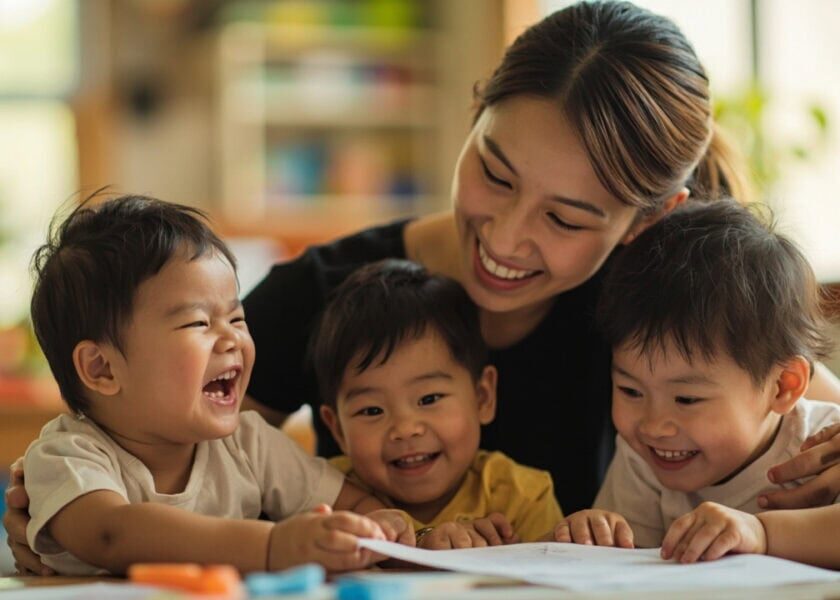
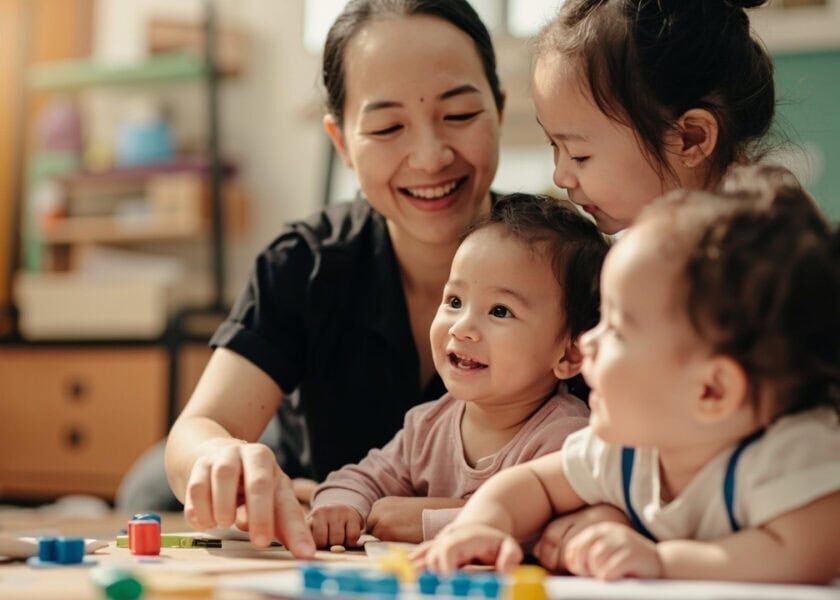
The intimacy of a small group — or one-on-one care in your own home — is where cultural attunement actually happens. In a group of three, a caregiver can notice and respond to the specific cultural context of each family. This is qualitatively different from larger settings where cultural identity can easily become invisible in the crowd.
The Village That Holds Heritage and Horizons Together
This is what we mean when we talk about the childcare village. The concept is old — it takes a village to raise a child — but in multicultural Singapore, it has a particular richness.
Your village is not a monoculture. It is made of Chinese uncles and Malay aunties and Indian grandparents and Eurasian friends and caregivers who come from their own cultural worlds, and who are all, in their own ways, contributing to the making of your child.
The question is not whether that village will be culturally diverse. It will be. The question is whether the childcare arrangements you choose will honour that diversity and give it shape, or whether they will default to a flattening that serves nobody well — least of all the child.
Navigating the Grandparent Dynamic
The grandparent question comes up in almost every family, in one form or another. Grandparents carry their own cultural wisdom, their own investment in how the next generation is raised. When that vision diverges from yours — when your own mother believes that children should be more obedient, or your in-laws feel that your child is not being exposed to enough of their heritage language — the tension can feel impossible to resolve without disappointing someone you love.
What thoughtful childcare can offer in these moments is not a resolution — family dynamics are not for childcare providers to adjudicate. But what good care can offer is consistency. A reliable, culturally intelligent care framework that stands alongside whatever arrangements you have with extended family, not in opposition to it.
When a child has a caregiver who reinforces the heritage language at the same time that grandparents are doing the same during weekend visits, something remarkable happens. The child does not experience these influences as competing. They experience them as complementary — because they are.
The message the child receives is: this is who we are, and everyone around us agrees that it matters.
That is the emotional architecture of a child who grows up confident in their identity — not because one cultural influence won and another lost, but because the adults in their life were, in their different ways, pointing at the same deep truth. That you come from somewhere, and that where you come from is worth knowing.
The Caregiver as Cultural Bridge
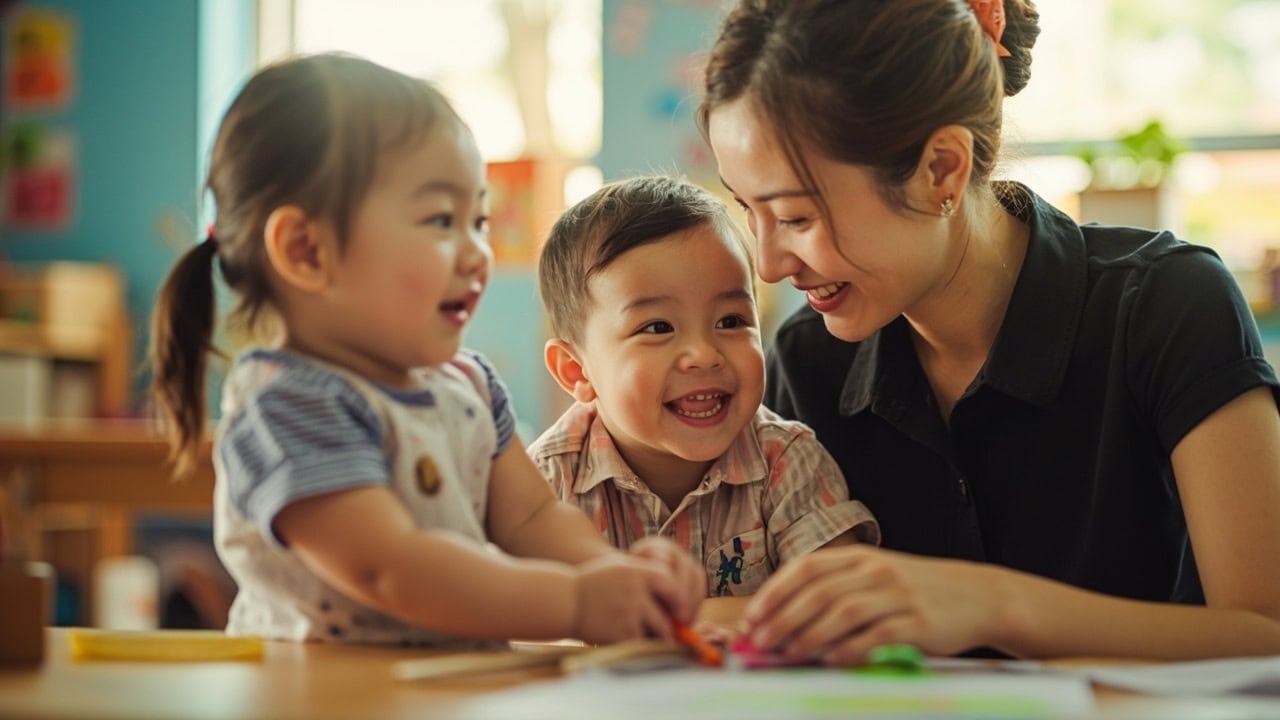
A childcare partner who takes multicultural family life seriously acts as a bridge. A bridge between what your family already knows and what your child is becoming. A bridge between the wisdom of the older generation and the realities of the world your child will inherit. A bridge between heritage and horizons.
Building such a bridge requires more than good intentions. It requires systems, transparency, and trust — and trust is strengthened by verification, not diminished by it. Open communication with families should be standard. Where deployed, measures like CCTV in care spaces are not about suspicion; they are about making the invisible visible, so you never feel uncertain about what is happening in your child’s day.
What EduNanny Singapore Offers Your Family
EduNanny operates as part of the ECDA Childminding Pilot, which means care is anchored in standards thoughtfully designed for the Singapore context — not imported wholesale from elsewhere, but developed with an understanding of how Singapore families actually live.
Through the pilot, families have access to care arrangements that are affordable, with Monday to Friday care blocks designed to align with the rhythm of working family life. Eligible families can utilise their Child Development Account and Baby Bonus contributions, making quality care not only culturally attuned but practically accessible across a wide range of households.
In terms of the care itself, we maintain ratios of up to one to three infants in home-based settings, because we believe that the intimacy of a small group — or one-on-one care in your own home — is where cultural attunement actually happens. In community and centre-based pathways, we bring that same spirit of attentive, personalised care — working with families rather than simply serving them.
Our caregivers are not selected for technical competence alone. They are selected for warmth, for attentiveness, for the kind of cultural humility that allows them to receive your family’s values as gifts rather than constraints. When a Singapore family walks through our door or invites one of our childminders into their home, they are bringing with them a cultural inheritance as real as the child’s DNA. They are bringing language preferences and discipline philosophies and grandparent dynamics and deeply held values about what a good childhood looks like. And they are trusting us to hold all of that with the same seriousness they hold it.
What Your Child Receives
A child who feels seen — not just safe, but seen — in all the dimensions of who they are, develops differently than a child who must compartmentalise parts of themselves before they even leave for preschool.
A child who grows up understanding that belonging is not exclusive, that one can be deeply rooted and widely reaching at the same time, carries a kind of confidence that no curriculum can manufacture. It is the confidence of belonging fully to several worlds, and knowing that each one is real.
When your child grows up knowing that they belong — not despite the complexity of their cultural inheritance, but through it — they carry something extraordinary into every room they enter for the rest of their life:
- The ease of someone who has never had to choose between parts of themselves
- The empathy of someone who has always understood, instinctively, that other people’s worlds are just as real as their own
- The confidence not of someone who has never been uncertain, but of someone who has navigated genuine complexity and emerged whole
Questions to Ask Your Childcare Partner
If you are searching for infant care or childminding in Singapore, here are the questions worth asking — beyond the basics of licensing, safety certifications, and logistics:
- Can they describe how they would honour your specific cultural context? Look for answers that go beyond generic statements. Do they ask about your family’s languages, values, and traditions? Do they have a process for learning what matters to your family?
- What is their caregiver-to-child ratio, and why? Small ratios are not just about supervision — they are about the space to attune, to notice, to respond as an individual rather than managing a group.
- How do they handle communication with families? You should never feel uncertain about what is happening in your child’s day. What systems are in place for daily updates, for raising concerns, for cultural questions that arise?
- How do they approach heritage language exposure? Is it treated as a checkbox or as something woven naturally into daily care? The difference matters enormously in the message your child receives.
- Do they seem comfortable with complexity? The right childcare partner will not promise to simplify your child’s cultural world. They will promise to hold it thoughtfully.
Your Child’s Identity Is Not Waiting to Be Simplified
We know that choosing childcare is one of the most consequential decisions you will make as a parent. We know that in Singapore, that decision carries cultural weight that it carries in few other places on earth. And we know that what you are really choosing, when you choose a childcare partner, is a set of values — a belief about what your child needs, who they are becoming, and what kind of world they are being prepared to inhabit.
We believe your child deserves a childcare arrangement that sees them fully. Every dimension of them. Every thread of who they come from, and every possibility of who they are becoming.
We believe that the cultural village your child enters in these early years should be a source of strength, not confusion. That the adults around them should feel like allies, not competing influences. That heritage and horizons are not opposites, but conversation partners — and that the best childcare is the kind that holds that conversation with grace, with intention, and with genuine love for the child at the centre of it all.
In a city as diverse as ours, that may be the most important thing a childcare partner can offer.
Your child’s identity is not waiting to be simplified. It is waiting to be understood. And we would be honoured to be the ones who help you tend it.
If you are ready to explore what culturally intelligent childminding looks like for your family, we welcome the conversation.
At EduNanny Singapore, we believe that quality childcare begins with understanding — of each child, each family, and the cultural worlds they carry with them. Learn more about our approach to childminding or our story.