Open-ended play at home: the preschooler amounts and safety checks
A Straits Times report in September 2026 described a free neighbourhood playdate built around open-ended materials. That is news; the number a squeezed family actually needs comes from the Health Promotion Board's Childhood Health Behaviours Checklist for 4-6 year olds. It asks whether a child spends at least 180 minutes doing a variety of physical activities of any intensity, spread throughout the day, and whether at least 60 minutes of that is moderate to vigorous. [1]
The Singapore Physical Activity Guidelines add a useful line: the 180 minutes does not have to be done all at once and every minute counts, with the 60 minutes of moderate-to-vigorous activity applying to all children aged three and older. The American Academy of Pediatrics supplies the other half of the answer — during open-ended play, the adult's role can be quite minimal. Here is the amount, the adult's job, the materials and the safety check, in that order. [2] [3]
How much play to make room for
The checklist's examples for the 180 minutes are ordinary: playground play, ball games and cycling, involving running, jumping, catching, throwing and kicking. For the 60 minutes of moderate-to-vigorous time, it gives running, rope-skipping and playground games such as tag or catching. If you are unsure whether a burst counts, the guidelines' intensity cues are plain language — light means a child can talk in full sentences and sing, moderate means talking in phrases or short sentences but unable to sing, vigorous means difficulty talking. [1] [2]
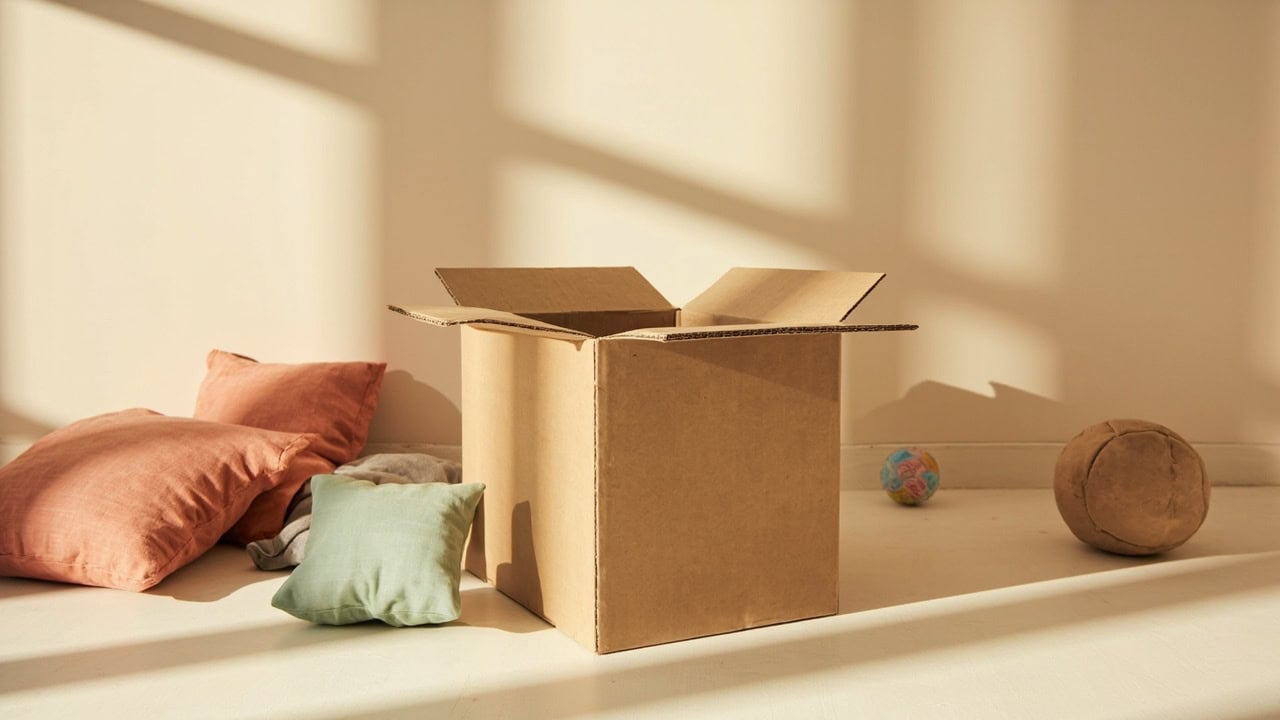
Two more items on the same checklist shape the week. One asks that total screen use outside school stays under an hour daily, and that an adult discusses with the child what he or she is watching. Another asks that the child engages in outdoor active play daily, such as outdoor playgrounds, catching or tag, ball games and cycling in outdoor areas. If those minutes feel unreachable, our optional suggestion is to budget them in bursts rather than one outing: twenty minutes of tag after school, fifteen minutes of ball play before dinner, and a twenty-five minute cardboard-and-cushion build that ends in a chase. That is an editorial idea, not a tested routine. [1]
What the adult is actually doing while they play
The AAP guidance is specific that your role can be quite minimal and that the play you undertake can be almost any activity. The age bands differ slightly but point the same way. For 1 to 3 year olds, AAP guidance says playful learning where children take the lead and follow their own curiosity should be the main focus, and that it is parents' and caregivers' presence and attention that enrich children. For 4 to 6 year olds, it advises giving time and space to act out imaginary scenes and roles, allowing play to be unstructured, and noting that some boredom allows for creativity. [3] [4]
So the division of labour is simple: the child decides what the game is, and the adult stays close enough to notice when a cushion tower becomes a climbing hazard. Consider this hypothetical run: a five-year-old turns three cushions and a laundry basket into a fort, decides the sofa is a ship, and an adult sits on the floor nearby answering questions rather than setting rules. One study reported by the AAP is often quoted here — 3- to 4-year-old children anxious about entering preschool were two times more likely to feel less stressed when allowed to play for 15 minutes, compared with classmates who listened to a story. That finding belongs to that age group and that anxious context, not to every child and every session. [3] [4]
Materials you already own
The AAP makes a plain economic point about play materials: simple toys such as blocks, balls, jump ropes and buckets are often the best kind for children, and can be more effective in allowing imagination and creativity than more expensive toys. The same article notes that kids tend to have fun with things as simple as a cardboard box — which is why a delivery box is a legitimate piece of play equipment rather than something to put out for recycling. [3]
HealthHub's guidance for toddlers gives concrete household versions worth adapting for a preschooler: cushions for a safe game of catch, a hopscotch pattern made with masking tape across the floor, and an obstacle course built from household objects. Those examples are written for toddlers, so use your judgement on fit. For the preschooler, the guidelines' own tips are to create a home environment that encourages movement and exploration, encourage a wide variety of movements such as running, jumping, catching, throwing and kicking, and introduce activity-based games. [5] [2]
Free play safety checks before the first session
Supervision is the first item, not a formality. AAP playground guidance says that even on safe, age-appropriate playgrounds, adult guidance and supervision is the best way to prevent injuries, and that researchers say a lack of supervision is linked with nearly half of playground-related injuries. Near water, the rule is tighter: whenever children under age 5 are in or around water, an adult — preferably one who knows how to swim and perform CPR — should be within arm's length, providing touch supervision. And on trampolines, the AAP recommends they never be used at home, because they cause thousands of injuries each year, especially in children under age 6. [6] [7]
HealthHub's exercise-safety list fills in the smaller checks: suitable clothes and shoes, water before, during and after activity, avoiding exercise outdoors during the hottest time of the day, and adult supervision when needed. These AAP pages cover water, trampolines and supervision, but do not set a minimum size for toy parts, so ask your child's doctor about that separately before handing over a box of small recycled objects. [8]
The smallest version to run this week
Make room for activity in small blocks across the day rather than one long outing, let the child lead while you stay present and alert, use what the house already contains, and run the safety check before the first session rather than after the first tumble. [2] [3] [8]
Use the Health Promotion Board checklist as a reflection tool at the 4-6 year check-up, the way the Board intends it, rather than as a test your child can pass. Fill in one ordinary week against the 180-minute and 60-minute items, note honestly what happened, and take any 'no/rarely' answers into the conversation with the doctor or nurse. [1]
Read next
- HDB playground guidelines and preschool outdoor play
- Neighbourhood playground safety checks
- Checks before an indoor play session
Sources
- CHILDHOOD HEALTH BEHAVIOURS CHECKLIST
- MOVE WITH FUN & GROW
- 10 No-Cost, Screen-Free Activities to Play with Your Preschooler – HealthyChildren.org
- The Power of Play: How Fun and Games Help Children Thrive – HealthyChildren.org
- Toddlers and Physical Activity – What You Need To Know
- Playground Safety: How to Ensure Injury-Free Fun – HealthyChildren.org
- 5 Questions to Ask Before a Playdate – HealthyChildren.org
- Getting Fit Through Fun for kids
EduNanny Editorial · AI-assisted research and writing, reviewed by our automated editorial team. Sources checked 2026-10-10. Featured image: AI-generated editorial illustration.