
Near Home Gentle Beginnings and a Civic Promise for Singapore Infants

The Gentle Engine of a Nation: An Editorial Blueprint for EduNanny Singapore
Good evening, parents, caregivers, partners in public life. Thank you for gathering around the smallest citizens among us and for asking a large and worthy question: what does it take to give every infant in Singapore a safe, joyful, developmentally rich start—close to home, and close to heart? This article expands the vision of EduNanny by BUTLER into a practical, action-oriented guide for families, educators, and policymakers alike. It translates a noble ideal into everyday choices, routines, and supports that can be implemented in homes and communities across Singapore.

EduNanny by BUTLER: Proximity, Purpose, and Practice
EduNanny is a national social initiative designed to place excellent infant care within walking distance of families across Singapore. We participate in the ECDA Childminding Pilot (December 2024 to December 2027) to test, refine, and scale practices that are humane, rigorous, and scalable. We operate Monday to Friday, 7am to 7pm, islandwide, through centre-based and home-based childminding. Our core commitments are ultra-low 1:3 ratios, floor-level learning environments, visible safety practices, and affordable care—starting from $33/day with fees payable by CDA/Baby Bonus. We welcome children in community premises and vetted homes; we meet families where they live and work; and we pair proximity with the uncompromising standards of a leader in infant care.
Beyond a service, EduNanny is a continuous practice—a stance and a set of routines that shape infants’ earliest experiences in a way that matters for years to come. The following sections translate five living practices into practical guidance, tips, and examples you can begin using today, whether you choose EduNanny or another trusted provider.
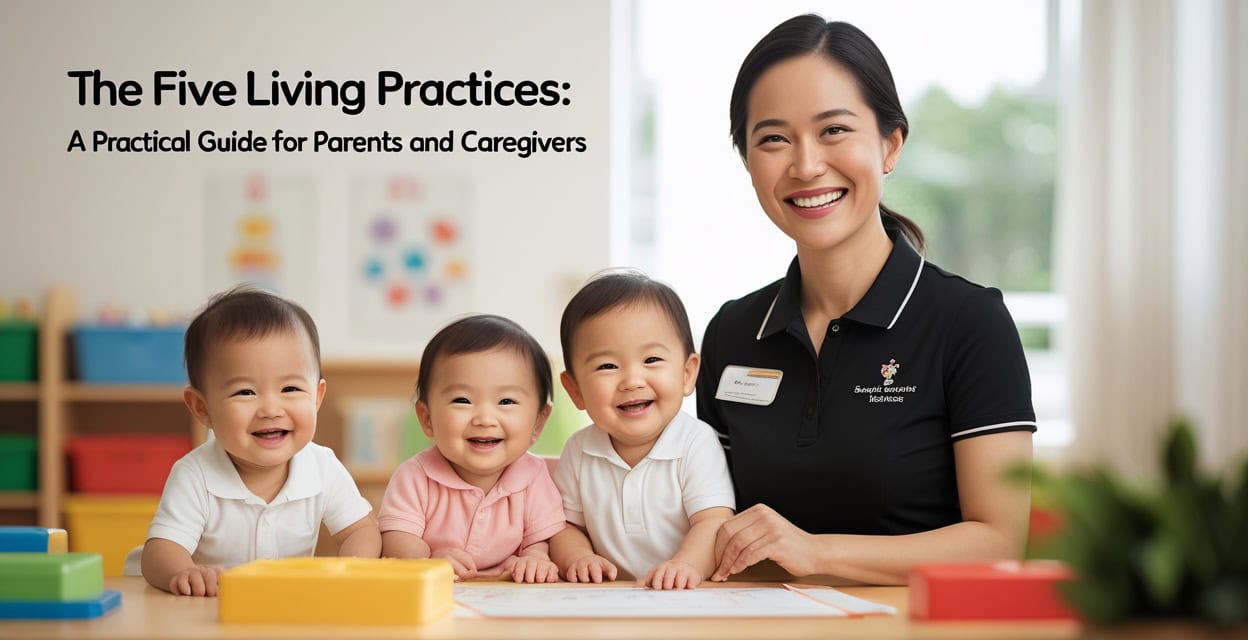
The Five Living Practices: A Practical Guide for Parents and Caregivers
Topic One: The Attentive Minutes Pedagogy
Infancy is taught in minutes, not modules. Our three quiet moves ground every interaction in the present moment and set the stage for long-term brain development.
- Mind the minute: Observe the infant’s precise state—alert, drowsy, hungry, satiated—before intervening. Practical tip: practice a 60-second state check at the start of every routine, noting one signal (e.g., eye focus, body tension, rooting reflex) and adjusting your action to suit it.
- Mirror the mood: Match tone, pace, and posture to the child’s nervous system. Regulation precedes exploration. Practical tip: if a baby is fussy, lower your voice, slow your breathing, and hold eye contact at the infant’s horizon line to reestablish safety.
- Make it meaningful: Add one gentle challenge—a new texture, a new word, a new reach—so today is a tiny step beyond yesterday. Practical tip: introduce a tiny texture during a tactile playtime (e.g., silk vs. cotton, or a soft brush) and narrate what the child is exploring.
Actionable takeaway for families: Build micro-mondays or micro-moments into daily routines—feeding, diapering, and soothing—where you narrate what you’re doing, respond to cues, and introduce a single new sensation or word. With a 1:3 ratio, caregivers can kneel to the child’s level, narrate care (“I am warming the bottle; you are waiting; I see your hands wave”), and expand micro-moments into brain-building exchanges.
Topic Two: Safety as Architecture, Not Afterthought
Safety should be visible, layered, and calm. We design environments and routines to be legible, predictable, and soothing for infants and parents alike.
- Environments: Floor-level learning zones with soft boundaries; safe sleep practices anchored in evidence; natural light balanced with quiet corners; modern layouts that enable continuous supervision. Practical tip: create a dedicated “calm corner” with a low, supportive seat, soft lighting, and minimal distractions to help regulate arousal.
- Protocols: Meticulous hygiene, bottle handling, and disinfection; accident-prevention checklists integrated into daily routines; precise documentation of incidents and near-misses to inform practice. Practical tip: use a simple, laminated daily checklist that caregivers and parents review together at handover to ensure continuity.
- People: The 1:3 ratio is a safety intervention in itself; it enables true supervision, timely soothing, and unrushed routines. Practical tip: train all staff in quick mood-matching techniques so every infant receives rapid, individualized soothing when needed.
- Transparency: Innovation CCTV provides live visibility to leadership and, where implemented, parent-access windows—building trust in the care environment. Practical tip: balance transparency with privacy by establishing clear schedules for camera access moments and ensuring consent has been aligned with families.
- Proximity: Near-home care reduces travel time and stress exposure for infants and reduces risk windows from long commutes. Practical tip: map a family’s commute and plan backup drop-off points to minimize transitions that can unsettle a child.
Practical home-based application: Create a safe, quiet zone at home with clear boundaries, maintain hygiene routines (handwashing before feeds, sanitized toys), and establish a predictable daily rhythm that mirrors the infant’s needs rather than the calendar.
Topic Three: Development as a Daily Arc
Development unfolds when relationships, routines, and rich experiences meet. EduNanny structures the day to support the whole child, honoring each child’s timeline.
- 0–6 months: Co-regulation and sensory organization. Slow feeds, skin-safe textures, face-to-face time, and soft vestibular play to build a steady nervous system. Practical tip: use baby massage techniques during soothing times and narrate the caregiver’s actions to model social cues.
- 6–12 months: Motor mastery and cause-and-effect. Floor time for rolling, creeping, cruising; object permanence games; simple turn-taking with sounds and smiles. Practical tip: introduce cause-and-effect toys (pop-and-fill, stack-and-nest) to encourage exploration without frustration.
- 12–24 months: First words and first choices. Narrated care, picture cues, sign supports; offering two good options to build autonomy without overwhelm. Practical tip: use picture cards to label daily routines and provide one choice between two outfits or snacks to foster decision-making.
- 24–36 months: Imitation to intention. Parallel play becomes social beginnings; tidy-up rituals practice executive function; little chores build pride. Practical tip: assign age-appropriate tasks (putting blocks away, setting a nap mat) to cultivate responsibility and self-regulation.
Key principle: we do not rush milestones; we remove obstacles. We do not standardize children; we standardize the conditions—presence, predictability, play—that let them flourish in their own time.
Topic Four: Happiness as Predictable Joy
Happiness in infancy is attuned ease, not mere amusement. We cultivate it through three guiding pillars (R3).
- Rhythms: A stable daily flow—arrive, greet, explore, eat, rest, explore, handover—so the body learns what the clock will soon confirm. Practical tip: craft a one-page family rhythm map that shows typical wake times, nap windows, and feeding cues to reduce anxiety during transitions.
- Relationships: The same primary educators in small pods; consistent voices and faces a child can map and trust. Practical tip: maintain a consistent caregiver pairing for at least a week whenever possible to establish secure attachment patterns.
- Rich Play: Simple, open-ended materials—scarves, cups, blocks; water and sound; peekaboo and clapping games—that turn curiosity into confidence. Practical tip: rotate a small set of open-ended toys weekly to keep novelty high and encourage flexible thinking.
Outcome: when a child feels that the world makes sense and welcomes them, they test, try, and triumph. That is happiness—the foundation for lifelong curiosity and resilience.
Topic Five: The Purpose of Childminders—A Threefold Mandate
Childminders are not stopgaps; they are civic artisans shaping the fabric of society.
- For the child: A secure base and a safe haven, hour by hour, so exploration is brave and return is gentle. Practical tip: develop a child’s “comfort box” with a favorite toy, a familiar blanket, and a small routine that signals the caregiver is present and ready to help with transitions.
- For the parent: Real convenience—near home, home-based or centre-based, Monday to Friday, 7am to 7pm—so work and care can coexist without guilt or guesswork. Practical tip: use a monthly planning sheet that lists drop-off and pick-up windows, childcare days, and backup arrangements so that families can anticipate and plan with confidence.
- For the nation: A National Social Initiative with a Maximum Employment Mandate—raising professional standards, dignifying care work, and widening the circle of capable hands. Practical tip: parents can engage in feedback sessions with educators to influence policy and shape ongoing professional development opportunities for care teams.
Proximity pods reduce commute strain, knit neighborhoods, and anchor trust in early care as critical infrastructure for Singapore’s future. Practical insight: when choosing a provider, prioritize those with clear safety protocols, transparent communication, and a plan for staff training and career progression that elevates the entire sector.

What EduNanny Delivers: Services and Features That Work
- Excellence made accessible: Care from $33/day, with fees payable by CDA/Baby Bonus; rigorous staff training; modern, calm environments; and a 1:3 ratio that is both humane and effective. Practical tip: ask for a detailed breakdown of training hours, ongoing professional development, and how safety drills are practiced and reviewed.
- Choice without compromise: Centre-Based Childminding for a structured learning environment; Home-Based Childminding for care at the doorstep; and digital distance support (CCTV transparency and daily journals) to keep families connected from anywhere. Practical tip: request sample daily journals and a video tour of a typical day to understand how care is delivered in different settings.
- Islandwide convenience: Monday to Friday, 7am to 7pm; community and home premises distributed across neighborhoods to shorten the distance between family and care. Practical tip: map your commuting routes and identify two nearby EduNanny pods to create a flexible backup plan.
- Safety by design: Layered safeguards, thoughtful layouts, unbroken supervision, and transparent operations. Practical tip: ask for a safety audit report or recent incident-review summary to understand how lessons are translated into practice.
- A public promise: As part of the ECDA Childminding Pilot, EduNanny aligns private excellence with public purpose, building a model that dignifies early care as infrastructure for the future. Practical tip: seek opportunities to participate in pilot feedback sessions to help refine policies and improve outcomes for all families.

A Day in Brief, So You Can Picture It
- Arrival: The handover is unhurried; we read the child’s state and the parent’s notes; we mirror the infant’s mood before we move.
- Morning: Floor-level exploration, narrated caregiving, responsive feeds; a short walk or fresh-air window when suitable.
- Midday: Safe sleep in calm rooms with consistent cues; soft wake-ups; sensory play that matches the child’s arousal state.
- Afternoon: Language-rich play, first signs or words, tiny chores for pride; tidy-up as a game to lay executive-function tracks.
- Departure: A handover that tells the day’s story—what was tried, what was learned, what felt good, and what we will try next.

Policies That Parents Ask About—Answered Plainly
- Operating hours: Monday to Friday, 7am–7pm.
- Settings: Centre-Based and Home-Based Childminding, islandwide.
- Ratios: 1 educator to 3 infants.
- Transparency: Innovation CCTV and secure daily updates to your device.
- Fees: Affordable from $33/day; payable by CDA/Baby Bonus.
- Oversight: EduNanny by BUTLER, within the ECDA Childminding Pilot.
- Employment impact: Maximum Employment Mandate supports jobs, training, and professionalization in the early years sector.
- Find us: EduNanny.com and Childminding.EduNanny.com
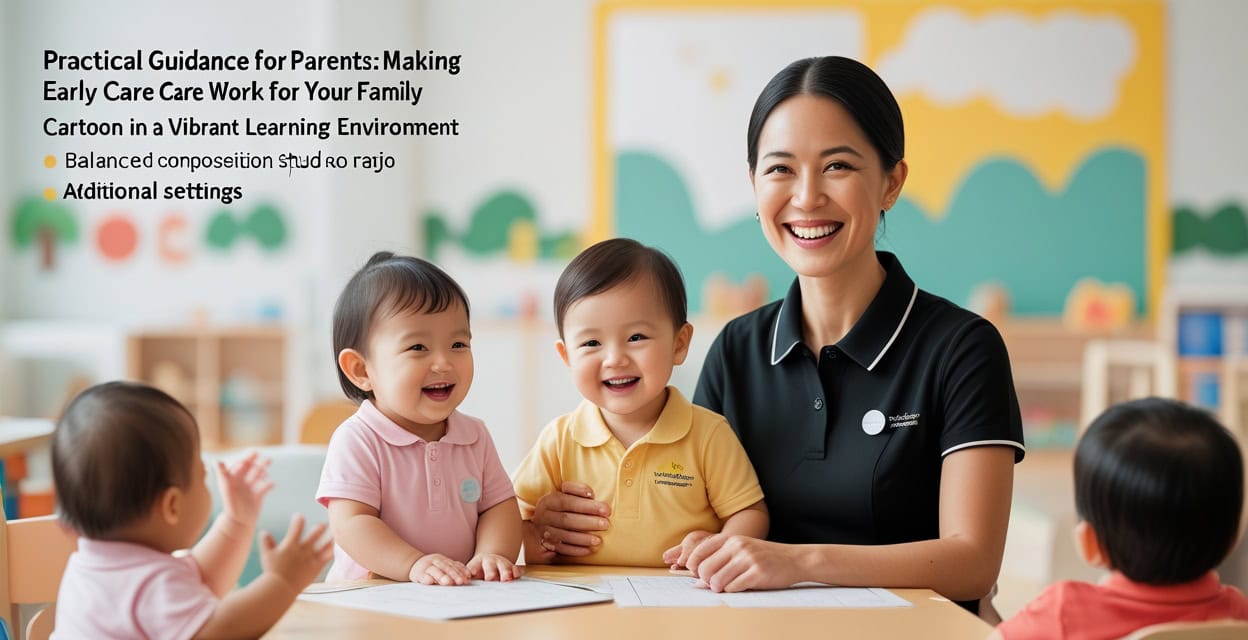
Practical Guidance for Parents: Making Early Care Work for Your Family
- Choosing between Centre-Based and Home-Based: Consider your child’s temperament, your proximity to the care setting, and how you manage routines at home. Centre-based settings can offer structured group activities and socialization, while home-based care can provide a more intimate, consistent caregiver relationship. Practical tip: visit both settings during peak hours, observe interactions, and interview staff about routines, safety, and communication.
- Partnering with Caregivers: Establish a shared daily rhythm, agree on cue-based communication, and use digital journals to document milestones and concerns. Practical tip: schedule a weekly 15-minute debrief with your childminder to align on the upcoming week’s goals and any changes in the child’s needs.
- Safety Essentials at Home: Create a floor-level play zone, secure sleep areas, and implement a simple hygiene routine. Practical tip: perform a monthly home safety audit, focusing on choking hazards, blind cord safety, and safe sleep positions, and involve your child in age-appropriate safety learning to foster trust and compliance.
- Supporting Development Milestones: Use the five learning tracks (co-regulation, gross motor, language, autonomy, executive function) as a checklist for home activities. Practical tip: design a “milestone mini-challenge” each week—e.g., a new gross motor task or a first word—paired with positive reinforcement to build confidence.
- Technology and Transparency: Leverage CCTV updates and daily journals to stay informed, while also setting boundaries for screen time. Practical tip: designate a daily “care update window” where you review messages with your child and discuss what they did that day to reinforce learning at home.

Conclusion: Why Childminding Matters—and How EduNanny Serves That Mandate
Infants’ early years are not merely personal experiences; they are civic design. EduNanny’s approach—proximate, high-quality care delivered through a sustainable, transparent, and scientifically informed practice—turns private comfort into national infrastructure. By meeting each child at eye level, moving at their nervous system’s pace, and multiplying small moments into sturdy minds and open hearts, we create a foundation for confident learners, caring citizens, and resilient families. For parents, we promise predictability and partnership. For childminders, we offer training, dignity, and a profession worthy of its importance. For Singapore, we are building a gentle engine—close to home, steady in practice, and strong enough to power bright futures.
If this vision resonates with your family or your calling, explore EduNanny’s offerings, join the pilot, and help shape a standards-driven, emotionally intelligent, near-home care ecosystem that serves today and era-defining tomorrow. Visit EduNanny.com or Childminding.EduNanny.com to learn more and get involved.
Join the conversation. Build trust. Shape a brighter start for every infant in Singapore.
[#earlychildhood, #Singapore, #EduNanny, #infantcare, #childminding]Ready to Experience Excellence?
Transform Your Family’s Journey
Discover Singapore’s leading infant care and childminding services. Expert guidance for your little one’s first thousand days.