How Singapore Parents Can See Quality in Childcare
The Moment Every Singapore Parent Knows
There is a moment every parent in Singapore recognizes. It comes after the tour, after the glossy photos, after the conversation with the centre director who speaks beautifully about child-centred learning and holistic development. It comes when you are sitting in your car, or on the train home, or lying awake at night, and you realize you still do not know.
You have visited three providers. You have asked the right questions. You have done your research. And yet something in you is still uncertain, still second-guessing, still wondering whether you will make the right choice for the most important person in your life.
That uncertainty is not a weakness. It is not a sign that you have not tried hard enough, or that you are somehow less capable than other parents who seem to make these decisions with confidence. That uncertainty is wisdom in action—the part of you that has looked past the polished surfaces and sensed there is something deeper to find.
The problem is not your instincts. The problem is that no one has yet given you the tools to trust them.
Why Quality Is Hard to See in Singapore’s Childcare Sector
Singapore’s childcare sector is vibrant and growing. There are excellent providers doing remarkable work with our youngest children. There are also providers who have become very skilled at presenting well—crafting marketing that sounds exactly like what quality looks like, because they know what parents want to hear.
When everything looks good on paper, when every website uses the same words about qualified teachers, safe environments, and enriching experiences, how are you supposed to choose? How do you know which tour is a genuine window into a child’s daily life and which tour is a carefully choreographed performance?
The answer is not to work harder at the research. It is not to read more reviews or visit more centres or ask more questions until you stumble into certainty. The answer is to develop trained observation.
Most parents who visit a childcare centre are watching. They are taking in information, processing impressions, trying to form a judgment based on what they observe. But trained observation goes deeper. It asks you to look for specific, observable signals of quality that cannot be easily faked—signals that emerge from the daily culture of a place rather than from a one-hour performance.
Consider this distinction as you approach your next visit. You are not just gathering impressions. You are learning to read signs.
What Quality Looks Like: A Framework for Trained Observation
The Environment
When you walk into a space, your eyes register what is there. But trained observation teaches you to notice how it feels—not in an abstract, emotional way, but in a precise way.
Listen carefully to the sound environment. A high-quality infant space is not silent, but it is not chaotic either. You should hear a range of sounds: a caregiver speaking softly to one child, the natural hum of interaction, perhaps some gentle background music or the sound of a mobile turning.
What to notice: You should not hear sustained crying with no response, because in quality care, crying is attended to. You should not hear the television filling silence.
Notice the physical details. Natural light matters for infants—it supports their developing circadian rhythms and creates a warm, engaging atmosphere. Notice the smell. A clean space should smell clean, not like industrial sanitizer.
Notice whether the space is organized in a way that suggests thoughtfulness:
- Are materials at the right height for small hands?
- Is there visual interest without overwhelming stimulation?
- Does the arrangement support both independent exploration and safe supervision?
A space designed for children will feel different from a space decorated for visiting parents. Look for evidence that the environment serves its purpose for the children who live in it daily.
The Caregivers
This is where trained observation becomes truly powerful. You can learn more in ten minutes of watching a caregiver interact with a child than in an hour of talking about curriculum frameworks.
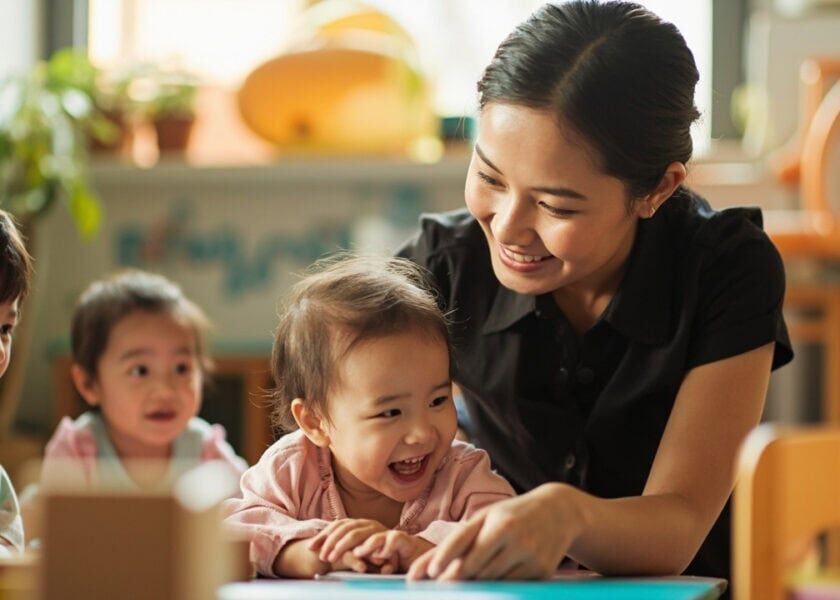
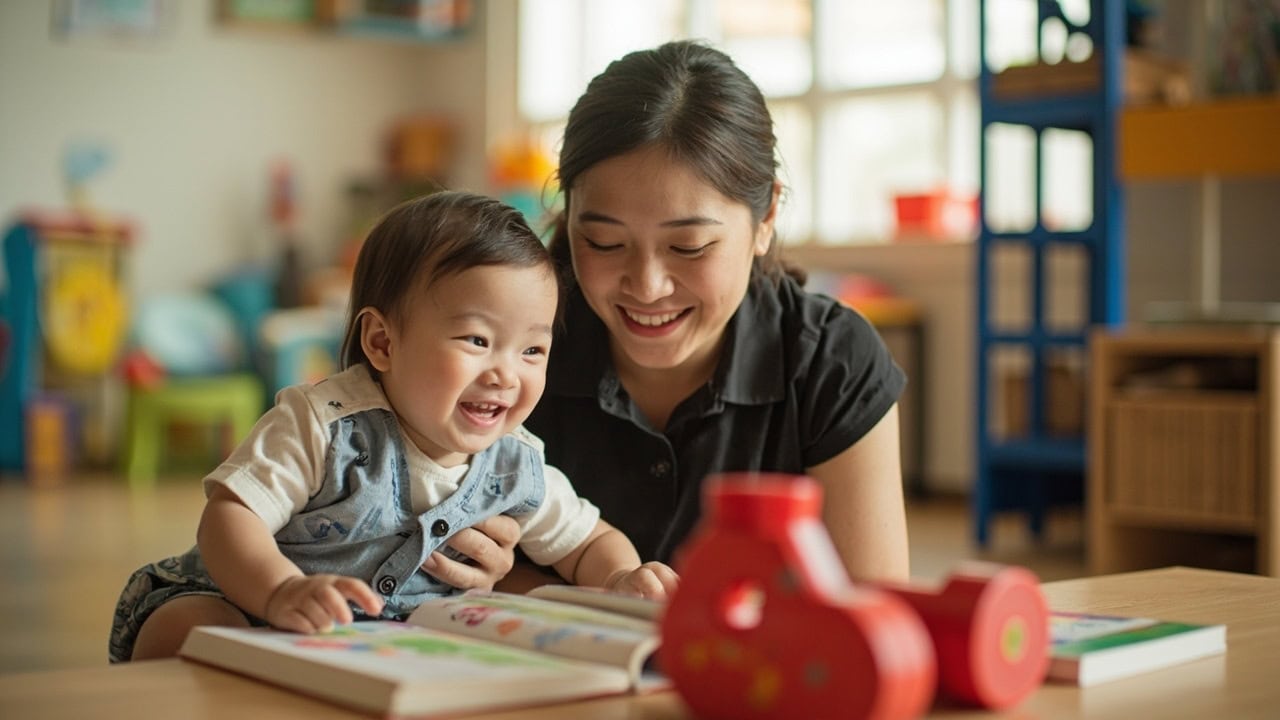
Watch their hands. Are they reaching for the child, or reaching with the child? There is a profound difference. Reaching for implies doing something to the child. Reaching with implies doing something alongside them—being with them in their experience, supporting their discovery rather than directing it.
Watch their eyes. Where are they looking? A caregiver who is truly present will have a quality of attention that is recognisable: they are not glancing around the room, they are with the child in front of them, responsive and engaged. Their eyes follow the child’s focus. They notice what the child notices.
Watch them with a fussy infant. There is no single right way to soothe a child, but there are observable signals of attunement: a calm voice that matches the situation rather than rushing to fix; a gentle rhythm that helps the child regulate; a willingness to stay with the child’s discomfort rather than quickly distract or dismiss it.
You cannot fake this kind of presence. It comes from genuine training and genuine care.
The Children
Perhaps the most important trained observation skill of all is watching the children who are already in the environment.
When you visit, pause and really look at them. How do they move through the space? Do they seem tense and watchful, or do they move with a kind of ease that suggests they feel safe?
Watch their faces—not for any forced smile or performance, but for something subtler: a sense of engagement, of being present, of not being merely managed. Watch how they respond to caregivers. Do they seek out certain adults? Do they move toward them with trust or away from them with hesitation?
The behaviour of children in an environment is one of the most honest reflections of that environment’s quality, because children cannot fake their own security.
The Drop-Off and Pick-Up Window
These transitions are often overlooked as evaluation moments, but they reveal volumes. Watch how caregivers greet your child in the morning. Watch how they hand your child over in the afternoon.
These moments reveal the relationship between caregiver and family, the quality of communication, and whether you are a partner in your child’s care or simply a customer dropping off and picking up a service.
A quality provider will not just hand your child over efficiently. They will take a moment to connect—to share something about your child’s morning, to receive information about the night before, to make the transition feel like continuity rather than disruption.
Questions That Invite Observation
The questions you ask matter as much as the answers you receive. Shift from asking for descriptions to asking to observe.
Instead of asking: “What is your curriculum?”
Ask: “Can I watch a feeding, a nappy change, or a transition between activities?”
Instead of asking: “What are your teacher qualifications?”
Ask: “How does the team communicate with parents and what does that look like in practice?”
A quality provider will welcome your observation. They will not just tell you about their excellence; they will show you. If a provider is reluctant to let you see the daily reality, that itself is information.
Your Child Feels Your Confidence
Here is what many parents do not realise: children are exquisitely attuned to their parents’ emotional states.
When you drop off your child feeling anxious and uncertain, that anxiety transmits. It may be imperceptible—a slight tension in your voice, a lingering look, a reluctance to leave. But infants feel it.
When you drop off your child feeling confident, feeling good about the choice you have made, feeling that you have seen clearly and chosen wisely, that transmits too. Your child feels the difference between a parent who is anxious because they do not know and a parent who is calm because they do.
That difference shapes your child’s own sense of security, their ability to trust the new environment, their capacity to explore and learn and grow.
This is why evaluation confidence is not just about making a good decision. It is about your child’s daily experience of feeling safe—feeling that the adults in their life know what they are doing and are paying attention. Your informed judgment is a gift to your child.
How to Practise Trained Observation
Come to visits not just with your questions written down, but with your eyes open. Ask to observe, not just to be told. Pay attention during drop-off and pick-up, because these are not just logistical moments—they are windows.
During your visit:
- Notice the sensory environment—sound, light, smell, organisation
- Watch caregivers with attention—their hands, their eyes, their presence
- Look at the children—how they move, how they engage, how they relate to adults
- Observe transitions—between activities, between caregivers, between spaces
After your visit:
- Ask yourself: did what I see feel consistent throughout, or did it feel like a performance?
- Notice how you felt during the visit—calm and curious, or tense and uncertain?
- Consider: would I be comfortable dropping my child here every day?
You do not need to become an expert. You need to learn to trust what you already sense and give it a framework. Even one focused observation visit—where you watch the environment, the caregivers, and the children—can give you more useful information than five tours conducted with no specific focus.
Your intuition is observation refined by love. When you learn to trust that instinct and combine it with a trained framework for seeing, you become a parent who sees clearly. Your trained eyes notice what others miss.
Where Quality Is Not Just Promised, But Seen
This is exactly the approach we have built at EduNanny. We are participants in the ECDA Childminding Pilot, offering both home-based and community-based pathways that give Singapore families genuine choice in how their infants and young children are cared for.
Our model is built on a conviction that quality is not something you can only find in a large centre, and that for many families, home-based care offers irreplaceable benefits:
- Smaller ratios—our infant ratio is up to one caregiver to three children
- Consistent caregivers who know your child deeply
- A home environment that feels familiar and warm
We know that trust requires transparency. Our communication practices include regular updates to parents, and CCTV measures where applicable, because we believe you have the right to see what is happening with your child.
Our services are accessible through CDA and Baby Bonus, because we believe quality infant care should not be a privilege available only to those with significant means. Every child in Singapore deserves to be truly seen, known, and nurtured.
Our caregivers are trained to see your child. Not just to watch them, not just to manage them, but to see them: their rhythms, their preferences, their emerging personality, the way they signal hunger or tiredness or overstimulation, the way they light up when they discover something new.
Go to Your Next Visit With New Eyes
Singapore parents work incredibly hard. You navigate demanding careers, long commutes, the pressure of an education system that starts earlier and earlier, and somewhere in all of that, you are trying to make the right choices for your children.
The childcare decision feels enormous because it is enormous. You are placing your infant in someone else’s care for the majority of their waking hours. That is a profound act of trust, and it deserves a thoughtful response.
But that trust does not have to be blind. It can be informed. It can be based on what you can actually see, what you can actually observe, what you can actually verify.
That feeling you have—that uncertainty when you are trying to evaluate childcare, that sense that you need more than polished brochures and reassuring words—that feeling is not your weakness. It is your wisdom. It is your awareness that quality cannot be assumed, that presentation is not the same as substance, that your child deserves more than what looks good on paper.
Your job is not to suppress that feeling or push past it. Your job is to develop the skill to act on it.
See what is there. See what matters. And know that you are capable of making this choice, because you are paying attention, because you care enough to look closely, because you have always had the wisdom to sense that something deeper is there. You simply needed someone to show you how to find it.
We invite you to visit us. Not for a polished performance, but for a genuine window into how we care for children. Watch our caregivers. Observe our environment. See how our children move through their day with ease and trust. Let your trained eyes evaluate what we offer, because we are confident in what they will find.
Your child’s security begins with your clarity. Let us help you find it.
We are EduNanny—care that is not just competent, but attentive; not just professional, but personal; not just available, but excellent. Serving Singapore’s families with the conviction that every child deserves to be truly seen.
Learn more about who we are or get in touch to begin your journey.