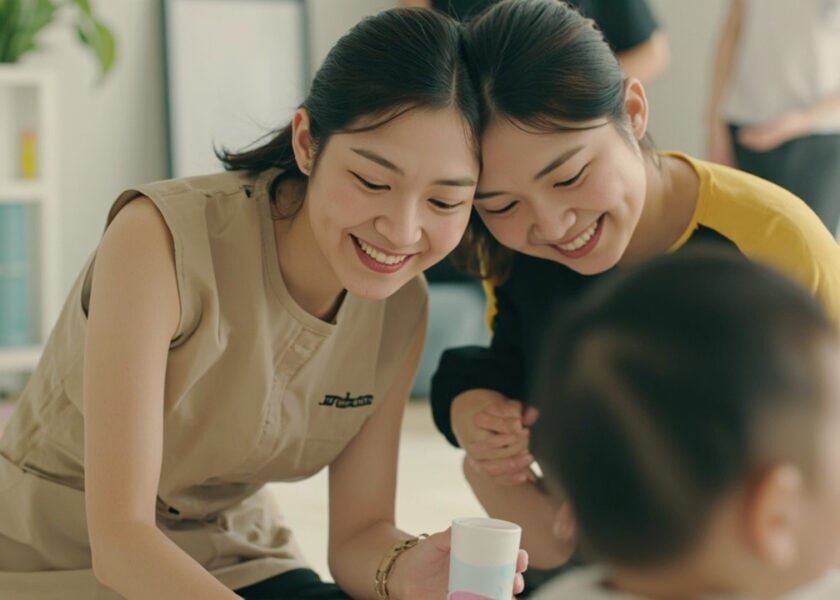
After Enrollment, Building Your Daily Childcare Partnership
The Quiet Gap After Enrollment
There is a particular kind of quiet that settles over a Singapore household in the days after childcare enrollment. The tours are done. The decision is made. The deposit is paid. And suddenly, you find yourself standing at the door of your own home, wondering what happens next.
Most parenting content is built for the before. There are checklists for choosing, rubrics for comparing, frameworks for deciding. You have been told how to research, what to observe on a centre tour, which questions to ask a caregiver. You have been prepared for the choice.
But no one tells you what it feels like when Tuesday morning arrives and the decision is already behind you. No one walks you through what happens when the caregiver greets your child at the door and you have to trust that the next eight hours will be good ones. No one prepares you for the small, daily questions that follow:
- What do I say in the morning handover?
- How do I know if something is wrong?
- How do I bring up a concern without making it awkward?
- How do I build something real with this person who now spends more waking hours with my child than I do?
This is the gap. And it is wider than most parenting conversations acknowledge.
Quick Summary: What Sustains Partnership After Childcare Enrollment
For parents already enrolled or actively researching, the daily partnership is where quality actually gets built:
- Morning handovers are relational, not administrative. Share context: a poor night’s sleep, a visiting grandparent, a developmental milestone at home. This costs you thirty seconds and changes everything.
- Evening listening matters as much as morning talking. Receive caregiver updates without defensiveness. Ask curious questions. Your child benefits when both adults in her life are aligned.
- Noticing a concern is not overreacting. Approach conversations with assumed positive intent. Structure concerns as collaborations, not accusations.
- Signs of a working partnership are quiet. Your child runs toward the caregiver, not away. Updates feel warm and specific. Concerns are received and responded to.
- The partnership evolves as your child does. What begins as feeding updates becomes collaborative observation of milestones, social dynamics, and independence.
Choosing Is an Opening, Not a Conclusion
Choosing childcare is not the end of the parenting decision. It is the beginning of a relationship. And like any important relationship, the quality of what you build together in the months and years that follow is not determined by the moment you met. It is determined by what you do after.
That distinction matters more than it might first appear. If you think of childcare as a transaction — a service purchased, a slot filled, a problem solved — then your engagement with it ends at enrollment. But if you understand it as a living partnership, one that evolves as your child grows, responds to new challenges and new stages, and deepens or frays based on daily choices and daily conversations, then the real work has only just begun.
This is not about being a perfect parent. It is about being an intentional one. The families who feel most confident about their childcare arrangements are not the ones who made the smartest decision on enrollment day. They are the ones who understood that the decision was an opening, not a conclusion.
Continuity matters enormously here. Research on early childhood development consistently shows that children thrive in relationships that are stable and predictable. A caregiver who has been with your family for six months understands your child’s rhythms, her fears, her joys, the things that soothe her and the things that unsettle her. That accumulated knowledge is irreplaceable.
When you invest in a childcare relationship and nurture it over time, you are not just creating convenience. You are giving your child the developmental gift of a secure, familiar bond. The relationship your child builds with a consistent caregiver becomes a foundation for her sense of security, her social development, and her ability to explore the world with confidence.
Two Daily Habits That Build Partnership
The first and most foundational habit of a strong parent-caregiver partnership is something deceptively simple: the way you say goodbye in the morning and the way you listen in the evening.
Morning Handover: Context Is a Gift
Morning handovers are not administrative. They are relational. When you arrive and say only “See you later,” you miss a small but meaningful opportunity.
When you take thirty seconds to share that your child slept poorly, or that she is going through a phase of resisting breakfast, or that there is a grandmother visiting this weekend who will pick her up early — you are giving the caregiver context. You are saying: this person matters to the story of my child’s day.
Consider the difference this makes in practice. The caregiver who knows that your two-year-old is working through a hitting phase at home can respond with patience rather than confusion. The caregiver who knows that your infant did not sleep well will understand why the morning nap was especially critical. Context is a gift you give to the person caring for your child. It costs you almost nothing. It changes everything.
This is not about over-communicating. It is about communicating with intention.
Evening Listening: Receiving Updates as Partnership
And in the evening, when you arrive and your caregiver offers an update — “She ate well today, but she seemed tired in the afternoon, so we took it slower” — the quality of your listening matters.
You are receiving information about your child’s day from someone who was present for it. You are being trusted with observations that help you understand your child more fully. When you listen without defensiveness, ask curious questions, and receive the update as a gift rather than a report, you communicate something powerful: that you see this caregiver as a partner in understanding your child, not as an employee delivering a performance review.
This daily rhythm of sharing and listening, of giving context in the morning and receiving it in the evening, is where partnership begins. It is small. It is ordinary. And it is the invisible practice that separates a childcare arrangement that merely functions from one that genuinely flourishes.
Raising Concerns Without Damaging Trust
Partnership also means knowing how to raise concerns when something does not feel right. And this is where many parents go quiet.
You notice something. Perhaps your child has been coming home with a diaper rash that seems to be getting worse. Perhaps your toddler seems more clingy than usual in the mornings. Perhaps the updates from the caregiver have become brief and formulaic when they used to feel warm and specific. Something is off. And your instinct is to sit with it, to second-guess yourself, to wonder if you are being too sensitive or too demanding.
Here is what we want you to know: noticing is not overreacting. Your observations as a parent carry weight. You know your child in a way no caregiver can, and you have every right — and every reason — to raise a concern when you have one. The question is not whether to speak up. It is how.
The Premise of Constructive Communication
Constructive communication with your caregiver begins with a simple premise: assume positive intent. Approach the conversation with the belief that this person wants what you want — for your child to be happy, safe, and thriving. That belief is not naive. It is the foundation that allows you to speak honestly without making the other person defensive.
Consider the difference between these two approaches to a concern about your child’s afternoon energy:
- Accusation: “Why does she always seem tired when I pick her up?”
- Collaboration: “I’ve noticed she seems more tired than usual in the evenings. Is there anything I should know about how her afternoons are going? Is there anything we can adjust at home to help?”
The first version sounds like an accusation. The second sounds like a collaboration. And the response you get to the second question is far more likely to give you the information you actually need.
This is not about softening your concerns. It is about structuring them so they can be heard. A caregiver who feels respected and trusted will work with you to solve problems. A caregiver who feels criticized will protect themselves first. And your child is the one who loses in that dynamic.
Raising concerns constructively is one of the most important skills you will develop as a parent. Not because you will always have concerns — ideally, over time, you will have fewer — but because the way you raise them shapes the entire partnership. When parents and caregivers can navigate difficult conversations with honesty and care, trust does not erode. It deepens.
How to Know If the Partnership Is Working
Which brings us to a question every parent eventually asks, usually quietly, in the car on the way home: How do I know if this is actually working?
The signs are often subtle. Your child runs to the caregiver in the morning, not away from her. Your toddler mentions something that happened at childcare with casual comfort, as part of the ordinary texture of her life, not as a noteworthy event. When you ask “What did you do today?” you receive an answer that sounds like a real day — some mild frustration, some laughter, some quiet moment — not a performance.
Your caregiver volunteers information unprompted. She notices when something changes. She asks questions about your child’s preferences and remembers the answers. She tells you when your child did something new, with a pride that sounds genuine.
And critically, when you raise a concern, it is received and responded to, not dismissed or met with silence. The caregiver speaks about your child as a person she knows, not as a task on a schedule.
These are the quiet indicators of a partnership that is working. Not dramatic moments of reassurance. Not your child declaring that she loves her caregiver. But the small, daily texture of a relationship that has consistency, warmth, and mutual respect.
What Quality Childminding Looks Like
When evaluating infant care and childminding in Singapore, these indicators distinguish genuine quality:
- Responsive interaction. Caregivers who respond to your child’s cues — her cries, her facial expressions, her attempts at communication — rather than following a rigid schedule. In infant care especially, responsiveness builds the foundation of secure attachment.
- Consistent presence. A caregiver who is there long enough to truly know your child, not a rotating cast of strangers. Ask about caregiver turnover rates. Ask how continuity is maintained.
- Transparent communication rhythms. Updates that come regularly, not just when you ask. Warmth in the details. Specificity about your child’s day, not generic reassurances.
- Partnership orientation. A caregiver who asks questions about your child’s preferences, who remembers what you share, who sees you as a collaborator rather than a client.
- Comfort with feedback. When you raise a concern, it is met with openness, not defensiveness. Difficult conversations are handled with care, not avoidance.
What EduNanny Singapore Offers Beyond Enrollment
Now, here is what this looks like when it is supported well by the structure around it.
At EduNanny Singapore, part of what we have built is designed specifically for this partnership. Not just the enrollment process — that is the beginning, and it matters — but the ongoing, daily experience of being in a childcare relationship. We know that families who feel supported in this partnership are families who feel good about their choice long after the decision has been made.
That support takes practical forms:
- Consistent caregiver relationships, so the bond your child builds has room to deepen and the accumulated knowledge that comes from continuity is preserved.
- Transparent communication rhythms, where updates are a regular part of the day rather than something you have to request.
- CCTV access where deployed, offering an added layer of reassurance — not because trust should require surveillance, but because visibility can quiet the small anxieties that make it harder to be present as a parent.
- Small ratios that allow caregivers to truly know each child, not just manage a group.
- Monday to Friday care blocks that fit the rhythms of working families.
As part of the ECDA Childminding Pilot, EduNanny by BUTLER offers a pathway designed to make quality infant care accessible. With fee structures that reflect the pilot’s commitment to affordability, we have worked to remove some of the structural barriers that make sustained, quality childcare relationships difficult to maintain.
Where families qualify, CDA and Baby Bonus usability means the financial logistics do not add unnecessary friction to an already demanding season.
The Thomas AI Chatbot represents another dimension of this support — not replacing the human relationship that is at the heart of good childcare, but making the administrative and informational layers of parenting in these early years easier to navigate. Questions that arise at odd hours, practical guidance that fits your specific situation, information that helps you show up more confidently in your daily partnership. These tools are not the partnership. They are the scaffolding that lets the partnership breathe.
What we are describing here is not a feature list. It is a philosophy made practical. We believe the relationship between parent and caregiver is the most consequential relationship in your child’s early years — not because institutions do not matter, but because children are wired for connection, and the quality of the connections around them shapes who they become.
Common Questions Parents Ask
“What if I don’t click with the caregiver?”
Chemistry matters, but it can be built. The initial handshake is just the beginning. What matters more is whether both of you are committed to the relationship, whether communication feels open over time, and whether your child’s comfort is growing. If you find the early days awkward, give it time — and communicate. The relationship between two adults who share a deep investment in a child’s wellbeing tends to find its rhythm.
“What if I raise a concern and it makes things worse?”
This fear is understandable, but the risk of silence is greater. Unspoken concerns tend to grow. If you approach with assumed positive intent — believing that the caregiver wants the same thing you do — and structure your feedback as a collaboration, you will most often find that the conversation strengthens rather than damages the relationship. A caregiver who cannot receive honest feedback is not a partner worth keeping. A caregiver who can is worth far more than the temporary discomfort of a difficult conversation.
“How do I know if I’m being too demanding?”
You are not being too demanding when you are asking questions about your child’s day, sharing relevant context, or raising a genuine concern. That is called parenting. You may be overstepping if your requests are constant, if they micromanage the caregiver’s approach, or if they leave no room for professional judgment. The line is when your requests begin to undermine the caregiver’s ability to do her job. Communication that supports your child’s wellbeing is always appropriate.
“What if my child doesn’t seem happy?”
Mild resistance in the mornings is normal, especially during transitions. What matters is the pattern over time. Does your child settle after you leave? Does she mention her caregiver with warmth? Does she seem generally secure and curious? If your child shows persistent distress — ongoing crying, regression in development, fear or avoidance — those are signals worth taking seriously. Bring them to your caregiver with curiosity, not accusation. Together, you can often find the cause and restore equilibrium.
Your Role in Sustaining Quality
Here is a truth worth accepting early: the quality of your child’s childcare is not solely determined by the arrangement you chose. It is sustained — or undermined — by the engagement you bring to it.
You are not a passive observer of your child’s childcare. You are an active participant in it. The caregiver who cares for your child is not a replaceable service provider. She is a person who is building something with you, day by day, morning handover by morning handover, evening update by evening update.
This does not mean you need to be involved constantly. It means you need to be present when you are there. It means your morning handover should communicate care, not just obligation. It means your evening listening should receive updates as gifts, not entitlements. It means your concerns should be raised with honesty and care, and your appreciation should be expressed without hesitation.
The daily partnership you build with your caregiver is one of the most meaningful things you will do as a parent. Not because it is easy — it is not — but because it is real. It is the work of showing up, communicating honestly, listening generously, and trusting another human being with the most precious thing in your life. It is slow. It is incremental. And when it works, it becomes one of the quiet foundations of your child’s sense of security and belonging.
A Partnership Worth Building Well
You were prepared to choose. Now prepare yourself for what comes after.
The daily partnership is where the real work of great childcare happens. And it is a partnership worth building well.
If you are in the research phase, we invite you to explore how EduNanny Singapore structures not just enrollment, but the ongoing experience of parent-caregiver partnership. We believe the relationship you build with your caregiver should feel natural, trusted, and rewarding — not managed, monitored, or transactional.
Start a conversation with us. Tell us about your family, your needs, your concerns. Let us show you what sustained partnership looks like in practice.
The decision to enroll matters. But the daily work that follows is where your child’s wellbeing is actually built.