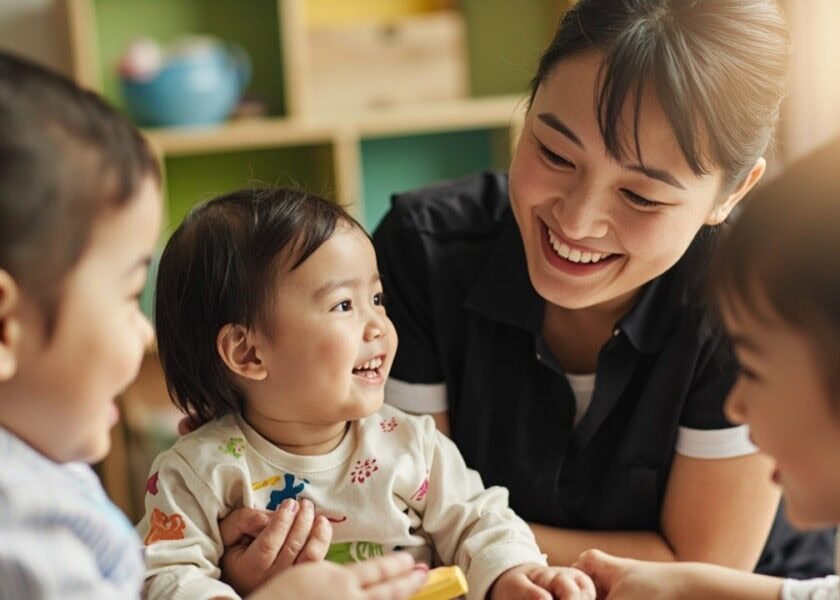
How Expert Caregivers Notice What Shapes Your Child
The Invisible Differentiator: Professional Observation in Infant Care
When we talk about observation in infant care, we are not talking about watching. These are entirely different activities.
Watching is passive. It is the eyes moving across a room, registering movement, confirming that a child is present and safe. Any caregiver can watch a child.
But noticing—true noticing—is an active, trained, deeply intentional practice. It is the difference between hearing and listening. Between looking and seeing. And in the first thousand days of a child’s life, that difference is not subtle. It is everything.
What Expert Caregivers Actually Notice
Professional observation is the discipline of watching for what a child cannot yet say. In the infant and toddler years, children communicate primarily through behavior—through their engagement with materials, their play choices, their patterns of attachment and exploration, their responses to transition and stimulation.
A trained caregiver learns to read these signals with precision. They notice when a child who typically gravitates toward sensory play begins to linger at the construction area, fingers tracing the edges of blocks, curious about stacking and balance for the first time.
They notice when a typically confident walker begins to pause before navigating a small step. When a child who speaks in sentences at home falls silent in the group setting for the first time. When the particular pitch of crying that means tiredness shifts, subtly, into the cry that means hunger.
These are not guesses. These are read patterns, tracked across days and weeks, built into a developing picture of each individual child.
The Science Behind the Practice
Early childhood development research has long recognized that children in the first three years of life pass through sensitive periods—windows of opportunity when specific skills and neural pathways are most readily developed.
What this means practically is that the caregiver who notices when a child is entering a new developmental phase, and responds with appropriately matched support, can genuinely influence how smoothly that transition unfolds.
A child moving from parallel play toward associative play benefits from a caregiver who recognizes the shift and creates conditions that support it. A toddler entering a language explosion needs an environment rich in responsive interaction, a caregiver who narrates their play, who names their discoveries, who pauses to listen even to half-formed sentences.
This is not intuitive for most parents. It is not obvious on a visit. But it is exactly what trained professional observation makes possible.
Singapore’s Childminding Pilot: The Framework That Makes Noticing Possible
At EduNanny, this is the practice that shapes how caregivers work every single day. As part of the ECDA Childminding Pilot, EduNanny operates within a framework that recognizes home-based and community-based care as credible, high-quality pathways for Singapore families.
The pilot structure is built around standards—ratio requirements that allow caregivers to actually observe, rather than simply manage; documentation practices that track developmental progress over time; communication protocols that keep parents genuinely informed.
The infant ratios maintained within the pilot, up to one caregiver for every three infants, are not simply regulatory numbers. They are the breathing room that makes real noticing possible.
When a caregiver is responsible for fewer children, they can watch longer, track patterns across the day, notice the small shifts that reveal the larger story of each child’s development.
This is why the most reliable predictor of quality outcomes in infant care is not a beautifully illustrated curriculum or a gleaming facility. It is the caregiver who can tell you, with specificity, what your child was absorbed in this morning, what made them laugh yesterday, which peer they have started watching from across the room, what they do with their hands when they are thinking hard about something.
That kind of knowledge does not happen by accident. It happens through practiced observation, day after day.
How to Recognize Quality Observation During Your Visit
Parents sometimes ask how they can evaluate this for themselves. When you visit a childcare setting, there are observable signals that reveal whether professional observation is actually happening.
- Caregivers seated at child height, narrating what a child is doing rather than directing it
- Brief notes being made—not lengthy assessments, just quick jottings that suggest a habit of tracking
- How caregivers respond to a child’s distress: do they move immediately to comfort, or do they first pause to read what the distress is communicating?
- Whether caregivers seem to know which children are currently in transitions—whether a new tooth is coming in, whether there was a restless night at home, whether a child is testing a new skill
These are the marks of a setting where observation is valued and practiced.
The Communication Bridge
Observation that remains private, that never reaches the parent, serves only half its purpose. What families need are caregivers who observe well and share what they see.
The daily check-in, the end-of-day note, the brief conversation at pickup—these moments become meaningful when both parties are reading the same child.
When a parent hears, “She spent twenty minutes today building a tower and knocking it down, and then she started building again, higher—she seems to be working on something around persistence,” that parent has been given a window into their child’s inner life. They can follow up at home. They can recognize this new quality in their child.
When you receive a message that says, “She didn’t want to join the circle time today, so I sat with her nearby and she watched from the edge—she’s been doing this more often, I wonder if something is on her mind,” you know that your child has not disappeared into a group. You know that an individual human being has noticed her hesitation, honored it, and thought about what it might mean.
This is the kind of transparency that builds trust—not the trust that comes from surveillance cameras alone, though cameras can be a useful part of a broader communication strategy, but the deeper trust that comes from knowing your child is seen.
Your Questions, Answered
If you are researching infant care in Singapore, you likely have specific questions that tours do not always answer.
Will my infant receive individual attention?
This depends largely on group sizes and caregiver ratios. In settings where ratios are maintained at one caregiver to three infants or fewer, caregivers have the time to notice individual patterns rather than simply managing groups. Ask about how many infants each caregiver is responsible for during your visits.
How will I know what happens during the day?
Quality childminding programmes build in structured communication—daily check-ins, brief notes, end-of-day summaries. The key question is not whether communication happens, but whether it reflects genuine observation. Listen for specifics: not just “she had a good day,” but what she was absorbed in, what made her laugh, how she responded to a particular moment.
Is home-based care as credible as centre-based care?
Singapore’s ECDA Childminding Pilot explicitly recognizes home-based pathways as credible options. What matters is not the setting but the quality of observation and care within it. Home-based care can offer smaller ratios, familiar environments, and more individualized attention—advantages that formal recognition and structured standards help families access with confidence.
What if I still feel uncertain after the tour?
This is completely normal. The most important aspects of quality care are not visible on a tour. Trust your instincts about caregiver warmth and programme philosophy, but also ask the questions that reveal whether observation is actually practiced: How do caregivers track developmental progress? What does a typical day look like in terms of caregiver-to-child interaction? How do you communicate with parents about what you observe?
Making Your Decision: A Framework for Parents
If you are navigating the uncertainty of those first childcare decisions, hold onto this conviction: you are right to want more than a clean room and a warm smile. You are right to want someone who notices.
Here is what to look for as you evaluate your options:
- Ask about ratios. In infant care, smaller groups enable more observation. Understand how many children each caregiver is responsible for.
- Ask about communication. How will you know what happens during the day? What form does daily reporting take?
- Observe during the visit. Do caregivers interact at child height? Are they narrating rather than directing? Do they seem to know the children as individuals?
- Ask specific questions. “Can you tell me what a typical morning looks like for an infant in your care?” Listen for whether the answer reflects observation or just scheduling.
- Trust your instincts. If something feels off, keep looking. The right fit matters more than convenience.
The Partnership Model
Expert observation in childcare settings becomes even more powerful when parents participate in the same practice. When caregivers share what they notice—specific moments from the day, patterns they are tracking, questions they are holding—parents can follow up at home with aligned awareness.
This is the partnership that transforms childcare from a service you use into a collaborative effort in your child’s development. Evening conversations become richer when you know what absorbed your child at noon. Home activities become more intentional when you understand what skills she is currently working on.
When both parties are reading the same child, the child experiences consistency of attention. They are known in multiple settings, by multiple people who communicate about them. This continuity of being seen is itself a contribution to healthy development.
A Final Word
There is a moment that happens in excellent infant care that most people never see. It is not dramatic. It does not happen on tours.
It happens in the ordinary hours, when a caregiver watches a child struggle with a puzzle for the fourth time and notices something shift—not frustration this time, but concentration. The caregiver does not solve the puzzle for the child. They do not step in with the answer. They simply note what they see. They stay close. They wait. They are present.
And in that small moment of being truly noticed, truly seen in the effort, the child is building something that no curriculum can teach. They are building the knowledge that their effort matters. That someone is paying attention. That they are known.
For families who believe that attention is not incidental to good care—that attention is the care itself—there is a path that reflects this conviction.
EduNanny welcomes families who share this belief. Our caregivers are trained to notice—not as a vague commitment to warmth, but as a disciplined, daily practice. They are supported by structures that make noticing sustainable. And they are guided by a philosophy that recognizes observation not as an administrative task but as a form of respect.
To truly see a child is to honor who they are. It is to refuse the shortcuts of generic care in favor of the more demanding, more rewarding work of individualized understanding.
Whatever path you choose for your family in these early years, hold fast to one conviction: your child deserves to be noticed. Find the people who know how to notice. And trust that this quiet discipline—this invisible, essential, transformative practice of professional observation—is the foundation on which everything else is built.
Your child deserves to be noticed. Let’s begin that conversation.