
EduNanny Singapore Five Pillars Turning Everyday Care into a Civic Infrastructure for Lifelong Flourishing

EduNanny Singapore: Transforming Everyday Care into a Flourishing Life
In the earliest moments of life, safety and belonging are the incubators of learning. A caregiver’s chest, a steady breath, and a predictable rhythm can wire the brain for trust, curiosity, and resilience. EduNanny envisions Singapore’s care landscape as an architecture for flourishing—where everyday care becomes a deliberate, science-informed foundation for lifelong development. This article expands on that vision with practical guidance, real-world insights from EduNanny practice, and concrete steps families can take to partner with caregivers in nurturing infants and toddlers.

EduNanny: A Standard, Not a Logo
EduNanny is a standard of care—not merely a brand. It embodies attachment, safety, and developmental opportunities delivered by trained childminders across homes, community spaces, and modern centers. Supported by thoughtful technology and anchored in a national commitment, EduNanny operates under the ECDA Childminding Pilot as a National Social Initiative with a Maximum Employment Mandate. This structure creates dignified, skilled caregiving jobs while ensuring infants receive steady, attentive presence for strong futures.
Families are offered real choices aligned with real life: Centre-Based Childminding and Home-Based Childminding, with Distance support for remote guidance, daily coaching, and continuity of care. Services run Monday through Friday, 7am to 7pm, islandwide in both community and home settings, maintaining an ultra-low 1:3 infant ratio. Transparent, family-friendly fees are payable by CDA or Baby Bonus, and all settings adhere to consistent standards. Modern layouts, privacy-preserving CCTV options, and a curriculum grounded in both science and heart make premium-quality infant care accessible and affordable—starting from $33/day.
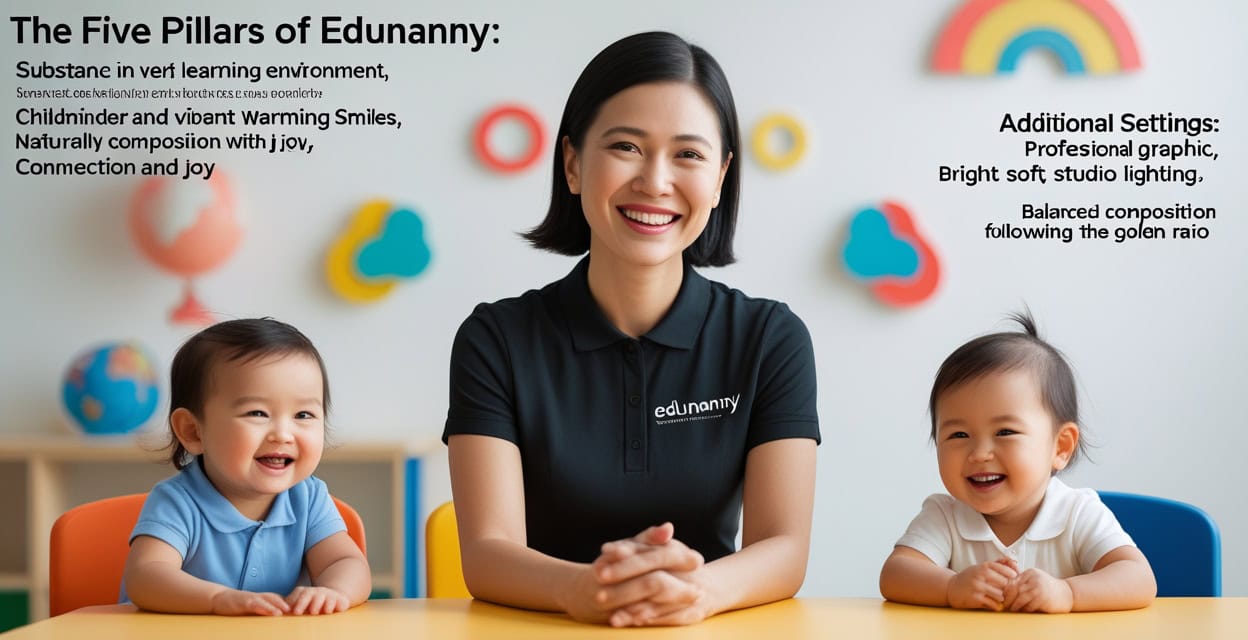
The Five Pillars of EduNanny: Substance Over Slogans
EduNanny focuses on five interconnected pillars that translate theory into everyday practice. Each pillar offers actionable strategies, real-world examples, and measurable expectations for families and caregivers alike.
1) Micro‑Attunement: The Small Acts That Build Big Brains
Development is built in relationships. We train childminders to notice and respond to subtle cues, shaping the infant’s sense of safety and readiness to learn.
- A pause before lifting or moving an infant to foster anticipation and trust.
- A mirrored coo or gentle vocalization that communicates, “I hear you” before words arrive.
- A slow, respectful hand during diapering that transforms routine into ritual and regulation.
These micro-moments are not optional extras; they are foundational. By prioritizing attunement, we protect time and attention, reduce stress hormones, lengthen attention spans, and cultivate daily joy as a consistent rhythm rather than a fortunate outcome.
2) Safety as a Daily Ritual, Not a One-Time Checklist
Safety is a culture, not a poster. It should be palpable from the moment a caregiver and parent greet each other at handover.
- Environment: Modern, uncluttered layouts with clear sightlines; purposeful equipment; safe-sleep designs aligned with evidence and comfort.
- Process: Two-step handovers, written feeding and sleep logs, and daily briefings at pick-up to ensure a shared, up-to-date map.
- Technology: Innovation-driven CCTV where appropriate—as a transparency tool, not surveillance—paired with ongoing staff training.
- Rhythm: A 7-to-7 protocol that respects infants’ biological clocks—sleep windows, feeding cues, sensory breaks—so safety and regulation stay in harmony.
Secure beginnings require secure systems. The same safety standards travel across center and home settings to ensure consistent protection and care.
3) The Developmental Choreography: From Senses to Symbols to Self
Learning emerges through embodied action in the earliest years. EduNanny designs a Living Curriculum that aligns with the brain’s readiness, blending care, play, and guided discovery.
- Sensorimotor mastery: ample tummy time, safe mats for exploration, and open-ended objects that invite grasp, shake, transfer, and manipulation.
- Communication bloom: responsive serve-and-return interactions, infant-directed speech, baby sign to reduce frustration, and song as a core rhythm of language.
- Social cognition: gentle peer presence within the 1:3 circle, turn-taking with objects, shared attention, and the foundations of empathy.
- Self-competence: Montessori-inspired independence—low shelves, child-height mirrors, and unhurried routines that invite infants to participate in their care.
Guided by Vygotsky’s idea of the zone of proximal development, our caregivers stand in the space between what a child can do alone and what they can do with help—present, patient, and purposeful.
4) The Architecture of Happiness: Making Joy Measurable and Repeatable
Joy is not a mood board; it is a measurable atmosphere that supports resilience and well-being.
- Familiar faces: consistent caregivers who provide a secure base.
- Predictable flow: daily rituals—hello songs, goodbye waves, and steady language at nap-time—that create script and predictability.
- Sensory stewardship: thoughtfully balanced stimulation—soft light, natural materials, and meaningful music—to support nervous-system learning without overwhelm.
- Parent partnership: brief daily debriefs, a simple mobile app for logs and photos, and clear communication plans during routine changes.
Well-being is tracked with humane indicators: steady sleep patterns, longer focused play, reduced startle responses, and smoother transitions. Happiness means recovery and consistent comfort, not the absence of tears.
5) The Civic Heart of Childminding: A Public Service with a Family Soul
Childminding is community infrastructure in human form—an essential bridge enabling work-life balance, economic participation, and social cohesion. EduNanny’s ECDA pilot is designed as a National Social Initiative because the stakes are national: talent, cohesion, and health begin at the cradle.
- Maximum Employment Mandate: professionalizing caregiving jobs, building skills, livelihoods, and dignity.
- Accessibility with integrity: islandwide coverage, Centre-Based and Home-Based options, plus Distance guidance for continuity.
- Affordability with transparency: pricing from $33/day, CDA/Baby Bonus eligibility, and clear inclusions so families understand value.
- Trust by design: standardized training, uniform safety norms across settings, and privacy-forward, tech-enabled transparency.
When care is close to families, quality is high, and costs are clear, a city breathes more easily. This is more than a childcare strategy—it is a social compact.

From Theory to Practice: Day-to-Day Realities and Practical Guidance
Here is how EduNanny translates its five pillars into daily routines, policies, and interactions that families can observe, participate in, and improve upon.
Attunement in Practice: Practical Scenarios and Routines
- Morning handover: caregiver notes the infant’s night sleep duration and morning cues; parent and caregiver align on today’s targeted activities.
- Midday check-ins: a short video or photo highlights the child’s engagement with a sensory activity (e.g., ribbon exploration under warm light).
- Evening debrief: a two-minute summary maps what went well and what to adjust tomorrow, ensuring continuity and shared understanding.
Safety Protocols You Can Observe
- Environment: uncluttered spaces with purposeful design and clear sightlines for supervision.
- Handover: two-step process with concise notes on feeding and sleep.
- Tech transparency: CCTV where appropriate, with clear guidelines about data use and caregiver privacy.
- Emergency readiness: posted emergency contact lists, practiced drills, and rapid incident reporting processes.
The Living Curriculum: Practical Pathways for Senses, Symbols, and Self
- Sensorimotor play: tactile materials, movement-rich activities, and open-ended toys to stimulate exploration.
- Language and communication: slow-paced, infant-directed speech, songs, and visual cues to support early literacy and social communication.
- Social and emotional growth: turn-taking games, shared attention, and caregiver-led conversations that model empathy.
- Independence and dignity: age-appropriate self-help tasks and predictable routines that empower children to participate in their care.
Joy Metrics: Measuring Well-Being Without Over-Pathologizing
- Sleep stability: longer stretches and fewer night awakenings.
- Play engagement: sustained focus, curiosity-led exploration, and positive affect during activities.
- Transition ease: smoother shifts between activities and less resistance to routines.
- Caregiver responsiveness: timely responses to cues, warmth in interactions, and consistent routines.
Public Service with a Family Soul: How EduNanny Supports Society
- Job creation and professional development: robust training pipelines and fair wages.
- Access and equity: islandwide services with clear eligibility and supports for diverse family needs.
- Transparent financing: straightforward fees and benefits to help families plan and budget.
- Consistent standards: unified quality and safety benchmarks across all settings.

A Day in the Life: Concrete Scenarios for Families
Imagine a typical day across EduNanny’s network, with consistent routines that feel both personal and public.
- Morning: A caregiver greets the infant by name, confirms sleep cues, and gently initiates a morning activity that fosters exploration and mood regulation.
- Midday: A planned sensory activity is documented with a brief photo, followed by a short, child-led play break to support attention and self-regulation.
- Afternoon: A predictable nap sequence respects the infant’s rhythms; caregivers use consistent cues and transition language to prepare for rest.
- Evening: A quick debrief highlights progress, concerns, and adjustments for tomorrow, with parents receiving a succinct update and photo story.

What Parents Can Do Today: Practical Actions to Support EduNanny Principles
Parents are essential partners in turning EduNanny’s framework into daily, living practice. Consider these steps to maximize outcomes for your child:
- Share your child’s rhythms: provide up-to-date information about sleep, feeding, and comfort preferences to inform daily planning.
- Ask to observe attunement moments: notice how caregivers pause before interactions, respond to cues, and maintain calm during routine tasks.
- Engage in the daily debrief: review the day with your caregiver, ask questions, and note any changes in routines that affect your child.
- Support home routines: replicate beneficial rhythms at home (e.g., predictable songs, soothing transitions) to reinforce learning and attachment.
- Partner on development goals: discuss milestones, language learning, and social play, and align on ways to encourage progress both at care settings and at home.

For Caregivers: Training, Standards, and Professional Growth
EduNanny emphasizes ongoing professional development, reflective practice, and community-based accountability. Training covers attachment theory, safe-sleep practices, responsive communication, and culturally responsive care. Caregivers are supported with regular coaching, peer learning communities, and clear pathways to advancement within the maximum-employment framework.

Enrollment, Access, and How to Get Involved
Interested families and caregivers can engage EduNanny through established channels:
- Visit EduNanny.com for general information and program overviews.
- Explore Childminding.EduNanny.com for enrollment details, locations, and service formats.
- Contact local coordinators to discuss eligibility, fees, and available slots across Centre-Based, Home-Based, and Distance coaching options.

A Closing Invitation
Imagine a Singapore where each child’s morning begins with a caregiver who knows their song and their yawn; where policymakers envision cities built on secure relationships as a public norm; and where caregivers are honored for both skill and heart. EduNanny is precise, patient, and profoundly human—ready now to serve infants in center-based settings, home-based environments, and through distance support.
Let’s build a nation where care is not a private favor but a public investment—and where every breath on a caregiver’s chest becomes a promise kept.
For enrolment and information:
- EduNanny.com
- Childminding.EduNanny.com
EduNanny by BUTLER. Excellence made practical. Care made public. Joy made daily.

Conclusion: A Future Shaped by Safe, Attuned, Developmental Care
EduNanny offers a comprehensive, human-centered approach to early childhood care that blends attachment research, developmental science, and public policy. By prioritizing micro-attunement, daily safety rituals, a dynamic developmental curriculum, measurable happiness, and a civic-minded view of caregiving, families and care professionals can partner to shape strong futures. The practical steps outlined here—attunement in daily routines, transparent safety practices, a living curriculum, and active family-caregiver collaboration—provide a clear path toward a Singapore where the smallest citizens receive our greatest wisdom and our calmest care.
Take the next step: learn more, engage with a local EduNanny program, and consider how these principles can influence your family’s routine, your caregiver’s practice, and Singapore’s broader approach to early childhood development.
SEO keywords: [#EduNannySingapore, #InfantCareSingapore, #AttachmentTheoryInCare, #1to3Ratio, #CivicChildminding]