Honoring Grandparent Wisdom While Choosing Your Child’s Care
Quick Summary: What This Guide Covers
If you’re feeling the weight of competing expectations around your child’s care, you are not alone. This article explores:
- Why grandparent involvement in Singapore childcare is both beautiful and complex
- What developmental science tells us about the first thousand days
- How to honor family wisdom while making choices that serve your child
- A framework for navigating family conversations about childcare
- How professional childminding can complement rather than replace family involvement
The Singapore Reality: Three Generations, One Decision
Consider what it means to be a grandparent in Singapore. You have raised your own children. You know what it feels like to hold a newborn, to watch first steps, to experience the tender terror of parenthood. And now, in your later years, you are offered something precious: the chance to be present again for a new generation.
For many grandparents, the desire to care for grandchildren is not interference or overreach. It is love, expressed in the only language they know. It is the feeling that their wisdom still matters, that they still have something irreplaceable to offer, that they are still essential to this family’s story.
And so grandparents offer. They say, “Let us help. We raised children too. We know what is needed.” The intention behind this offer is, more often than not, pure and beautiful and worthy of honor.
But here is what we must also acknowledge: the world in which those grandparents raised their children is not the world your child is growing up in. The developmental science that was emerging during their parenting years has now become foundational knowledge. The understanding of infant neuroscience, of attachment patterns, of the critical windows for language development and social-emotional growth has advanced in ways that shape how we think about early childhood care.
This is not to dismiss generational wisdom. It is to recognize that wisdom and knowledge are not always the same thing, and that loving someone deeply does not automatically mean that love takes the specific form that child needs.
What You Notice When You Watch Your Child
You know this in your bones. You have felt it in those moments when you observe your child and notice something a grandparent might miss. The way your eighteen-month-old works through a puzzle with a concentration that reveals cognitive leaps happening in real time. The way your two-year-old navigates a conflict with another child, using emotional regulation skills that are still fragile, still developing. The way your infant watches your face during feeding, drinking in not just milk but connection, building the neural architecture for trust and relationship.
These are not just cute moments. They are developmental data. They are your child becoming who they will be.
You understand the profound importance of those first thousand days. You know that the brain is building itself faster during this period than at any other time after birth. You know that secure attachment, responsive caregiving, and developmentally appropriate stimulation create foundations that affect not just this year, but school readiness, emotional resilience, and the capacity for relationship across a lifetime.
Navigating the Emotional Complexity
And here is where the tension lives, does it not? You want quality care for your child. You have done the reading. You have asked the questions. You care deeply about getting this right.
And yet you also love your parents. You do not want to wound them. You do not want to dismiss their offer. You do not want to suggest that their love, or their care of you when you were small, was somehow inadequate.
You want to honor the generations that made you while also honoring what you now know about your own child’s needs. You want to say yes to grandparent love without saying no to professional development.
This is not a simple tension to hold. And the loneliness of it can be surprising. You may find that friends and other parents do not quite understand the specific shape of your struggle, because their families are different, their grandparents more or less involved, their situations not quite yours. You may find that the conversations you need to have feel too delicate for casual advice, too personal for parenting forums, too loaded to raise at the family dinner table.
And so you carry it quietly, this sense of wanting two things that feel, in the moment, incompatible.
You Are Not Being Disloyal
But here is what I want you to hear: you are not being disloyal. You are not being ungrateful. You are not rejecting your family’s love when you recognize that your child may need something your family structure cannot fully provide.
What you are doing is exactly what good parents do. You are holding your child’s development as your compass. You are letting their needs, not your comfort or anyone else’s expectations, guide your decisions. And that is not just acceptable. It is essential.
The question is not whether you love your parents enough to let them care for your child. The question is whether the care arrangement you choose truly serves your child’s development. That is the question that deserves to lead. Not because grandparents are wrong to want to help, but because your child’s becoming is too important to be determined by anything other than their own needs.
What Grandparents Offer and the Questions That Matter
Before we go further, let us acknowledge what grandparents often offer that is genuinely valuable. They offer:
- Continuity of relationship — the thread that connects your child to their history
- Unconditional love — the kind that only comes from seeing you as a child first and a parent second
- Cultural transmission — the passing down of language, tradition, and family story in ways that build identity and belonging
- Presence — the gift of knowing they are there, steady and familiar
These are not small things. They matter enormously. Any care arrangement you choose should seek to preserve and honor these gifts, not replace them.
Questions Every Family Should Consider
Every child is different. Every family is different. The decision about childcare must be made with radical honesty about what your specific child needs and what your specific family situation can offer. There is no universal right answer. There is only the honest, sometimes difficult work of looking at your own reality.
- Developmental responsiveness: Is the care environment attuned to my child’s individual temperament, learning style, and emerging needs?
- Peer interaction: Does my child have opportunities to learn crucial social skills from peers, which are simply not available in a family-only setting?
- Intentionality of support: Is the developmental support consistent and informed by current understanding of early childhood?
- Caregiver wellbeing: Can the caregiver sustain the quality of attention that young children need, especially over time?
And we must ask the hardest question of all: What happens to the grandparent-grandchild relationship when grandparents are also primary caregivers? There is a different quality of presence that comes from being a grandparent who plays and spoils and offers wisdom than from being a grandparent who must also enforce limits, manage daily crises, and bear the weight of responsibility for a young child’s wellbeing. That role shift can change the relationship in ways that are not always positive.
Beyond Either-Or: A Better Model
The choice between family care and professional care is often presented as more binary than it needs to be. It does not have to be an either-or.
The most thoughtful families create arrangements that weave together the contributions of grandparents and the strengths of professional care, creating something that honors both and serves the child better than either could alone.
Think about what that grandmother-grandchild relationship could be if it were built on joy rather than obligation. If the child ran to grandmother’s arms after a day of rich learning and exploration, eager to share discoveries, rather than grandmother spending her days exhausted by full-time care. If grandmother could offer wisdom and presence without the daily grind of responsibility. If parents could come home confident that their child’s developmental needs were met, rather than anxious about whether grandmother was keeping up with the latest guidance on nutrition, sleep, or developmental milestones.
What Quality Childminding Actually Looks Like
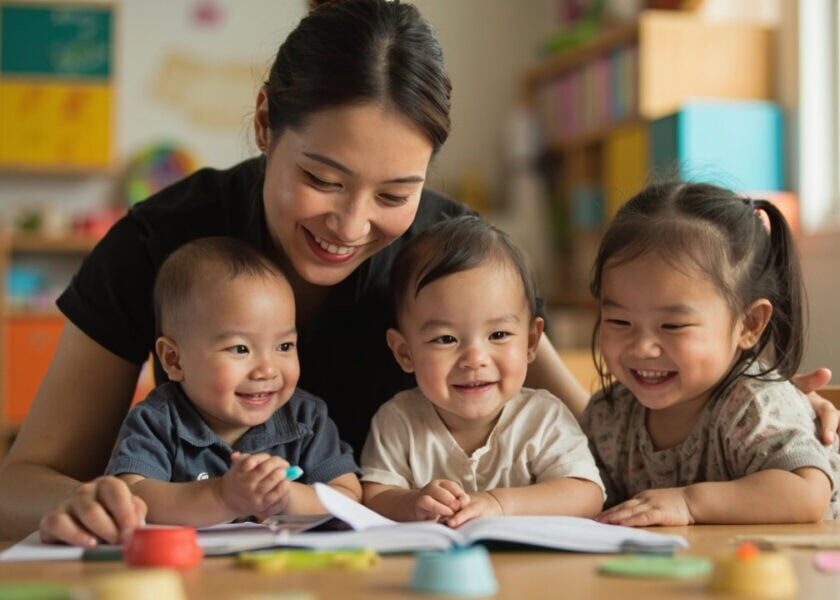
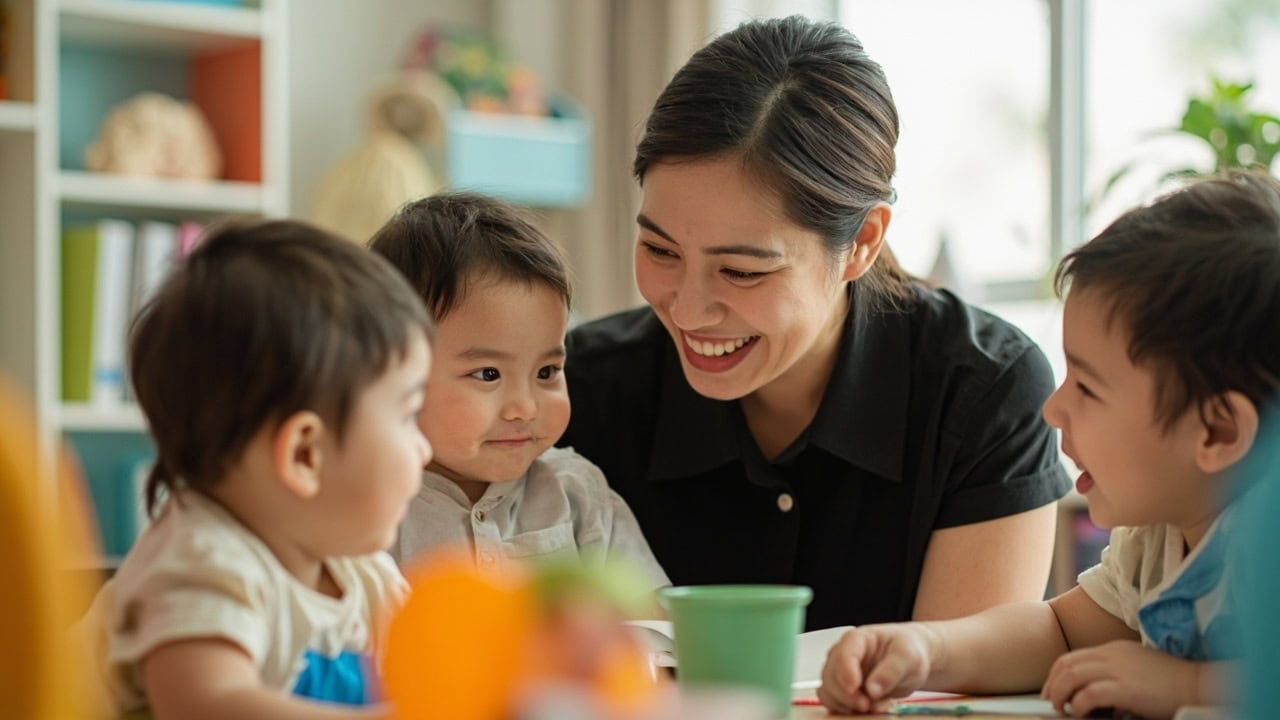
Quality childminding is not just supervision. It is intentional, developmentally informed care that recognizes the science of early childhood while honoring the emotional reality of families. It means:
- Responsive caregiving — creating environments where children feel safe enough to explore, secure enough to attach, and supported enough to develop at their own natural pace
- Attentive ratios — small groups allowing every child the responsive attention that developmental science tells us matters so profoundly
- Communication — regular updates on development and wellbeing so parents remain connected to their child’s daily experience
- Documentation — tracking development so that care can be attuned to where each child is in their learning journey
How EduNanny Supports Your Family
EduNanny by BUTLER was designed with this complexity in mind. We do not see ourselves as replacing grandparents. We see ourselves as partnering with families, as offering a kind of support that allows grandparents to be grandparents rather than primary caregivers, that allows parents to return to work with confidence, that allows children to receive developmentally informed care while remaining embedded in the love and history of their extended family.
EduNanny operates under the ECDA Childminding Pilot, part of a carefully structured initiative designed to offer quality home-based care to Singapore families. We maintain infant ratios of up to one to three, meaning every child receives the responsive, attentive care that developmental science tells us matters in those early years. Our care operates within Monday to Friday blocks, providing predictability for work arrangements while respecting the importance of family time on evenings and weekends.
We have also thought carefully about accessibility. Within the pilot fee structures, families can access CDA and Baby Bonus funds to offset care expenses, making professional care a genuine possibility for more Singapore families.
When you hand your child to someone, you are handing them the most precious thing in your life. We do not take that lightly. Our approach includes transparency measures that modern parenting requires: open communication about your child’s day, regular updates on development and wellbeing, and where deployed, CCTV access that allows you to see the environment your child is in. These are not substitutions for trust. They are acknowledgments that trust must be built and rebuilt, and that parents deserve the information they need to feel confident in their choices.
A Framework for Your Decision
| Consideration | Questions to Ask |
|---|---|
| Developmental Fit | Does this arrangement attune to my child’s unique temperament and emerging needs? |
| Caregiver Capacity | Can this arrangement sustain quality attention over time without burnout? |
| Social Development | Will my child have opportunities for peer interaction appropriate to their stage? |
| Family Relationships | Will this preserve rather than strain the bonds that matter most? |
| Communication | Will I know what is happening in my child’s day? |
What Will Matter in Twenty Years
In five years, in ten years, in twenty years, when you look back at this moment of decision, what will matter?
Will it matter whether grandmother was the primary caregiver, or whether the family used a professional service? Or will what matter be something else entirely:
- Whether your child grew up secure, curious, capable of relationship, ready for the world
- Whether your family remained close, or whether the strain of an impossible arrangement drove wedges between generations
- Whether you made your decisions from a place of clarity and courage, or from guilt and fear
The first thousand days of your child’s life are rushing by, right now, in this very moment. They will not come again. The brain that is forming, the patterns of attachment that are being laid down, the foundations of everything your child will become: these are being built in the days you are living right now.
This is not a reason for anxiety. It is a reason for intention. It is a reason to make your choices deliberately, honestly, and with your eyes on what truly matters.
Walking This Path Together
EduNanny exists because we believe every child in Singapore deserves care that is worthy of their potential. We believe families deserve support that strengthens rather than strains their bonds. We believe that navigating the complexity of modern family life should not mean choosing between the love of grandparents and the needs of children.
We believe there is a better way, and we have built our service around making that better way real for families like yours.
You are not alone in this. You are not wrong for feeling the tension. You are not failing for wanting something more than what the older generation had to offer.
You are doing exactly what parents have always done: you are trying to do better, to give more, to serve the next generation as well as it can be served. That impulse, that love expressed as effort, is the most beautiful thing about families. It is how we grow, across generations, from what we were given to what we can become.
Let us build something that honors where you came from while serving where your child needs to go.
If you would like to explore what a thoughtful, development-focused childminding arrangement could look like for your family, we welcome the conversation. Learn more about who we are and how we support families across Singapore.