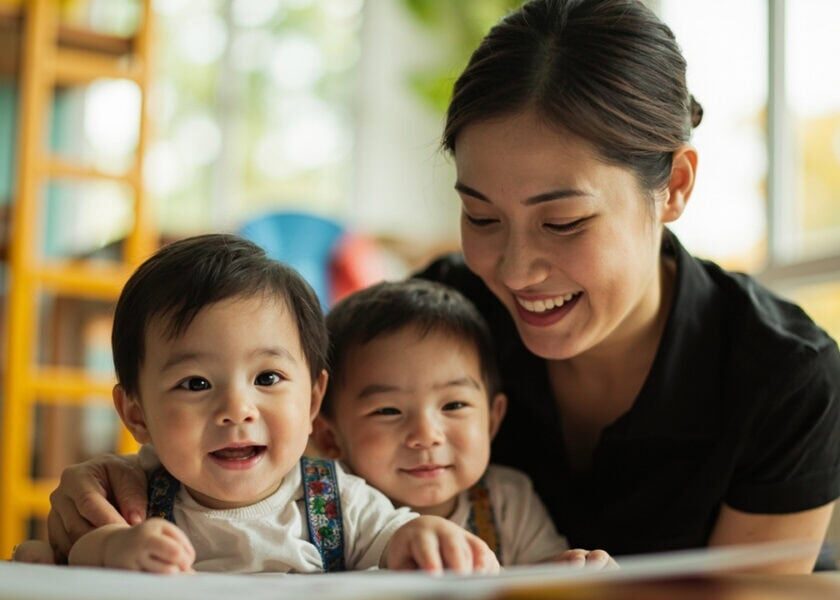
Growing Your Family’s Childcare Story Without Starting Over
When a Second Child Enters Your Childcare Arrangement: What Changes, What Stays the Same, and Why It Matters
There is a moment, quiet and often unannounced, when a parent realises that bringing a second child into an existing childcare arrangement is a different kind of decision than the first one.
The first time, everything felt new. The questions were urgent, the stakes enormous. Which centre? Which programme? How do we know we can trust someone with this small person who has only just learned to hold their own head up? Parents spend months researching, visiting, deliberating. It is a decision made largely in the dark, guided by instinct, reputation, and hope.
But the second time, the ground is different. The centre has a face. The caregiver has a name. There is a history. The question shifts from “how do we find someone we can trust?” to something more specific: how do we extend the trust we have already built to this new person?
That shift matters. And it reveals something important about what quality childcare actually becomes, over time, for families who choose it well.
The Foundation You Have Already Built
When you enrolled your first child, you made a decision with limited information and maximum weight. You were building something from nothing. The caregiver did not yet know your child’s temperament, your family’s rhythms, the small particularities that would come to define your experience together. Everything was earned in real time, through thousands of small interactions, through the daily unfolding of trust.
All those months of uncertainty, of wondering whether you had made the right choice, of watching your child for signs of distress or contentment that you could not yet read, were not wasted. They were the foundation.
Now, with a second child, you arrive at the same door carrying something different. You carry knowledge. You know how this place responds when your child is struggling. You know what the caregiver does on difficult days. You know, in your body, whether this is a place that truly sees your child or merely cares for them.
That knowledge is not nothing. It is, in fact, everything.
What Your Firstborn Learns Through This Transition
When a second child enters an established childcare arrangement, there is a witness. Your firstborn child is watching. Not consciously, perhaps, but deeply. Children understand more than we give them credit for, and what they observe during this transition teaches them something about how families grow, how they absorb new people, and whether the world they have come to trust can hold more.
The firstborn’s world at childcare is a settled world. Routines they know by heart, friendships they have built, favourite corners of the room they return to each morning. The arrival of a sibling into that same world is a kind of disruption, and children feel disruption even when it is joyful.
What parents do in those early weeks, and how the caregiver responds to both children, shapes what the firstborn learns about change, about family, about whether there is room for them and then also for someone new.
How to Support Your First Child
- Keep one morning ritual sacred. If your firstborn has a special goodbye routine with the caregiver, protect it. Do not let it disappear under the pressure of managing two children.
- Ensure individual moments. Even briefly, let your first child have their own exchanges with the caregiver. They need to know that relationship remains intact.
- Let them be part of it. If the arrangement allows, let your first child show the second child around. This positions them as a guide, not a displaced resident.
- Name what you see. Acknowledge that this is a big change. Simple honesty works: “I know this feels different. It’s okay to miss how things were for a little while.”
These are not guarantees against adjustment struggles. But they are acknowledgements that the firstborn’s experience of this transition deserves attention too.
The Caregiver-Child Relationship Deepens
What does it mean for a caregiver to hold two children from the same family at different developmental stages simultaneously?
It means something different than it would for a caregiver who has just met one of those children. When a caregiver knows the first child well, they have context. They know how that child learns, what soothes them, what makes them laugh, where they are in their language development, how they navigate conflict with other children.
That context does not disappear when a second child enters the picture. It deepens. It informs how the caregiver approaches the new arrival, because the new arrival is not being understood in isolation. They are being understood as part of a family story the caregiver is already a part of.
Consider what this looks like in practice. A caregiver who has watched your toddler learn to stack blocks understands something about that child’s persistence, their problem-solving style, their relationship with frustration and triumph. When your newborn arrives, that caregiver does not start from zero. They are already attuned to the rhythms of your family.
They notice, perhaps before you do, when this new child mirrors a tendency they recognise from the first, or when this child is entirely their own person. Either way, they are paying attention with the context that only time and relationship can provide.
This is one of the most understated values of continuity in childcare. The caregiver does not simply provide care. They hold an understanding of the family. They remember things parents have shared. They have watched the first child grow and can therefore anticipate, in broad strokes, what this second child might be like. They are not starting from zero. They are continuing.
The Practical Realities of Two Children at Different Stages
The practical realities of managing two children in different developmental stages at the same care arrangement are real, and they deserve honest acknowledgment. A toddler building towers with blocks and a newborn tracking sounds with their eyes require different kinds of attention, different kinds of language, different expectations.
A caregiver navigating both needs skill, patience, and genuine attentiveness to each child as an individual while holding the family as a unit.
This is why ratios matter. When caregiver-to-child ratios are appropriate, the caregiver can give each child what they need. When ratios are stretched too thin, even the most dedicated caregiver is forced to prioritise, and something gets lost.
There are also logistical realities that need supporting structures: different nap schedules, different feeding routines, different everything. Monday to Friday care blocks, CDA and Baby Bonus usability which removes some of the financial friction that can make family life feel like a constant negotiation with budgets, transparent communication so that parents always know what is happening and why.
None of these details are the point. The point is what they make possible. What they make possible is for parents to trust that both children are held well, that the caregiver knows each of them, that the family is not being processed but cared for.
Your Questions, Answered Honestly
If you are considering this transition, you may recognise some of these concerns in yourself. They are normal. They deserve honest answers.
“Will my first child feel replaced or displaced?”
This is a real fear, and it deserves real attention. But the answer lies in what you preserve, not what you add. As long as your firstborn’s relationship with the caregiver remains intact, and as long as they have space to be the “older one” rather than simply the one who was there first, they can experience this transition as expansion rather than loss. The caregiver’s role here is crucial, which is why choosing an arrangement where the caregiver understands your family matters.
“Can one caregiver really give enough attention to two children at different stages?”
Yes, when the structural conditions allow it. Ratios matter. A caregiver with three infants can know each one. A caregiver with eight is managing. This is not a criticism of caregivers; it is a structural reality. The right ratios are not luxuries. They are the conditions that make quality care possible.
“What if the second child doesn’t settle as well as the first?”
Every child is different, and every settling process is different. But when the caregiver already knows your family, they have more tools to help. They understand your parenting style, your child’s cues, the rhythms that matter. That context makes adaptation possible in a way that starting fresh does not.
“Is it selfish to keep both children in the same arrangement rather than finding something specialised for the second child?”
No. Continuity is not a compromise. It is a gift you give your children. The question is not whether one arrangement is better than another in the abstract, but whether the arrangement you have serves the children you have. For families who have found something that works, the answer is often yes, and the second child benefits from the first child’s settled experience as much as the first child benefits from being able to witness their sibling’s welcome.
A note on guilt and choice: There is no single right answer that applies to every family in every circumstance. The world of childcare is full of good options and difficult tradeoffs, and every family navigates it as best they can. But for families who have found something that works, who have built something real with a caregiver and a centre, the work does not have to be repeated. The foundation is there. The trust is earned. And there is genuine value, for both children and for the family as a whole, in staying with what you have built as you grow.
How EduNanny Supports Growing Families
EduNanny was built for families like yours. Not families who need childcare once and move on, but families who need a partner across the full arc of their children’s early years. The model is designed for exactly this kind of long-term relationship, with flexibility across home-based and centre-based pathways, with fee structures that aim to be within reach, and with a team of caregivers trained not just in the mechanics of infant care but in the attunement and sensitivity that genuine early childhood development requires.
When your second child enters an EduNanny arrangement, they are not starting fresh. They are joining a relationship that already exists. The caregiver who has been part of your family’s story continues that story. The first child sees their world expand rather than dissolve. The parents have one less thing to negotiate and one more person they can trust.
The ECDA Childminding Pilot maintains ratios of up to one to three infants in home-based care, with centre-based pathways available for families whose circumstances suit that environment. These are not arbitrary numbers. They are structural conditions that allow caregivers to do the kind of work that matters: to know each child, to observe each child’s development, to adapt their approach to each child’s specific needs, and to do all of this within the context of a family with more than one child.
The Thomas AI Chatbot offers parents a practical extension of this partnership. Questions that arise in the middle of the evening, uncertainties about development or routine, the small daily anxieties that parenting generates: these can be addressed quickly and thoughtfully, because EduNanny understands that support should not end when the care day does.
But the real answer is simpler than any feature. Two children, known deeply, held consistently, developed individually, and understood as part of the same family story. Not two separate experiences but one ongoing relationship with a family that is growing. The first child continues to thrive because their world is stable. The second child enters that world and finds it already ready for them. The caregiver holds both without losing sight of either.
The Door Stays Open
The first thousand days of a child’s life matter enormously. Research has given this period the attention it deserves. But what the research cannot always capture is what parents know in their bodies: that the children in your care are not waiting for a perfect family. They are simply waiting for you, and for the people you have chosen to surround them with, to show up consistently, to notice them, to love them in the particular way that this family loves.
Children do not just need care. They need the sense that the world is a reliable place, that the people who hold them will continue to hold them, that their history matters and is remembered. When a second child enters an arrangement where the caregiver already holds that history, they enter a world that is ready for them. They do not have to start from scratch either.
That is what EduNanny wants to help you do. Not just for the first child. For all of them.
EduNanny Singapore is here for that growth. For the second child entering a trusted arrangement. For the first child watching their world expand. For parents who want more than a service provider and are looking for a genuine partner in their children’s early years.
If you are considering how to extend your existing childcare relationship to a second child, or if you are still searching for the right foundation to build on, EduNanny is ready to have that conversation with you. The door you walked through the first time is still open. It opens a little wider every time a family grows.
#ChildcareInSingapore #SecondChildCare #InfantCareSingapore #Childminding #EduNannySG