Beyond Safety Finding Childcare Where Your Child Feels Home
The Question Every Singapore Parent Carries to the School Gate
There is a moment every parent in Singapore knows. It comes after the centre tours, after the waitlist decisions, after the reassuring conversations with leaders who show you bright classrooms and carefully planned curricula.
You have researched. You have visited. You have weighed the options with the serious attention you once reserved for career decisions. And yet, standing at the school gate or handing your child to a caregiver, a question surfaces—quiet, persistent, impossible to fully answer with brochures or star ratings.
The question is not whether your child is safe. It is something deeper. It is whether they are alright in there—whether the place you have chosen would feel like a small home to them, or simply a place where they are looked after.
That question, the one that lives beneath all the logistics and quality checklists, is the right question. And it is one that too much of the childcare conversation fails to honour.
Why Singapore Parents Feel This So Acutely
We live in a city that does research. Singapore parents are among the most intentional in the world when it comes to raising their children. You read. You compare. You visit centres during operating hours and sometimes request second visits. You ask about teacher qualifications, student-to-caregiver ratios, meal programmes, and hygiene protocols. You check for CCTV cameras and ask about communication practices. You want transparency. You want consistency. You want to know that the people caring for your child will notice when something is wrong and know what to do.
All of this is necessary. None of it is sufficient.
Singapore parents are also navigating impossible constraints—work demands, housing realities, the sheer cost of raising a family in one of the world’s most expensive cities. Many have no real choice but to select based on logistics, affordability, and proximity.
Beneath the question of logistics and affordability and centre reputation, there is a more vulnerable question that does not always get voiced: Am I doing the right thing? Is this environment where my child will feel like they belong? Will they remember these years as years where they felt held, or years where they had to learn to manage on their own?
Those questions deserve real answers. Not reassurance without understanding, and not information without compassion. They deserve an honest reckoning with what developmental science tells us about the first years of life, and a clear-eyed look at what different care environments actually offer.
Emotional Architecture: The Foundation Beneath Everything Else
Every child is born with an extraordinary capacity to explore, to learn, to connect, to become themselves. But that capacity does not unfold automatically. It requires specific conditions—a particular kind of environment, both relational and environmental, that allows the child to feel secure enough to venture out, curious enough to engage, and held enough to return to when the world feels overwhelming.
Developmental scientists call this a secure base: the psychological foundation from which a child can do everything else that matters. The science here is not controversial. Decades of research across multiple cultures and countries have shown that the quality of early attachment relationships predicts a remarkable range of outcomes—not just emotional ones, but cognitive, social, and even physical health trajectories that extend well into adulthood.
Children who develop secure attachments in their early years show greater resilience, better executive function, more sustained curiosity, and healthier relationship patterns. This is not because they were given more expensive toys or more structured curricula. It is because they were given the relational conditions that allowed their brains to develop in the way that human brains are designed to develop—in connection with attuned, responsive, emotionally present caregivers.
This is why we speak of premium childcare not as a luxury but as developmental architecture. When you build a house, you can choose beautiful fixtures and finishes, but if the foundation is weak, everything else is compromised. Early emotional security is that foundation. Everything that comes later—academic learning, social skills, independence, the ability to regulate one’s own emotions and respond to the emotions of others—rests on it.
How a Secure Base Works in Practice
Think of it this way. A child who feels genuinely safe—who senses that the adults around them know them, value them, and will be there—can afford to be curious. They can walk away from their caregiver to investigate a toy, knowing that the caregiver is still there, still attuned, still a source of comfort if needed. They can try new things, fail, try again. They can form friendships with other children because they have internalised the experience of being cared for and can extend that warmth outward.
Now consider the child who is cared for but not held. Who is in an environment that is safe and stimulating but where the rhythms are institutional rather than relational, where there are many children and few moments of genuine one-to-one attunement, where consistency is promised but the reality is a rotating cast of caregivers who mean well but cannot truly know each child.
That child learns something different. They learn to adapt. They learn not to expect their needs to be met with warmth. They learn to manage. And somewhere beneath that adaptation, a quiet anxiety takes root—not because anyone meant to cause harm, but because the environment did not have the emotional architecture to support the kind of security a developing child requires.
What Quality Care Actually Looks Like
Emotional architecture is felt before it is seen. It is not about colour schemes or toy collections or whether the walls are decorated with educational posters. Those things can matter, but they are the furniture of care, not its foundation.
True emotional architecture is present in:
- The way a caregiver kneels to a child’s level before speaking—not towering above, but meeting them where they are.
- The way a child’s name is used—not as a label but as an acknowledgment: I see you, you are here, you matter.
- The rhythms of the day, which should feel responsive rather than rigid, understanding that a toddler who resists nap time is not being difficult but expressing a developmentally normal need for autonomy within a secure structure.
- The way crying is met—not with efficiency, but with presence. With the quiet message that your feelings are not a problem to be solved but a reality to be accompanied.
The Critical Role of Caregiver Ratios
Emotional architecture is also about ratios. When an infant or toddler is in an environment with a high number of children per caregiver, even the most devoted adult cannot truly attune to each child’s emotional state. The body is present but the attention is divided. The child learns to shout louder or to go quiet. Neither response is healthy.
When ratios are small—one caregiver to one, two, or three infants—something different becomes possible. The caregiver can notice the micro-expressions, the subtle shifts in mood, the moments when a child is on the edge of overwhelm and needs to be gently soothed before they spiral. This is not luxury. This is the architecture of emotional security, built one interaction at a time.
Environments That Nurture Versus Those That Manage
Understanding the difference between these two types of environments is one of the most important things you can know. Here is a practical framework:
| Environments That Manage | Environments That Nurture |
|---|---|
| Rigid daily schedules that prioritise adult convenience | Flexible rhythms that respond to children’s needs and cues |
| High child-to-caregiver ratios | Small ratios allowing genuine attunement |
| Caregivers who are warm but transactional | Caregivers who know each child as an individual |
| Behaviour managed through consistent rules | Emotions met with presence and co-regulation |
| Children expected to adapt to the environment | Environment adapted to meet the child |
| Consistency promised but staff turnover common | Consistent relationships built over time |
This is not a judgement of parents who make different choices. Many families have no real choice at all. But even within those constraints, knowing what to look for matters.
What You Can Actually Look For
The fear that lives beneath every childcare decision—the fear that your child might feel unseen, anxious, or unsafe—is not a weakness to be managed. It is a sign of love. It is the part of you that knows, with a certainty that no checklist can provide, that what your child needs most is not supervision but presence. Not a programme but a relationship. Not a centre but a home.
That love deserves an honest answer. When visiting any childcare environment—centre or home-based—pay attention to:
- How caregivers speak to children: Are they kneeling to eye level? Using names with warmth? Speaking about feelings as real?
- How crying is handled: Is there urgency to soothe, or does it feel like something to be managed quickly?
- Whether you can sense the emotional climate: Do the children seem tense, or do they move with ease?
- The caregiver’s responsiveness: Can you observe a caregiver noticing a child’s subtle cues—a glance, a change in posture—and responding appropriately?
- Your own instinct: After a visit, ask yourself: would my child feel held here? Not just safe, but held.
A Different Pathway: EduNanny by BUTLER
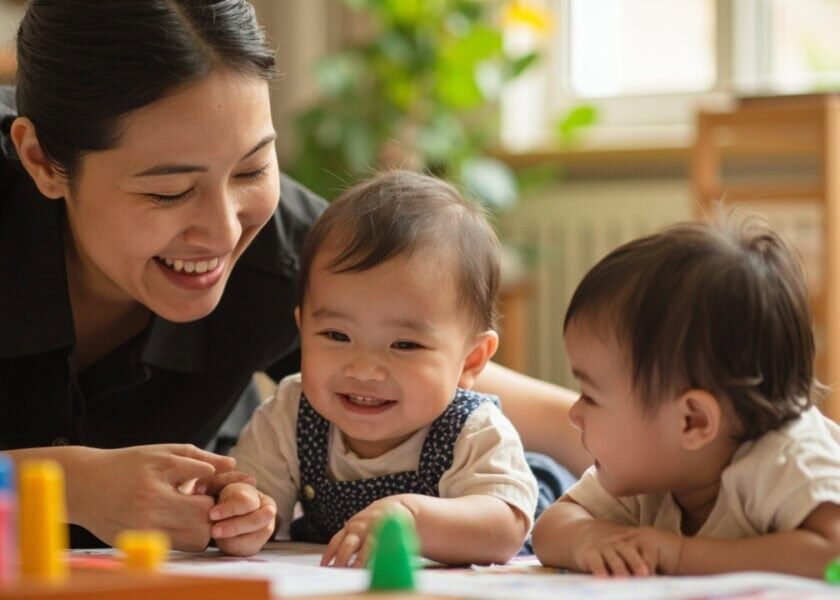
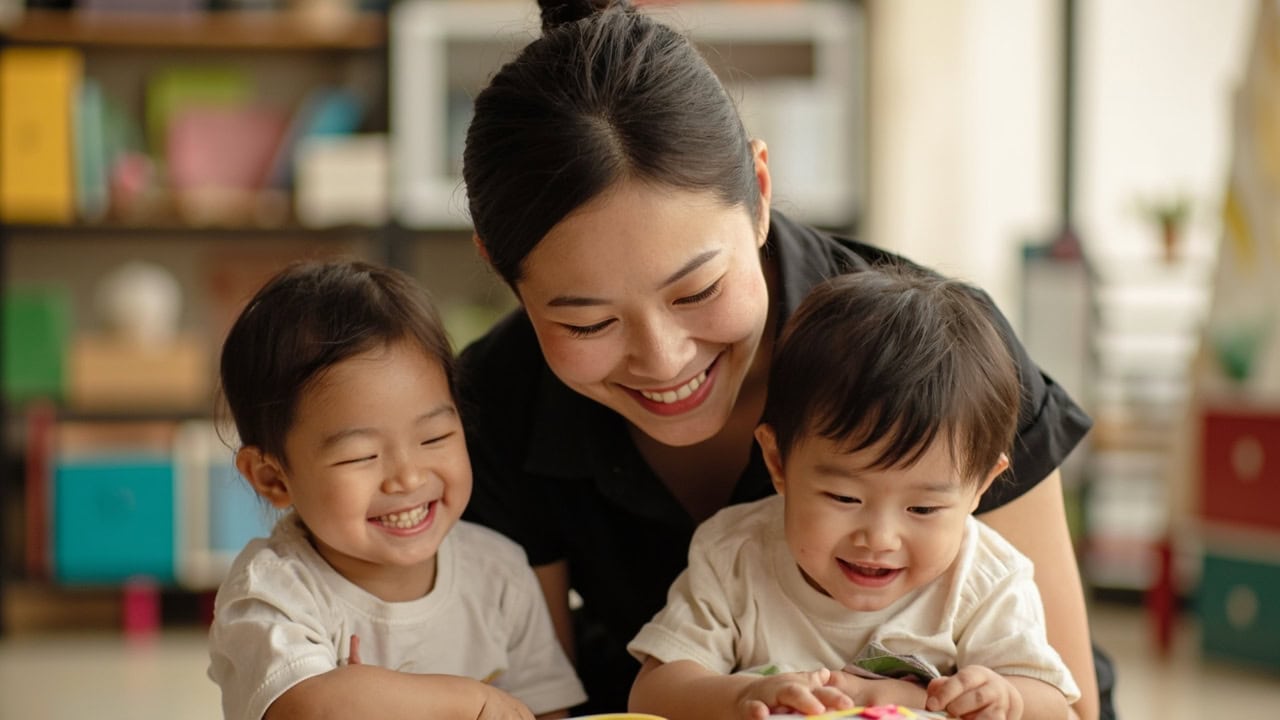
EduNanny is part of an ECDA Childminding Pilot—a recognition that home-based and community-based pathways can offer something that large centre-based settings often cannot. When care happens in a home environment, the rhythms are smaller, the relationships are closer, and the child can develop a genuine sense of belonging rather than simply attending a programme.
This is not a lesser option. For many families, particularly in those crucial early years, it is a more developmentally aligned one.
- Ratios that make attunement possible: Up to one caregiver to three infants, so that every child can be genuinely known, not just adequately watched.
- Trained, supported caregivers: Treated as professionals because the dignity of the childminder and the quality of care are inseparable. When a caregiver feels respected and valued, they bring that presence to the child.
- Transparent practices: Communication practices and CCTV measures are in place not as surveillance but as partnership—a way of showing parents that they have nothing to hide and everything to share.
- Family rhythms respected: Monday to Friday care blocks designed around how families actually live.
- Accessible fee structures: CDA and Baby Bonus usability so that financial constraints do not force families into environments that are convenient but not right.
EduNanny is built on understanding, not just service. The understanding that parents are not looking for a babysitter. They are looking for a place where their child will flourish—where they will feel safe enough to be themselves, explore enough to grow, and held enough to know that they are loved even when you are not in the room.
Choosing With Confidence
There is a word that captures something that no other word quite does. The word is home. Not the building, but the feeling. The feeling of being in a place where you are known. Where the patterns are familiar and the people are consistent. Where your small preferences and quirks are noticed and honoured. Where you can be completely yourself—tired, cranky, joyful, curious—and still belong.
That is what every child deserves from their childcare. Not just to be cared for, but to feel home.
When you find a place where your child feels truly held, you will know it—not because of a star rating, but because of the way they look when you pick them up. Still connected. Still secure. Ready to tell you about their day, because their day was spent in a place that was worth coming back from.
We believe we have built one answer to the question every Singapore parent carries. Not as a slogan or a marketing promise, but as a commitment to the kind of care that builds people—one relationship at a time, one attentive morning at a time, one child who feels, for the first time in your absence, that they are exactly where they should be.
If you are exploring childcare options for your infant or toddler in Singapore, we invite you to learn more about what EduNanny by BUTLER offers. To tour our homes. To ask questions. To see whether this feels like the kind of place where your child could feel held.
Because that love—the one that brought you to this decision, that keeps you up at night wondering if you are choosing well—that love deserves an answer it can trust.
We would be honoured to show you ours.