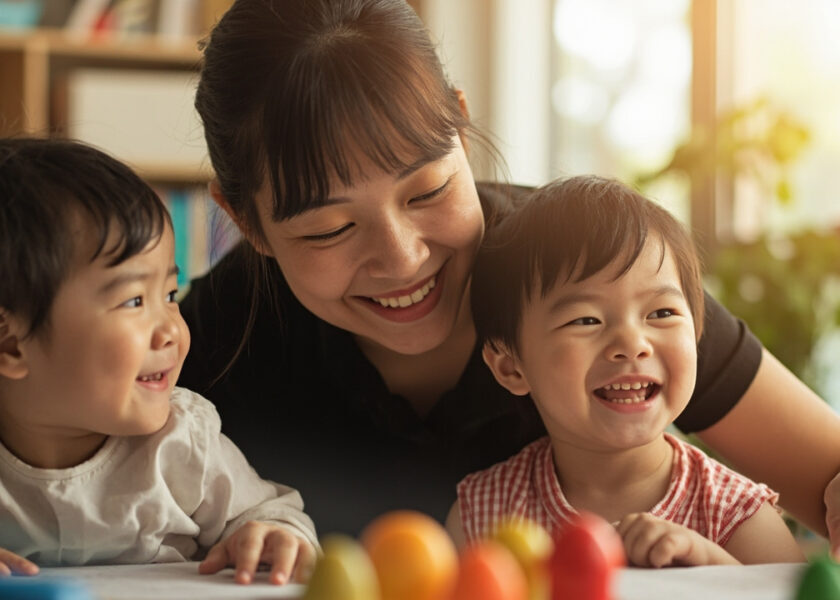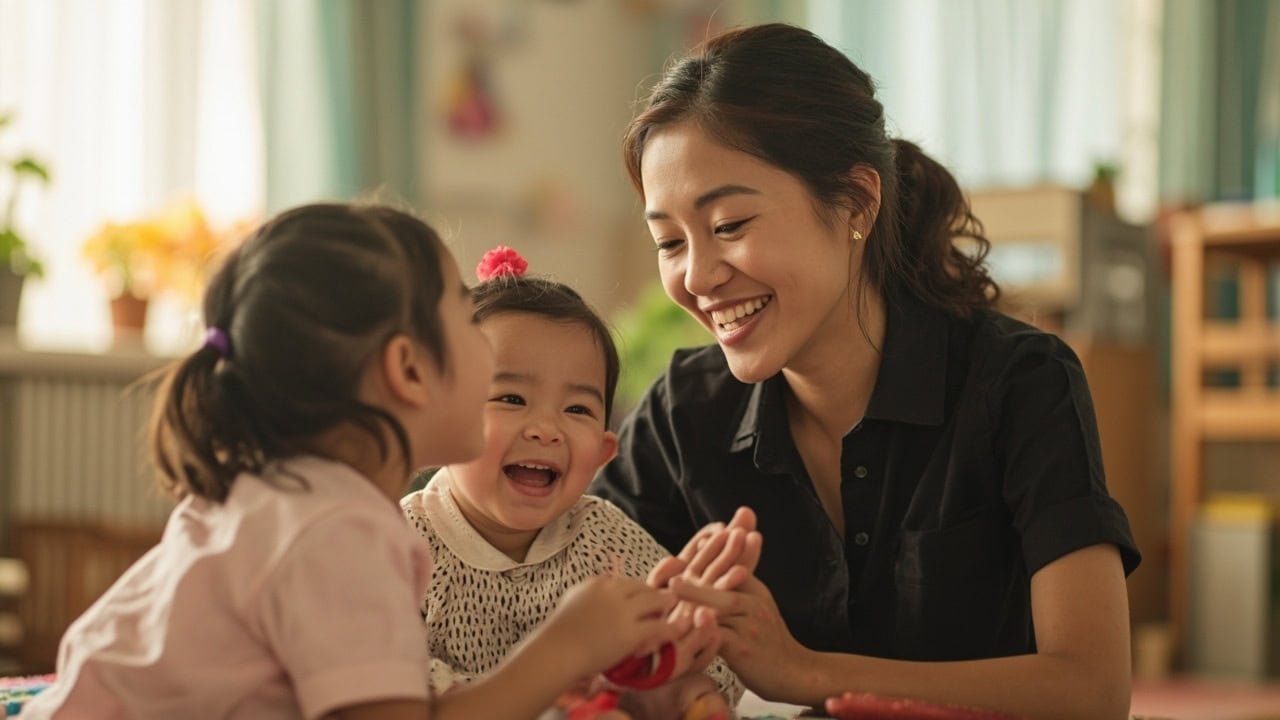
Five Ways Your Child Grows in a Quality Childcare Day
The Five Developmental Domains Your Child Grows Across Every Day
Most parents, when they imagine a childcare day, picture something like this: children in a room, playing, being watched. Maybe a teacher organising an activity. Snacks and naps in between. It sounds fine. It sounds safe. But it does not sound like growth.
The truth is more interesting — and more reassuring. A quality childcare day has a structure that is almost invisible to the untrained eye, but that creates the conditions for learning to happen naturally. This structure is what educators call rhythm.
Rhythm is not restriction. Rhythm is the architecture of predictability that allows a child to feel safe enough to explore. When a child knows that circle time comes after free play, that snack comes after outdoor time, that nap follows lunch, they stop spending emotional energy on wondering what comes next and begin to invest that energy in what is happening now.
They become available for learning. They become available for growth.
In quality childcare, children grow across five interconnected domains that researchers and educators have identified as essential to early childhood development:
- Motor Skills — Both fine motor (small muscle control) and gross motor (large muscle movement)
- Language and Communication — Vocabulary, listening, expression, and early literacy
- Social-Emotional Growth — Empathy, sharing, emotional vocabulary, and peer relationships
- Cognitive Exploration — Curiosity, problem-solving, and age-appropriate critical thinking
- Creative Engagement — Art, music, imaginative play, and sensory experiences
These domains do not exist in isolation. A child building a tower with blocks is simultaneously developing fine motor skills, cognitive skills, and creative engagement. A child sharing a toy at snack time is developing social-emotional skills, language, and self-regulation. Quality childcare weaves these domains together throughout the day, creating experiences that develop the whole child.
What a Developmental Day Actually Looks Like
Let us walk through a real day. Not as a tour guide would show you — through hallways and notice boards and brightly decorated walls. But as a parent would understand it: as a morning of tower-building and negotiation, of songs about caterpillars and new words for feelings, of water transferred between containers with focus that looks like meditation, of a child falling and getting back up, of paint and imagination and the particular joy of making something that did not exist before.
The Morning: Preparation and Free Play
The morning begins before the children arrive. The caregiver — your child’s caregiver, the person who will be their companion for the day — is already preparing the environment. The toys are arranged not randomly but intentionally. The morning activity is set up. The space has been considered: Where will the light fall? Where will a child feel safe to sit and explore? Where will movement be encouraged and where will calm be possible?
This is not decoration. This is preparation. And it is the first signal that what happens here has been thought about — deeply, specifically, with your child in mind.
When your child arrives, the handover is brief but complete. You share something — how they slept, what they ate for breakfast, that they seemed interested in birds this morning, that they are missing a favourite stuffed rabbit you promised to bring this afternoon. These details matter. They are not small talk. They are the threads that connect your world to theirs for the hours ahead. A good caregiver listens for these threads and holds them gently throughout the day.
Motor Skills: Active Bodies, Purposeful Play
Morning free play is where motor development begins, though you would not call it that if you were watching. You would call it a child building a tower with soft blocks, then knocking it down, then building it again, higher. You would call it a child running in the outdoor space, climbing, navigating uneven surfaces, learning the relationship between effort and outcome.
You would call it a child negotiating space with another child — this is my corner, that is your corner — in a language made of gestures and expressions and the beginnings of shared understanding.
The environment has been set up for this. The materials are present. The space is safe. The caregiver is nearby — not hovering, not directing, but present — noticing when a child needs a gentle challenge, when a child needs encouragement, when a child needs simply to be seen in their accomplishment.
Language and Communication: Words That Build Minds
There is circle time, where language development happens most visibly. You would call it a group of children sitting on a colourful mat, singing a song about a caterpillar turning into a butterfly, following along with their eyes as picture cards are held up.
Language does not develop in isolation. It develops in relationship, in context, in the back-and-forth of conversation. And so the caregiver speaks — not at the children, but with them.
A child says, “Dog!” The caregiver says, “Yes, a brown dog with floppy ears. What do you think he wants to do?”
A child says, “I’m sad.” The caregiver says, “You look like you are feeling sad. Can you show me with your face? Let’s use our sad voice. Sometimes it helps to say the feeling out loud.”
This is language-rich care. It is not a curriculum. It is a quality of attention, a quality of response, a quality of conversation that runs through the entire day — present in the morning greeting, in the narration of activities, in the quiet conversations at lunch, in the songs sung before nap, in the stories read in the afternoon glow.
In Singapore, where many children grow up bilingual or multilingual, this language-rich environment is especially important. Quality care holds all of the language — across all languages — with respect and intention.
Social-Emotional Growth: Learning to Be With Others
Outdoors, social dynamics shift. The space is larger. The rules of interaction change. Children must navigate more movement, more noise, more possibility.
A child falls. The caregiver does not rush. A child looks up. The caregiver waits. The child decides to get up. The caregiver acknowledges: “You had a little fall. You got back up.”
A child takes a toy from another child. The caregiver intervenes — not with punishment, but with narration. “I see you wanted that toy. Jiamin was playing with it. Let’s think about what we can do.”
Children learn empathy not by being told about it, but by being in relationship — by experiencing the small conflicts, the small negotiations, the small moments of seeing another person’s face and understanding that there is a person behind it.
Cognitive Exploration: Curiosity in Action
You might call it a child transferring water from one container to another, concentrating with a focus that looks like meditation. But what is actually happening is spatial reasoning, pre-mathematical thinking, the concept of volume. A child is developing the small muscles in their hands and fingers that will one day hold a pencil, tie a shoelace, button a jacket. A child is learning about gravity, about cause and effect, about their own capability.
The caregiver sees the water transfer and understands its cognitive significance. They ask: “What do you think will happen if we pour more slowly?” “Which container holds more?” “Can you fill both containers to the same level?”
These are invitations to think — to make thinking visible, to put language to experience, to deepen the learning that is already happening in the hands and the senses.
Creative Engagement: Making Something That Did Not Exist Before
Creative engagement is not about producing a beautiful painting that parents can take home. It is about what happens inside a child when they press paint to paper and see colour bloom, when they squeeze clay and feel resistance, when they shake a maraca and hear the connection between their action and the sound.
Creative engagement is cognitive engagement. It is problem-solving, spatial reasoning, executive function, and emotional expression. A child who has access to rich creative experience is a child who is developing the whole of themselves.
Meals, Transitions, and Rest: Where Learning Continues
Transitions are often underestimated, but they are where the most learning happens — and where the most dysregulation can occur if they are not handled well.
Lunch is a transition. Wash hands, sit down, the smell of food, the social ritual of eating together. Meals in quality childcare are not just nutrition. They are language opportunities, social practice, and sensory education.
And then there is nap.
Rest is not the absence of learning. Rest is part of learning. A child’s brain consolidates the experiences of the morning during sleep. Quality care protects nap time — the dimness, the calm, the presence of a caregiver who pats a back, who hums a lullaby, who is there when a child stirs and needs reassurance that the nap can continue.
The Caregiver: Not a Supervisor, But an Intentional Developmental Partner
A supervisor watches. A supervisor ensures safety, prevents harm, maintains order. These things are necessary. They are the baseline.
But an intentional caregiver does more. An intentional caregiver sees the tower and understands that a child is learning about gravity, about cause and effect, about their own capability. They see the water transfer and understand that a child is developing spatial reasoning, pre-mathematical thinking, the concept of volume. They see the negotiation between two children over a corner of the room and understand that a child is learning the most complex skill humans develop: how to be with another person, how to assert needs, how to accommodate, how to share space and attention and desire.
Intentional care is not about filling every moment with instruction. It is about recognising that every moment is already full — full of potential, full of learning — and about creating the conditions for that potential to unfold.
Why Ratio Matters
The caregiver’s role here is irreplaceable. The caregiver is not just a supervisor. The caregiver is a model — of how to speak to another person, of how to handle frustration, of how to apologise, of how to notice and name emotions, of how to be a calm, regulated presence when everything feels chaotic.
Children learn to do what their caregivers do long before they can do what their caregivers say. This is why the ratio matters so much.
A one-to-three infant ratio, which is what EduNanny maintains in its pilot programs, is not an administrative detail. It is the condition that makes genuine responsiveness possible. It is the difference between a child being cared for and a child being truly known.
Some Days Require More
Some days, a child needs more movement. Some days, a child needs more quiet. Some days, a conflict arises that takes an hour to navigate. Some days, a child is not themselves — is clingy, or withdrawn, or angry, or just plain tired — and the day must bend to meet them.
Quality care is not a factory process. It is a relational practice. It requires trained, attentive, emotionally mature caregivers who can read a child’s needs, adapt in real time, and respond with both professionalism and warmth.
How to Recognise Quality When You Are on a Tour
For parents who are wondering how to recognise this kind of quality when they are reading a brochure or standing in a childcare centre for the first time, here is what to look for.
- Look at the caregiver’s hands. Are they doing something? Are they engaged with a child, or are they idle?
- Look at the children’s faces. Do they seem settled? Not necessarily quiet — children are meant to be noisy and lively — but settled in the sense of belonging.
- Do the children go to the caregiver easily? Does the caregiver kneel down to a child’s level when speaking to them?
- Do the children seem to have choices? To be able to choose their activity, to move through the space freely within appropriate limits?
- Look at the environment. Is it prepared? Are materials accessible, interesting, rotated? Is there evidence of children’s work on the walls — not just commercially produced posters, but photos of the children engaged in activity, samples of their art, records of their play?
- Look at the schedule. Is there a rhythm? Is rest protected?
And ask questions:
- Ask about ratios.
- Ask how transitions are handled.
- Ask what happens if a child is upset.
- Ask how they communicate with parents — and ask to see what that communication looks like.
The Question to Ask at Pickup
Communication is not a luxury in childcare. It is the bridge that connects your world to theirs. Ask: “What did my child do today?” and notice whether the answer is specific, real, and something you can build on.
You should receive updates, photos, observations, stories. You should feel the confidence that comes not from trust alone, but from evidence — from the concrete, daily, observable evidence that your child is growing.
What This Means for You as a Singapore Parent
Here is what we know about parents in Singapore. You are not a monolith. You are not a demographic. You are individuals — some of you are returning to work after maternity leave, navigating the particular exhaustion and hope of that transition. Some of you have always worked, and have navigated different kinds of questions from different kinds of people who wondered if you were doing the right thing. Some of you are single parents carrying more than your share alone. Some of you are grandparents raising grandchildren. Some of you are navigating the particular challenges of bilingual or multicultural households, of children with additional needs, of financial constraints that make every decision feel loaded.
Whatever your story, you are here because you want the best for your child. And you are wrestling with the question that every parent wrestles with: How do I give my child what they need when I cannot be with them every moment?
The answer is not to be with them every moment. The answer is not to sacrifice your own life, your own work, your own self. The answer is to find a partner who will be with them the way you would be with them, as much as possible, as well as possible.
Why EduNanny Participates in the ECDA Childminding Pilot
EduNanny participates in the ECDA Childminding Pilot — not just because it makes services accessible through structures like CDA and Baby Bonus usability, and not just because it keeps fees within affordable ranges for Singapore families — but because the pilot represents a commitment to elevating the entire field of childminding in Singapore.
It represents a belief that caring for young children is not a fallback, not a low-skill job, but a profession — a calling — that deserves recognition, training, support, and respect.
We believe that the childminder who holds your infant, who sings to your toddler, who celebrates your child’s first friendship and names your child’s first emotion and notices when something is not quite right — that person is doing some of the most important work in the world. And we treat them that way.
The Answer to the Question You Ask Every Morning
There is a moment, at the end of every EduNanny day, when parents arrive to pick up their children. You see them — the parent at the door, the child across the room who looks up and sees you, the face that changes, the body that orients toward you like a plant toward light.
And in that moment, you want to know: Was this a good day? Did they grow? Did they learn? Did they feel loved?
The answer, if we have done our work, is yes. Not because we replaced you. Not because we are better than you. But because we joined you. Because we extended the circle of care that began with you, and held it in your absence, and kept it warm.
Your child is not just passing time in our care. They are living a day designed for development. A day where every transition is an opportunity, every interaction is an invitation, every moment is held with the intention and attention your child deserves.
And at the end of that day, they come home — tired, and full, and a little bit changed. And you hold them. And you ask them what they did. And they may or may not have the words yet.
But somewhere, underneath the words they cannot yet say, there is the experience of a day that mattered.
That is what we offer. Not a promise. A practice. A daily, concrete, observable practice of developmental care that begins the moment your child arrives and continues through every hour until you hold them again.
What is my child actually doing right now?
They are growing.
Ready to explore what this looks like in practice? Speak with our team to learn more about how EduNanny’s developmental approach supports your child’s growth — and gives you the confidence you deserve.
To learn more about EduNanny and our approach to developmental childcare, visit our About Us page or explore our homepage.