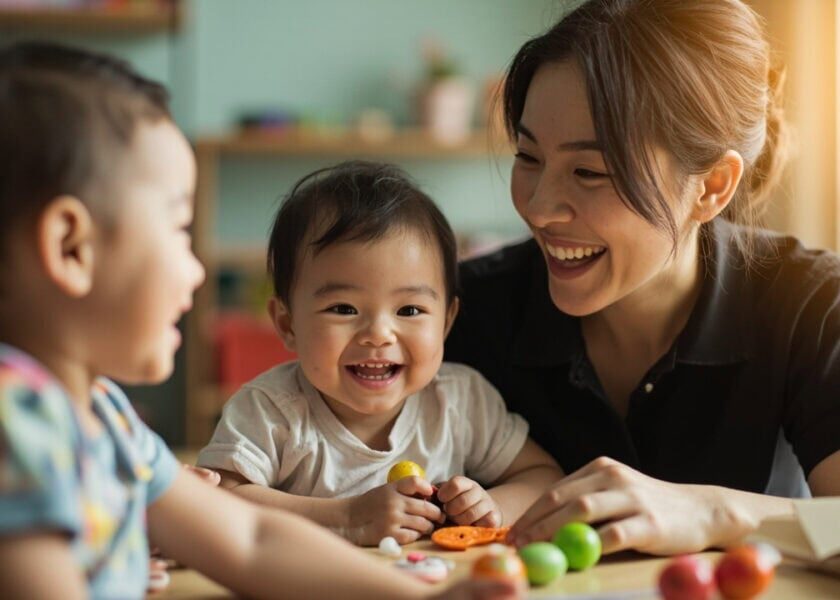
Five Quiet Signs Your Child Is Truly Flourishing in Care
“`html
Quick Summary: Five Signs Your Child Is Flourishing
Quality childcare does not keep its work hidden. It produces evidence. When you know what to look for, the signs of genuine flourishing are readable — not just to specialists, but to you. Here is what the research and years of observation have taught us:
- Emotional security: Your child greets you at pickup with warmth, then returns to what they were doing without needing you to witness it.
- Social growth: Your child narrates relationships, not just events. They say “Mia and I built something,” not just “I played.”
- Language development: Your child brings home new words, new sentence structures, and a growing ability to name their own feelings.
- Adaptive confidence: Your child meets new situations with engaged curiosity rather than retreat or panic.
- Autonomous curiosity: Your child sustains attention, follows an interest, and is absorbed in their own discoveries — without needing to perform that for you.
Each of these is a sign. Together, they form a pattern — and that pattern is something only you, as the parent who knows your child best, can read most reliably.
The Reunion as Evidence: Reading Emotional Security
The difference between hoping your child is flourishing and seeing that they are flourishing is not a matter of faith. It is a matter of observation. And observation, it turns out, is a skill — one that deepens when you have the right environment producing the right signals.
Start with the reunion. You arrive and your child looks up. Not with panic. Not with the frantic search of a child who has been holding themselves together under unfamiliar management. They look up and they see you, and something in their face shifts — a softening, a quick brightening — and then, crucially, they return to what they were doing.
They do not collapse. They do not need to.
That pause — the recognition, the warmth, the ease of return — is not a small thing. It is a signature. It tells you that your child has been secure enough in your absence to build something, to be somewhere, to belong to a space that was not yours but was still safe.
Now watch what happens in the minutes that follow. Your child may come to you. They may not. They may run to a caregiver first — to show a block tower, a mark on a page, a small victory they have been tending. If they do, notice what that means.
They are not confused about who you are. They are not choosing the caregiver over you. They are choosing to share. And the person they are sharing with has been present enough, warm enough, consistent enough that your child instinctively includes them in the circle of people worthy of good news.
That is not something a child does for a stranger. That is something a child does for someone who has mattered to them during the day. It is a quiet, enormous compliment, and it is legible only if you know to look for it.
What the Social World and Language Tell You at Pickup
Consider the social world. At pickup, you may hear about a child who shared, or a child who helped, or a child who did not want to share at all but worked it out somehow. Listen to the way your child narrates these moments.
A child in quality care does not simply report events. They begin to narrate relationships. They say, “Mia and I built something.” They say, “Teacher said it was okay to feel angry but not okay to hit.” They begin to carry an understanding of social dynamics that did not come from a lesson plan. It came from living inside a miniature society — one with rules, with conflict, with the slow, miraculous work of learning that other people have feelings too, and that those feelings can be navigated.
What you are seeing when your child returns home with these small social stories is not incidental. It is evidence of a peer environment managed by adults who intervene thoughtfully — who do not rescue, but guide. Who do not eliminate friction, but use it as raw material.
And then there is language — perhaps most easily overlooked because it is so ordinary. You may not have been told that your child practiced a new sound today, or learned a new word, or said something in a context that surprised you. But language grows in environments that are rich in responsive interaction — where a caregiver narrates what a child is doing, mirrors their sounds, expands their single words into short sentences, reads aloud with attention and warmth.
These are not dramatic interventions. They are the steady, daily, human work of being with a child. And a child who is absorbing that environment will bring it home. You will notice it in the words they choose, the questions they start to ask, the way they begin to narrate their own experience back to you with increasing complexity.
“I no sad. I just missed you a bit.”
Three years old, and already constructing something that did not exist six months ago. That is language growth — and it is happening quietly all around you, in the ordinary hours you are not there to witness.
Adaptive Confidence and Autonomous Curiosity
There is another dimension worth naming, because it is the one most easily mistaken for simple personality. Call it adaptive confidence. You see it when your child encounters something new — a different room, a different caregiver for a day, a new activity — and instead of freezing or collapsing, they pause, assess, and then move forward.
Not because they are fearless. Because something in them has learned that new things can be survived, and explored, and that there are people nearby who will help if the survival gets difficult.
That quality — that willingness to lean toward the unknown with a measured, engaged curiosity — is not inborn. It is cultivated. It is the product of an environment where a child has been given just enough challenge to stretch, and just enough support to succeed.
And then there is autonomous curiosity — which is, if we are honest, the most beautiful evidence a parent can read. It is the child who, at pickup, does not immediately come to you but is engaged in something — stacking, sorting, drawing, pretending — and who is not performing for you. They are simply doing. They are in the middle of a thought and they are not ready to leave it.
They are becoming a person who can be alone in the most generative sense. A person who can sustain attention, follow an interest, create something from nothing. That is the hallmark of a child who is not just being cared for but is being allowed to grow — who is given time, space, and the freedom to be the author of their own small discoveries.
When you see this in your child, you are seeing the product of hours spent in an environment that trusted them enough to let them wonder.
What Singapore Parents Actually Worry About
If you are researching infant care in Singapore right now, you are likely carrying several questions at once. Is my child too young? Will they feel abandoned? How do I evaluate a centre I have never been inside? What if the caregivers change? What if something goes wrong and I never know?
These are not irrational fears. They are the questions of a thoughtful parent, and they deserve thoughtful answers.
On separation: Some separation difficulty is normal and does not indicate poor care. What indicates poor care is a child who does not recover — who remains visibly distressed day after day, who seems diminished rather than expanded by the experience. A child in quality care may take time to settle. But the trajectory should be toward security, not toward ongoing protest.
On caregiver consistency: Ask directly about staff turnover and whether your child will have primary caregivers. Consistent faces are not a luxury — they are the foundation of everything described above.
On communication: You should not need to guess. Ask what the daily rhythm looks like. How do they share updates with parents? Can you speak with the caregiver directly? These are reasonable requests, and a quality provider will welcome them.
On your own read: Trust your instincts, but give them time to work. The signs described in this article are most legible over weeks and months, not in a single observation. If your child is showing consistent patterns of emotional security, social engagement, language growth, adaptive confidence, and autonomous curiosity — that is evidence. Act on it.
How Quality Childminding Creates the Conditions for Evidence
The ECDA Childminding Pilot taught us something that sounds simple but is genuinely transformative: when ratios are held to a standard that allows a caregiver to truly see each child — when the same few faces are present day after day — the emotional architecture that a child builds during those hours becomes observable. It surfaces. It travels home with them.
Small ratios matter not as a bureaucratic metric but as a condition for warmth. Trained caregivers matter not as a checkbox but as the presence of people who can read a child’s distress, respond to their curiosity, and hold the emotional temperature of a room. Consistency matters because a child cannot build security with strangers, no matter how well-meaning.
These are not abstractions. They are the conditions under which the signs described above reliably appear — and reliably travel home with your child at the end of each day.
What EduNanny Has Built Around This Principle
EduNanny, under the banner of BUTLER, has designed its approach around exactly this understanding. The ECDA Childminding Pilot created a pathway — home-based, community, and centre-based — that makes consistent, warm, attentive caregiving not an aspiration but a standard.
- Small ratios that allow caregivers to truly know each child
- Trained caregivers who can read and respond to what each child needs
- Monday to Friday care blocks designed around the rhythms of real family life
- Accessible fee structures that make quality care achievable for more families
- Support tools such as the Child Development Account and Baby Bonus for eligible families
Where deployed, open communication channels are not surveillance — they are an invitation. An invitation for you to see what is happening in those hours, and to come to pickup knowing what to look for.
This is the promise, stated plainly: we believe that when you walk through the door at pickup, you should be able to see something. Not everything. Not a performance. But something real — a sign, a moment, a small unmistakable piece of evidence that your child spent the day inside an environment that was worthy of them.
The Most Important Thing We Can Tell You
We have watched this happen across hundreds of families in Singapore. The evidence of flourishing does not always announce itself in grand gestures. It is more likely to arrive in the way your child says goodbye in the morning — without dread, with something closer to eagerness. It is in the way they tell you about their friends. It is in the way they ask questions about the world and expect answers. It is in the way they sleep better, eat better, play more freely, and look at you with a face that is not just happy but secure.
All of these are readable. All of them are real. And all of them are the product of the same thing: a child who has been held, guided, challenged, and loved — in the hours that matter most, by people who took that responsibility with the full weight it deserves.
We do not ask you to trust blindly. We ask you to look. And then we ask you to trust what you see. Because what you will see, in a childcare environment that has been built with this kind of intention, is your child — not the idea of your child, not the anxious projection of what they might be feeling, but the real, specific, irreplaceable person they are becoming.
And you will know.
That is what childminding is at its highest purpose. Not a service you purchase. Not a convenience you accept. It is a partnership in the truest sense — one that says to you: we are here during the hours you cannot be, and we will leave the evidence where you can find it. We will make your child visible to you, in all the ways that matter.
You chose quality. You were right to. Now let us show you why.
If you are ready to explore what this looks like in practice — and what it looks like to walk through a childcare door knowing what to look for — EduNanny is here to start that conversation with you.
Learn more about EduNanny’s ECDA-registered childminding programme, or read more about who we are and what we stand for.
“`