When Home and Care Observations About Your Baby Differ
EDUNANNY® BY BUTLER · PARENT GUIDE
If you notice your baby turn away from a song at home while the caregiver describes a look towards a voice during care, first ask whether the accounts describe the same kind of moment.
Compare the activity, timing, observed response and adult action. This gives both adults a clearer conversation while leaving room for what neither of you knows.
Begin with what each adult actually noticed
A parent and a caregiver may have observations from different times, places and activities. Put those details into words before treating a difference as evidence that someone is wrong.
“She looked towards me when I paused” describes an action in a sequence. “She prefers my way” adds an interpretation. Ask for the words, movements or sounds that were noticed, and what happened immediately around them.
The Raising Children Network’s guidance on communication with parents recommends everyday language, accurate information about observations and checking understanding. Its advice supports a respectful exchange; it does not provide a way to diagnose an infant’s feelings from a gesture.
You can offer an observation from home in the same descriptive way. Say what you were doing, what your baby did and what you did next. If you only remember part of the sequence, say so.
There is no need to turn a look, a quiet moment or a turned head into a fixed statement about trust, readiness or development. The useful starting point is the account of the moment itself.
Check whether you are comparing like with like
Choose one observation from each setting and ask which details are similar. Was it the same activity? Was the adult doing the same thing? Was the account from before handover or much later? These questions describe the comparison; they do not establish why a baby responded.
The example below is invented. It does not describe an observed family, a preferred infant response or a test to repeat with a baby.
| Detail to clarify | Fictional home account | Fictional care account | What to ask |
|---|---|---|---|
| When it happened | Fictional home accountBefore the morning handover. | Fictional care accountLater in the care period. | What to ask“Which moment are we each describing?” |
| The activity | Fictional home accountThe parent began a familiar song. | Fictional care accountThe caregiver spoke, then paused. | What to ask“Were the sound and sequence the same?” |
| The observation | Fictional home accountThe baby turned their head away. | Fictional care accountThe baby looked towards the adult. | What to ask“What did you notice just before and after?” |
| The adult’s next action | Fictional home accountThe parent stopped the song. | Fictional care accountThe caregiver continued the care routine. | What to ask“What happened next, and what remains unclear?” |
These are two accounts of different moments. They do not show that the song caused the turned head, that the caregiver’s approach was better or that the baby prefers one adult. A comparison can remain incomplete without either adult needing to fill in a cause.
You do not need identical routines or identical infant responses to have a useful discussion. Begin by understanding what each person is reporting.
Leave the explanation open when the information is incomplete
A practical conversation can separate three things: what was observed, what someone thinks might have mattered and what has not been established. Keep a possibility in the second group unless there is more information to support it.
For example, “There were several voices nearby” is context if it was noticed. “The voices caused the response” is a proposed explanation. Asking about the surroundings may help clarify the account, but it does not turn that explanation into a fact.
The Raising Children Network’s guidance for parents and carers encourages sharing routine changes and useful information about the child. That is a reason to bring context into the conversation, rather than requiring the caregiver to guess what happened at home.
A fictional conversation that keeps both accounts in view
A parent might say: “At home I started the song, saw a turned head and stopped. You described a look towards you later. Could you tell me what you were doing at that point?”
The caregiver might reply: “I was speaking rather than singing, and the look came during a pause. I don’t know whether the song would have produced the same response.” This dialogue is invented to illustrate clarification, not reported from an EduNanny family or care session.
The adults now have a difference in activity and timing to discuss. They still do not have an explanation for the baby’s response, and they do not need to invent one.
For reading the wording of a written update, see our daily care note guide. Here the task is to compare two adults’ accounts of two moments.
Decide what you need to clarify next
Repeat back the comparison briefly: “We were describing different activities at different times.” Ask the other adult whether that captures their account accurately. If something is missing, clarify it before discussing a change to care.
You might agree to describe the activity more clearly in a future update, or to share a routine change from home. Keep the request practical. There is no need to recreate a moment, keep presenting a song or seek a particular response to settle the discussion.
If a caregiver proposes a change in approach, use our guide to considering a different care suggestion for that separate decision. Comparing observations does not itself authorise a change to an agreed care plan.
A conversation about context is not a health assessment. If you are concerned about your baby’s health or development, seek advice from their healthcare professional. Raise a concern about safety or treatment directly with the caregiver or provider rather than waiting for more ordinary observations.
Compare the accounts before deciding what they mean
Describe each moment, keep its context attached and ask what remains uncertain. You can leave with a clearer account even when you cannot explain the difference.
The aim is a useful shared understanding of what was noticed, without a judgement about the baby, the parent or the caregiver from one response.
Sources and image credit
- Raising Children Network: communication with parents — clear observations and checking understanding.
- Raising Children Network: relationships with educators and carers — sharing routines and useful context.
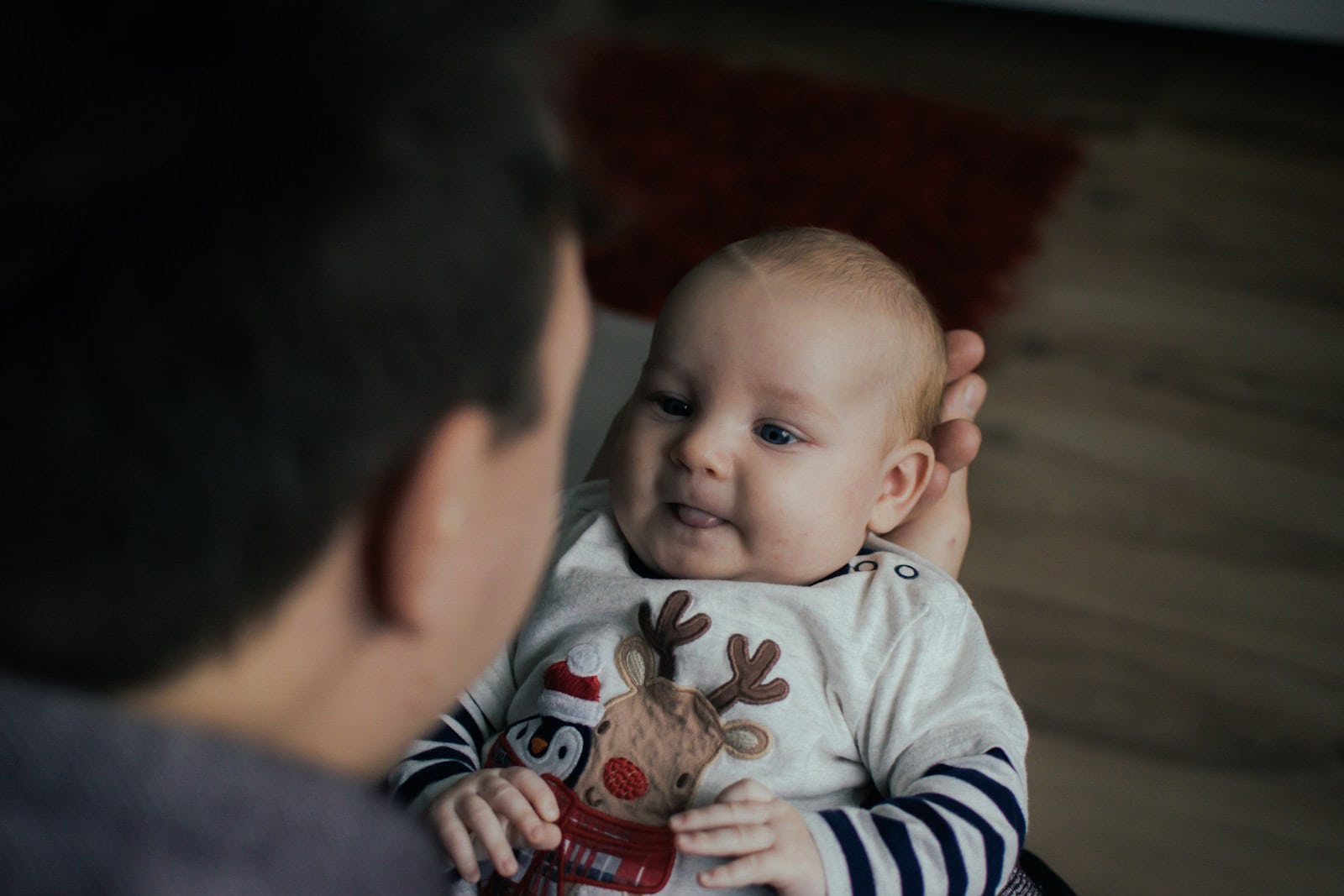
Stock photograph by Egidijus Bielskis on Unsplash, used under the Unsplash licence. An illustrative adult-and-baby interaction; it does not depict the fictional comparison or EduNanny staff or clients.