Comment, Pause, Return: A Toy Car Naming Game for Your 13-to-18-Month-Old
A descriptive comment can invite shared play without requiring an immediate spoken reply. Follow this three-step rhythm and worked toy-car example for your toddler.
“What is that?” can turn a familiar object into a test. “You pushed the car” begins with what your child is already doing. For toddlers aged 13 to 18 months, a Comment, Pause, Return rhythm keeps naming connected to shared play. Say what your child is doing, leave room for a sound, glance, reach or repeated action, then respond to whatever they add. The exchange does not depend on an immediate spoken answer, and it is a way to enjoy play rather than assess development.
When naming starts to feel like a quiz
It is easy to turn a familiar object into a test. “What car?” asks for a label. “Where is the car?” asks your child to locate it. “Can you say car?” asks for a spoken response. Each question can be useful when your child is interested, especially when the answer leads naturally back to the play. The practical shift is to notice when the exchange requires a particular response while your child is still occupied with the object or action.
A descriptive comment starts with the play itself. While your child pushes a toy car, you can say, “The car is going.” If the action is clear, “You pushed the car” adds a few words without asking your child to repeat a label. Short, repeated phrases can keep language clear during everyday play. UNICEF’s baby talk guidance describes simpler language through repeated words, slower speech and expressive movement. During floor play, phrases such as “Car goes”, “you pushed” and “your turn” are enough to begin.
Questions do not need to disappear. Harvard’s serve and return guidance describes responsive, attentive interaction with plenty of back and forth. In shared play, that can mean noticing what your child does next instead of deciding in advance how the exchange must continue.
Use a Comment, Pause, Return rhythm
The rhythm has three parts. Each can be brief, and none requires a particular response from your toddler.
- Comment on what you can see. Use a short phrase about the current play: “You rolled the ball”, “Bear is going down” or “You found the cup”. Stay with an object, action or interest your child is already showing.
- Pause without adding another prompt. Leave enough space for your child to act or signal. There is no set number of seconds to wait. Do not repeat a question, supply the expected word or ask for another turn.
- Return to your child’s contribution. Match an action, sound or gesture with a simple phrase or movement. If your child pushes the car again, you might say, “Car goes” and roll it once along. If your child looks up after making a sound, you can respond with the same sound or say, “You pushed the car.” You do not need to identify one correct meaning before joining in.
In our ECDA Childminding Pilot, we also shape responsive play this way. We choose simple experiences around what an infant is doing and showing interest in, including naming familiar objects, responding to sounds and using simple words and turn-taking as gestures develop.
A worked round with one large toy car
Choose a large, stable toy car that is suitable for your toddler’s age and has no loose or detachable small parts. Place it within your child’s reach on a clean play mat and stay close enough to supervise. HealthHub’s guide to toddlers aged 13 to 18 months includes pushing a toy car and taking turns moving it back and forth among examples of early learning behaviour.
Your toddler may respond differently at every round. The following is an illustrative exchange, not a sequence your child is expected to complete.
| What you notice | What you say or do | How the exchange continues |
|---|---|---|
| Your toddler pushes the large car. | “You pushed the car.” | Name the visible action without asking for the word “car”. |
| The push ends and your toddler pauses. | Say nothing. Keep your hands relaxed and stay nearby. | Do not add “again”, “where” or “what is it”. |
| Your toddler pushes again, looks up or makes a sound. | “Car goes.” Roll the car along once more if the action still suits the play. | Let your child decide whether the movement or exchange continues. |
| Your toddler reaches towards the car after looking away from you. | “You reached the car.” | Return to the action rather than asking your child to name it. |
| Your toddler turns towards something else or stops joining in. | Say nothing and park the car within reach. | Let the round end without a final prompt. |
Next time you bring out the car, you can begin with “You pushed the car” again. Once the rhythm feels comfortable, change only one element. You might say “Push, push” while moving the car once, or say “your turn” as your child takes it. Keeping most of the exchange consistent makes your child’s next contribution easier to notice.
Keep the exchange open to your child
Some rounds may include a sound, another push, a glance, a reach or your child carrying the car away. Let that contribution determine what you do next. If your child joins in, return. If your child moves on, follow the change and let the play end naturally. You can keep the method flexible by changing the word, the movement or the toy rather than adding more demands.
HealthHub notes that toddlers develop differently and advises seeking professional advice for concerns specific to your child. Speak with your child’s doctor if you are concerned about eye contact, following a point or a lack of meaningful words. HealthHub also advises seeking advice early if your toddler cannot walk independently or say a meaningful single word by 18 months, and recommends discussing a possible hearing concern.
Keep language close to the action, then give your toddler room to decide what happens next.
Sources and further reading
- EduNanny ECDA Childminding Pilot · EduNanny
- Baby talk: Mini parenting master class | UNICEF · www.unicef.org
- The Beginner’s Guide To Taking Care of Your Toddler: 13 to 18 Months · www.healthhub.sg
- 5 Steps for Brain-Building Serve and Return – Download Resources · developingchild.harvard.edu
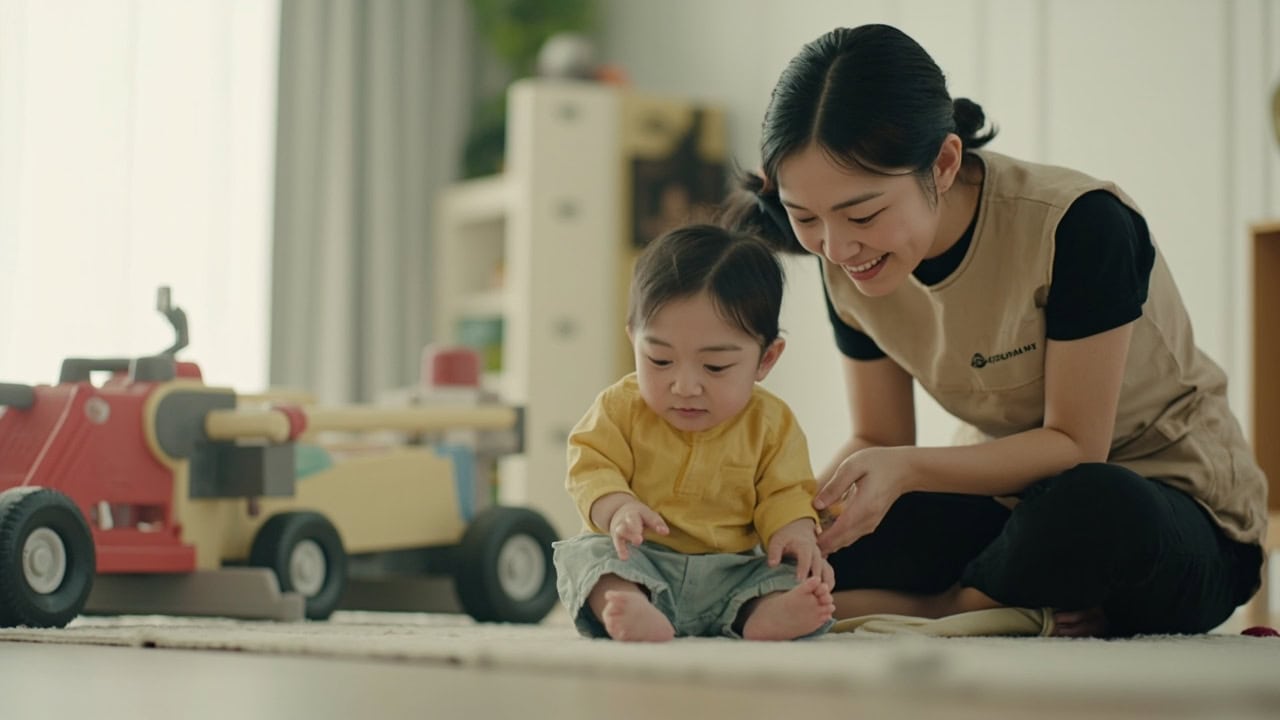
The image in this article was generated with AI for illustration. It does not show an actual EduNanny staff member, child or facility.
Choose one large familiar toy for an unhurried Comment, Pause, Return round today. Notice what your toddler adds, without asking what they must say.