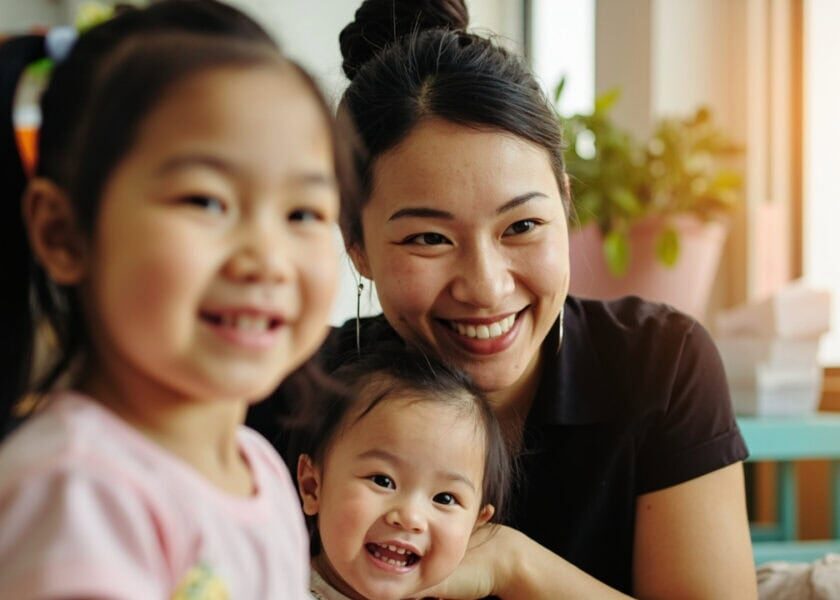
Childcare That Helps Your Whole Family Thrive Together
The Question Underneath Every Childcare Decision
There is a question that most Singapore parents carry quietly, in the margins of every childcare decision, and almost no one writes about it directly. It is not the question on parenting forums or the one raised in playgroup WhatsApp groups. It is deeper than that—not arriving as words but as a feeling. A persistent, low-grade wondering about what this choice will do to the people you love most.
Will this make my family stronger? Calmer? More connected?
Or will it add stress, conflict, distance?
This is the question underneath the question. And it deserves an honest answer.
When we look at childcare not as a service for the child alone, but as a piece of infrastructure for the entire family’s emotional health, relational quality, and long-term flourishing—everything changes about how we choose, how we evaluate, and what we are actually hoping for.
The years from birth to around six are sometimes called the first thousand days. But what they actually contain is something harder to measure than development charts or school readiness metrics. They contain the construction of a marriage, the shaping of a grandparent relationship, the slow evolution of who you are as a parent, and the daily emotional weather that your children grow up breathing in.
These are not separate from childcare decisions. They are what childcare decisions are actually made of.
How Childcare Shapes Your Marriage
Consider, for a moment, the partnership—the two people who chose to build a family together and now find themselves navigating exhaustion, identity shifts, and the weight of a thousand small decisions that no one prepared them for.
Research consistently shows that the transition to parenthood is one of the most significant stressors a couple can face. In Singapore, where dual-income households are the norm, that stress is compounded by the realities of housing, careers, and the pressure to optimize everything.
When childcare is uncertain, unresolved, or a poor fit, it does not stay contained within the hours it occupies. It leaks into evenings. Into weekends. Into the conversation you have at ten p.m. when you are both supposed to be resting but instead you are reviewing the day and wondering if the arrangement is working.
Couples begin to orbit around the childcare problem rather than each other. The intimacy that sustained the relationship before children gets crowded out by logistics, guilt, and the quiet resentment that builds when one person feels they are carrying more than their share.
Now consider what happens when childcare is not just adequate but genuinely right. When you trust the person caring for your child. When communication is consistent and transparent. When you come home at the end of the day and your child is happy, fed, safe, and genuinely engaged rather than merely watched.
The difference that makes to a marriage is not trivial. It is the difference between arriving home tense and arriving home ready to reconnect. It is the difference between a partnership that is surviving and a partnership that is still building something together.
Restoring the Grandparent Relationship
There is another relationship that childcare decisions reshape, and in Singapore, it carries a particular cultural weight: the relationship with grandparents.
In many Singapore families, grandparents are not peripheral figures. They are deeply invested co-raisers, often carrying significant childcare responsibilities, particularly in the early years. And this is both a gift and a pressure.
The gift is obvious—grandparents bring love, continuity, and a kind of generational wisdom that no manual can replace. The pressure is more subtle: the boundary between respect and obligation, the emotional complexity when parenting philosophies differ, and the unspoken tension that can build when the weight of childcare falls heavily on one set of grandparents, particularly maternal grandmothers.
When childcare is professionalized and trusted, something unexpected happens. Grandparents get to be grandparents again. They get to show up for visits and play, to share their stories and their warmth, to be the people their grandchildren run to—rather than the people who are exhausted from being the default fallback every weekday morning.
This is not about replacing grandparents. It is about giving them back their rightful place in the family ecosystem. Quality childcare is relational rescue. It restores the grandparent-grandchild bond to what it is meant to be: joyful, generous, and free of obligation.
And it does something equally important for the parent in the middle—it removes the guilt of depending too heavily on parents who have already raised their children and deserve their own lives.
The Parent in the Middle
Parenthood changes you. This is not a revelation. But what is less discussed is how much that change depends on whether you feel capable—whether you feel supported, and whether you have the bandwidth to be the parent you actually want to be, rather than the depleted, reactive version of yourself that emerges when everything is too much.
The childcare decision is, in a deep sense, a decision about your own identity as a parent. Will this choice help you grow into someone who is confident, present, and emotionally available? Or will it add another layer of worry, another source of guilt, another thing you are managing instead of living?
Singapore parents are exceptionally hard on themselves. There is a particular intensity here—the awareness of competition, the awareness of opportunity costs, the awareness that every choice might be the wrong one. In that context, finding childcare that you genuinely trust is not a luxury. It is a form of self-compassion.
It is saying: I need support that is worthy of the trust I am placing in it, because I cannot pour from an empty cup, and right now mine is dangerously low.
This matters because the parent’s internal experience of childcare radiates outward. A parent who trusts their childcare arrangement sleeps better. Is more patient. Has more to give emotionally when they are with their children. When you choose childcare that makes you feel supported, you are not just making a logistical decision. You are choosing the emotional weather of your home.
What Quality Childminding Actually Looks Like
There is a quality to mornings when you are not frantically trying to manage everything yourself. There is a quality to evenings when you come home and your child has had a full day—not just supervised, but engaged, played with, read to, held. There is a quality to weekends when the whole family is genuinely together because the weekday care has been handled with such care that you do not need to spend Saturday and Sunday recovering from guilt or anxiety.
This daily emotional rhythm is the invisible infrastructure of family life. When it is chaotic, rushed, anxious, and uncertain, every relationship in the home is affected by it. When it is calm, consistent, and trustworthy, the same is true. The family thrives not despite good childcare but partly because of it.
What to Look For
- Genuine trust, not just surface-level reassurance—communication systems that keep you informed throughout the day, not just a quick update at pickup
- Structured caregiver ratios—for infants, a small ratio means the caregiver can bond meaningfully with your child rather than just manage logistics
- Transparent operations—in programs like the ECDA Childminding Pilot, families receive structured support that reflects a commitment to trust over surveillance
- Consistent, proactive communication—parents should not have to wonder what happened during the day; they should know
- Integration with your family’s existing support system—good childcare does not replace grandparents; it restores their role
Making It Financially Accessible
For Singapore families across income levels, practical support structures exist. The CDA and Baby Bonus schemes can be applied within childminding program fee structures, making quality care not only emotionally sensible but financially accessible. Childcare as family infrastructure should not be a privilege available only to those with significant means.
Addressing Common Concerns
“Will my baby be safe and truly cared for?”
This is always the first question, and it should be. Quality childminding programs maintain structured caregiver-to-infant ratios, provide transparent communication throughout the day, and operate within professional frameworks that include training, oversight, and accountability. These are not luxuries—they are the minimum standard you should expect and demand.
“I feel guilty about not doing it all myself.”
Many Singapore parents, particularly mothers, carry a quiet guilt about needing childcare support. Here is what the research and lived experience consistently show: parents who feel supported make better parents. The emotional contagion works both ways. A calm, confident parent creates a calmer, more secure child. Delegating care to a trusted, qualified arrangement is not a failure. It is a decision that protects the very relationship you are trying to nurture.
“Won’t this disrupt the bond with my baby?”
The opposite is more often true. When you are freed from the anxiety of uncertain childcare, you are more present during the hours you do have with your child. The bond is protected by your emotional availability, not by sheer hours of physical proximity. Many parents find that after joining a quality childminding program, the quality of their interaction with their child actually improves because they are no longer depleted and distracted.
“What about integrating with my parents’ involvement?”
This is one of the most thoughtful questions a Singapore parent can ask. The answer is not either-or. Quality professional childcare and involved grandparents are not in competition—they are complementary. The goal is to build a family childcare ecosystem where grandparents are present because they want to be, not because they have to be. That distinction changes everything about the quality of the relationship.
EduNanny Singapore: Childcare as Family Infrastructure
This is where EduNanny by BUTLER stands apart. Their approach goes beyond matching families with caregivers. In the ECDA Childminding Pilot, families working with EduNanny receive support that is structured, professional, and grounded in real transparency.
Caregivers are trained and supported within a professional framework. Infant ratios are structured to allow for genuine attention, genuine bonding, and genuine safety. Communication is consistent and proactive, so that parents are not left wondering but are instead kept genuinely informed throughout the day.
When parents know what is happening during the care hours, they can be fully present when they are with their children. That presence is not just good for the child. It is the oxygen that keeps a marriage breathing.
EduNanny’s model allows families to access professional, reliable childcare that supplements or thoughtfully integrates with existing family support—without the pressure of a single grandparent carrying the entire load. Grandparents can be involved because they want to be, not because they have to be. This changes the shape of who does what, and in doing so, changes the emotional quality of every relationship in the home.
Raising a child today involves a quantity of information, decisions, and second-guessing that no previous generation faced. EduNanny has developed tools to help parents navigate this complexity—not by replacing judgment, but by making information more accessible and decisions more manageable. This is childcare that recognizes the reality of contemporary parenting: that you are navigating a hundred decisions while also working, resting, relating, and trying to be a good partner and a good child and a good friend. You need support that meets you where you are.
The Complete Question Every Singapore Parent Is Really Asking
Most content about childcare in Singapore frames the question incorrectly. It asks: Is my child safe? Is my child developing well? Is my child ready for school?
These are not wrong questions. But they are incomplete questions.
The complete question is: Is my family thriving?
Because the answer to that question does not live only within your child. It lives in the way your marriage feels after a long week. It lives in the warmth of the visit from your parents when they are rested and happy to be there. It lives in the patience you have left at the end of the day to read one more story, to answer one more question, to be truly present rather than just physically there.
The years from birth to six are not just a developmental window. They are the years in which your family is being constructed. The relationships are being formed. The emotional patterns are being set. The person you are as a parent is being shaped by the quality of support you receive and the choices you make in these years.
Childcare, chosen thoughtfully and entered into with trust, is one of the most significant gifts you can give to your family. Not because it replaces what you do, but because it supports everything you do.
- It gives your marriage room to breathe.
- It gives grandparents their joy back.
- It gives you the confidence and the bandwidth to be present in ways that matter.
- It gives your children the daily emotional weather of a calm, connected, thriving home.
EduNanny by BUTLER offers families in Singapore access to the ECDA Childminding Pilot—a program designed not for families seeking adequacy, but for families seeking excellence. With care available across defined blocks, structured infant ratios that allow for genuine attention and bonding, and communication systems that keep parents informed and involved, EduNanny Singapore is built around a vision that goes beyond child development.
It is a vision of childcare as family infrastructure. It is the belief that every family deserves to flourish together—and that the right childcare decision is one of the most powerful choices you can make toward that flourishing.
If you are a Singapore parent searching for infant care or childminding that truly supports your whole family, EduNanny is ready to answer the question underneath your question. Not just: Who will care for my child? But: How will this choice help my family become what we want to be?
That is a vision worth trusting. And it is one that, for families ready to receive it, changes everything.
Explore how EduNanny by BUTLER supports families across Singapore through the ECDA Childminding Pilot. Connect with the team to learn more about what thoughtful, professional childminding can mean for your family.