
Fraud Blocker edunanny.com

Category: Childminding

edunanny-06726dc36829d1f420f8bfa7bb155d09
June 6, 2026

What Your Child Comes Home Telling You Every Day

The Real Landscape Singapore Parents Navigate

Before talking about how to evaluate quality, it helps to name the landscape you are actually navigating. Singapore parents today often find themselves in what is sometimes called the sandwich generation—managing demanding work commitments that require presence and focus, while also honouring input from parents and in-laws whose own child-rearing experiences were shaped by a different Singapore, different economic realities, and different expectations about what safety, stimulation, and love look like in early childhood.

On top of this, you are likely reading research on early brain development, absorbing headlines about the first thousand days, feeling the weight of every interaction your child experiences during these formative years. You are doing all of this while managing a household, a career, relationships, and the ordinary exhaustion of modern life.

In this context, the childcare decision is not simply a logistics question. It is about finding someone who will be an extension of your family during the hours when you cannot be there. It is about creating a second environment that feels warm, safe, and growth-oriented. It is about choosing a person or a place to entrust with one of the most important responsibilities in your life.

And yet, the tools most parents use to make this decision are remarkably surface-level. Credentials matter—licences, ratios, certifications. First impressions matter too—is the space clean, are the teachers smiling, is there a curriculum on the wall? Logistics matter—is the location convenient, does the schedule fit, is the fee manageable?

These are not wrong criteria. But they tell you almost nothing about the quality of observation that will happen in that space. They tell you nothing about whether your child will be truly seen, truly known, truly responded to with sensitivity and attunement. They tell you nothing about whether you will receive the kind of partnership that helps you grow alongside your child—not just receive reports at the end of the day.


What Quality Childcare Actually Looks Like

The difference between adequate care and excellent care is not always visible on a tour. It lives in the micro-moments—the way a caregiver responds when a child is frustrated, the patience in a teacher’s voice when a toddler is struggling to communicate, the quiet attentiveness when a baby is transitioning between states of alertness. These moments are not dramatic. They do not make for impressive marketing photographs. But they are the texture of your child’s daily experience, and they shape development in ways that matter enormously.

The Homecoming Window

Here is one of the most practical frameworks you can develop as a parent: learning to read the homecoming window. When your child returns at the end of a care day, there is a brief transition period that experienced parents come to recognise with practice.

Your child may be tired, overstimulated, hungry, or reaching for physical closeness. Or they may be energised, eager to share something, delighted by a new word or a new skill they are trying out.

In those first few minutes of homecoming, your child is communicating volumes about how the day went—what they experienced, what challenged them, what delighted them, what they need from you now. But here is the question that most parenting resources do not ask: are you equipped to read that communication accurately?

Most parents are not taught this. They learn it through accumulated experience, by gradual attunement to their child’s patterns. But this learning can be accelerated enormously when your childcare partner is actively teaching you to see what they see.

What to Look For in Your Child’s Behaviour

When you pick up your child and observe them closely in that first twenty minutes at home, you can learn a great deal. Consider these indicators not as a checklist, but as a vocabulary you are building over time:

  • Physical ease: Does your child settle comfortably into your arms, or do they feel tense, rigid, or unusually floppy? Body tone communicates emotional state long before words do.
  • Eye contact and engagement: Does your child look toward you with recognition and warmth, or do they seem avoidant, glazed, or overstimulated? The quality of eye contact tells you about the attuned interactions your child experienced during the day.
  • Play quality: Does your child initiate play that is curious, sustained, and exploratory? Or do they seem withdrawn, repetitive, or disconnected? The way a child plays after care reveals a great deal about what their day felt like inside.
  • Energy regulation: Is your child crashing from overstimulation, or are they settling into a comfortable rhythm? A child who has been in a genuinely warm environment tends to transition more smoothly between stimulation and rest.
  • Communication cues: Does your child try to share something from their day—pointing, babbling, showing you a mark on their clothing? Or do they seem to have nothing to offer, as though the day left no trace? Expressive children in responsive environments tend to bring something home.

These observations, accumulated over weeks and months, build a picture in your mind of who your child is becoming. This is what developmental literacy looks like in practice—not a test your child takes, but a language you learn by paying attention.

The Philosophy That Changes Everything

The best childcare does not just care for your child. It teaches you how to read your child more clearly.

This is a fundamentally different way of thinking about what you are selecting. When you receive a note describing how your child spent twenty minutes carefully transferring dried beans from one container to another—exploring the weight, texture, and sound—you are learning something about their current fascinations, their concentration span, and their sensorimotor development.

When you hear that your child sought physical closeness with their caregiver after a moment of distress, you are learning something about their attachment style, their need for emotional regulation, and how sensitively that need was met. This is data. It is the kind of data that, accumulated over weeks and months, builds a picture in your mind of who your child is becoming. And this is something you cannot get from a centre tour. You cannot get it from reading credentials. You can only get it from a sustained partnership in observation.

The quality of communication you receive from your childcare partner matters enormously—not as reassurance, but as information. Ask yourself:

  • Does my childcare provider tell me what my child was drawn to today, or just that they ate and slept?
  • Do I receive observation notes that reflect developmental patterns over time, or generic daily summaries?
  • Do I feel like a recipient of reports, or a partner who is learning alongside the caregiver?
  • Does the communication help me understand my child’s current preoccupations, strengths, and growth edges?

If you are nodding because your current arrangement does not offer this, that is information. It may not mean the care is poor, but it may mean you are missing the partnership dimension that makes childcare truly valuable over the long term.


The Singapore Reality: Family Expectations and Parental Guilt

There is a dimension of the Singapore childcare decision that is rarely spoken about directly: the reality of mixed input. Many families are navigating expectations from grandparents and extended family that differ from their own understanding of child development.

There may be gentle but persistent suggestions that children should be toilet-trained earlier, should be more independent, should not be held so often. There may be concerns that outside childcare somehow diminishes the family bond or replaces the influence of elders.

I want to reframe this gently but clearly: quality childcare does not replace your role in your child’s life. When done well, it strengthens your capacity to fulfil that role.

Quality childcare gives you information about your child that makes you a more perceptive, more confident parent. It models responsive caregiving so you can see what attuned interaction looks like and bring that understanding into your own home. It creates a continuity of care philosophy that supports rather than conflicts with what your family values.

There is also the particular kind of guilt that many working parents in Singapore carry—the worry that they are somehow failing their child by returning to work, by entrusting their infant to someone else during these early years. If this resonates with you, I want to offer something important from developmental research: what matters most in early childhood is not the quantity of time but the quality of attuned responsiveness.

Children can form secure attachments with multiple caregivers when those caregivers are consistent, sensitive, and warm. What children need is not parental omnipresence but parental presence that is genuinely attuned when it occurs.

When you choose a childcare arrangement that supports your child’s development, that creates a warm and stimulating environment, that communicates with you honestly about what your child is experiencing—you are making a responsible, loving decision that allows your whole family to thrive. And when that arrangement teaches you how to be a more attuned parent in the hours when you are together, you gain something that many parents never receive: a developmental partner who helps you grow alongside your child.


How to Evaluate Infant Care: What to Actually Look For

If you are currently researching childcare options in Singapore—whether centre-based or home-based—here are the questions that matter most, beyond the credentials and logistics.

Questions to Ask Yourself After a Visit or Observation

  • How did the caregiver respond to a child who was upset or frustrated? Did they move quickly with warmth, or did they wait? Was the interaction patient and attuned, or hurried and routine?
  • What does the space feel like when children are in it? Is there a calm energy, or chaos? Do children seem to have choices about what they do, or is everything tightly scheduled and directed?
  • How do the caregivers speak to children? Are they warm and conversational, or primarily directive? Do they narrate what is happening, or mostly correct behaviour?
  • What would I actually know about my child’s day? If you cannot imagine receiving meaningful observation notes from this arrangement—not just meal and sleep logs—ask yourself what you would be learning about your child over time.
  • Do I feel like a partner or a customer? The best childcare relationships feel collaborative. You are not just purchasing supervision. You are entering a shared practice of observing and supporting your child’s development.

Questions to Ask the Provider Directly

  • Can you describe what a typical day looks like for an infant in your care?
  • How do you communicate with parents about their child’s development—not just their routine?
  • How do you handle a moment when a child is clearly distressed?
  • What does your ratio look like, and how does that affect the individual attention each child receives?
  • How do you involve parents in the care approach?

How EduNanny Approaches Childcare Differently

EduNanny, a service under BUTLER operating within the ECDA Childminding Pilot, is built around a specific philosophy: that childcare should do more than supervise. It should elevate your understanding of your own child. The pilot framework maintains ratios of up to one caregiver to three infants, ensuring the individualized attention that is developmentally critical in the earliest years. Fees are structured to be accessible, and payment mechanisms include the Child Development Account and Baby Bonus schemes.

But the structural details, while important, are only part of what makes EduNanny different. The real distinction lies in how caregivers engage with both children and parents on a daily basis.

Observation as a Daily Practice

EduNanny’s caregivers are trained to observe with intention. Rather than generic daily reports that confirm your child ate well and slept well, parents receive observation notes that reflect what their child was drawn to, how they approached new experiences, where they sought connection, and where they sought independence.

A note might describe a child’s twenty-minute engagement with a sensory activity, or the way a toddler worked through frustration with a puzzle before seeking a caregiver’s help—not as a performance metric, but as a window into the child’s current developmental preoccupations.

This is not reporting for its own sake. It is the sharing of developmental literacy that allows you to understand your child more completely over time. When you receive this kind of information consistently, you begin to notice patterns in your own child that you would never have caught otherwise. You start to understand their temperament, their learning style, their social instincts. And you bring that understanding home—not as a parent who is anxious about what is happening at childcare, but as someone who is genuinely curious about who their child is becoming.

Partnership Over Supervision

EduNanny’s approach is designed to integrate with family life rather than operate parallel to it. The observation practices, the communication rhythms, the daily notes shared with parents—these are not reports from a separate world. They are bridges back to your family, designed to make you a more capable reader of your own child.

This matters particularly in Singapore, where many families are navigating different generations of expectations about child-rearing. When your childcare partner is actively sharing what they observe about your child, you are building your own internal framework—one that is informed by real evidence, not by anxiety or comparison. You become better equipped to respond to your child’s needs with confidence, and better able to articulate your choices to family members who may have different views.

What This Looks Like in Practice

Consider an everyday scenario. Your child comes home from an EduNanny care session and you notice they seem especially calm, engaged, and vocal during the evening. You check the observation note and learn that they spent part of the afternoon in a caregiver-led activity exploring different textures and sounds, and that they showed particular interest in a song that involved hand movements and turn-taking.

Suddenly, your evening interaction makes more sense. You understand why your child is in this particular state. You know what drew them. And you can build on it—perhaps introducing similar textures or songs at home, extending the curiosity and connection they experienced during the day.

This is the feedback loop that quality childcare creates. It is not about the caregiver doing everything. It is about the caregiver helping you do more.


Your Child Is Telling You Who They Are

The question you are facing is not simply, whom do I trust with my child? It is, how do I develop the knowledge to recognise quality when I see it? How do I learn to trust my own observations? How do I build the kind of confidence that comes not from blind faith in a credential, but from deep understanding of what I am seeing?

This is a more demanding question. It asks more of you as a parent. It asks you to be an active learner rather than a passive recipient of reassurance. But it also gives you something far more valuable: it gives you agency. It gives you an internal framework that will serve you not just in this childcare decision, but in every developmental milestone, every parenting challenge, every moment when you need to understand what your child is communicating and respond with wisdom and love.

The best childcare partners know this. They do not simply want your trust. They want to teach you how to see what they see, so that your trust becomes informed, active, and deeply personal. They want your child to thrive in their care—and they want you to thrive in your understanding of your child.

EduNanny is designed around this philosophy. Not as a marketing promise, but as a daily practice. The caregiver ratios that allow for genuine attention. The communication structure that prioritises developmental observation over superficial reassurance. The transparency that lets you see into the care environment with clarity. The philosophy that treats you as a partner in your child’s development, not just a customer purchasing a service.

Your child communicates who they are every single day—in the way they play, the way they reach for you, the way they explore or hesitate, the way they come home from a care day energised or needing closeness. The question is not whether your child has something to tell you. The question is whether you are ready to listen more carefully, and whether you have the right support to help you hear what they are saying.

EduNanny is here to help you listen. To help you see. To help you grow into the parent you already have the capacity to become.

If you are currently navigating this decision—if you are weighing options, feeling the weight of the choice, and looking for a childcare partner who will treat your family with the seriousness it deserves—I encourage you to consider what it would mean to have a relationship that teaches you something about your child every single day. Not just reports, but shared observation. Not just safety, but developmental growth. Not just peace of mind, but genuine confidence.

Ready to explore what a developmental partnership in childcare looks like? Learn more about EduNanny’s childminding approach and discover how daily observation and parent communication are woven into every aspect of care.

You can also read about the EduNanny team and their approach to childcare, or get in touch to discuss your family’s needs.


edunanny-06725fd393483d31b603980259683230
June 6, 2026

What Your Child Experiences at EduNanny Singapore Daily

The Hours That Matter: A Day Inside Quality Childcare at EduNanny Singapore

There is a particular silence that fills a Singapore car at seven-thirty in the morning. The kind of silence where a parent is saying goodbye to something they cannot yet name or prove—that small, quiet hope that the next eight or nine hours will be good for their child. That the people on the other side of a door will notice what they notice, comfort what needs comforting, teach what needs teaching. That the child who walks through that door will emerge at the end of the day not just safe, but seen.

You have stood in that silence. Or you will. And in that silence, there is a question you cannot ask aloud because asking it would mean admitting how much you need the answer to be yes.

What actually happens in the hours I am not there?

This article is an answer to that question. Not a marketing answer. Not a promise. An answer. We are going to walk through a complete day at EduNanny Singapore—from the moment your child’s hand leaves yours in the morning, to the moment you hear their voice in the doorway telling you about their day—and we are going to see, together, what genuine quality looks like when it is built into every hour rather than promised in a brochure.

If you are reading this between meetings or during your commute, here is what matters most:

  • Emotional check-ins happen in the first ten minutes—not a greeting, but a deliberate reading of your child’s state
  • Learning is embedded in daily life—materials chosen intentionally, not random toys
  • Mealtimes are relational—caregivers eat with children, not just supervise them
  • Rest is treated as trust-building, not just a schedule item
  • You receive actual information at pickup—not scripted updates, but real observations about your child’s day

These are the specific moments where quality operates—or fails to. Keep reading to understand exactly what each one looks like.


The Morning Arrival: Where Trust Begins

Let us begin where every parent begins: at the door.

The morning arrival is not, as it might appear from the outside, simply a handoff. It is a translation. For the next few minutes, you and your child’s caregiver are engaged in the most important kind of communication—there is no shared vocabulary yet, no established shorthand. You are transferring knowledge about your child that you have accumulated over months or years in a matter of moments. You are telling them, through a glance and a phrase, that this child is tired today, or anxious about something, or working on a new skill with their fork, or needs an extra minute of closeness before separation.

At EduNanny, this morning exchange is not rushed. The caregiver who receives your child is not glancing at a clock or mentally preparing the next activity. They are listening. They are noting the way your child clings or the way they bounce confidently toward the door. They are receiving the information you are offering and, in doing so, acknowledging that you are the expert on your child—and that expertise matters here.

The First Ten Minutes: Emotional Check-In

Within the first ten minutes, something important happens that you will never see on a tour or in a photograph. It is called an emotional check-in, and it is as clinical in its observation as it is tender in its execution.

The caregiver notes your child’s face. The posture. The quality of their greeting to peers and adults. A child who was fine in the car but arrives with a tight jaw and a hand that will not let go of a parent’s sleeve is a child who needs something different this morning than the child who runs in looking for a particular friend.

The trained caregiver sees this. And what they do next is not a scripted response. It is a decision.

Perhaps they kneel down at eye level and offer a choice: “Do you want to hold Mr. Rabbit this morning, or would you like to help me water the plants first?” The choice is not about the plants or the rabbit. It is about giving the child agency at the exact moment they need to feel that the world is not a place where things simply happen to them. It is about signaling that their feelings are noticed, that the transition matters, that the morning can be shaped.

Perhaps instead they simply sit nearby during free play, close enough that the child knows they are present, quiet enough that the child does not feel watched. Sometimes the most professional thing a caregiver can do is nothing at all—wait, and watch, and trust that the child will find their footing if given space and the quiet assurance that someone is there.

Learning Through the Morning: What Quality Actually Looks Like

By nine o’clock, the day has found its rhythm.

In Singapore, we are sometimes guilty of thinking that learning must look like a lesson. That there must be a whiteboard, a structured activity, a measurable outcome. But for infants and young toddlers, learning is not a separate event from living. Learning is what happens when a child pours water from one container to another and suddenly understands, with their whole body, that the same amount of liquid can look different in different vessels. Learning is what happens when two children negotiate over a red block and, in doing so, are learning about power and fairness and the way their voice sounds when they are frustrated.

The Materials and the Presence

At EduNanny, the morning learning block is built around this understanding. There are materials on the shelves—not random toys, but resources chosen with specific developmental intentions:

  • A set of cylinders that vary in diameter teaches pre-mathematical thinking
  • A basket of fabric squares teaches texture discrimination and vocabulary
  • A low mirror on the wall teaches self-recognition

None of this is decoration. None of this is accidental. Every object in a quality infant environment is there because it offers the child something to discover.

But the materials are only half of it. The other half is the caregiver who is present—watching, not hovering; facilitating, not directing.

When a fourteen-month-old picks up a wooden puzzle piece and mouths it, the caregiver does not snatch it away. They say, quietly, “That’s wood. It feels smooth, doesn’t it?”

When a two-year-old stacks blocks with fierce concentration and they topple, the caregiver does not rebuild them. They wait. They watch the child’s face. They note whether the toppling is met with frustration or delight, because that tells them something important about where this child is in their relationship with persistence and failure.

Why Smaller Ratios Matter

You may have heard that Singapore is expanding its approach to infant care through the ECDA Childminding Pilot. This is not simply a policy initiative. It is recognition that there are different pathways to quality care, and that home-based and community-based settings can offer something that large centre-based environments sometimes cannot: a smaller scale, a closer relationship, a ratio of caregivers to children that allows for this kind of individual attention.

At EduNanny, the ratio matters. When there are one, two, or three infants in a caregiver’s charge rather than six or eight, something changes. The caregiver can know each child as an individual. They can notice when a child’s appetite changes, when their sleep is disturbed, when a new word has appeared, when a new fear has emerged.

This is not sentiment. This is the mechanism by which quality operates.

Mealtime and Rest: Where Relationships Deepen

By mid-morning, the day takes on another texture. This is mealtime—and later, rest time. These hours reveal the difference between care that fills time and care that builds trust.

Mealtime: Connection Through Feeding

If you have ever watched a young child learn to eat, you know that it is one of the most vulnerable processes a human being undertakes. They are learning to manage food in their mouth, to coordinate swallowing, to recognize hunger and fullness, to tolerate new flavors and textures. They are messy. They are sometimes slow. They are sometimes upset.

At EduNanny, mealtimes are treated with the seriousness they deserve.

The caregiver sits with the children. This is not just supervision. This is modeling. The caregiver eats with them, and in doing so, shows them that eating is a pleasure, that food is to be enjoyed, that meals are a social act.

They name the foods. They describe their colors and textures:

  • “This banana is cold today. We put it in the fridge.”
  • “The rice is fluffy.”

These are not just words. They are vocabulary building. They are the sensory education that happens best in context.

When a child resists a new food—and they will, because this is developmentally normal—the caregiver does not force. They do not bribe. They do not make a game of it in a way that turns food into a performance. They simply offer. They may try again another day, with the same calm expectation. They may offer the new food alongside a familiar one, so the child has agency. They may simply eat it themselves with obvious enjoyment and let curiosity do its work.

There is a moment at every mealtime when something shifts—a child laughs at a mess they have made, or reaches across the table to touch a peer’s cheek, or says a word they have never said before over a bowl of porridge. These moments are not interruptions to the schedule. They are the schedule. They are what care is for.

Rest Time: The Architecture of Security

By noon, the day softens. Sleep is not, for young children, simply a biological necessity. It is an act of trust. To fall asleep is to surrender alertness, to become vulnerable, to believe that the world will remain safe and known in your absence. For a child in a childcare setting, this is an enormous thing. They are falling asleep in a place that is not their own bed, surrounded by sounds and smells that are not the ones they have known since birth.

The caregiver knows this. And so the preparation for rest is deliberate.

There is a transition—perhaps a story, perhaps a song, perhaps a walk to the sleep room—that tells the child’s body and brain that the pace is changing, that the noise will quiet, that the light will dim. This is not entertainment. It is signal. It is the caregiver saying, through routine and rhythm, that the world is predictable, that the next thing has been thought of, that there is nothing to fear.

In the sleep room, there is often a caregiver sitting nearby. Not hovering. Not staring. Simply present. When a child stirs and reaches out for comfort, there is a hand to hold. When a child cries out from a dream, there is a voice that is familiar and calm. When a child cannot settle, there is patience—not the impatience of a schedule, but the genuine patience of someone who understands that this child’s sleep will not be rushed.

And when your child wakes, they are not greeted with a list of what they missed or a rush to the next activity. They are greeted with a caregiver who is already there, whose face shows recognition and welcome, whose first words are not “time to go” but “Good afternoon, [child’s name]. You slept well.”

This is one of the clearest signals you will ever receive about the quality of care your child has received. When a child wakes from sleep and is immediately comforted, immediately seen, immediately welcomed back into the rhythm of the day, you are seeing evidence that your child was thought about even when they were not conscious.

The Afternoon: Engagement, Transition, and Coming Home

The afternoon has its own character. By one o’clock, the children are awake, fed, and beginning again.

There is outdoor time, weather permitting—the courtyard or balcony that gives children a chance to feel sun and wind, to run and climb and fall and get up, to understand their bodies in space.

There is art—not crafts, not gluing sequins to a pre-cut shape, but genuine art. Paint on paper. Clay on a table. Crayons that make marks that surprise the child who made them. This is not about the product. It is about the process: the sensory exploration, the cause and effect, the way a child’s face lights up when they discover they can make something happen.

There is music. Not a scheduled lesson, but a natural part of the day. A song that accompanies hand-washing. A rhyme that signals that it is time to tidy up. The sound of a caregiver humming while they change a diaper, making the most intimate moments of care into moments of connection.

There is language, constantly. A caregiver narrating what is happening. “You are putting the blue car in the box. The blue car is going night-night in the box.” This is not baby talk. It is cognition wrapped together. The caregiver is giving the child words for their experience, and in doing so, building the architecture of thought itself.

The Closing Circle

By four o’clock, there is a closing circle. This is the transition that many parents do not know happens, but it is one of the most important moments of the day.

The children gather. Perhaps they sit on a small rug. Perhaps they hold an object—a stone, a shell, a piece of cloth—that signals it is time to be still together. The caregiver speaks. Sometimes they sing. They talk about what happened today. They remind the children that their families are coming. They prepare them for the transition that is about to happen.

This is teaching. The caregiver is teaching children how to end things—how to close one chapter and prepare for another, how to say goodbye to a place that has been good to them, how to carry the day with them rather than simply dropping it.

These are skills that will serve your child for their entire life. The ability to transition well, to let go of one thing and enter another, is not trivial. It is the skill that will help your child enter school, navigate friendships, manage change.

The Evening Homecoming

When you arrive, you will see this. You will see your child transition from the group to you—not abruptly, not with confusion, but with recognition.

“Mama is here. Papa is here. Time to go home.”

And then the handoff, which is the mirror image of the morning. The caregiver tells you something:

  • Perhaps it is simple: “She had a good nap. She ate well.”
  • Perhaps it is more specific: “She was very interested in the water play today. She used the word ‘splash’ for the first time.”
  • Perhaps it is something you need to know: “She seemed tired this afternoon. She might need an early night tonight.”

This is the visible thread that connects your day to your child’s day. This is how you know that the hours were not a blank. This is how you know that your child was not simply minded but was thought about, attended to, known.

The Evidence That Appears at Home

And then you take your child home. And this is where the architecture of quality becomes visible to you.

You will see it in the way your child talks about their day. Not in vague generalities—”I played”—but in specific moments they can recall. “The lady read us a book about a bear.” “I held the cat.” “We went outside and the sand was hot.”

You will see it in the way your child relates to the caregiver. There will be a warmth that is not forced. There will be a familiarity that is not mere habit. There will be a child who talks about “my teacher” or “my nanny” with the same ease they talk about a family member, because to them, this person is a significant figure in their life. They have been shaped by this person’s attention.

You will see it in your child’s development. Not dramatic leaps, not miracles, but steady, sure growth. New words. New skills. A new confidence with food, with peers, with the world. Your child is not simply being cared for. They are being nurtured in a way that is moving them forward.

And you will see it, most importantly, in yourself. Because trust is not only what your child feels. It is what you feel. And when you drive away from EduNanny each morning with a quiet confidence that your child is in the right place, when you stop checking your phone compulsively for messages, when you can actually focus on your work or your life knowing that something good is happening on the other side of that distance—something changes. Something releases. The invisible anxiety that lived in your chest begins to quiet.

Finding Quality Infant Care in Singapore

If you are currently visiting childcare options and feeling overwhelmed, here is what to look for and what questions to ask.

Questions to Ask During a Visit

  • What does a typical morning arrival look like? Listen for specifics about how children are received, whether there is time for exchange between caregiver and parent, and whether the answer suggests flexibility or rigidity.
  • How do caregivers handle a child who is struggling to separate? Look for answers that acknowledge emotions and offer choices, not answers that dismiss or rush the child.
  • What do the learning materials teach? If the answer is “we have toys for all ages,” that is a general answer. A quality environment can explain why specific materials are available at specific developmental stages.
  • What does mealtime look like? Caregivers eating with children, not just supervising, is a significant indicator of relational care.
  • How do you prepare children for rest? Look for mention of routine, transition, and presence—not just “they sleep according to their schedule.”
  • What information will I receive at pickup? Specific observations about the child’s day—not just “she had a good day”—indicates that attention was paid.

Red Flags to Watch For

  • Rushed arrivals and departures with no time for exchange
  • General answers that do not reflect knowledge of your specific child
  • A learning environment that appears random rather than intentional
  • Mealtimes that feel supervisory rather than relational
  • No visible transition or closing routine before pickup
  • Vague pickup reports: “She was fine” is not the same as “She used the word ‘splash’ for the first time today”

What the ECDA Childminding Pilot Means for Singapore Families

The ECDA Childminding Pilot represents Singapore’s recognition that families need different pathways to quality care. Home-based and community-based settings can offer smaller ratios, closer relationships, and more individualised attention than large centre-based environments.

When evaluating any childcare option, ask about:

  • The ratio of caregivers to children
  • The training and qualifications of caregivers
  • Whether the setting participates in any government quality frameworks or pilots
  • What payment schemes are accepted (CDA, Baby Bonus, subsidies)

What EduNanny Singapore Offers

EduNanny by BUTLER is built on the understanding that every parent deserves to know what happens in the hours apart—and that trust is built through transparency, not promises.

We are part of the ECDA Childminding Pilot, which means we are part of Singapore’s commitment to finding thoughtful ways to support families in the earliest years of their children’s lives. Our approach is built on several foundations:

  • Smaller ratios that allow caregivers to know each child as an individual
  • Intentional care informed by child development knowledge, not just task completion
  • Transparent communication through photos, notes, and specific handover conversations throughout the day
  • Accessible fees through CDA acceptance and Baby Bonus compatibility
  • Parental support through our Thomas AI Chatbot, available whenever questions arise between pickup and drop-off

Our Monday to Friday blocks are designed to support the realities of working parents in Singapore—not as a limitation but as a framework that allows families to plan and breathe. And our approach extends across Singapore, because every child deserves this kind of attention.

There is a moment, late in the evening, when a parent and child are together again after a day apart. The house is quiet. The child is tired in the good way, the way that comes from a day of fullness. And the parent is holding them, or sitting near them, and there is nothing to do but be together.

In that moment, something passes between parent and child that has no name. It is not just the relief of reunion. It is the quiet knowledge that the hours apart were not wasted, not lost, not a gap in love. They were hours in which the child was building something. Growing. Learning the world.

And the parent, in that moment, feels something that is hard to describe but unmistakable. They feel that the decision they made—the decision to trust, the decision to let go of some of the hours so that their child could have them in a different way—was the right decision.

A Warm Welcome

So when you stand in that morning silence again—when you kiss your child’s forehead and hand them over and close the car door and drive away—there will still be a question in your mind. But now you know the answer. You know what happens in the hours. You have seen the architecture of a quality day.

And the answer is: everything good. Everything intentional. Everything that a child needs and a parent hopes for, built hour by hour, decision by decision, by people who care enough to get it right.

That is what EduNanny offers. That is what we invite you to experience.

If you are ready to learn more about how we support Singapore families through quality infant care and childminding, we welcome you to reach out. We are glad to answer your questions, share our approach, and help you determine whether EduNanny is the right fit for your family.

Welcome. We look forward to meeting you.

Learn more about EduNanny Singapore, our approach through the ECDA Childminding Pilot, or get in touch to discuss your family’s needs.
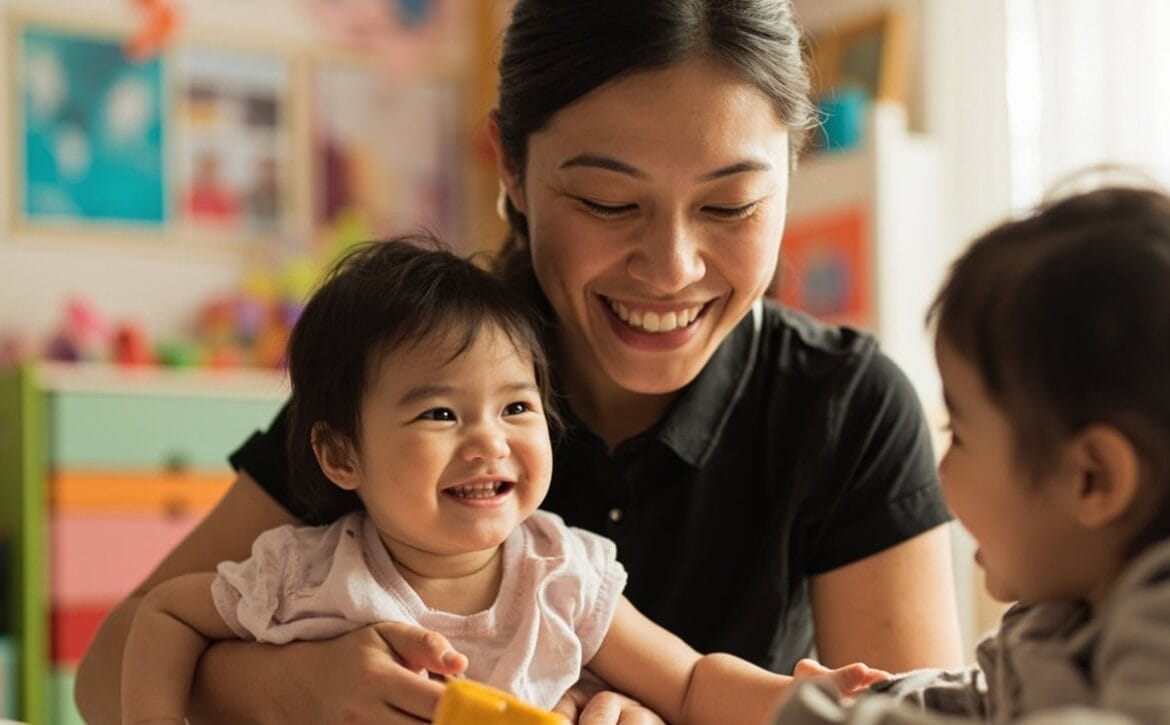
edunanny-06725173823a2cf9e4aaf354d2f6f7b1
June 6, 2026

The 30-Day Childcare Transition: What Every Singapore Parent Should Know

Quick Summary: The 30-Day Childcare Transition

  • The first drop-off is usually the hardest moment, not because it is developmentally most significant, but because the decision becomes concrete
  • Behavioral changes in the first two weeks are signs of healthy adaptation, not distress
  • Daily communication from caregivers builds trust through small, consistent acts of transparency
  • Your child’s secure attachment to you is the foundation that allows them to form new relationships with confidence
  • By weeks three and four, most children show quiet signs of secure adaptation: waving at caregivers, engaging in parallel play, accepting routine changes more easily
  • Your own emotional journey parallels your child’s, moving from acute anxiety toward genuine curiosity and quiet pride
  • Quality care during this transition actively supports your child’s developmental growth, not just their safety

What Actually Happens at the First Drop-Off

You are walking through a door. You are handing your child to someone who is not family. The distance feels enormous, even if it is only across a room. Your child may cry. They may also, strangely, not cry—and this can be just as unsettling, because you do not know what to do with a departure that seems too easy.

Both responses are normal. Both responses are, in most cases, entirely healthy. But in that moment, standing in an unfamiliar space with your child’s face turning toward a caregiver you met only once or twice before, you are not thinking about developmental health. You are thinking about the trust you are extending, and whether it will be honored.

At EduNanny, we understand this. The first drop-off is structured with intention. A caregiver will meet you at the door, will speak to your child at their level, will offer a warm and unhurried greeting. We do not rush this moment. We do not usher you out quickly so that your child can be settled more efficiently.

Your calm departure—your ability to say goodbye with confidence and love—is one of the most important gifts you can give your child in this transition. The caregiver will receive your child not as a task to be completed, but as a person to be welcomed. They will receive you, too, as a parent whose concerns are valid and whose partnership we are honored to begin.

The First Weeks: Communication, Trust, and Adaptation

In those first days, you will receive messages. You may expect updates only at the end of the day, and you may find that your caregiver sends a note in the morning, a photograph at lunch, a small observation about something your child did. This is not incidental. Trust is built in the twenty-first century not through grand gestures but through the accumulation of small, consistent acts of transparency.

When you receive that photograph, you are not merely seeing what your child looks like in that moment. You are seeing that they are safe, that they are attended to, that someone is paying attention to the small details that matter to you.

Over the first two weeks, you will likely notice fluctuations in your child’s behavior. They may be clingier in the evenings. They may have difficulty settling for sleep. They may be hungrier than usual, or seem more tired, or paradoxically more independent than you expected. This is not distress. This is adaptation.

When a child begins to show flexibility in their preferences, when they accept comfort from a caregiver they did not previously know, when they begin to look around a room with curiosity rather than wariness—you are watching neurological adaptation in real time. The brain is literally building new pathways, strengthening connections associated with social confidence, emotional regulation, and environmental mastery.

The secure attachment your child has formed with you in their first year of life is not a limitation that prevents them from forming other attachments. It is the foundation that allows them to do so with confidence. Children who feel securely held by their parents explore the world more freely. They take social risks because they know they have a home base to return to.

Around the end of the second week, and increasingly through the third and fourth, most children begin to show the quiet signs of secure adaptation:

  • They wave at their caregiver when they arrive in the morning
  • They make eye contact with other children
  • They begin to engage in parallel play, watching others and learning from observation
  • They accept a snack or a story or a change in routine with less resistance than before

These are not dramatic transformations. They are subtle, and they are profound. They indicate that your child is not merely tolerating this new environment. They are beginning to belong to it.

Your Own Journey: The Parent’s 30-Day Arc

Meanwhile, you are on your own journey. The first day, you will come home to an empty house or a quiet office and feel the strange absence of the routine you have just disrupted. You may feel relief. You may feel guilt. You may feel both and then feel guilty about feeling relief.

All of these feelings are appropriate. They do not mean that you made the wrong choice. They mean that you are a human being who loves their child and is navigating a genuinely difficult thing.

By the end of the first week, the acute anxiety of the drop-off may begin to soften. You will start to notice that the caregiver’s morning message comes at a predictable time, that your child seems to be settling into a rhythm, that the end of the day is approaching with something like normalcy.

By the second week, you may notice that you are starting to look forward to hearing about your child’s day. The messages are becoming a source of genuine interest rather than pure reassurance. You are curious about what your child did, what they ate, who they played with, what made them laugh.

This is a significant shift. It means that your anxiety has begun to quiet enough for your genuine parental curiosity to emerge. It means that you are beginning to see the childcare arrangement not merely as a necessary compromise, but as an experience in its own right—one that has its own texture and meaning.

By the end of the first month, something quiet and significant will likely happen. You will pick up your child, and they will be radiant with the fullness of their day. They will show you something they made, or tell you something that happened, or simply run to you with a kind of uncomplicated joy that tells you they had a good day, and that you are the person they most wanted to see.

And in that moment, you will feel something you may not have expected. You will feel proud. Not proud that you survived the transition, though you have, and that is real too. Proud of your child, for their adaptability, for their courage, for the person they are becoming in ways you are only beginning to understand.

Quality Childminding and the EduNanny Approach

The question is not whether your child can do this. Research, and experience, and the simple testimony of parents who have walked this path, tells us that they can. The question is whether the environment you choose supports them in doing it well.

Quality childminding during these first weeks means several things in practice:

  • Relationship-rich care: Your child is not one of many in a room. They are known, seen, and attended to as an individual.
  • Consistent caregivers: The people caring for your child are present day after day, building familiarity and trust.
  • Transparent communication: You know what your child’s day looks like, not through grand updates but through consistent, honest sharing.
  • Patient observation: Caregivers who understand what secure adaptation looks like do not interpret early fussiness as failure or a parent’s anxiety as interference.
  • Developmental awareness: The transition period is recognized as a time of significant growth, not merely a settling-in phase to be managed.

EduNanny was built for this. Not as an afterthought, but as a central purpose. We are part of the ECDA Childminding Pilot, which means our programme is designed around the recognition that home-based and community-based care, when it meets high standards, offers something that large institutional settings often cannot. It offers warmth, individual attention, and the kind of relationship-rich environment that young children need for healthy development.

Our ratios reflect this priority. With up to one-to-three infant care, your child is not one of fifteen in a room. They are one of a very small number, which means they are seen, known, and attended to. It means that when they reach for a caregiver’s hand, someone is there to hold it.

Our caregivers are trained and supported to understand what secure adaptation looks like, which means they do not interpret a child’s early fussiness as failure or a parent’s anxiety as interference. They interpret it as what it is: the normal, healthy response to a significant life transition. They are patient. They are consistent. They build trust with your child day by day, and they build trust with you in the same way.

Throughout this journey, we are committed to transparency. Where deployed, CCTV measures are in place, not because we doubt our caregivers, but because we believe that parents deserve to see what their child’s day looks like. Daily observation notes are shared. Communication is consistent and honest.

We also know that modern parenting comes with a particular kind of mental load. Between work, family, and the endless logistics of daily life, there are moments when you need an answer quickly—a reassurance that something is normal, a resource that understands your specific situation. This is why we developed Thomas, our AI chatbot, available to support parents with questions about child development, routine, and care. Thomas is not a replacement for human guidance. It is an additional layer of support, there when you need it, responsive when you are uncertain at eleven o’clock at night.

Addressing Your Concerns and Choosing Well

If you are reading this, you probably have questions. Let us address a few of the most common ones directly.

What if my child cries every day at drop-off? Some children do cry for longer than others during the transition period. This does not mean the arrangement is wrong. It means your child is processing a significant change. The key question is not whether there is crying, but whether the crying decreases over time, and whether your child is showing the quiet signs of adaptation between drop-offs.

What if I feel guilty? Guilt is a normal part of parenting. It means you care. It does not mean you are doing something wrong. Most parents who persist through the first month find that their guilt transforms into something else entirely: a quiet pride in watching their child thrive.

How do I know if the caregiver is right for my child? You know by the communication you receive, by how your child responds to the caregiver over time, and by whether you feel heard as a parent. Trust your instincts, but also give the relationship time to develop.

What if something goes wrong? Quality care means that concerns are addressed promptly and honestly. You should feel comfortable raising issues, and you should receive thoughtful responses. This is a partnership, and partnerships require communication.

As you evaluate your options, consider asking these questions:

  • How does the caregiver handle the first drop-off? Is there a structured approach, or is it left to chance?
  • What does daily communication look like? How often will you hear from them, and in what format?
  • What are the caregiver-to-child ratios? How many children are in the environment at one time?
  • How is the caregiver trained to understand child development and attachment?
  • What is the policy on transparency—observation notes, updates, or CCTV if available?
  • Are there flexible fee structures? What subsidies or schemes can be applied?
  • Is the location convenient for your daily routine? Proximity matters for the long term.

The fee structures within the pilot have been designed to make quality care accessible, and we encourage you to explore the options available through CDA and Baby Bonus, which can be applied to eligible arrangements. We want this to be a choice you can make with confidence, not one that adds financial anxiety to the emotional weight you are already carrying.

Monday through Friday care blocks are available across our island-wide network, which means that wherever you are in Singapore, there is likely a community or centre near you that is part of the EduNanny family. You do not have to travel across the island for quality care. You can find it close to home, close to work, close to the rhythms of your life.

Returning to That Morning Doorway

This is the reframing that quality childcare makes possible. It is not about you needing help, or about your child needing to learn to be independent, or about any of the guilt-laden narratives that surround this choice in our culture. It is about your child being a full human being with their own capacities, their own social curiosity, their own ability to form bonds and navigate new environments and grow in directions you could not have predicted.

And it is about you being a parent who gave them the opportunity to do so, not because you had to, but because you recognized that this is what children do. They grow. They adapt. They reach toward the world.

The parent standing in that silence, with their child’s hand warm in theirs, is not making a mistake. They are doing something that humans have always done, which is to entrust their children to the care of others, and to trust that the world will receive them with the same love they receive at home. The difference is that today, you have more choice about who that world is, and more information about what that care looks like, and more support along the way than parents have had in generations before you.

You are not abandoning your child. You are expanding their world. You are giving them the gift of new relationships, new experiences, new spaces in which to grow. And you are giving yourself the gift of knowing that while you are doing this important work in the world, your child is safe, seen, and thriving in the care of people who take this responsibility as seriously as you do.

The first thirty days will ask something of you. They will ask for patience, for trust, for the willingness to sit with uncertainty and not need it to resolve immediately. But they will also give something back. They will give you a deeper knowledge of your child. They will give you a community of support. And they will give you, on a quiet evening somewhere in the middle of this journey, a moment when you realize that your child ran to their caregiver this morning with the same easy trust they once reserved only for you—and that this does not diminish your bond.

It multiplies it.

Your child is more ready than you think. And so are you.


To learn more about EduNanny and how we support families through this transition, visit our homepage or read about our approach to quality childminding. If you have questions or would like to begin a conversation about your family’s needs, we invite you to reach out to us.

edunanny-0672432eff65c8969497f6f4ce16c38e
June 6, 2026

Finding Childcare Peace That Lets You Be Fully Present

Quick Summary

If you are reading this between meetings, here is what matters most:

  • That background worry you carry about your child’s care is not a sign of distrust — it is a sign of how much you love them
  • The real question underneath childcare decisions is not “Is this place good enough?” but “When can I finally stop worrying and just be with my child?”
  • Finding genuine trust in childcare reshapes your entire relationship with your child — not just the logistics
  • Quality childcare is available within Singapore’s ECDA Childminding Pilot ecosystem, including options like EduNanny that are built around the kind of trust that makes parental peace of mind possible

Read on for the fuller picture of why this matters and how to find care that lets you be the parent you want to be.


The Unnamed Weight of Modern Parenting

We have become very good at talking about what children need. We have built an entire language around their development, their milestones, their emotional security. This is important — it is essential.

But in all of this conversation about the child, we have left something unsaid about the parent. Specifically, about what happens inside a mother or father when they cannot fully release the worry that tethers them even to moments of supposed rest.

You arrive home from work. Your child runs to you, arms open, face bright with the particular joy of reunion. And part of you is fully there, reaching back, present in the moment.

But another part of you is still at the office. Still in the daycare pickup line. Still holding the background question: Was today a good day? Did they eat enough? Was the caregiver patient when they were fussy? Did they feel held?

What That Background Anxiety Actually Costs

That background anxiety has a cost. It dulls your presence. It creates a distance between you and your child even when you are physically together.

It makes you less patient. Less playful. Less able to simply be with your child rather than managing your worry about them.

The child feels this, even if they cannot name it. They sense that something is not quite free in the way you are with them. And this becomes a quiet ripple in the relationship — not because you love them less, but because a part of your attention is always somewhere else, monitoring.

This is the invisible tax of uncertain childcare. And in Singapore, it is especially acute.

Why Singapore Parents Feel This More Strongly

There is a particular pressure in Singaporean parenting that is hard to explain to those who have not lived it — the awareness that you are being watched, that your choices reflect on you, that there is an unspoken benchmark of what good enough actually means.

You feel it in the conversations at playdates. In the comparisons made at birthday parties. In the way relatives ask questions that feel like judgments.

Is this the right school? Is this the right caregiver? Is this the right balance?

And so we perform competence. On the outside, we are decisive, confident, clear. We have made the choice and we stand by it. But inside, the uncertainty persists.

We read the reviews. We check the ratios. We ask other parents. We wonder if we should have done more.

The Problem Is Not Information

Here is what may be the most surprising thing about this struggle: it is not a problem of information.

We are not lacking data. Singapore parents are some of the most thoroughly researched, thoroughly vetted decision-makers in the childcare landscape. We know the questions to ask. We know what the standards are. We know what good looks like on paper.

What we are lacking is something deeper — the felt experience of genuine trust. We know what we should feel. What we are waiting for is actually feeling it.


Trust as a Felt Experience

Trust, when it is real, is not an intellectual conclusion. It is not the result of a thorough vetting process or a reassuring conversation with a caregiver.

Trust, when it is real, is something you feel in your body.

It is the moment you stop holding your breath. It is the moment you can put down your phone at the dinner table and actually be at the dinner table.

It is the moment your child runs to their caregiver with the same ease with which they run to you — and you realize that your child has two safe places now, not one.

This is what we are really looking for when we search for childcare. Not just supervision. Not just competence.

We are looking for partnership — the kind of care that feels like an extension of our own love, not a replacement for it. We are looking for people who will love our children the way we would, even when we cannot be there.

And when we find that, something shifts.

What Changes When You Find Genuine Trust

The anxiety does not disappear entirely. Love always carries some concern, and this is right and good. But the background hum quiets. The watchfulness softens into something more like trust. And in that quiet, something precious becomes possible again.

You become more present with your child.

Not because you have tried harder. Not because you are a better parent. But because the part of you that was holding the worry can finally rest.

You can listen fully when your toddler tells you about their day. You can play without one eye on the clock. You can be patient in the way you want to be patient, because you are not running on the depleted reserves of constant vigilance.

Children also need parents who can be fully with them. Parents who are not depleted by anxiety, distracted by worry, running on empty. Parents who can show up, again and again, with something real to give.

That is what finding the right childcare ultimately serves — not as a service, but as the quiet architecture of a family life that works, that holds, that gives parents and children alike the space to be who they are.


What Quality Childminding Actually Looks Like

Before exploring what EduNanny offers, it helps to be clear about what quality childminding actually means — because in Singapore’s diverse childcare landscape, not all arrangements are built the same way.

The Foundation: Ratio and Attention

The single most concrete indicator of quality in infant care is caregiver-to-child ratio. When a caregiver has fewer children to watch, they can respond more fully to each one.

They can notice the small shifts — the first signs of hunger, the moment a child needs to be held, the quiet distress that a larger group might miss.

This is not just about safety. It is about your child being known as an individual, not managed as part of a group.

Consistency and Continuity

Children build trust through predictable relationships. A caregiver who knows your child’s rhythms — their sleep patterns, their food preferences, the particular sound they make when they need comfort — provides something fundamentally different from a rotating roster of faces.

Consistency is not a luxury. It is a developmental need.

Communication as Connection

What does it mean to actually know what is happening when you are not there?

Transparency matters. Not because parents distrust caregivers, but because parents take their children’s lives seriously. Regular updates, honest reporting, open channels of communication — these are not add-ons. They are part of what makes trust possible.

When you can see your child being held, playing, resting, being spoken to with warmth, the trust deepens. You are not imagining their day. You are being invited into it.

Professional Structure and Accountability

Quality care exists within accountable frameworks. ECDA oversight, proper registration, clear standards — these are not bureaucratic necessities. They are the foundation that allows personal trust to rest on something solid.

You are not relying on goodwill alone. You are relying on a system that has been designed to uphold quality, and on people who have chosen to be part of it.


EduNanny: Built for the Trust You Are Looking For

EduNanny is part of something important: the ECDA Childminding Pilot, a recognition that Singapore families need more than one pathway to reliable, quality care.

Home-based care, community options, centre-based support — these are not interchangeable boxes. They are different shapes of the same underlying need: parents who need to work, and children who need to be known.

EduNanny operates within this ecosystem with a clarity of purpose. They are not offering a transaction. They are offering a partnership.

The Architecture of Attention

One of the most concrete ways this partnership expresses itself is in ratios. EduNanny maintains a ratio of up to one caregiver to three infants.

This is not an accident. This is a deliberate architecture of attention. When a caregiver can give more of themselves to fewer children, something different becomes possible — genuine responsiveness, patient comfort, the kind of noticing that comes from truly knowing a child.

Removing the Barriers to Trust

The practical realities matter too. Monday to Friday care blocks. Fees structured within the pilot framework to remain accessible. The ability to use CDA and Baby Bonus funds.

These are not secondary concerns. They are part of what makes trust possible, because they remove the stress of impossible logistics.

When parents do not have to choose between quality and affordability, they can make the choice that actually feels right. They can stop compromising and start committing.

The Dignity of the Caregiver

There is something else worth naming: the dignity of the childminder.

Too often, the conversation around childcare positions caregivers as interchangeable service providers — bodies in a room, tasks to be performed. EduNanny understands that quality care begins with people who are treated as professionals, given real training, held to real standards, and trusted with real responsibility.

When caregivers are valued, they give better care. When they are supported, they can sustain the patience and warmth that children need.

This is not soft thinking. It is the practical foundation of everything else.

Answering the Questions You Are Really Asking

If you are researching infant care in Singapore, you likely have specific questions. Here is what thoughtful consideration looks like for each:

  • “Will my child feel secure?” Security is built through consistent, warm, responsive care. Look for arrangements where your child is known as an individual, where their cues are recognized and responded to, where the relationship deepens over time.
  • “Will I know what’s happening during the day?” Transparency is non-negotiable. You should have regular communication — not surveillance, but genuine connection. Updates, photos, honest reporting. You should feel like you are part of your child’s life, not shut out of it.
  • “Is this actually affordable?” Cost matters, and it should not force impossible choices. Look for arrangements that work within Singapore’s support structures — CDA, Baby Bonus, pilot frameworks. Affordability and quality are not opposites.
  • “What if something goes wrong?” Accountability matters. Look for care that operates within recognized frameworks — ECDA registration, pilot programme structures, clear standards and oversight. Personal trust and systemic accountability are partners, not competitors.
  • “Will this actually reduce my worry?” This is the real question. Not whether the care is technically adequate, but whether it will allow you to put down the weight you have been carrying.

The answer comes not from finding perfect care, because no care is perfect. We are looking for trust — the kind that is earned through small, consistent, reliable acts of care. The kind that builds over time, through daily reports and gentle attention and the simple fact that your child is happy when you pick them up, not because they have been managed into happiness, but because they have been genuinely well.


A Practical Framework for Choosing Infant Care

If you are beginning your search — or if you are mid-search and feeling overwhelmed — here is a practical framework for evaluating your options.

Consideration Why It Matters Questions to Ask
Ratio Determines how much individual attention your child receives How many children per caregiver? How does this change as children grow?
Consistency Children need predictable relationships to build security Is the caregiver team stable? Will my child have a primary caregiver?
Communication Transparency builds trust and keeps you connected How will I receive updates? How often? In what format?
Training and Standards Professional caregivers provide more reliable care What training do caregivers receive? Is there ECDA oversight?
Affordability Logistics should not undermine quality Can I use CDA or Baby Bonus funds? Are there subsidy options?
Philosophy of Care The underlying approach shapes daily interactions How do they handle feeding, sleep, distress? Does this align with my values?

Most importantly: trust your response to the caregivers themselves. You are looking for people who seem to genuinely love what they do — who will love your child even when you are not there.


Finding the Peace You Are Looking For

The question is not really about childcare logistics. It never was.

The question is: when can I stop worrying and just be with my child? When can I be the parent I want to be — patient, present, curious about who they are becoming, unafraid of the hard moments because I know they are not facing those moments alone?

EduNanny is here for that work — the daily, unglamorous, essential work of care that makes everything else possible.

Not a solution to every anxiety, because that would be a false promise. But something more honest: a genuine partnership, a transparent relationship, a caregiver network built on real ratios and real accountability.

A structure designed to reduce the mental load, not add to it.

A team that understands, because they have seen this story many times, that the parent who can rest is the parent who can be present. And the child who is seen by trusted, consistent, loving hands is the child who grows into their full capacity for trust themselves.

What Becomes Possible

Here is what becomes possible when you find genuine trust in childcare.

The dinner table becomes a place of conversation. The bedtime routine becomes a ritual of connection. The ordinary moments of a Singapore family day become the texture of a childhood that your child will carry with them — not just remembered, but felt, in the deep and lasting way that comes from being truly seen by the people who love them.

You become more present with your child. And in that presence, everything changes.


Ready to Explore Your Options?

If you are considering EduNanny as part of your childcare journey, reach out to learn more about how the ECDA Childminding Pilot works, what arrangements are available, and whether it is the right fit for your family.

The conversation starts with listening — to your concerns, your hopes, and what you are really looking for. Because the goal is not to sell you a service. It is to find out whether a genuine partnership is possible.

And they will be here tomorrow, and the day after, and for as long as families need someone to stand beside them in the work of raising a child.

edunanny-0672354087dd8eb0d0e0ecfcd8a925f8
June 6, 2026

Beyond Supervision: Why Attachment Science Should Guide Your Childcare Choice

The Moment You Hand Over Your Child — and the Question That Haunts You

There is a moment, unhurried and heavy, when you place your child into someone else’s arms. It lasts only seconds. Your child’s hand reaches for your collar or finds the familiar fabric of your clothing, and in that small grasp is everything you cannot yet say aloud.

You adjust the strap of your bag. You remind yourself that you have prepared for this — the research, the visits, the questions asked and answered. And yet something in you stays behind in that room, watching, just a little longer, until the door closes between you.

What you are feeling in that moment is older than parenting itself. It is the weight of a question that every working parent carries, sometimes in silence, sometimes in the small rituals of reassurance performed before leaving the house:

Is my child okay?

Not just supervised. Not just safe. But okay, in the deeper sense. Okay in the way that matters for a small person who is building the architecture of their inner world, one interaction at a time.

What This Article Covers

  • Why “Is my child okay?” is different from “Is my child supervised?”
  • How attachment science explains what young children need to thrive
  • What quality childminding looks like in daily practice
  • How to read observable signs of healthy development at the evening reunion
  • What EduNanny Singapore does differently — and why it matters

The Question Beneath the Question

Beneath the logistics of schedules and proximity, beneath the practical anxieties about nutrition and nap times, there is a quieter, more urgent wondering:

Is my child building what they need to build while I am away? Are they learning that the world is a place where they can be held, heard, and responded to? Or are they learning something else — something harder to name but easy to feel — that the people who love them most are the ones who leave?

This is the question beneath the question. It is not irrational. It is not sentimental. It is, in fact, the most important question a working parent can ask — because the answer shapes something fundamental about the child you are building together.

For decades, developmental science has known what children need. But childcare marketing rarely says it plainly. At EduNanny Singapore, we built our entire approach around one thing: attachment. Not as a buzzword, but as the observable, measurable foundation of everything that follows.


What Developmental Science Has Known for Fifty Years

The first years of life are not simply a period of growth. They are a period of construction.

The child is not just growing larger, learning to walk, beginning to babble. The child is building a model of how relationships work — a template, encoded deep in the nervous system, that will shape how they approach every connection they will ever have.

Psychologists call this the internal working model of trust. You might call it the foundational belief a child develops about whether people can be relied upon, whether their needs matter, and whether the world is a safe place to venture into.

This model is not built through grand gestures or elaborate curricula. It is built through small, consistent, repeated moments of being responded to:

  • When a caregiver notices a flicker of hunger before the cry begins and offers food at exactly the right moment.
  • When a toddler reaches for a toy and the caregiver narrates what is happening — I see you want the red one — in a voice that says, I am here, I am paying attention, you matter.
  • When a child falls and the caregiver crouches down, makes eye contact, and names what happened: That was a surprise, wasn’t it? You’re okay. I’m right here.

Each of these moments, taken alone, seems small. But children are not collecting moments the way adults collect data points. They are living inside them. The nervous system does not distinguish between a meaningful event and a mundane one. It only registers: Was I responded to? Was my need met? Was someone there?

Over months and years, the accumulation of these micro-responses becomes the architecture of the self.

Secure Attachment: What It Looks Like

A child who has been consistently responded to develops what psychologists call secure attachment — a quiet, deep-seated confidence that they are worthy of care and that the world contains people who can provide it.

This child does not need constant reassurance because they have internalized the experience of reliability. They can explore because they know, in their bones, that there is a base to return to. They can be curious because they are not depleted by the constant work of managing anxiety about whether anyone is coming.

The research on this is extensive and consistent: attachment security in infancy is one of the most powerful predictors of emotional regulation, social competence, and confident engagement with the world at age five, ten, and beyond. The science has been built over fifty years of careful observation, longitudinal studies, and cross-cultural validation. It is not tentative.


What Quality Childminding Looks Like in Practice

When we designed EduNanny under the ECDA Childminding Pilot, we began with a question about what attachment science actually requires in practice: What does a caregiver need to be and do, hour by hour, day by day, in order to serve as a secure base for the infant in her care?

The answer is both simple and demanding.

Consistency

The same caregiver, over time, so that the child can build an expectation of reliability. A child who is passed from face to face cannot internalize the experience of anyone being a base because there is no one base to return to.

The emotional economy of the infant’s world requires a stable point of reference — someone whose presence is a known quantity, whose voice is recognized, whose response patterns are predictable. Consistency is not a luxury or a nicety. It is the mechanism through which attachment is built.

Low Caregiver-to-Child Ratios

When a caregiver is responsible for three infants, she can notice. She can catch the early signals of hunger, the micro-expressions of discomfort, the moment when a child is about to escalate from irritation to distress.

When she is responsible for six or eight, those moments pass unobserved, and the child learns that signals do not produce responses. The internal working model adjusts accordingly.

EduNanny operates with ratios of up to one caregiver to three infants in our infant care settings. This is not a marketing number. It is a developmental requirement.

Emotional Attunement

This is the capacity to read the child’s internal state and respond in a way that validates and matches that state. A securely attached caregiver is not simply warm. She is precisely warm — calibrated to the individual child, attuned to the specific rhythms of that small person’s needs.

She does not soothe all distress the same way. She notices what this child needs in this moment: sometimes comfort, sometimes space, sometimes distraction, sometimes simply the quiet presence of someone who is not anxious.

Time

Attachment is not built in a week or a month. It is built through the accumulation of responsive interactions across seasons. EduNanny structures care around consistent, ongoing relationships rather than rotating assignments. We think of our caregivers not as staff but as the practitioners of a daily developmental practice.

A Morning in Practice

When a child arrives, the caregiver is already present, already settled into the rhythm of the space. She kneels to the child’s level. She uses the child’s name. She does not rush the greeting.

In attachment science, the quality of the reunion matters — the way a child is received after an absence communicates something powerful about whether absences are survivable and whether returns are reliable. The caregiver allows the child a moment to take in the space, to locate a familiar toy or object, to breathe before being expected to engage.

An Afternoon in Practice

The caregiver moves through the space not on a fixed schedule but in response to what she observes. When an infant stirs from a nap, she is nearby — not looming, not rushing, simply present. She speaks before she acts. She narrates:

You’re waking up now. You’re stretching. The light is coming through the window.

This is not chatter. It is the architecture of language acquisition and emotional regulation, delivered through the simple practice of being talked to as a person who matters, long before words are possible.

When two toddlers reach for the same toy, the caregiver does not solve the problem by removing the toy or declaring a winner. She moves close. She names the conflict in a calm voice. She stays physically and emotionally present while the children work through the experience of wanting the same thing.

Her calm is the lesson. Her steady presence is what the children are learning from. This is how emotional regulation develops — not through being told to calm down, but through being inside the experience of a caregiver who is calm.


Reading the Evidence: What the Evening Reunion Tells You

And then, at the end of the day, there is the moment you have been waiting for. The door opens. You come through it. And your child looks up.

What you see in that moment is data. Not a performance or a posed expression, but the unfiltered result of the hours you were apart.

Warm but Contained Reunion

A securely attached child, after a day of responsive care, will show what researchers call a reunion behavior that is warm but contained. Not frantic. Not indifferent.

There may be a brief moment of excitement, a quick smile, an arm reaching for you — and then a settling. The child can be picked up, can orient toward you, can be soothed by your presence without needing to act out the anxiety that was held in check all day.

The child has been practicing, in small ways, the skill of tolerating temporary absence because the absence was never experienced as abandonment. The caregiver was consistent. The returns were reliable. And now you are here, and the model holds.

Language Development

You will notice the quality of your child’s language. A child who has spent the day in an environment of rich, responsive interaction — where a caregiver narrates experience, names emotions, and responds to vocalizations with reciprocal engagement — will often show accelerated language development.

You may hear new words. New combinations. A richness in the way your child describes what happened during the day that surprises you, because language is not acquired in isolation. It is acquired in relationship, in the back-and-forth that researchers call serve-and-return — the foundational rhythm of human communication.

Exploration and Confidence

A secure child, confident in the reliability of the base, is a curious child. You may see this in the way your child moves through the world at home — willing to try new things, to venture a few steps away, to engage with novelty without collapsing into anxiety.

This is not personality. It is the direct result of an internal working model that says: I can explore because I know where my base is. Someone will catch me if I fall.

Enrichment, Not Depletion

You may notice something subtler still: a sense that your child is not depleted by the day but enriched by it. That the hours apart have not worn down the relationship between you but have, paradoxically, deepened it.

Because a child who has experienced reliable care in your absence has also experienced something else: the knowledge that you made a choice to place them somewhere good. That you thought about them. That you chose people who would be for them what you would be.

What You Are Looking For: The Pattern

Not perfection. Not the absence of all distress. Children cry. Children have difficult days. Children go through phases of separation anxiety that are developmentally normal and do not indicate failure.

What you are looking for is a pattern. A trajectory. A child who, over weeks and months, shows evidence of growing security, growing confidence, growing language, and a deepening capacity to be soothed and regulated.

The evening reunion, observed over time, is one of the most reliable windows into your child’s emotional world that exists.


The EduNanny Difference

EduNanny Singapore is part of the ECDA Childminding Pilot, operating under a framework designed to expand access to quality infant and childminding care across Singapore. We offer both home-based and community-based pathways, recognizing that families have different needs and different contexts.

Our Commitments

  • Infant ratios of up to 1:3 — the ratio that attachment science says is necessary for quality attention that builds security.
  • Consistent caregivers — not rotating assignments, but stable relationships built over time.
  • Emotional attunement training — caregivers who practice warmth as a skill, not a performance.
  • Accessible fee structures — many families can access support through CDA funds and Baby Bonus arrangements, and we help parents navigate these options.
  • Communication and transparency — regular updates and, in applicable settings, CCTV access. These are trust features, not surveillance features.
  • Thomas, our AI companion — a practical resource to support parents along the way, answering questions that arise at odd hours and helping you make sense of what you observe.

We do not ask our caregivers to perform warmth. We ask them to practice it, which is a different and more demanding thing. Warmth that is performed is variable. Warmth that is practiced becomes a skill, a habit, a way of being with children that is reliable even on difficult days, even when the child is not easy to reach, even when the work is invisible and exhausting and no one is watching.

Questions Worth Asking Any Childcare Provider

When you are researching infant care options in Singapore, here are the questions worth asking — beyond the checklist of qualifications and facilities:

  • Who will be the primary caregiver? Will it be the same person, day after day?
  • What is the caregiver-to-child ratio? Can the caregiver realistically notice my child’s individual signals?
  • How does the caregiver respond to distress? Is there a consistent, calm approach?
  • What does a typical day look like? Is it schedule-driven or response-driven?
  • How is the evening reunion handled? Is there time for a proper handover?
  • How can I observe what my child’s day was like? What communication can I expect?
  • How does the setting handle the development of language and emotional regulation — not just physical safety?

The answers to these questions will tell you something meaningful about whether the setting is designed for supervision or for the kind of developmental care that builds security.


Choosing a Relationship, Not Just a Service

When you handed your child to someone else this morning — or when you are about to, if you are still in the searching phase — what were you really hoping for?

Not the superficial answer. Not the checklist answer about qualified staff and clean facilities and reasonable hours. The real answer.

It was likely this: I hope my child is building what they need to build. I hope the hours apart are not taking something from them but adding something to them. I hope that when I come home at the end of the day, my child will be whole, and curious, and reaching for me not in desperation but in the quiet confidence of someone who has been well cared for and knows it.

This is not an unreasonable hope. It is not naive or sentimental. It is the most reasonable hope a parent can have, and it is supported by fifty years of developmental science.

Children do build what they need to build in the context of responsive, consistent, emotionally attuned care. The internal working model of trust is not a metaphor. It is a neurological reality, and it can be constructed well or poorly, deliberately or accidentally.

You are not choosing a service when you choose childcare. You are choosing a relationship for your child — the daily, formative, scientifically grounded relationship that will become part of who they are.

EduNanny Singapore exists so that you do not have to hope blindly. So that the daily experience your child is having can be the experience that builds security, confidence, and the capacity for connection that will carry them through school, through adolescence, through adulthood.

So that when you observe your child at the evening reunion, you are not reading ambiguous signals but clear evidence — the evidence of a child who is okay, in the deepest sense. Who is building well. Who has a base to explore from and a world that makes sense because someone, during the hours you were apart, was paying close, precise, loving attention to what that small person needed.

We take that responsibility seriously. Not as a slogan. As a practice, day after day, interaction after interaction, until the pattern is so deeply established that your child carries it forward into the world as something simply and quietly true:

I am worthy of care. People can be relied upon. The world is a place I can venture into with confidence because I know there is always somewhere to come home to.

That is what we are building here. That is what EduNanny Singapore is for.

And that is why, when your child comes home calm and curious tonight, you will know — not because anyone told you, but because you can see it — that your child is truly okay.


Ready to Learn More?

If you are researching infant care or childminding options in Singapore and want to understand how EduNanny can support your child’s early development, we welcome the conversation.

Visit our website to learn more about our approach, or speak with our team to explore what a secure base could look like for your family. You can also read about us and our commitment to developmental, attachment-informed care.

edunanny-06722727860456318a944c20e63d7a9c
June 6, 2026

Why Your Singapore Child Acts Differently After Childcare

“`html

Why Your Child Comes Home Different After Childcare

There is a moment that every working parent in Singapore knows.

It happens in the evenings, somewhere between the walk home from the bus stop and the first step through the front door. You reach down to lift your child from the stroller or take their hand, and something feels different. They are quieter than this morning, or perhaps noisier—more clingy, more tearful, more wired, more withdrawn. The child you kissed goodbye eight or nine hours ago seems to have traveled somewhere far and returned as someone you almost recognize but not quite.

Your first instinct is to wonder if something happened. Was there a conflict? Did they feel lonely? Are they being treated well?

These questions are not wrong to ask. But they are only part of the picture.

The behavioral shift you notice when your child comes home is not necessarily a warning sign. In most cases, it is evidence that your child is processing, adapting, and growing in ways that will shape who they become. You are not imagining this. You are not being an anxious parent. You are being an observant parent. And that observation deserves a real answer, not a dismissive reassurance that everything is fine.

What This Article Will Give You

  • Understanding of why behavioral changes after childcare are normal—and healthy
  • Clear explanations of the most common patterns Singapore parents observe
  • Science-backed insight into how young children process their days
  • Practical guidance on responding to evening homecoming behaviors
  • Reassurance that you know your child better than you think

What Is Actually Happening Inside Your Child’s Mind

Across Singapore—in HDB flats in Ang Mo Kio and Toa Payoh, in condominiums in the City Hall area, in landed properties in the suburbs—a small but profound ritual takes place every evening. The child who has spent the day in someone else’s care returns home to the person they know best in the world. And something in their behavior tells you that the day was not nothing.

Singapore parents are not simply asking, “Did my child have a good day?” They are asking, “Am I making the right decision? Is this arrangement working? Is my child thriving, or merely surviving?” These questions deserve understanding, not generic reassurance.

The Science of State Regulation

A child’s brain is not a smaller version of an adult brain. It processes the world differently—particularly in how children experience and store the events of their day.

Where an adult might integrate a new experience into an existing framework of understanding within minutes, a child often cannot do this in the same session. They need time. They need safety. They need the presence of a familiar attachment figure.

Developmental psychologists use the term state regulation to describe how children manage their emotional and behavioral states across different environments. When your child enters a new setting—school, childcare, a grandparent’s home—their brain must work to adjust. They observe the new adults, learn the new routines, navigate the social landscape of other children, and function within rules that may differ from what they know at home. This is not passive. This is active cognitive and emotional labor.

Then, at the end of the day, they must transition back. Here is where something remarkable happens: the very behaviors that may alarm you—the clinginess, the tears, the sudden inability to do things they could do yesterday, the explosions over small things—are often signs that your child is doing the work of integration. They are bringing the experiences of the day into contact with their sense of self, their sense of security, and their relationship with you.

Your child has spent hours holding themselves together in a world where they had to be a certain way. When they come home, they release that regulation. The defenses come down. The emotions that were held during the day come flooding out—not because something went wrong, but because they finally feel safe enough to let them.

This is not dysfunction. This is how healthy children process their days.


The Most Common Patterns Singapore Parents Observe

Naming what you are seeing is often the first step toward understanding it. Here are the patterns seen most frequently in families across Singapore.

The Clingy, Tearful Child

Many parents interpret this as evidence that their child is unhappy at childcare, that separation is causing harm. But often, it is the opposite. This child has been holding their anxiety inside all day, managing it with the tools available to them—which might mean distraction, engagement, or quiet compliance. When you appear, the dam breaks.

What this means: The tears are not evidence of a bad day. They are evidence that your child trusts you enough to show you how hard the day was.

The Withdrawn, Quiet Child

Some children integrate by going quiet. They may seem subdued, listless, less animated than usual. If your child is withdrawn but not distressed, they may simply need time and low-stimulation comfort before they are ready to play. They are resting their sensory and emotional systems.

The Hyperactive, Disregulated Child

Some children do not decompress—they discharge. The school or childcare day has been full of structure, expectation, and control. The moment they are free, they run, jump, shout, and test every boundary they can find. Your child is releasing the accumulated tension of the day. They need a safe space to do that, and it is not a failure of regulation—it is a healthy release mechanism.

The Regressed Child

The child who was potty-trained now has accidents. The child who could dress themselves now wants to be dressed. The child who was using full sentences now speaks in fragments or baby talk. Regression is one of the most misunderstood behaviors in early childhood. It is not a step backward. It is a retreat to a younger state of self in order to process current stress. When your child regresses after childcare, it often means they have encountered something new or challenging that they do not yet have the resources to integrate at their current developmental level. They are asking for support, not signaling failure.

The Emotionally Explosive Child

A refusal to put on shoes becomes a full meltdown. A wrong-colored plate at dinner triggers inconsolable tears. These explosions are frequently the unprocessed residue of the day finding its way out. Your child may have been holding frustration, fear, or overwhelm for hours, and the first safe opportunity to release it is now, with you, in a context that feels small enough to manage.

None of these patterns mean your childcare is failing your child. None of them mean your child is not ready for the arrangement you have chosen. Each of them, in most cases, means your child is human, is young, and is doing the difficult work of growing up in a world that asks more of them than they can always articulate.


Quality Care Creates Noticeable Change

If the childcare is excellent—if the caregivers are warm and attentive, if the environment is stimulating and safe—should your child not simply be happy all the time? Should they not come home unchanged?

No. The opposite is true.

When your child is in an environment that genuinely engages their mind, stretches their abilities, exposes them to new social dynamics, and challenges them at the edge of their development, they will come home changed. Not damaged. Not distressed in a harmful way. Changed, because they have grown.

Think about how you feel after a day when you have done meaningful, demanding work. You are not the same person who woke up that morning. You have expended cognitive and emotional energy. You have learned something, solved something, navigated something. You need time to integrate. You are tired in a way that is different from physical tiredness.

Your child is doing the same thing, but their integration process is more visible and more raw because they have fewer tools for managing it.

This is why reframing the question matters. You are not asking, “Why is my child behaving differently after childcare?” You are asking, “What is my child doing between the morning goodbye and the evening hello?” The answer is: they are becoming someone new—not someone unrecognizable, not someone disconnected from you. But someone who has been shaped by experiences you were not present for, and who needs you to help them understand what that means.


What Quality Childminding Looks Like in Singapore

Whether your child is in centre-based care or home-based childminding, quality is consistent across arrangements. Here is what it looks like.

Defined by Attention, Not Just Setting

Quality care is defined not by the setting but by the attention your child receives. When the ratio is one caregiver to three infants—as it is within the EduNanny pilot for the earliest and most vulnerable age group—your child is not a name on a register. They are a person whose needs, rhythms, and signals are known and responded to. For children under two, this is not a luxury. This is a developmental necessity.

Defined by Continuity

When your child is cared for by the same trusted caregiver or small team over time, they build the attachment that makes separation and reunion safe. They learn that departures are not abandonments and that returns are guaranteed. This security is the foundation on which all learning is built.

Defined by Partnership With Parents

The best childcare is not a replacement for parental presence. It is a complement to it. Caregivers who see themselves as collaborators with you rather than substitutes for you are the ones who will give your child what they need.

Quality care creates a distinct daytime experience that your child must transition from, and that transition itself is developmental work. The evening homecoming is not a disruption to your bond with your child. It is an invitation—a daily ritual where your child says, in the only language they have: I have been away. I have changed today. I need you to help me understand what has happened and who I am becoming.


How to Respond When Your Child Comes Home Changed

Here is what you can do with this knowledge. How do you respond to these evening behaviors in a way that supports your child and helps you feel confident in your choices?

1. Receive Rather Than Rescue

When your child comes home dysregulated, your instinct may be to fix it—to distract them, to offer treats, to immediately soothe the distress away. This is not wrong, but it can be incomplete. What your child often needs most in the first few minutes is simply to be seen.

“I can see you had a big day. I can see you have a lot of feelings right now.”

You do not need to solve anything. You need to witness. That alone begins the integration process.

2. Slow the Transition

The walk home from childcare, the moment of pickup, the journey back into your domestic world—these minutes matter enormously. If your child has been in childcare all day, the transition home is a bridge between two worlds. Rushing it can leave your child feeling unresolved.

Give them time to make the crossing. A few extra minutes at the playground, a calm walk through the neighborhood, a stop for a drink of water at a familiar coffeeshop. These small pauses are not inefficiencies. They are developmental scaffolding.

3. Ask Open Questions, Not Closed Ones

Instead of “Did you have a good day?”—to which a toddler may answer only “Good” or “No”—try:

  • “What was the best part of your day?”
  • “What did you play with?”
  • “Who did you sit next to at lunch?”

These questions give your child something concrete to share, and the answers will tell you more than you expect.

4. Pay Attention to Patterns Over Time

One evening of unusual behavior is rarely significant. A pattern of behaviors—recurring clinginess, persistent withdrawal, consistent regression, ongoing dysregulation—may indicate that something in the arrangement needs attention. Perhaps the ratio of children to caregivers is too high for your child’s current needs. Perhaps the environment is overstimulating or understimulating. Perhaps your child would benefit from a different type of care arrangement, at least for a season.

Patterns tell a story. Trust what you see over days and weeks.

5. Talk to Your Caregivers

If you have chosen a care arrangement, you should have a relationship with the person or team caring for your child. You should be able to ask questions like “How did Junhao seem today?” and receive an honest, thoughtful answer. You should feel that the people caring for your child understand them as an individual, not just as one of several charges to be managed.

This is why the quality of your care relationship matters. At EduNanny, we understand that caring for your child means caring for your family—and that relationship requires transparency, open communication, and mutual trust. We believe that the families who entrust us with their children deserve more than a service. They deserve a partnership built on genuine understanding.


Addressing Your Real Concerns

Let me speak directly to the questions that many Singapore parents carry.

“Am I making the right decision?”

The honest answer is that the right choice depends on your child, your circumstances, and your values. But the quality markers we have outlined are consistent: attentive ratios, continuity of caregiver, warm environment, genuine partnership with parents. Whether you are considering home-based childminding through the ECDA Childminder Pilot, community-based care, or centre-based pathways, these are the standards to look for.

“How do I know the childcare is actually working?”

Watch for integration rather than stasis. A child in quality care will come home changed—not distressed, but transformed by the day’s experiences. They will be tired in a way that reflects learning and growth, not depletion. Watch for the reunion ritual itself. A child who can move from separation anxiety in the morning to emotional release in the evening and back to secure attachment overnight is doing exactly what healthy children do.

“What if the behavioral changes are too extreme?”

There is a difference between a child who is processing and a child who is struggling. If your child is not sleeping well for extended periods, if they are losing weight or stopping growth, if they are becoming consistently fearful of the childcare setting—these are signals to take seriously. Talk to your caregiver. Talk to your pediatrician. Trust your instincts—but also remember that extreme behaviors sometimes signal extreme growth, and the two can look similar at first glance.

“What about affordability?”

The ECDA Childminder Pilot gives Singapore families access to home-based care that meets quality standards—with ratios, training, and oversight that make excellence achievable. The pilot fee structures are designed to make this care accessible, and existing schemes like the Child Development Account and Baby Bonus can be applied. We believe that financial considerations should not force families into arrangements that do not serve their children.


Your Evening Homecoming Is Not an Obstacle—It Is an Invitation

You are raising the next generation of Singapore. In an environment of extraordinary economic pressure, cultural complexity, and competing demands, you are trying to give your children what they need to grow into capable, caring, resilient human beings. And part of what they need is high-quality care during the hours when you are working, learning, or managing the logistics of modern life.

This is not a failure of parenting. This is parenting.

The evening homecoming, with all its messiness and emotional complexity, is not a disruption to your bond with your child. It is part of what deepens it. Every time you meet that invitation—with patience, with presence, with the willingness to simply be with your child’s feelings rather than fix them—you are doing something profoundly important. You are teaching your child that love is not just in the greeting and the goodbye, but in everything in between.

You know your child better than you think. Not because you have read the right books or attended the right parenting classes, but because you have loved them since before they were born and you will love them long after they no longer need you in the same way. That knowledge is not fragile. It is the most reliable guide you have.

The behavioral changes you notice in the evening are not obstacles to your relationship. They are part of the relationship. They are the evidence that your child is alive, growing, and processing the world in exactly the way a child should.

Trust what you see. Trust what you feel. And when the weight of uncertainty becomes too much to carry alone, know that there are people and systems designed to walk this path with you—not to replace the parent you are, but to support the parent you want to be.

Begin the Conversation

EduNanny was built on this understanding. We are here not just to care for your child, but to help you understand what you are seeing in them—to be the trusted guide who sits beside you when the evenings feel confusing and reminds you: this is normal. This is healthy. Your child is doing important work.

And so are you.

If you are considering your childcare options in Singapore and want to understand how quality childminding works—and why the evening homecoming might be the most important ritual in your family’s day—we invite you to begin a conversation with us. Explore what EduNanny offers. Ask the questions this article has not answered. Tell us about your child and what you are looking for.

Because every family deserves to feel confident that their child is not just being cared for, but being understood.


Thank you for caring enough to ask the hard questions. Thank you for being the kind of parent who shows up, who pays attention, who wants to do better. Your children are fortunate, and so is the city they are growing up in.

“`

edunanny-06721989eb62c22e0bbed3007ba2bb5a
June 5, 2026

The Grief and Grace of Working Parenthood in Singapore

“`html

The Unspoken Truth Working Parents in Singapore Are Carrying

Not the grand debate about childcare quality. Not the checklist of what to look for in an infant care programme. But the quiet, unglamorous, deeply human thing that happens before any of that — the thing that is actually keeping Singapore parents awake at night, and which almost no one is willing to name directly.

It is the grief of missing your child. And it is the beginning of everything.

What We Do Not Say Enough in Singapore

Loving your child completely, and leaving them in someone’s care so that you can work, is not a contradiction. It is one of the most emotionally honest acts a parent can perform. But somewhere between the cultural expectations, the social media snapshots of perfect family life, and the internalized voice that says you should be doing more, working parents in Singapore have lost the language for what they are actually feeling.

They are not wondering whether the childcare centre is good enough. They are wondering whether they are good enough.

They are not asking if the caregiver is qualified. They are asking if they have failed.

This is the wound. And until we address it — directly, honestly, with the kind of warmth that does not minimize but does not despair either — every other conversation about quality, trust, and development will feel like it is floating above the real thing.

The Judgment That Compounds the Grief

Singapore has a particular way of making parents feel observed. The school gates. The family gatherings. The well-meaning comments at Chinese New Year. There is an unspoken catalogue being kept.

  • You work too much.
  • You are not spending enough time with your child.
  • Someone else is raising your child.
  • You should be doing this yourself.

Parents absorb it. They internalize the judgment until it sounds like their own voice, until they are the ones telling themselves they are not enough. They stop advocating for their own needs. They stop trusting their own instincts. They silence themselves in meetings with their own partners because they feel guilty for wanting anything that takes them away from their child.

The conversation in Singapore about working parents and childcare rarely names this dynamic. It focuses on logistics. It offers checklists. It talks about quality ratios and developmental outcomes and curriculum alignment. These things matter. But underneath all of that logistics is a human being who is in pain, who is doing something genuinely difficult, and who is being told — sometimes explicitly, more often silently — that they should feel bad about it.

That is not a policy problem. That is a dignity problem. And it deserves to be met with honesty.


The Mythology of the Parent Who Does It All

Here is what I want every working parent in Singapore to hear: the mythology of the parent who does it all, who is present for everything, who never misses a moment — this mythology does no one any good.

It does not help you. It does not help your child. It creates an impossible standard that you will spend years trying to meet and will never quite reach, and in the process, you will exhaust the very resources that would allow you to be the parent you actually want to be.

The Reframing That Changes Everything

The insight I want to offer is not comfortable. It asks something of you. But I believe it is true, and I believe it is the only framing that will allow you to move through this period of your life with something like grace.

Your child does not need your physical proximity at every moment. Your child needs your psychological presence at the moments that matter.

Research in developmental psychology speaks to this consistently. What predicts a child’s security and healthy development is not the number of hours a parent spends in the room, but the quality of attunement in the relationship. The attuned gaze. The regulated nervous system. The parent who can be emotionally present and not depleted.

Consider this: a parent who comes home from work and is genuinely present for three hours of connection, play, reading, and attuned responsiveness — that parent is doing something profoundly valuable. A parent who is physically present for eight hours but distracted, depleted, and emotionally checked out because they have been running on empty all day — that parent is present but not available.

Not the quantity of time. The quality of presence.

The Geometry of a Family That Can Hold All of Its Members

The hours apart — the hours you spend at work, building your career, contributing to your household, doing the things that allow your family to live and grow — those hours, if they are filled with intention and purpose, are not a subtraction from your child’s life. They are a condition of your ability to be fully present when you return.

The parent who is fulfilled, who has something of their own to offer, who is not martyring themselves on the altar of constant availability — that parent returns home with something to give. That is not selfishness. That is the geometry of a family that can hold all of its members.


What Quality Childminding Actually Looks Like

Here is the difficult, necessary truth: the reframing I have offered only works if the hours apart are genuinely good for your child. If your child is not thriving in your absence, if the separation is creating real anxiety or disconnection, then the whole framework collapses, and you are left with guilt and no resolution.

This is where the conversation about quality childcare stops being an abstract discussion of curriculum frameworks and ratios, and becomes the most important practical act of love available to a working parent.

The Hours Matter More Than We Admit

Because the hours apart are not just hours. They are hours in which your child’s nervous system is either developing a sense of security or learning that the world is an unpredictable place. They are hours in which your child is either forming healthy attachments with responsive caregivers or learning to manage without the attuned presence they need.

The quality of those hours is not a logistical detail. It is the condition that makes everything else possible.

What You Are Actually Looking For

Parents in Singapore are not looking for a substitute. They are looking for a partner — someone who will hold their child with the same attention and warmth they would themselves, who will extend the circle of care rather than replacing it, who will take the responsibility so seriously that parents can actually leave for the day without dreading what happens next.

This means finding care that offers:

  • Emotional attunement. A caregiver who notices your child’s cues, who responds consistently, who creates a predictable and warm environment.
  • Communication transparency. Regular updates that help you feel connected to your child’s day — not surveillance, but trust-building.
  • Developmental responsiveness. Caregivers who understand infant and early childhood development, who can support your child’s growth in age-appropriate ways.
  • Partnership orientation. Someone who sees themselves as an extension of your family, not a replacement for your role.

Addressing the Real Concerns Singapore Parents Carry

“Am I Failing My Child by Working?”

The grief of missing your child is not the same as neglect. It is the evidence of love. Every parent who has felt that specific ache when their child does something remarkable at childcare and they were not there to see it — know that the grief is proportional to the love. It is not evidence that something is wrong with your family. It is evidence that your family means everything to you.

We do a disservice to Singapore parents when we imply that missing moments is something to be optimized away. There will be moments you miss. There will be first words spoken to someone else, first steps taken in the garden of a childcare home, small laughs and small triumphs that happen outside your line of sight.

This is not a failure of your love. This is the nature of a life in which you love someone so fiercely that the thought of a single unshared second is unbearable. That is not weakness. That is the whole weight of your heart, in the smallest possible form.

“How Do I Know the Care Is Actually Good?”

You investigate. You ask questions. You observe. You trust your instincts, which are often better than you give them credit for.

Look for caregivers who can explain how they respond to your child’s specific needs and temperament. Look for regular, substantive updates rather than perfunctory checkboxes. Look for someone who welcomes your questions and sees partnership as part of their role. Look for training in infant and early childhood development. Look for environments where your child seems genuinely comfortable and engaged.

The ECDA Childminding Pilot reflects a philosophy of quality within reach — maintaining ratios that allow for the kind of focused, responsive care that infants and young children genuinely need. Affordability and excellence are not opposing forces; they are part of what makes quality care accessible to families who need it.

“What If My Child Feels Abandoned?”

The child who is held by a warm, attentive caregiver does not experience a diminishment of parental connection. They experience an expansion of the secure base from which they can explore the world.

The child who has multiple secure attachments does not experience confusion about who their primary caregiver is. They experience something richer: a family architecture in which they are held by more than one person who loves them, and in which that holding makes them more resilient, not less.

“I Feel Guilty Even Thinking About This”

The guilt does not go away, and it should not. But it can be transformed.

When you do not have to spend your working hours wondering whether your child is okay, you can be present at work. When you do not have to spend your evenings depleted and guilty, you can be present at home. The child feels the difference. The child who encounters a parent who is genuinely available, who can meet their gaze and respond to their needs without distraction or resentment — that child is learning something invaluable about what relationships can feel like.

Choosing quality care is itself an act of love, one that serves your child by serving you.

Questions to Ask When Evaluating Care

  • How do you handle my child’s specific needs around sleep, feeding, and comfort?
  • What does a typical day look like, and how do you adapt to individual rhythms?
  • How do you communicate with parents throughout the day?
  • What training do you have in infant development and emotional attunement?
  • How do you support children who are adjusting to the separation?
  • What happens if my child is unwell or needs extra support?

The Invitation: Choosing Care Without Choosing Against Your Child

This is what the conversation is really about, at its core. It is about giving parents permission to choose care without choosing against their child.

It is about saying, clearly and without equivocation: the act of choosing quality care for your child is not a failure of love. It is love, expressed in a different register. It is the recognition that you cannot give what you do not have, and that the most generous thing you can do for your child is to be the parent you are capable of being — and that parent sometimes needs support in order to exist.

You are not failing. You are doing something extraordinarily difficult with remarkable courage. And the door you walk through every morning, leaving your child in the arms of someone you trust — that door leads somewhere. It leads to the evening when you come home, and your child runs to you, and you are there. Present. Whole. Ready.

What You Are Choosing

The grief you feel when you leave your child in the morning is not evidence of your failure. It is evidence of your love. It is the price of caring deeply about another human being in a world that does not allow any one of us to be everything, everywhere, all at once.

And the choice you make to find quality care — care that you trust, care that you have investigated, care that you return to day after day because it is good for your child and therefore good for your family — that choice is not a compromise. It is an act of love so practical and so honest that it might not look like love at first.

It is the love that says: I cannot be here for every moment, but I can make sure that every moment here is worth being here for.


EduNanny: Holding the Love Forward

EduNanny was built on a recognition that parents in Singapore need more than logistics — they need a partner in care. They need someone who understands the emotional weight of what they are entrusting, and who takes that responsibility with the seriousness it deserves.

EduNanny’s childminders are not just vetted and trained. They are selected for their capacity to hold both the parent and the child in mind simultaneously. They understand that parents need more than a daily report — they need to feel that their child has been genuinely seen, genuinely responded to, genuinely held with warmth in their place.

Trust Mechanisms, Not Surveillance

When parents receive regular updates about their child’s day, when there is transparency and open communication built into the programme, when appropriate measures are deployed to support peace of mind — these are not surveillance mechanisms. They are trust mechanisms. They are the conditions under which a parent can stand at the door in the morning, look at their child, and genuinely say to themselves: she will be okay. And mean it.

That is not a small thing. That is everything.

Practical Support for the Daily Complexity

EduNanny’s approach extends beyond the human relationship to the practical support parents need in navigating this chapter of their lives — tools that answer questions, offer guidance, and help parents manage the daily complexity of childcare arrangements without adding to the mental load. Technology, used thoughtfully, can be an extension of care rather than a replacement for it.

Where EduNanny Fits

EduNanny exists in the space between what parents need and what they can give. It holds that space with warmth and intelligence. It takes the responsibility seriously because it understands that what is at stake is not just childcare logistics — it is the emotional architecture of a family, and the wellbeing of a child who deserves to feel secure enough to grow.

EduNanny is here to help carry that love forward. Not to replace it. Not to compete with it. To extend it, and honor it, and do the work of keeping it safe while you are away.

That is what we are here for. And that is why this work matters — not just for the children, and not just for the parents, but for the idea of family that we are all, in different ways, trying to build and protect and sustain.


If this resonates with you, we invite you to reach out. We are here to listen, to answer your questions, and to help you find the care that lets you walk through that door in the morning knowing: she will be okay.

Because you are not failing. You are loving. And that love deserves support.

“`

edunanny-06720b2801168eb1394070b12e56d1bc
June 5, 2026

What Your Child Is Building in the Hours You Cannot See

The Science of Early Care: How Your Child Experiences Childcare

When a child enters a new environment—a childcare setting, a home with a caregiver, a room full of other children and the adults who tend them—they enter it through their senses first. Long before they understand the concept of childcare, they experience it as a sensory world.

The smell of the room. The texture of the mats beneath their feet. The particular quality of the light streaming through windows. The temperature of the air on their skin. The sounds—the cadence of voices, the rhythm of movement, the echo of other children.

In Singapore’s climate, there is also the shift: the air-conditioned cool of the centre versus the humidity outside, the transition that happens every morning and every afternoon. These sensory contrasts register in your child’s nervous system even when they cannot yet name them.

Every one of these details is telling your child’s brain something:

  • Is this place familiar or strange?
  • Does it smell like the people I trust?
  • Does it sound like safety or noise?
  • Is this light comfortable or harsh?

And the answers to these questions matter—because during the first three years of life, a child’s brain is building its fundamental architecture at a speed it will never reach again. Every experience, every sensory impression, every moment of connection or disconnection, is being processed and woven into the neural pathways that will determine how this child understands the world.

When a caregiver consistently and sensitively responds to a child’s needs—when they notice distress and respond with comfort, when they maintain a predictable rhythm, when they match the child’s emotional state—the child’s brain is learning something profound:

  • It is learning that the world is a place where needs are met.
  • It is learning that people are reliable.
  • It is learning that it can feel safe, and then curious, and then confident.

Developmental psychologists call this an internal working model—the mental blueprint a child builds for understanding relationships, safety, and self. It is constructed in the first three years of life, primarily through the quality of caregiving. And it does not rebuild itself later. The foundations are laid, and everything else builds upon them.

What Separation Anxiety Is Actually Telling You

Separation anxiety, which so often distresses parents, is actually a sign that this system is working. It means your child has formed an attachment to you—they have internalised your presence as something real and reliable. When you leave, they feel the absence because you are real to them.

A child who shows no separation anxiety has not necessarily adapted well. They may have simply not formed the secure attachment that makes the anxiety possible.

What makes separation manageable is not the absence of attachment but the presence of another trusted figure. And in that moment of transition, when you hand your child to a caregiver and leave, the question is not whether your child will miss you—they will. The question is whether there is someone present who can help them hold that feeling until you return.

Someone who can say, with their hands and their voice and their patient, calm presence: I know. This is hard. But you are safe here, and I am here, and we will wait together.


The Secure Base: Reading Your Child’s Experience Over Time

A child who has internalised a sense of security does something remarkable in a good care environment. They use their caregiver as a launch pad.

They venture out—curious, interested, engaged—because they know they have somewhere safe to return. This is called secure base behaviour, and it is one of the most reliable indicators that a child is experiencing genuine care rather than mere containment.

You can observe this if you know to look for it:

  • A child in quality care will move away from their caregiver to explore, then turn back—a glance, a smile, a small check in.
  • Then they venture further.
  • The distance and duration of these explorations grow over time.

The child is learning that they can move through the world and return to safety. That relationships are not chains but lifelines.

A child who is merely tolerating care may stay close, may show little spontaneous exploration, may seem listless or watchful. They are managing, not thriving. The difference is not visible on a tour. It is not captured in a photograph. But it is visible to anyone who knows how to read a child’s behaviour over time.

Learning to Read the Evening

The hours after pickup are a window into the hours of the day.

A child who has been in a caring, attuned environment all day will often come home and behave in a particular way. They will be open, engaged, able to play independently for stretches. They may be tired—children in quality care work hard, in the best way—but they will not be depleted. They will seek connection, but not desperately. They will settle.

A child who has merely been supervised, or who has been in a setting that was understaffed, overstimulating, or emotionally disconnected, may come home and fall apart. They may be clingy, whiny, unable to be put down. They may cry at small frustrations or seem unusually rigid. They may sleep poorly, or sleep too much in a way that suggests their nervous system has been on high alert all day.

The clinginess and the regression and the difficulty settling are not behavioural problems to be corrected. They are messages. They are your child’s way of telling you: something was missing today.

You know your child. You know what their good day looks like. If the evenings have become consistently hard, if the transition home is disproportionately difficult, it is worth asking what is happening during the hours you cannot see.


What Genuine Quality Care Looks Like

The conditions that create quality are not accidental. They are built into the design of care. Understanding these conditions can help you evaluate any setting you are considering.

The Three Pillars of Quality

Pillar What It Means What It Looks Like
Attunement The caregiver’s ability to perceive and respond to the child’s internal state Noticing subtle cues before crying: changes in breathing, tension in shoulders, the flicker of uncertainty before a tantrum
Consistency Predictable patterns in routine and relationship Regular sequences of feeding, sleeping, greeting, and transition that allow the child to anticipate and trust
Ratio The number of children per caregiver Small enough that each child can be truly known and held in mind

Attunement is not intuition alone—it is a skill. It is the difference between a caregiver who is doing their job and a caregiver who is doing their craft. A truly attuned caregiver notices when a child’s breathing changes, when their body stiffens, when their eyes lose focus. They do not wait for distress to become visible. They read the subtle language of the body and respond before a small discomfort becomes a big feeling.

Consistency, too, is neurological scaffolding. When feeding times, nap times, greeting rituals, and transition moments happen in a predictable sequence, the child can begin to anticipate, to prepare, to trust that what they need will come. Without this predictability, a child’s brain must remain perpetually vigilant. There is little room left for curiosity, for play, for the rich cognitive work that early development requires.

And ratio is the precondition for attunement. In the ECDA Childminding Pilot model, the ratio of caregiver to infant is never more than one to three. A caregiver who is responsible for four, five, or six infants cannot attune to each of them in the way that true quality requires. They can manage. They can supervise. They can keep children safe in the most basic sense. But they cannot hold the internal world of each child with the care that this age demands.


EduNanny’s Approach: Built Around the Relationship

EduNanny builds its entire philosophy around the caregiver-child relationship as the fundamental unit of quality—not curriculum, not facilities, not programmes.

The ECDA Childminding Pilot model establishes the ratio of one caregiver to no more than three infants. This is intentional. It creates the conditions in which attunement becomes possible.

EduNanny extends this philosophy across its pathways—home-based, community, and centre-based—recognising that different families have different needs, but that none of these pathways should compromise the fundamental relationship that builds a child’s sense of safety.

EduNanny invests in the training and development of its caregivers—not just in childcare skills, but in the art of attunement, in the science of attachment, in the understanding that every routine interaction is an opportunity to tell a child: you are safe, you are seen, you matter.

We know that placing your child in someone else’s hands requires trust. EduNanny addresses this through transparency: regular communication, updates, photographs, and where deployed, measures such as CCTV that allow parents to feel connected to their child’s day. These are not surveillance tools. They are bridges—acknowledgment that parents need to feel that they are still present in their child’s life even during the hours of separation.


Evaluating Your Options: A Practical Guide

When parents ask what to look for when choosing care, I offer this framework: look for the relationship, not the facility. Look for the caregiver who is not just doing tasks but is in a relationship with your child. Watch how they hold your child. Watch how your child responds to them over time.

Questions to Ask During a Visit

  • How do you handle the transition when a parent drops off?
  • What does a typical day look like for the children?
  • How do you know when a child is distressed versus just tired?
  • What happens if a child won’t settle for a nap?
  • How do you communicate with parents during the day?
  • What is the ratio of caregivers to infants in this setting?

Red Flags to Watch For

  • Caregivers who seem hurried or distracted, managing multiple tasks at once
  • A room where children are frequently unsupervised by an adult’s gaze
  • Rigid routines that do not allow for individual child rhythms
  • Caregivers who dismiss developmental concerns or attribute all crying to “adjustment”
  • No system for regular parent communication

Common Concerns Addressed

“How do I know what’s really happening when I’m not there?”

No system can eliminate this uncertainty entirely. What you can do is learn to read your child’s evening behaviour as evidence, observe secure base behaviour over time, and ask specific questions about how the caregiver handles transitions, distress, and the small moments that are not in brochures.

“Is quality care affordable for working families?”

The ECDA Childminding Pilot is designed to make quality care accessible. Fee structures are developed with affordability in mind. CDA and Baby Bonus funds can be used. Monday to Friday care blocks provide the consistency that working families need. Quality and accessibility are not opposites.

“What if my child doesn’t seem to like the caregiver?”

Give it time. The first days and weeks in any new environment are overwhelming for a young child. What matters is the trajectory. Over weeks, does your child begin to show any signs of secure base behaviour? Do they venture out and return? Do they show evidence of feeling safe? If the pattern over time is one of increasing comfort rather than persistent distress, that is a positive sign.


The Question Worth Asking

Let me close by returning to that moment at the threshold.

When you hand your child to a caregiver and turn to leave, what is actually happening? Your child is beginning a passage—a daily journey through hours that will shape them.

The child who runs to greet you at the end of the day, who is glad to see you, who is also glad to have been where they were. The child who comes home and plays, who sleeps peacefully, who wakes up the next morning and walks toward the door with some measure of anticipation rather than dread. This is not a small thing.

This is the internal experience that becomes the felt sense of safety, the belief that the world is reliable, the foundation for every relationship and every learning that comes after.

You are not buying a programme. You are not buying a facility. You are buying a daily experience that your child will have—an experience that is teaching your child’s brain whether people are kind, whether routines are reliable, whether they can venture out and come back whole.

Every greeting and every feeding and every nap and every gentle transition is saying something about the world to your child. And it is being heard, in ways you cannot fully see, by the brain that will carry those messages for the rest of their life.

That is what EduNanny holds as its responsibility. Not just to supervise. Not just to develop. But to create, every day, the conditions in which your child can learn, in the deepest and most literal sense, that they are safe.

If that is what you are looking for—if that is what your child deserves—then EduNanny is here. Not as a service you hire, but as a partner in the most important work there is: the nurturing of a human being in the years when they are most malleable, most curious, most open to the world.

The hours apart are not a pause in your child’s growth. They are growth itself. And the question of what happens in those hours is not a question of logistics. It is a question of who your child is becoming.

That is a question worth asking. And it is a question worth answering with care.


If you would like to learn more about EduNanny’s approach to quality childminding and childcare, you are welcome to connect with our team. You may also explore our about us page to understand the standards and values that guide our work with families across Singapore.

edunanny-0671fcf8e1dd49b9bd6385bf2a2d944f
June 5, 2026

The Courage to Leave: Singapore Parents and Quality Childcare

Understanding the Weight You’ll Carry

There is a particular kind of morning in Singapore that no one prepares you for. It arrives quietly, without fanfare, on the day you first leave your infant in someone else’s arms and walk away.

You have done everything right. You have toured the facility, asked your questions, checked the ratios, reviewed the credentials. You have prepared the bottles, laid out the tiny clothes, written the notes about sleep patterns and feeding cues and the specific way your baby likes to be held.

And still, in that moment—when the caregiver reaches for your child and your baby reaches back, not yet knowing that this new person will become someone they trust—you feel something crack open in your chest. Something that sounds like a voice you have carried your whole life: a good mother would not leave.

That voice is not your truth. That voice is fear wearing the costume of love. And the moment you walked out of that room—your hands empty, your heart full, your steps heavier than they have ever been—was not the moment you failed as a parent. It was the moment you became one who makes impossible choices out of love, and carries them with a courage you did not know you had.

Singapore is a city of working parents. We have some of the highest female labour participation rates in the world, parental leave policies, infant care subsidies, and flexible work arrangements increasingly normalised across industries. And yet, despite all of this, something remains unspoken in the gap between what we know intellectually and what we feel in our bodies when we leave our children.

“You are not abandoning your child. You are providing for your child. You are working because your family needs your income, because your career matters, because your identity as a whole person matters, because the parent you are when you come home at the end of the day matters too.”

This guilt—this invisible weight that settles in your chest and does not lift for days or weeks—is not weakness. It is the sound of a parent loving deeply enough to feel the weight of every choice. It is a sign of your commitment. A symptom of your devotion. The shadow side of a love that is so fierce, it cannot help but feel implicated in every moment of distance.


Building Trust With Your Child’s Caregiver

We have been taught to think about trust as binary: either you trust or you do not. Either you have done your due diligence or you have not. Either the caregiver is worthy of your child or they are not.

But trust is not a switch. It is built in the thousand small exchanges that accumulate between you and the person who cares for your child:

  • The message you send in the morning and the response you receive
  • The way the caregiver remembers that your baby likes to be sung to before feeding
  • The way they notice a rash before you mention it and send a photo asking if you want them to apply the cream you left in the bag
  • The way they tell you, at pickup, about the small triumph of the day: the first time your baby rolled over, the new face your baby made, the moment of fierce concentration as they tried to grab a toy

These are not features. They are not checklist items. They are the texture of daily trust-building, and they matter more than any credential or ratio or facility rating. Because what they communicate is not just competence. What they communicate is presence. Attention. Care.

The Unspoken Contract

There is a contract between working parents and their child’s caregiver, and it is more demanding than any employment agreement. It says:

I am trusting you with the most precious thing in my life. I am trusting you to notice when my baby is hungry, tired, unwell, content, curious, frustrated. I am trusting you to respond with the same attention I would provide. I am trusting you to keep them safe, to help them grow, to love them even as you care for them.

And in return:

I am promising to honour your role. To see you as a partner, not a service provider. To communicate honestly, to trust gradually, to remember that we are on the same side.


What Quality Childminding Looks Like

Quality childminding is not supervision. It is not the purchase of surveillance. It is the formation of a relationship, a partnership, an unspoken agreement between adults who share one purpose: raising this child well.

Small Ratios by Design

Research consistently indicates that caregiver-to-infant ratios matter for the quality of responsive care. Smaller numbers mean that when your baby cries, there is a hand reaching for them. When your baby needs feeding, there is attention to spare. When your baby needs the specific kind of responsive care that builds neural pathways and secures attachment, there is capacity to provide it.

At EduNanny Singapore, our infant ratios are kept small—by design, because we believe that the number of infants a caregiver can truly know and respond to is limited, and that limit is a feature, not a constraint.

Transparent Communication

Singapore parents want to know what is happening with their children. This is not helicopter parenting. This is the reasonable desire of any loving parent to have a window into their child’s day.

Quality arrangements include communication systems designed to keep you informed:

  • Daily updates, photographs, and developmental notes
  • Feeding and sleep logs
  • Real-time notification of anything noteworthy
  • Open channels for your questions and observations

These are not bureaucratic requirements. They are bridges—the daily threads that connect your day to your child’s day, even when you are not in the same room.

Accessible and Sustainable

Affordability matters. The guilt of needing childcare is often compounded by the guilt of affording it. Singapore parents should not have to choose between quality care and financial sustainability.

Our participation in the ECDA Childminding Pilot means that fees are structured to be accessible. CDA and Baby Bonus funds can be utilised, which means the accounts you have already built for your child can work for this purpose. Monday to Friday care blocks provide the predictability that working parents need.

This is not charity. This is infrastructure. This is what a city owes its families: the ability to work, to provide, to parent, and to do all of these things without constant financial anxiety eroding the joy of raising a child.


The Quiet Shift: From Anxiety to Peace

The guilt does not disappear all at once. It erodes. It is worn away by something far more powerful than logic or reassurance—something that arrives not as a thunderclap but as a whisper: small moments, accumulated over time, that begin to tell you a different story.

It happens in the third or fourth week, for most families. You will know it when it comes:

  • It is the morning when your baby—your wailing, clingy infant of just weeks ago—reaches for the caregiver with something that looks, unmistakably, like recognition. Like comfort. Like safety.
  • It is the photograph that arrives on your phone showing your child laughing, your child sleeping peacefully, your child reaching up with grabby hands toward a face that has become familiar.
  • It is the daily report that mentions, almost in passing, that your baby ate well today, or slept particularly long, or made a new sound.

These are not proof. Proof is what we demand when we do not trust. And slowly, almost imperceptibly, you stop needing proof. You start needing something else: the simple continuation of these moments. The ordinary miracle of your child thriving in a place you chose, with people you vetted, in a rhythm that works for your family.

“It comes when you realise, one morning, that you did not check your phone during the commute. That you are thinking about the meeting ahead, not the separation behind. That your child, who you worried would feel the distance, has instead expanded to include new relationships, new safe spaces, new sources of comfort—and that this expansion has not replaced your bond. It has supplemented it.”


Practical Guidance for Singapore Parents

Before You Begin

  • Visit more than once. A single tour tells you about the facility. A return visit tells you about the routine.
  • Ask about caregiver ratios. Smaller numbers mean more individual attention.
  • Enquire about communication. How will you receive updates? How can you reach the caregiver?
  • Trust your instincts. If something feels off, it probably is.

In the First Weeks

  • Be honest about your anxiety. A good caregiver will understand, not judge.
  • Ask for what you need. More photos, more updates, more reassurance—whatever helps you settle.
  • Give it time. The first week is almost always harder than the second. The second is harder than the third.
  • Notice the small signals. A photo of your baby laughing. A note about a new sound. These accumulate into trust.

When the Guilt Feels Overwhelming

  • Name it. Guilt is not evidence of failure. It is evidence of love.
  • Remember why you made this choice. Your family needs your income. Your career matters. Your identity as a whole person matters.
  • Connect with other parents. You are not the only one who feels this way. You are not alone.
  • Trust the process. The quiet shift is coming. It may be closer than you think.

Common Concerns, Honest Answers

“Will my child feel abandoned?”
Children are remarkably resilient, and they are also remarkably perceptive. What they feel is not whether you are present or absent, but whether the environment is safe and responsive. When care is provided by attentive, trained caregivers in consistent, loving relationships, children do not feel abandoned. They feel held.

“Am I replacing my role as a parent?”
No. Choosing quality childcare does not replace your role—it supplements it. Your child comes home to you. Your child knows your voice, your smell, your specific way of being in the world. What they also know, now, is that the world contains other safe people. Other people who love them. This is not a diminishment of your bond. It is an expansion of your child’s world—and an acknowledgement that love is not a finite resource.

“What if the caregiver doesn’t care as much as I do?”
Good caregivers do not love your child the way you do—and that is not their job. Their job is to love your child the way a trusted person loves a child in their professional care: attentively, responsively, reliably. That is different from parental love, but it is not less. And over time, you may find that your caregiver has come to love your child genuinely, in their own way. This is not a threat to your bond. It is a gift to your child.

“How do I know when to trust?”
Trust is not a decision you make once. It is a practice you engage in daily. You will know you are ready to trust when you stop needing constant reassurance and start simply wanting to know how your child’s day went. When the updates become interesting rather than anxious. When the caregiver becomes a partner rather than a stranger. When leaving your child feels less like a risk and more like a rhythm.


A Story Worth Knowing

We worked with a parent, a few years ago. She came to us anxious, tearful, almost apologetic. She had just returned to work after sixteen weeks of maternity leave—longer than many, and still nowhere near enough. Her daughter was eight months old.

She showed up to the orientation with a list of questions thirty items long. She asked us to call her if her daughter so much as sneezed. She asked us to send photos every two hours. She asked us to wake her, no matter the time of night, if her daughter seemed at all distressed.

We honoured all of these requests. We called when the baby sneezed. We sent photos every two hours. We woke her when the baby stirred, though the baby was fine—always fine, eating and sleeping and growing exactly as she should.

And then, slowly, the calls became less frequent. The photo requests became fewer. The middle-of-the-night calls stopped entirely. By the end of the second month, this mother was texting us jokes. She was sending us articles about infant development. She was asking us what we thought about sleep training, about solid foods, about the brand of diaper cream another parent had recommended. She was treating us like colleagues. Like partners. Like the extended village it takes to raise a child in a city that sometimes feels too busy for village.

At the end of the first year, she wrote us a letter. She said that when she had first walked through our doors, she had felt like a failure. Like she was betraying her daughter by going back to work.

She was not. And the proof was in her daughter, who ran to our caregiver every morning with arms outstretched, who laughed when she saw the other children, who had grown into a confident, curious, deeply loved toddler—all because she had been loved in more than one place, by more than one person, in more than one way.


Begin Your Journey With Us

You are allowed to need help. You are allowed to return to work. You are allowed to want more from your career than the sacrifice of your ambitions. You are allowed to need a break, to need rest, to need a few hours in which you are not responsible for keeping another human being alive.

This does not make you a lesser parent. This makes you a human being raising another human being, which is hard enough without adding the burden of impossible standards.

We believe that children are not diminished by multiple sources of care. They are expanded by them. We believe that the parent who returns to work and chooses excellent care is not a parent who loves their child less. They are a parent who loves their child enough to build a team.

We believe that the guilt Singapore parents carry is a grief—the grief of an impossible choice that was never really a choice at all, but a necessity dressed in the language of loss. And we believe that this grief deserves to be witnessed, honoured, and gently, gradually released.

We believe that you—yes, you, the parent who is reading this and wondering if you are doing enough—are doing something extraordinary. You are working. You are providing. You are showing up, day after day, for your family.

“That is not failure. That is the bravest kind of love.”

If you are ready—if you have done the research, asked the questions, weighed the options and made your decision—you are allowed to stop carrying this alone. That is what EduNanny Singapore is for.

Not just the care. The partnership. The journey from doubt to trust, from anxiety to peace, from the weight of impossible choices to the lightness of having made a good one.

We are part of the ECDA Childminding Pilot, which means our caregivers operate within a structured framework designed to ensure safety, quality, and accountability. Our small ratios mean your child receives the attention they deserve. Our communication systems mean you stay connected to your child’s day. Our accessible fee structures mean you can choose quality without constant financial anxiety.

But more than that: we are here. We will call you when your baby sneezes. We will send photos, and reports, and small observations that tell you your child is thriving. We will remember the things you tell us about your child’s preferences, your family’s rhythms, your hopes and worries and all the unspoken things that make you who you are.

And slowly, imperceptibly, over days and weeks and months, we will help you let go of the weight. Not because you stopped caring. Because you finally found people worthy of that care.

Welcome. We have been waiting for you.


At EduNanny Singapore, we provide development-focused infant care and childminding for families across the island. Learn more about our approach, read about our values and standards, or reach out to speak with our team.

edunanny-0671ef52a32ebf64b99be2d2a449694d
June 5, 2026

What Your Child Brings Home Tells You About the Care They Need

The Space Between Supervision and Development

Singapore parents are making one of the most consequential decisions of their early parenting years: who will care for their child during the hours when they cannot be there. Dual-income households are not a trend here. They are the economic and social architecture of modern Singaporean family life.

Parents work. Children need care. And somewhere between those two facts, there is a space where either supervision happens or development happens.

Those are not the same thing. And the difference between them is not abstract. It is visible. It is measurable. It is the difference between a child who is kept safe and a child who is being built.

Let me tell you what that looks like when it is working well.


The Evening Homecoming: Your Child’s First Report Card

There is a kind of transformation that happens in a child who has been in the right care environment — not just the right physical space, but the right relational, intentional, developmentally informed space. And the remarkable thing is that parents can see it. They see it every evening. They are already seeing it. They simply have not yet been given the framework to understand what they are looking at.

What You Are Actually Watching

When your child comes home with something new — a word, a gesture, a way of playing — you are not witnessing coincidence. You are watching thousands of intentional interactions taking effect. You are seeing the product of responsive care, consistent warmth, and developmentally informed interaction.

Here are the five domains where quality care produces transformation you can actually see.

Domain 1: Language — The Most Visible Signal

Language is often the first signal, and it arrives in the most ordinary ways. A parent picks up their child and hears a sentence — a real, complete, three-or-four-word sentence — that the child did not possess the week before.

Not just a word, but a sentence. A child who says “Mummy, I want more” instead of pointing and fussing. A child who comes home naming emotions — “I felt sad when Joshua took my block, but then we built a tower together” — in language that reflects not just vocabulary but emotional processing happening in real time.

In quality care, language is not caught by accident. It is invited. A caregiver who narrates a child’s actions throughout the day, who names what the child is feeling before the child has the words for it, who reads, sings, and speaks in rich, responsive sentences — this caregiver is not just filling time. They are building neural pathways that will define how this child thinks, communicates, and connects for the rest of their life.

When a parent hears that language come home with their child, they are not hearing coincidence. They are hearing the product of thousands of intentional interactions that happened while they were at work.

  • Complete sentences where only words existed before
  • Emotional vocabulary: naming feelings before having a tantrum
  • Stories that reference events from the care environment
  • New songs, rhymes, or phrases

Domain 2: Social Confidence — The Quiet Certainty

The most visible transformations are often in the territory that parents find most emotionally significant: social confidence.

There is a moment that every parent in Singapore recognises. It happens at the playground or at a birthday party or in the lift lobby of a condominium. A child who previously clung to a parent’s leg at the sight of other children now walks directly into the group. Not with bravado, not with aggression, but with a quiet, self-assured interest.

They watch another child. They offer a toy. They try to join a game. And when it does not go perfectly — because it never does at two or three — they do not collapse into total distress. They adjust. They try again.

The Recovery Window

Researchers in child development call this a recovery window: the capacity to experience social frustration and return to equilibrium within a reasonable span of time.

That is not a personality trait that children are simply born with. It is a skill that is learned in environments where there are enough consistent, warm adults and enough age-appropriate social challenge.

In a group of children with one highly responsive caregiver, social confidence is cultivated deliberately — through guided play, through modelled conflict resolution, through the quiet, repeated experience of being in a social world and discovering that it is navigable.

  • Approaching other children with interest, not fear
  • Attempting to join games — and trying again if rebuffed
  • Waving goodbye to the caregiver without hesitation
  • Greeting you with genuine joy at reunion

Watch for this at homecoming. Does your child greet you differently now? Does their face light up with genuine joy — not just the relief of reunion, but a new kind of confidence in the greeting itself? Does your toddler wave at the caregiver as they leave, without hesitation, and then turn back to the room they are comfortable in?

These are not sentimental observations. They are developmental data.

Domain 3: Emotional Regulation — The Tender Territory

Emotional regulation is perhaps the most tender of these domains, and the one most worth watching.

Every parent in Singapore has seen a child fall apart over something small. A broken biscuit. A shoe that goes on the wrong foot. The wrong colour cup. These are not behavioural problems. They are the immature architecture of an emotional system that is still under construction.

The critical question is not whether your child falls apart — all children do — but what happens after.

In a quality care environment, a child learns that big feelings are survivable. Not because an adult tells them this, but because an adult sits with them in the big feeling, names it, stays, and helps the child find a way back to calm.

This happens dozens of times a week. And what parents often report, several months into quality care, is that their child is returning to calm more quickly. Not perfectly. Not every time. But with increasing reliability.

  • Faster recovery from tantrums over time
  • Self-soothing language: “I’m okay, I just need a hug”
  • Growing ability to name and express emotions
  • Decreasing intensity of emotional reactions over months

Domain 4: Motor Curiosity — The Physical Confidence

Parents often notice this one last, but it is one of the earliest and most reliable signs. A child who has been in quality care often moves through the world with a different kind of physical confidence.

Not the reckless, untrained movement of a child who has simply had a lot of unsupervised time. The precise, purposeful, curious physicality of a child who has been encouraged to climb, balance, pour, carry, push, pull, and explore — in an environment that is safe enough to allow real challenge and responsive enough to intervene before real danger.

  • Assessing new playground equipment before attempting it
  • Trying smaller versions first, then scaling up
  • Noticing gaps, heights, and risks before acting
  • Physical cognition developing in real time

Watch your child at the playground after several months in quality care. Watch how they approach a new piece of equipment. Do they assess it? Do they try a smaller version first? Do they notice the gap between the steps and the platform?

This is not accident. This is physical cognition developing in real time — and it happens fastest in environments where motor exploration is invited, not merely permitted.

Domain 5: Self-Direction — The Underappreciated Skill

A child in quality care begins, within weeks, to make choices. Not forced choices — not the false agency of being asked “do you want to put on your shoes” when the shoes are going on regardless. Real choices.

  • “Do you want the red cup or the blue cup?”
  • “Do you want to start with the blocks or the playdough?”
  • “Do you want to sit here or there?”

These are small choices. But they are not small in their effect. They are building the neural pathways for executive function — for planning, for decision-making, for the capacity to act with intention rather than pure impulse.

Parents often report, with a particular tone of surprise and delight, that their child has begun to say things like “I want to do it myself” or “I have an idea” — statements that reflect not just language development but the emergence of a self that is directing its own actions with increasing coherence.

  • “I want to do it myself”
  • “I have an idea”
  • Making choices and following through
  • Persistent attempts at tasks, even when difficult

These are the children who walk into Primary One not just with the vocabulary and the social skills they need, but with the inner architecture of a learner. Someone who is curious about the world and believes, at a foundational level, that their actions have an effect on it.

That is not taught. That is cultivated in the thousands of small moments of being given appropriate choice and experiencing the results.


Why the First Three Years Matter at a Neurological Level

This is not wishful thinking. It is the product of a concept from neuroscience that I want to make accessible, because it is the foundation of everything we are discussing.

The first three years of a child’s life are not simply a warm-up for the real developmental work that happens in school. They are, in a very real and measurable sense, the most consequential period of human development.

The brain at this age is extraordinarily plastic — it is building itself at a speed that will never be matched again. Every responsive interaction, every secure attachment, every moment of being comforted, being heard, being seen and mirrored by a consistent caregiver — these experiences are not just pleasant. They are physically sculpting the architecture of the brain.

They are building:

  • The stress-response system
  • The social circuitry
  • The language networks
  • The capacity for self-direction and curiosity

The brain is not a fixed organ that develops slowly and predictably like a building under construction. It is more like a living ecosystem that grows most rapidly and most responsively in the earliest years, pruning unused connections and strengthening the ones that are repeatedly activated.

What activates those strongest connections? Responsive care. Consistent, warm, developmentally informed interaction between a child and their caregivers.

This is why the difference between supervision and intentional developmental care is not a philosophical distinction. It is a neurological one. A child who is supervised is safe, and safety matters enormously. But a child who is in an environment designed around their developmental needs is not just safe — they are being built.


What Quality Childminding Looks Like in Singapore

Singapore parents are navigating a childcare landscape that is genuinely complex. The demand for quality care is enormous and growing. The economic logic of dual-income households is not optional for most families — it is structural.

Parents want their children to be safe, yes. They want them to be loved, yes. But increasingly, and with growing urgency, they want something more specific.

They want their child to be school-ready in the fullest sense — not just academically prepared, but socially fluent, emotionally resilient, curious about learning, and comfortable in their own skin in a classroom of thirty other children.

That is not an unreasonable expectation. It is a legitimate one. And it is achievable — but only if the care environment is designed around that outcome. Not incidentally producing it, but systematically cultivating it.

Parents ask what they should look for. What is the evidence that the care is producing results? The answer is this: watch your child. Not the incident reports. Not the photo updates, though those matter too. Watch your child at homecoming. Watch them across the weeks and months.

The evidence is not in a report card. It is in the body and behaviour of your child. It is in the language they bring home. The way they play. The way they recover from frustration. The way they look at the world.

Observable Markers of Quality

Domain What You Should See
Language Complete sentences, emotional vocabulary, stories from care
Social Confidence Approaching peers, joining games, waving goodbye
Emotional Regulation Quicker recovery from upset, self-soothing language
Motor Skills Assessing challenges, purposeful physical exploration
Self-Direction “I want to do it myself,” making and following through on choices

EduNanny’s Approach: Where Transformation Becomes Visible

EduNanny by BUTLER occupies a distinctive position in this landscape. Operating within the ECDA Childminding Pilot, EduNanny offers care that is structured around the developmental needs of infants and young children in Singapore — not just as a service that fills a parental need for childcare coverage, but as an environment where children’s developmental trajectories are expected to shift, and where those shifts are visible and communicable to parents.

  • Intentional developmental programming — not accidental learning, but planned cultivation across all five domains
  • Trained, consistent caregivers — the same faces, the same warmth, the same developmental attunement day after day
  • Small ratios — enough individual responsiveness to notice and respond to each child’s emerging needs
  • Pathways for Singapore families — including both home-based and community or centre-based options, removing friction from access
  • Visible evidence — regular communication about developmental progress, not just what was eaten and when

Parents should not have to guess whether the care is working. They should be able to see it.

That means clear, regular communication about what is happening in the care environment — not just what was eaten and when, but how the child engaged, what captured their interest, where they showed growth and where they encountered challenge. In locations where CCTV measures are deployed, parents have an additional layer of transparency. Our approach to observation and documentation is designed to give parents real insight, not curated reassurance.

Care blocks are structured around the Monday-to-Friday working week, with affordability considered within the pilot fee structure, and usability of CDA and Baby Bonus where applicable. These practical considerations remove real friction from the lives of Singapore families who are already managing enormous logistical complexity. Quality care should not only be available to those who can navigate a bureaucratic maze to access it.

For the moments when parents have questions — real questions, middle-of-the-evening questions, questions about development and behaviour that they do not know how to answer alone — the Thomas AI Chatbot offers a resource that makes parenting and childminding feel less like navigating in the dark. It is not a replacement for human guidance, but it is an acknowledgment that modern parents deserve support that meets them where they are, on demand, without shame and without confusion.


Practical Advice for Choosing Infant Care in Singapore

You already know when quality care is working. You have been watching your child come home each evening and noticing things. The question is whether you have the framework to interpret what you are seeing.

Watch for the five domains: language, social confidence, emotional regulation, motor curiosity, and self-direction. If you are seeing growth across these domains, the care is working.

It is normal for children to develop at different rates, and quality care is designed to meet each child where they are. The key is direction, not just level. You should be able to see your child moving forward, not just being maintained. Watch across weeks and months, not just days.

Some transformations are subtle. Some happen in the child’s relationship with the caregiver that you do not directly witness. The absence of regression, the maintenance of security, the continued attachment — these are also evidence of quality. But if months pass with no observable growth across these five domains, it is worth asking questions.

Noticing your child’s development is not pressure — it is connection. The parents who are most attuned to their child’s growth are not the most anxious. They are the most informed. And informed parents make better decisions, feel more confident, and trust their choices more deeply.

When you visit a potential care environment, ask yourself these questions:

  • Do the caregivers narrate what they are doing with the children, not just supervise?
  • Do the children seem engaged, curious, and comfortable — not just quiet?
  • Are there opportunities for real choice, not just scheduled activities?
  • Do caregivers sit with children during distress, or just redirect?
  • Is there evidence of individual attention, or is it one-size-fits-all?
  • Can the caregivers articulate what each child is working on developmentally?
  • Will you receive communication about more than meals and naps?

The answers to these questions will tell you whether you are looking at a supervision environment or a developmental one.


The Evening Moment

There is a particular quality to the observation a parent makes when they collect their child and notice something has shifted. It is not the observation of a researcher or a clinician. It is the observation of someone who loves this child more than they have ever loved anything, and who has been watching with quiet, desperate hope for signs that everything will be alright.

And when the sign arrives — when your child comes home with a new word, or a new way of playing, or a new way of looking at you — there is a feeling that goes with it. It is not just relief. It is something closer to recognition. You are recognising your child as they are becoming. You are seeing that the person you love most in the world is growing in directions that feel right, that feel whole, that feel like they are building toward something good.

That feeling is not sentimental. It is developmental data. It is your child’s nervous system telling you, through their behaviour, through their language, through the quality of their play and the resilience of their emotional recovery, that they are in an environment where they can thrive.

You do not need a checklist to read that data. You need to know what to look for.

  • When your toddler says “I felt scared when the loud noise happened, but Teacher Jane held me” — you are not hearing a cute anecdote. You are hearing evidence of a secure attachment forming.
  • When your two-year-old resolves a conflict with another child over a toy and comes to tell you about it with a mixture of pride and residual upset — you are watching emotional regulation and social problem-solving developing in real time.
  • When your child walks into the care environment without turning back — not because they do not love you, but because they trust the place they are going — you are watching the product of consistency, warmth, and safety over time.

These are the observable outcomes of intentional care. And they are not rare. They are not reserved for children of a particular background or temperament. They are the predictable product of environments where caregivers are trained, ratios are manageable, programming is developmentally informed, and the child’s experience is treated as the primary evidence of quality.

Your child is telling you something at homecoming. They have been telling you all along. And now, perhaps, you have the language to hear it.

What you are seeing is not coincidence. It is transformation. And it is the most natural, most human, most beautiful evidence that the care you chose is the right one.


EduNanny exists for parents who want more than supervision. Who want the evening homecoming to be full of things to notice and celebrate. Who want to pick up their child and feel, with growing certainty, that the care they chose is producing the outcomes they hoped for — not just on paper, but in the living, breathing, growing person in their arms.

We believe that the child is the proof. Not the brochure, not the credentials on the wall, not the feature list. The child. The way they come home. The way they play. The way they speak. The way they look at the world with curiosity and confidence, not anxiety and uncertainty.

Your child is becoming someone remarkable. Help them do it in an environment worthy of what they are building.

If you are ready to explore care where your child’s development is not just monitored but meaningfully cultivated, we welcome you to start a conversation with us.

EduNanny by BUTLER — Thoughtful, development-oriented childminding for families in Singapore, operating within the ECDA Childminding Pilot.