What Your Child Experiences at EduNanny Singapore Daily
The Hours That Matter: A Day Inside Quality Childcare at EduNanny Singapore
There is a particular silence that fills a Singapore car at seven-thirty in the morning. The kind of silence where a parent is saying goodbye to something they cannot yet name or prove—that small, quiet hope that the next eight or nine hours will be good for their child. That the people on the other side of a door will notice what they notice, comfort what needs comforting, teach what needs teaching. That the child who walks through that door will emerge at the end of the day not just safe, but seen.
You have stood in that silence. Or you will. And in that silence, there is a question you cannot ask aloud because asking it would mean admitting how much you need the answer to be yes.
What actually happens in the hours I am not there?
This article is an answer to that question. Not a marketing answer. Not a promise. An answer. We are going to walk through a complete day at EduNanny Singapore—from the moment your child’s hand leaves yours in the morning, to the moment you hear their voice in the doorway telling you about their day—and we are going to see, together, what genuine quality looks like when it is built into every hour rather than promised in a brochure.
If you are reading this between meetings or during your commute, here is what matters most:
- Emotional check-ins happen in the first ten minutes—not a greeting, but a deliberate reading of your child’s state
- Learning is embedded in daily life—materials chosen intentionally, not random toys
- Mealtimes are relational—caregivers eat with children, not just supervise them
- Rest is treated as trust-building, not just a schedule item
- You receive actual information at pickup—not scripted updates, but real observations about your child’s day
These are the specific moments where quality operates—or fails to. Keep reading to understand exactly what each one looks like.
The Morning Arrival: Where Trust Begins
Let us begin where every parent begins: at the door.
The morning arrival is not, as it might appear from the outside, simply a handoff. It is a translation. For the next few minutes, you and your child’s caregiver are engaged in the most important kind of communication—there is no shared vocabulary yet, no established shorthand. You are transferring knowledge about your child that you have accumulated over months or years in a matter of moments. You are telling them, through a glance and a phrase, that this child is tired today, or anxious about something, or working on a new skill with their fork, or needs an extra minute of closeness before separation.
At EduNanny, this morning exchange is not rushed. The caregiver who receives your child is not glancing at a clock or mentally preparing the next activity. They are listening. They are noting the way your child clings or the way they bounce confidently toward the door. They are receiving the information you are offering and, in doing so, acknowledging that you are the expert on your child—and that expertise matters here.
The First Ten Minutes: Emotional Check-In
Within the first ten minutes, something important happens that you will never see on a tour or in a photograph. It is called an emotional check-in, and it is as clinical in its observation as it is tender in its execution.
The caregiver notes your child’s face. The posture. The quality of their greeting to peers and adults. A child who was fine in the car but arrives with a tight jaw and a hand that will not let go of a parent’s sleeve is a child who needs something different this morning than the child who runs in looking for a particular friend.
The trained caregiver sees this. And what they do next is not a scripted response. It is a decision.
Perhaps they kneel down at eye level and offer a choice: “Do you want to hold Mr. Rabbit this morning, or would you like to help me water the plants first?” The choice is not about the plants or the rabbit. It is about giving the child agency at the exact moment they need to feel that the world is not a place where things simply happen to them. It is about signaling that their feelings are noticed, that the transition matters, that the morning can be shaped.
Perhaps instead they simply sit nearby during free play, close enough that the child knows they are present, quiet enough that the child does not feel watched. Sometimes the most professional thing a caregiver can do is nothing at all—wait, and watch, and trust that the child will find their footing if given space and the quiet assurance that someone is there.
Learning Through the Morning: What Quality Actually Looks Like
By nine o’clock, the day has found its rhythm.
In Singapore, we are sometimes guilty of thinking that learning must look like a lesson. That there must be a whiteboard, a structured activity, a measurable outcome. But for infants and young toddlers, learning is not a separate event from living. Learning is what happens when a child pours water from one container to another and suddenly understands, with their whole body, that the same amount of liquid can look different in different vessels. Learning is what happens when two children negotiate over a red block and, in doing so, are learning about power and fairness and the way their voice sounds when they are frustrated.
The Materials and the Presence
At EduNanny, the morning learning block is built around this understanding. There are materials on the shelves—not random toys, but resources chosen with specific developmental intentions:
- A set of cylinders that vary in diameter teaches pre-mathematical thinking
- A basket of fabric squares teaches texture discrimination and vocabulary
- A low mirror on the wall teaches self-recognition
None of this is decoration. None of this is accidental. Every object in a quality infant environment is there because it offers the child something to discover.
But the materials are only half of it. The other half is the caregiver who is present—watching, not hovering; facilitating, not directing.
When a fourteen-month-old picks up a wooden puzzle piece and mouths it, the caregiver does not snatch it away. They say, quietly, “That’s wood. It feels smooth, doesn’t it?”
When a two-year-old stacks blocks with fierce concentration and they topple, the caregiver does not rebuild them. They wait. They watch the child’s face. They note whether the toppling is met with frustration or delight, because that tells them something important about where this child is in their relationship with persistence and failure.
Why Smaller Ratios Matter
You may have heard that Singapore is expanding its approach to infant care through the ECDA Childminding Pilot. This is not simply a policy initiative. It is recognition that there are different pathways to quality care, and that home-based and community-based settings can offer something that large centre-based environments sometimes cannot: a smaller scale, a closer relationship, a ratio of caregivers to children that allows for this kind of individual attention.
At EduNanny, the ratio matters. When there are one, two, or three infants in a caregiver’s charge rather than six or eight, something changes. The caregiver can know each child as an individual. They can notice when a child’s appetite changes, when their sleep is disturbed, when a new word has appeared, when a new fear has emerged.
This is not sentiment. This is the mechanism by which quality operates.
Mealtime and Rest: Where Relationships Deepen
By mid-morning, the day takes on another texture. This is mealtime—and later, rest time. These hours reveal the difference between care that fills time and care that builds trust.
Mealtime: Connection Through Feeding
If you have ever watched a young child learn to eat, you know that it is one of the most vulnerable processes a human being undertakes. They are learning to manage food in their mouth, to coordinate swallowing, to recognize hunger and fullness, to tolerate new flavors and textures. They are messy. They are sometimes slow. They are sometimes upset.
At EduNanny, mealtimes are treated with the seriousness they deserve.
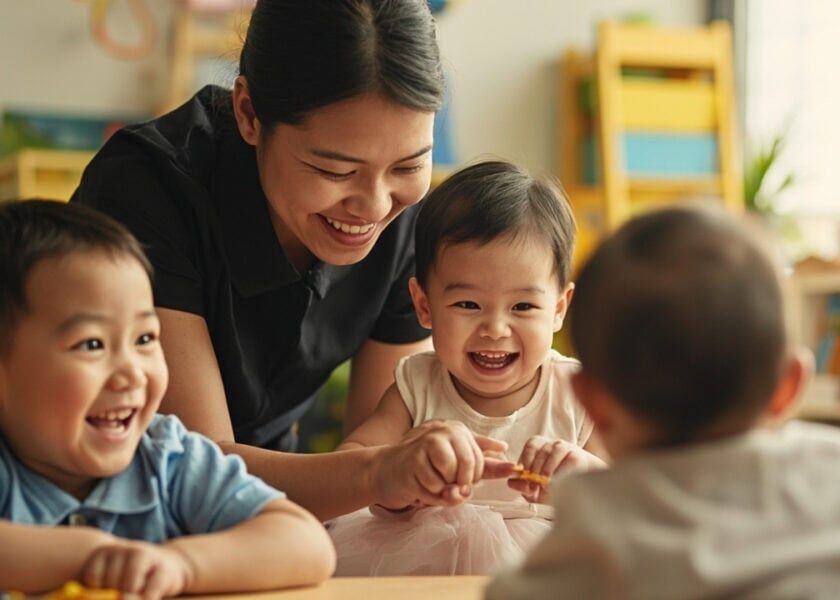
The caregiver sits with the children. This is not just supervision. This is modeling. The caregiver eats with them, and in doing so, shows them that eating is a pleasure, that food is to be enjoyed, that meals are a social act.
They name the foods. They describe their colors and textures:
- “This banana is cold today. We put it in the fridge.”
- “The rice is fluffy.”
These are not just words. They are vocabulary building. They are the sensory education that happens best in context.
When a child resists a new food—and they will, because this is developmentally normal—the caregiver does not force. They do not bribe. They do not make a game of it in a way that turns food into a performance. They simply offer. They may try again another day, with the same calm expectation. They may offer the new food alongside a familiar one, so the child has agency. They may simply eat it themselves with obvious enjoyment and let curiosity do its work.
There is a moment at every mealtime when something shifts—a child laughs at a mess they have made, or reaches across the table to touch a peer’s cheek, or says a word they have never said before over a bowl of porridge. These moments are not interruptions to the schedule. They are the schedule. They are what care is for.
Rest Time: The Architecture of Security
By noon, the day softens. Sleep is not, for young children, simply a biological necessity. It is an act of trust. To fall asleep is to surrender alertness, to become vulnerable, to believe that the world will remain safe and known in your absence. For a child in a childcare setting, this is an enormous thing. They are falling asleep in a place that is not their own bed, surrounded by sounds and smells that are not the ones they have known since birth.
The caregiver knows this. And so the preparation for rest is deliberate.
There is a transition—perhaps a story, perhaps a song, perhaps a walk to the sleep room—that tells the child’s body and brain that the pace is changing, that the noise will quiet, that the light will dim. This is not entertainment. It is signal. It is the caregiver saying, through routine and rhythm, that the world is predictable, that the next thing has been thought of, that there is nothing to fear.
In the sleep room, there is often a caregiver sitting nearby. Not hovering. Not staring. Simply present. When a child stirs and reaches out for comfort, there is a hand to hold. When a child cries out from a dream, there is a voice that is familiar and calm. When a child cannot settle, there is patience—not the impatience of a schedule, but the genuine patience of someone who understands that this child’s sleep will not be rushed.
And when your child wakes, they are not greeted with a list of what they missed or a rush to the next activity. They are greeted with a caregiver who is already there, whose face shows recognition and welcome, whose first words are not “time to go” but “Good afternoon, [child’s name]. You slept well.”
This is one of the clearest signals you will ever receive about the quality of care your child has received. When a child wakes from sleep and is immediately comforted, immediately seen, immediately welcomed back into the rhythm of the day, you are seeing evidence that your child was thought about even when they were not conscious.
The Afternoon: Engagement, Transition, and Coming Home
The afternoon has its own character. By one o’clock, the children are awake, fed, and beginning again.
There is outdoor time, weather permitting—the courtyard or balcony that gives children a chance to feel sun and wind, to run and climb and fall and get up, to understand their bodies in space.
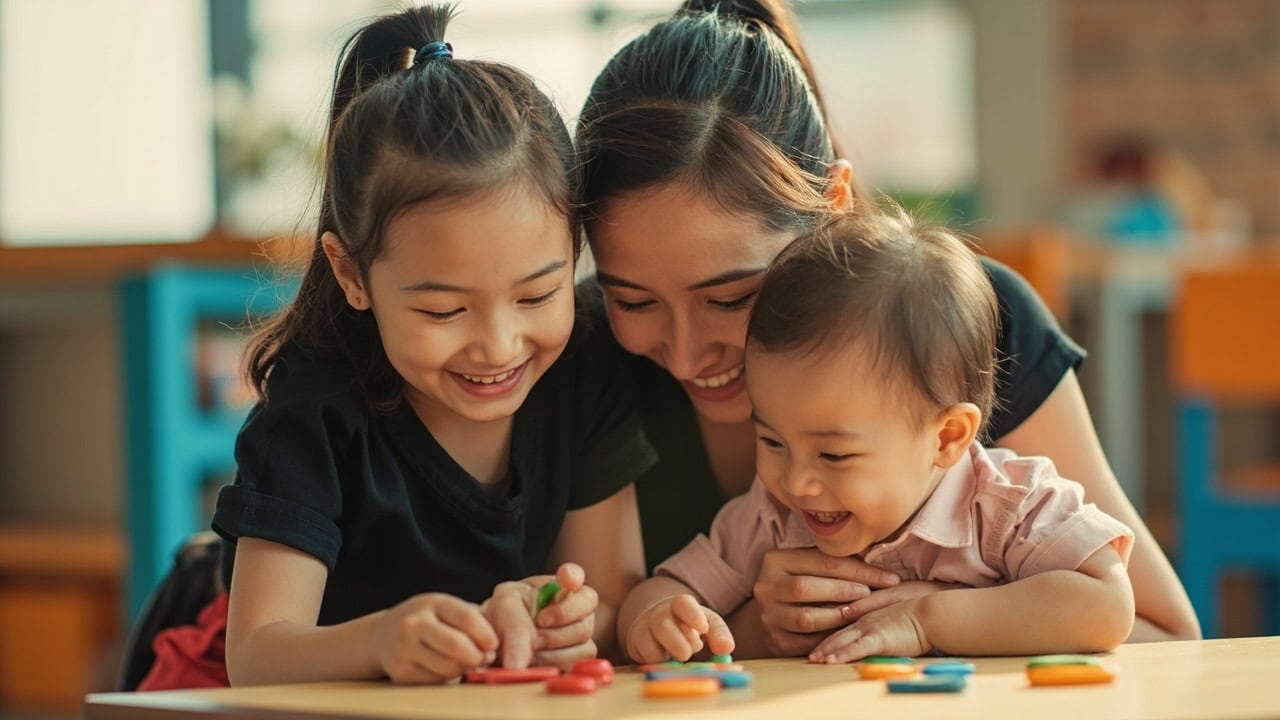
There is art—not crafts, not gluing sequins to a pre-cut shape, but genuine art. Paint on paper. Clay on a table. Crayons that make marks that surprise the child who made them. This is not about the product. It is about the process: the sensory exploration, the cause and effect, the way a child’s face lights up when they discover they can make something happen.
There is music. Not a scheduled lesson, but a natural part of the day. A song that accompanies hand-washing. A rhyme that signals that it is time to tidy up. The sound of a caregiver humming while they change a diaper, making the most intimate moments of care into moments of connection.
There is language, constantly. A caregiver narrating what is happening. “You are putting the blue car in the box. The blue car is going night-night in the box.” This is not baby talk. It is cognition wrapped together. The caregiver is giving the child words for their experience, and in doing so, building the architecture of thought itself.
The Closing Circle
By four o’clock, there is a closing circle. This is the transition that many parents do not know happens, but it is one of the most important moments of the day.
The children gather. Perhaps they sit on a small rug. Perhaps they hold an object—a stone, a shell, a piece of cloth—that signals it is time to be still together. The caregiver speaks. Sometimes they sing. They talk about what happened today. They remind the children that their families are coming. They prepare them for the transition that is about to happen.
This is teaching. The caregiver is teaching children how to end things—how to close one chapter and prepare for another, how to say goodbye to a place that has been good to them, how to carry the day with them rather than simply dropping it.
These are skills that will serve your child for their entire life. The ability to transition well, to let go of one thing and enter another, is not trivial. It is the skill that will help your child enter school, navigate friendships, manage change.
The Evening Homecoming
When you arrive, you will see this. You will see your child transition from the group to you—not abruptly, not with confusion, but with recognition.
“Mama is here. Papa is here. Time to go home.”
And then the handoff, which is the mirror image of the morning. The caregiver tells you something:
- Perhaps it is simple: “She had a good nap. She ate well.”
- Perhaps it is more specific: “She was very interested in the water play today. She used the word ‘splash’ for the first time.”
- Perhaps it is something you need to know: “She seemed tired this afternoon. She might need an early night tonight.”
This is the visible thread that connects your day to your child’s day. This is how you know that the hours were not a blank. This is how you know that your child was not simply minded but was thought about, attended to, known.
The Evidence That Appears at Home
And then you take your child home. And this is where the architecture of quality becomes visible to you.
You will see it in the way your child talks about their day. Not in vague generalities—”I played”—but in specific moments they can recall. “The lady read us a book about a bear.” “I held the cat.” “We went outside and the sand was hot.”
You will see it in the way your child relates to the caregiver. There will be a warmth that is not forced. There will be a familiarity that is not mere habit. There will be a child who talks about “my teacher” or “my nanny” with the same ease they talk about a family member, because to them, this person is a significant figure in their life. They have been shaped by this person’s attention.
You will see it in your child’s development. Not dramatic leaps, not miracles, but steady, sure growth. New words. New skills. A new confidence with food, with peers, with the world. Your child is not simply being cared for. They are being nurtured in a way that is moving them forward.
And you will see it, most importantly, in yourself. Because trust is not only what your child feels. It is what you feel. And when you drive away from EduNanny each morning with a quiet confidence that your child is in the right place, when you stop checking your phone compulsively for messages, when you can actually focus on your work or your life knowing that something good is happening on the other side of that distance—something changes. Something releases. The invisible anxiety that lived in your chest begins to quiet.
Finding Quality Infant Care in Singapore
If you are currently visiting childcare options and feeling overwhelmed, here is what to look for and what questions to ask.
Questions to Ask During a Visit
- What does a typical morning arrival look like? Listen for specifics about how children are received, whether there is time for exchange between caregiver and parent, and whether the answer suggests flexibility or rigidity.
- How do caregivers handle a child who is struggling to separate? Look for answers that acknowledge emotions and offer choices, not answers that dismiss or rush the child.
- What do the learning materials teach? If the answer is “we have toys for all ages,” that is a general answer. A quality environment can explain why specific materials are available at specific developmental stages.
- What does mealtime look like? Caregivers eating with children, not just supervising, is a significant indicator of relational care.
- How do you prepare children for rest? Look for mention of routine, transition, and presence—not just “they sleep according to their schedule.”
- What information will I receive at pickup? Specific observations about the child’s day—not just “she had a good day”—indicates that attention was paid.
Red Flags to Watch For
- Rushed arrivals and departures with no time for exchange
- General answers that do not reflect knowledge of your specific child
- A learning environment that appears random rather than intentional
- Mealtimes that feel supervisory rather than relational
- No visible transition or closing routine before pickup
- Vague pickup reports: “She was fine” is not the same as “She used the word ‘splash’ for the first time today”
What the ECDA Childminding Pilot Means for Singapore Families
The ECDA Childminding Pilot represents Singapore’s recognition that families need different pathways to quality care. Home-based and community-based settings can offer smaller ratios, closer relationships, and more individualised attention than large centre-based environments.
When evaluating any childcare option, ask about:
- The ratio of caregivers to children
- The training and qualifications of caregivers
- Whether the setting participates in any government quality frameworks or pilots
- What payment schemes are accepted (CDA, Baby Bonus, subsidies)
What EduNanny Singapore Offers
EduNanny by BUTLER is built on the understanding that every parent deserves to know what happens in the hours apart—and that trust is built through transparency, not promises.
We are part of the ECDA Childminding Pilot, which means we are part of Singapore’s commitment to finding thoughtful ways to support families in the earliest years of their children’s lives. Our approach is built on several foundations:
- Smaller ratios that allow caregivers to know each child as an individual
- Intentional care informed by child development knowledge, not just task completion
- Transparent communication through photos, notes, and specific handover conversations throughout the day
- Accessible fees through CDA acceptance and Baby Bonus compatibility
- Parental support through our Thomas AI Chatbot, available whenever questions arise between pickup and drop-off
Our Monday to Friday blocks are designed to support the realities of working parents in Singapore—not as a limitation but as a framework that allows families to plan and breathe. And our approach extends across Singapore, because every child deserves this kind of attention.
There is a moment, late in the evening, when a parent and child are together again after a day apart. The house is quiet. The child is tired in the good way, the way that comes from a day of fullness. And the parent is holding them, or sitting near them, and there is nothing to do but be together.
In that moment, something passes between parent and child that has no name. It is not just the relief of reunion. It is the quiet knowledge that the hours apart were not wasted, not lost, not a gap in love. They were hours in which the child was building something. Growing. Learning the world.
And the parent, in that moment, feels something that is hard to describe but unmistakable. They feel that the decision they made—the decision to trust, the decision to let go of some of the hours so that their child could have them in a different way—was the right decision.
A Warm Welcome
So when you stand in that morning silence again—when you kiss your child’s forehead and hand them over and close the car door and drive away—there will still be a question in your mind. But now you know the answer. You know what happens in the hours. You have seen the architecture of a quality day.
And the answer is: everything good. Everything intentional. Everything that a child needs and a parent hopes for, built hour by hour, decision by decision, by people who care enough to get it right.
That is what EduNanny offers. That is what we invite you to experience.
If you are ready to learn more about how we support Singapore families through quality infant care and childminding, we welcome you to reach out. We are glad to answer your questions, share our approach, and help you determine whether EduNanny is the right fit for your family.
Welcome. We look forward to meeting you.
Learn more about EduNanny Singapore, our approach through the ECDA Childminding Pilot, or get in touch to discuss your family’s needs.