Fraud Blocker edunanny.com

Category: Childminding

edunanny-062051780d6ff6b765357948ca65915c
April 4, 2026

How Quality Childcare Builds Your Baby’s Brain in Singapore

The Silence After You Leave: What Neuroscience Tells Us About Infant Brain Development in Quality Childcare

There is a particular silence that fills a room after a parent leaves their infant for the first time. Not a peaceful silence — the kind that hums with a hundred unspoken questions.

Is my baby crying right now? Is she reaching for someone who isn’t me? Is something being lost in these hours that I will never get back?

If you have ever stood at the threshold of a childcare centre, or handed your infant to a caregiver you have known for only a few days, or driven away from home knowing that somewhere across the city, your baby is learning to trust someone else — what you feel is not weakness. It is love in its most honest form.

And here is what the science of early childhood development has made beautifully, unmistakably clear: what you are feeling is also, in a profound way, unnecessary to fear.

What Science Tells Us

  • In the first twelve months, your baby’s brain builds more than one million new neural connections every second
  • Secure attachment can develop with multiple responsive caregivers — not just one parent at home
  • Quality infant care creates a “secure base” from which your child learns to explore confidently
  • Trained caregivers actively facilitate neurological development, not just supervise
  • Observable signs of healthy development can be seen at pickup and in evening behaviour
  • Choosing quality infant care is an active investment in your child’s brain architecture — not a compromise

The Architecture of a Mind: What Is Actually Happening in Your Infant’s Brain

The hours your infant spends in quality care are not hours of passive watching. They are hours of extraordinary, invisible construction. What is being built in your child’s brain during those hours — in the first year of life, in the earliest months — is nothing less than the architecture that will shape how she thinks, how she learns, how she relates to others, and how she meets the world for the rest of her days.

One Million Connections Per Second

In the first twelve months of life, your baby’s brain is building itself at a speed it will never again achieve. At no other point in human development does neural connection happen this rapidly, this densely, this irreversibly.

The brain is not merely growing during this time — it is being fundamentally constructed. Room by room. Connection by connection. In ways that will determine the layout of every room that comes after.

In the earliest months, an infant’s brain produces approximately one million new neural connections every second. Each of those moments — seemingly simple, seemingly ordinary — is a tiny electrical storm in the prefrontal cortex, the hippocampus, the temporal regions. Building pathways that will one day become her capacity for reasoning, memory, language, and emotional regulation.

Overbuilding, Then Refining

By the end of the first year, your child will have formed more neural connections than she will ever need. The brain, in its extraordinary efficiency, has overbuilt on purpose.

Because the next phase — the phase that happens largely between ages one and three — is the phase of pruning. The connections that have been used, reinforced, repeated in meaningful, responsive environments will be strengthened and preserved. The connections that have lain dormant, unused, unstimulated will be eliminated.

The brain is not keeping everything. It is keeping what has been mattered.

This is why the first year is not just important. It is foundational in a way that no other year can be — not because later years don’t matter (they do, profoundly), but because the first year sets the parameters. The brain is establishing its defaults. It is learning, on a cellular level, whether the world is a responsive place, whether exploration is rewarded or frightening, whether its cries bring comfort or silence.

The Active Ingredient in Neurological Construction

The quality of care. The responsiveness of the environment. The consistency and warmth of the adult presence. These are not amenities. They are not luxuries. They are the active ingredients in your child’s neurological construction.

Consider what is required. In the first year, an infant’s brain is exquisitely sensitive to the emotional tenor of her environment. Elevated stress hormones — specifically cortisol — in the early months can affect the development of the hippocampus, the brain region central to memory and learning.

But here is the nuance that matters enormously: not all stress is the same.

  • The stress of being left alone to cry for long periods is physiologically different from the stress of a minor frustration, a brief separation, a moment of uncertainty followed by comfort.
  • The first is toxic to development.
  • The second is manageable, even growth-producing.

The caregiver’s role is to ensure that the stress your infant experiences in care is the manageable kind — the kind that builds resilience rather than eroding it. This requires training. It requires the ability to read an infant’s cues with precision — to recognize the early signs of distress before they escalate, to respond with warmth before the cortisol system has fully activated.


Secure Attachment and the Myth of the Single Caregiver

There is a concept from developmental psychology called the secure base — a term coined by the British psychiatrist John Bowlby, whose work on attachment transformed our understanding of early childhood.

The secure base is the psychological foundation from which a child feels safe enough to explore the world. It is what allows an infant to look away from her caregiver’s face, to reach for a toy, to crawl across a room, to take a small, trembling step toward independence — because she trusts, on a deep and pre-verbal level, that the base is still there, that she can return, that she is held.

For decades, there was a lingering fear — and I understand the fear — that placing an infant in professional care might disrupt this foundation. That the secure base could only be located in one place, with one person, in the home. That hours spent apart might erode the very attachment that makes exploration possible.

What Research Actually Shows

The research does not support this fear. What the research shows, consistently and clearly, is that secure attachment is not about the number of attachment figures in a child’s life. It is about the quality of responsiveness, the consistency of care, the attunement between caregiver and child.

A child can develop a secure base with more than one adult. In fact, children who have multiple responsive, warm, consistent caregivers often demonstrate what researchers call a “secure base script” — a learned expectation that the world is reliable, that adults can be trusted, that exploration leads to reward rather than abandonment.

What this means for parents in Singapore — navigating the very real pressures of dual-income households, demanding careers, and the extraordinary complexity of raising a child in one of the world’s most competitive environments — is significant.

It means that choosing quality infant care is not a compromise. It is not a necessary concession to reality. It is, when done well, an active investment in your child’s secure base. It is saying to your infant: the world has more than one trustworthy person in it, and that is a good thing.


What Quality Infant Care Actually Looks Like

This is where the role of the caregiver becomes not just important but extraordinary.

When we talk about what a trained infant caregiver does, we are not talking about supervision. We are not talking about feeding schedules and diaper changes — though these matter, and they matter with a precision that surprises many parents.

We are talking about something closer to architecture. The caregiver in a quality infant care setting is, in a very real and documented sense, an architect of neural development.

What Caregivers Actually Observe

Consider what a trained caregiver understands when she sees a four-month-old babbling. She sees not just a pleasant sound, but the early firing of language circuits in the temporal cortex — a connection being reinforced by her responsive imitation.

When she watches a nine-month-old pull herself to stand, she sees not just a motor milestone, but the linking of motor planning regions with the reward circuits of the limbic system — the infant learning through her own body that effort produces success.

Your child receives sustained, individualized attention from an adult who knows her rhythms, her preferences, her particular style of seeking comfort. The caregiver learns your infant’s face, your infant’s cry, your infant’s particular way of turning away when she has had enough stimulation. This is not incidental to care. This is care.

Signs You Can Look For

The invisible architecture your child’s brain is building is, by definition, invisible. You cannot see the neural connections forming. But what you can see — and what you deserve to know how to read — are the outward expressions of this internal development.

At pickup, you may notice that your infant is not distressed the moment you arrive. A child who is securely attached in her care environment — who has experienced consistent, responsive care — does not spend the hours of your absence in quiet desperation. She explores. She plays. She engages. And when you arrive, she greets you with the calm confidence of someone who has been well, who trusts that you always return.

In the evening, you may notice your child is tired in a particular way — the deep, satisfied tiredness of a brain that has been productively engaged. Not the irritable, overstimulated exhaustion of a day spent without meaningful interaction. The tiredness of a mind that has been building.

You may notice language emerging earlier than you expected — words and sounds that you did not teach, because your child learned them from a caregiver who spoke to her, who narrated the world, who treated every interaction as an opportunity for language development.


Questions That Actually Matter When Choosing Infant Care

Use this knowledge as a lens — not to second-guess your choices, not to fuel anxiety, but to evaluate. To ask the questions that matter.

When you are considering an infant care arrangement, look past the checklist of logistics. Yes, safety matters. Yes, cleanliness matters. Yes, proximity and cost and schedule matter. But these are the foundation, not the building.

The question that should sit at the top of your evaluation is this: what is happening in my child’s brain during the hours I am not there, and is this environment building it well?

Questions to Ask Any Infant Care Provider

  • Caregiver training: What specific training do your caregivers have in infant development, not just childcare? Can they explain what they observe in a four-month-old’s babbling or a nine-month-old’s motor milestones?
  • Ratios: How many infants per trained caregiver? Smaller ratios mean more individualized attunement.
  • Typical day quality: What does a typical day actually look like for an infant? Not just the schedule of feeding and sleeping, but the quality of interaction. Is your child being spoken to throughout the day?
  • Responsiveness: Is your child held when distressed, or left to cry? How are cues being read and responded to?
  • Environment design: Is the space designed for developmental stage — mats and mirrors and objects of varying textures that invite the exploration your infant’s brain is hungry for?

This is how you evaluate infant care: not as a logistical problem to be solved, but as a developmental environment to be assessed.

The best infant care programmes know this. They can tell you, with specificity, what your child is working on developmentally, what skills are emerging, what the caregiver is facilitating.


EduNanny Singapore: Built on This Understanding

EduNanny Singapore was built on the understanding that infant care is not supervision — it is architecture. We are part of the ECDA Childminding Pilot, and we carry that designation not as a credential alone but as a commitment to a standard of care that takes seriously the science of what infants need in their first year.

We offer both home-based and centre-based pathways, because Singapore families are not a monolith.

  • Home-based care offers intimacy — small ratios and individualized attention that home-based care makes possible.
  • Centre-based care offers community and structure.

Both can be excellent. Both can be developmental. What matters is not the setting but the quality of what happens inside it.

What Parents in Singapore Can Expect

Our pilot fee structures have been designed with accessibility in mind, because the neuroscience of infant development should not be the exclusive domain of families who can afford premium private arrangements. CDA and Baby Bonus funds can be used, where applicable, to support these arrangements.

Monday to Friday care blocks provide the consistency that infant brains require — the reliable rhythm that allows a child to build expectations of safety, to learn that morning always comes, that the caregiver always arrives, that the day has a shape.

We communicate with parents because we believe transparency is not just a service feature but a developmental principle. When parents are informed, they are calmer. When parents are calmer, the home environment is calmer. When the home environment is calmer, the infant’s stress regulation is more stable. Communication is not a supplement to quality care. In the first year, when infants are exquisitely attuned to the emotional states of the adults around them, communication is part of the care itself.

Supporting You Alongside the Way

We know that navigating infant care — and all the questions it raises about development, attachment, and whether you are making the right choice — can feel bewildering at times. That is why we developed Thomas AI Chatbot: a tool designed to answer questions about your child’s development, to help you understand what you are observing, to walk alongside you in the work of raising a human being.

Where deployed, our CCTV measures reflect not a lack of trust but a recognition of the reality that parents face. We believe in making the invisible slightly less invisible. Not because we assume something will go wrong, but because we know that what parents need is not reassurance — it is evidence.


A Final Word for Parents in Singapore

Even with all of this — the training, the ratios, the communication, the science — infant care is not perfect. Children will sometimes cry at drop-off. Infants will occasionally have difficult days. The developmental trajectory of every child is not a smooth upward line; it has interruptions, regressions, variations that are entirely normal.

We do not promise miracles. What we promise is something more grounded: that your child will be in an environment designed, by knowledge and by intention, to support the architecture her brain is building in this irreplaceable year.

We live in a city that asks enormous things of parents. Singapore has one of the highest rates of female workforce participation in the world. We have high costs of living, competitive academic cultures, family structures that are evolving rapidly from what they were a generation ago.

The pressure on parents — on mothers especially, though not exclusively — to be present, to be perfect, to somehow reconcile the demands of career with the demands of early childhood is immense.

And into this pressure comes a question that carries enormous weight: should I leave my infant? Is it okay? Am I failing somehow by choosing to return to work, by entrusting my child to someone else’s care?

The neuroscience I have shared with you today answers this question with clarity and with compassion. Your infant’s brain is not being diminished by quality care. It is being constructed. The architecture that will carry your child through primary school and secondary school and into the relationships and careers and challenges of her adult life is being built right now — in your presence and in your absence, in the interactions you have with her at home and in the interactions she has with a trained, warm, responsive caregiver in the hours you are apart.

The return on that investment is not measured in standardised test scores or in the metrics that Singapore society is so skilled at tracking. The return is measured in something harder to quantify but infinitely more important:

  • A child who trusts the world.
  • Who explores it with confidence.
  • Who has learned at the deepest cellular level that she is held, that she is capable, that the adults in her life will respond when she calls.

The Image That Matters

I want to end with a different image from the one I began with.

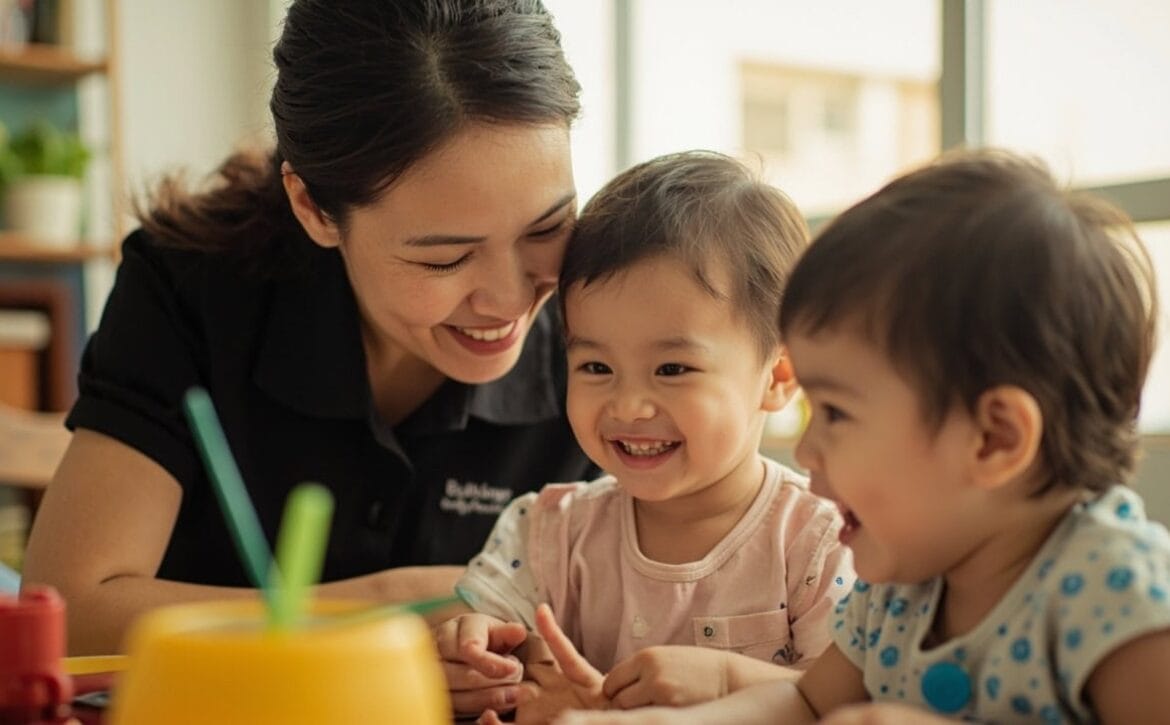
I want to end with the image of a caregiver, trained and present, sitting on the floor of a room where your infant lies. The caregiver is not just watching. She is speaking — quietly, warmly, narrating the world in language that your infant’s temporal cortex is drinking in like water.

She is responding to a cry not with frustration but with attunement — moving toward your child, lifting her, holding her against her chest where your infant can hear the steady rhythm of another human heart.

She is creating what developmental scientists call a “serve and return” interaction — the fundamental back-and-forth that builds neural pathways more effectively than any screen, any toy, any curriculum.

And in this room, invisible to the parent who cannot be there, your child’s brain is building. One million new connections per second. The architecture of a person.

That is what is happening in the hours you are not there.

And it is, when the care is right, nothing short of extraordinary.


If you are exploring quality infant care for your family in Singapore, we invite you to learn more about how EduNanny Singapore supports infant brain development through our ECDA Childminding Pilot programme, available in both home-based and centre-based pathways.

Have questions? We are always happy to hear from you at EduNanny Singapore.

edunanny-06204e0ea000e9563861b0d00e84ce3f
April 4, 2026

The Parent You Become When Childcare Gives You Back

“`html

The Structural Reality of Singapore Parenting

Singapore has built a society around the assumption that parents will work, contribute, and sustain careers while simultaneously raising the next generation. Singaporean parents have answered that call with extraordinary commitment.

Dual-income households are not the exception here. They are the norm. Expatriate families navigate the absence of grandparents and extended family networks that would otherwise form the invisible scaffolding of early parenting. Young parents, often far from the villages that other cultures take for granted, find themselves managing childcare, careers, household responsibilities, and the constant pressure to be present, attentive, and emotionally available to small children who deserve far more than fragments of a tired parent’s attention.

The data tells us this. The emotional experience confirms it. Singapore parents are exhausted in a way that is structurally invisible. There are no medals for this exhaustion. There is rarely even language for it.

What there is, is guilt. A persistent, low-grade guilt that whispers questions like: Am I present enough? Am I missing too much? Am I failing at the very thing I am working so hard to provide for?

And here is where we need to pause and name something that our culture rarely says aloud: that guilt is not evidence of bad parenting. That guilt is evidence that you care deeply, that you are paying attention, and that you are carrying a weight that no one person should be expected to bear in isolation.


The Belief That Makes Parents Wait Too Long

There is a belief that many parents hold, one so deeply embedded that it rarely gets examined. It goes like this: choosing professional childcare means choosing distance from your child. That the hours spent in someone else’s care are hours you will never recover, moments you will never witness, bonds that will form without you.

This belief carries enormous weight. It is the reason parents often wait too long to seek help, and it is the reason many parents feel they are betraying their children even as they make the practical choices that sustain their families.

But this belief, though understandable, is incomplete.

Here is what it misses: the parent in the room matters more than the number of hours in the room. A caregiver’s warmth, a centre’s curriculum, a nanny’s qualifications—these things matter enormously for your child’s development. But none of them can replace what a restored, emotionally available, mentally clear parent brings to the relationship.

Research consistently shows that children whose parents are emotionally present, who can respond with patience rather than irritation, who can listen attentively rather than distractedly, develop stronger attachment security, greater emotional regulation, and more resilience than children whose parents are physically present but emotionally depleted.

This is the insight that changes everything.


What Quality Childcare Gives Back to You

When we talk about quality childcare, we typically focus on what the child receives. The ratios. The curriculum. The safety measures. The warmth of the caregiver. These are essential considerations, and they deserve serious attention.

But there is another dimension to quality that our conversations rarely centre, and that is this: what does quality childcare give back to the parent?

This is not a soft question. This is an infrastructure question. It is the question of whether the care arrangement you choose is adding to your depletion or subtracting from it. Whether it leaves you more capable of presence or less. Whether, at the end of the day, you feel restored and ready to engage with your child, or whether you feel like you have merely transferred your child to another person and now need to collapse.

Quality childcare, when it is truly quality, functions as restoration infrastructure. It does not simply supervise your child. It gives you back something that is uniquely yours to give: your emotional capacity, your mental clarity, your energy for play, your patience for bedtime, your attention at dinner. It gives you back the person you were before you became so tired.

This is not a luxury. For many parents in Singapore, this is the difference between parenting from abundance and parenting from scarcity. Between showing up as the parent who delights in their child and the parent who is merely surviving until the next sleep regression, the next work deadline, the next milestone they feel they are failing to witness.

When a parent is restored, the parent-child relationship changes. When a parent has room to breathe, they listen differently. They respond differently. They are more curious and less reactive, more playful and less hurried, more capable of seeing the child in front of them rather than projecting their own exhaustion onto that child’s normal developmental behaviour.


Four Signs That Childcare Is Genuinely Restorative

So how do you know whether your childcare is genuinely restoring your capacity for presence? There are practical signs, and they are worth knowing because not all childcare arrangements serve parents well, even when they serve children adequately.

1. Resonance

After a period of time in a new care arrangement, do you notice something loosening in your chest? Do you find yourself more willing, not less, to engage with your child at the end of the day?

Or do you notice that your resentment is growing, that you resent the time you spend working so you can afford the childcare, that you resent the time you spend with your child because you are too depleted to enjoy it?

The former is restoration. The latter is depletion wearing the mask of family life.

2. Transparency

When you drop your child off, do you feel respected and informed? When you pick your child up, do you receive genuine, specific, useful communication about their day, their mood, their discoveries, their struggles?

Quality childcare should make you feel like a partner, not a customer. You should feel that you are being welcomed into a relationship, not processed through a transaction.

3. Trust

Not the abstract, feel-good kind, but the operational kind. Can you see what is happening in the care environment? Are there communication channels that keep you informed throughout the day? Are there transparency measures that let you know your child is safe and well without needing to second-guess?

Trust is built through consistent, reliable information, and it is essential for the kind of peace of mind that allows you to actually focus at work—which means you come home less stressed, which means you are more present.

Trust is not a soft benefit. It is a parental restoration tool.

4. Systemic Fit

Your family is a system. The care arrangement that works is one that accounts for that system. It is not simply about the child’s experience in isolation.

It is about whether the whole family functions better with this arrangement than without it. Whether your marriage or partnership is less strained. Whether your relationship with your child is deepening. Whether you feel like yourself again in the spaces between obligations.

If the childcare arrangement is adding friction to your family life rather than reducing it—no matter how praised its curriculum or how warm its caregivers—it is not the right arrangement for you.


The EduNanny Approach: Designed for the Whole Family

EduNanny by BUTLER was designed with this systemic understanding at its centre. We did not start from the question of how to care for children better. We started from the question of how to care for families better—which means caring for parents as whole people whose capacity for presence is the most important developmental variable in their child’s life.

Our approach is built on a recognition that is still, unfortunately, uncommon in the childcare landscape: that the parent’s wellbeing is not separate from the child’s wellbeing. It is foundational to it.

Professional Recognition and Structured Care

EduNanny participates in the ECDA Childminding Pilot, which reflects our belief that professional childminding deserves recognition as a legitimate, dignified, and essential form of early childhood support. This is not babysitting. This is skilled, responsive care that operates within a structured framework designed to protect children and support families.

The pilot makes this care accessible within a fee structure that recognizes Singapore families face real cost pressures, and it offers pathways that include both home-based and centre-based options so families can choose the arrangement that fits their circumstances and values.

Intentional Ratios for Better Care

Our ratios, where applicable up to one to three infants, are not industry minimums. They are statements of intent. Fewer children per caregiver means more attention, more responsiveness, more of the attuned interaction that drives healthy development.

But it also means lower stress for caregivers, which means better care, which means more trust, which means more peace of mind for parents, which means parents are restored more fully and return to their children more wholly.

Transparency Built Into Every Layer

We have designed communication and transparency into every layer of our service. When parents can see what is happening, when they receive regular, specific, meaningful updates about their child’s day, when they trust the environment their child is in, they can let go of the background anxiety that drains their emotional reserves.

They can be at work fully. They can be present when they are with their child. Where deployed, our transparency measures—including CCTV in select environments—are not surveillance tools. They are trust infrastructure. They are the operational expression of our commitment to the proposition that parents deserve to know what is happening with their children, and that this knowledge is not optional but essential for the kind of peace of mind that allows them to be the parents they want to be.


Choosing Care That Gives You Back to Yourself

There is a question we are often asked, and it comes from a place of genuine vulnerability. Parents want to know: Is it okay that I need help? Is it okay that I cannot do this alone? Is it a sign of something wrong with me that I feel relief when someone else holds my child, that I am grateful for the hours of care that let me work, that I am a better parent because of the village I have built rather than despite it?

The answer, from every angle we know, is yes. It is not only okay. It is wise.

The loneliness of modern parenting, especially in Singapore, where extended family networks are stretched thin and where the pace of professional life leaves little room for the kind of village-based childcare that humans have relied on for millennia, is not a personal failing. It is a structural condition. And structural conditions require structural solutions.

They require professional care arrangements that are designed to carry part of the weight. They require partners in childcare who understand that they are not merely caring for your child. They are caring for your family. They are caring for you.

There is a way of thinking about childcare that positions it as a service you purchase for your child, a box to check, a logistical arrangement that exists separate from your family’s emotional life. In this framing, childcare is a cost and a compromise.

We invite you to a different frame. What if childcare, when it is done well, is not a compromise with parenting? What if it is an act of parenting itself?

The act of choosing care that restores you so you can be present. The act of building a village that your child will grow up knowing as part of their world. The act of believing that your wellbeing matters, that your capacity for joy matters, that the person you are behind the parent matters.

This is not a soft or sentimental claim. This is a developmental one. Your child does not need a martyr. Your child needs you, whole and present, for the years that matter most.

The parent who is restored is the parent who can be fully there. Not partly there, not guiltily there, not resentfully there. Fully there.

The question to ask is not whether seeking help means you are less of a parent. The question is whether the parent you are becoming with support is the parent you want to be, and whether the parent you would be without it is the parent your child deserves.


You Are Not Failing. You Are Building.

The decision you are making, the search you are conducting, the questions you are asking—these are not signs of uncertainty or inadequacy. They are signs of a parent who cares deeply, who is paying attention, and who is doing the work of building something sustainable rather than collapsing under something that is not.

EduNanny by BUTLER was built for this moment, and for this purpose. We are here for the parent who is carrying more than they should be carrying alone. We are here for the family that has left the village behind and needs to build a new one. We are here for the expatriate navigating unfamiliar systems and the Singaporean parent balancing the demands of a culture that expects everything.

We are here not to replace you. We are here to give you back to yourself and to your child.

We would be honoured to be part of what you are building. And we would be honoured to give you back the room to be the parent you have always had the capacity to be.


EduNanny by BUTLER participates in the ECDA Childminding Pilot and offers both home-based and centre-based care options designed to support the whole family. If you are ready to explore care that gives you back the presence you want to bring to your child, we welcome you to reach out and begin a conversation.

Learn more about who we are or return to EduNanny.

“`

edunanny-06204a69da287b47318d8ff5b288cc29
April 4, 2026

Carrying Love and Ambition in the Same Set of Hands

Understanding the Emotional Weight of This Transition

We talk about childcare in Singapore as though the decision is purely logistical—as though it begins and ends with schedules, subsidies, and proximity to the MRT. And certainly, those things matter. But beneath the spreadsheets and the school tours and the comparisons between centres, there is a human moment that almost no one addresses directly.

The moment a parent realizes they are about to leave their child with someone else, and that realization carries a weight that is not easily set down.

The Unnamed Grief

Somewhere in Singapore tonight, a mother is lying beside her four-month-old, running through the daycare bag for the third time. The extra onesie. The labelled bottles. The small stuffed rabbit that smells like home. She is doing this not because she doubts the care her child will receive, but because doing something is the only way she knows to hold the feeling that she is not doing enough.

She is not failing. She is grieving.

And that grief deserves to be named, because unnamed grief becomes guilt, and unchecked guilt becomes the lens through which a parent sees every future decision—every pickup that feels rushed, every bedtime that gets shortened by tiredness, every moment that reminds her she is not present in the way she once was.

Guilt is a demanding tenant. It takes up all the rooms in the house.

Guilt Is Information, Not Evidence

But here is what we have learned in our years of walking alongside Singapore families through this transition: the guilt is not evidence that you are making the wrong choice. It is evidence that the choice is hard. Those are not the same thing.

There is a difference between a decision made from guilt and a decision made from intention:

  • Guilt asks: What am I giving up?
  • Intention asks: What am I building?

When you choose quality childcare, you are not subtracting from your child’s life. You are investing in the infrastructure that allows your family to function—not just financially, though that matters, but emotionally, relationally, and in terms of who you are becoming as a person outside the role of parent.

Guilt tells you that you care, that the stakes are real, that your child matters more than your comfort or your convenience. But guilt becomes destructive when it is the only voice in the room—when it tells you that any choice which causes you pain must be the wrong choice.

The truth is more complicated. The truth is that some of the most important decisions you will make as a parent will hurt. Not because you are failing, but because you are human, and humans are built to feel the weight of what they love.

Choosing to return to work is not evidence that you do not love your child. It is evidence that you love your child and yourself, and that both of those loves are real and valid and worth attending to.


Who You Are Becoming

Here is what most return-to-work guides do not tell you: the person who walks back into her office is not the person who left it.

She left carrying the weight of pregnancy and delivery and the raw, demanding first months of a child’s life. She returns carrying all of that, plus a new capacity for endurance, for presence, for recognizing what actually matters. She returns with a sharpened sense of efficiency, because she has learned to do everything one-handed and on little sleep. She returns with a deeper understanding of time, because she now knows exactly how precious it is.

Singapore parents, especially mothers, have been told for so long that the best thing they can do is be present that presence has become conflated with sacrifice. As though staying home is noble and returning to work is a compromise. But that framing erases something essential: the parent who returns to work is not the same person who left.

She is changed. She has spent months in an intimate, consuming relationship with her child that has rewired her nervous system and reorganized her priorities. And now she is going back into a world that may not immediately recognize or accommodate that change.

Let us be precise about what is happening: you are not abandoning your child. You are not choosing your career over your family. You are not failing at motherhood or fatherhood or any of the identities that mattered before this moment.

What you are doing is making a choice—one that comes with real costs and real trade-offs, but also with something that is rarely named in the conversation: intention.


What Your Child Is Learning

When your child watches you leave in the morning, they are learning something.

They are learning that the people they love can go into the world and come back. They are learning that absence is not permanent, that distance can be bridged, that the people who love them have lives and purposes that extend beyond the walls of home. They are learning that a parent can be both tender and capable, both present and away, both needed and whole.

This is not a small thing. It is, in fact, one of the most important things your child will learn in their first years of life.

The child who grows up watching a parent navigate professional life, who witnesses the complexity of balancing ambition and love, who sees that their parent can miss them and still show up fully in the world—that child is building something in themselves:

  • They are building resilience.
  • They are building a model of what an adult looks like.
  • They are learning, at a cellular level, that they do not need to choose between connection and capability, between being loved and being independent, between staying and going.

Your child does not need you to stay home. Your child needs you to flourish. And flourishing is not a single act—it is a practice, a daily choice, a willingness to show up in your own life even when showing up is hard.


Choosing Quality Infant Care in Singapore

If we are going to ask Singapore parents to trust the childcare they choose—and we are, because that trust is essential—then we owe them honesty about what quality actually means.

What Quality Actually Looks Like

Safety is the baseline. Parents need to know their child is safe. This is non-negotiable, and it is the foundation from which everything else begins.

Being seen, not just watched. Parents need to know that their child is being seen—that someone is noticing when they take their first steps, when they discover their hands, when they have a hard morning and when they have an easy one. Parents need to be told those things, not as updates, but as invitations to remain connected to their child’s day even from a distance.

The permission to leave. Parents need something that is rarely discussed but deeply felt: they need to be told that it is okay to leave. That leaving is not failure. That the person their child becomes in their absence is not diminished by that absence, but shaped by it in ways that will serve them for the rest of their lives.

What to Look For

  • Caregiver ratios that allow for genuine attention—one caregiver for every three infants, at most. This shapes every interaction, every feeding, every moment of settling.
  • Transparent communication—trust is not established once and then assumed. It is earned daily, through ongoing updates about your child’s day.
  • Consistent routines that reflect the rhythms your child already knows from home.
  • Qualified, trained caregivers who understand infant development and can respond to your child’s individual cues.
  • Clear policies on illness, emergencies, and daily operations—because surprises are harder to handle when you are already carrying so much.

Practical Guidance for Evaluating Care

Start with your priorities. Before touring centres or meeting caregivers, spend some time getting clear on what matters most to your family. Consider your child’s temperament, your work schedule, your financial situation, and your own emotional needs. All of these are valid.

Visit more than once. A single visit rarely tells the full story. If possible, visit at different times of day. Observe how caregivers interact with children who are not on their best behaviour. Notice whether the environment feels warm or clinical, responsive or routine.

Ask about the hard things. Ask about sick day policies, what happens if a caregiver is unavailable, how they handle feeding and sleep schedules, and what their communication with parents looks like in practice. The answers to these questions will tell you more than any brochure.

Trust your gut. After a visit, pay attention to how you feel. Do you feel heard? Do you feel like the caregiver saw your child as an individual? Or did the conversation feel transactional, rushed, scripted? Your instincts are valuable. They are informed by months of learning your child’s needs.

Give yourself permission to change your mind. The first arrangement you choose does not have to be permanent. If something is not working—if you sense that your child is not thriving, or that you are not getting the communication you need—it is okay to make a change.


How EduNanny Supports Your Transition

EduNanny was built with the understanding that this negotiation—the one happening largely in isolation, in the silence before the return—deserves support, not silence.

When we designed our approach to infant care and childminding in Singapore, we started not with curriculum frameworks or developmental milestones, but with a simple question: what do parents actually need during this transition?

The ECDA Childminding Pilot

EduNanny operates within the ECDA Childminding Pilot, which means we are part of a deliberate, structured effort to expand what quality childcare can look like in Singapore. This matters because the pilot is not just about providing care—it is about rethinking what care means.

It recognizes that families are not all the same, that children thrive in different environments, and that the pathway to quality infant care can run through home-based settings, community settings, and centre-based settings depending on what works best for each family.

What This Looks Like in Practice

  • Caregiver ratios that allow for genuine attention—one caregiver for every three infants, at most. This is not a marketing figure. It is an operational commitment that shapes every interaction.
  • Care blocks designed around working families, Monday through Friday, with the rhythms of professional life in mind.
  • Affordable fees within the pilot structure, with the Child Development Account and Baby Bonus schemes usable—because financial strain during this period is real, and cost should not force a family into a care arrangement that does not feel right.
  • Communication built into our approach—where CCTV measures are deployed, they are deployed not as surveillance, but as a layer of accountability that protects both your child and the caregivers who are showing up for them every day.

Supporting the Parent, Not Just the Child

No technology replaces the care of a trained, attentive caregiver who knows your child’s face, your child’s rhythms, your child’s particular way of being in the world. That human presence is the core of what EduNanny offers—not as a service feature, but as a commitment.

There will be mornings when you drive to the office and wonder if you made the right call. There will be moments when you hear about another parent who stayed home and feel a sharp twist of something—loss, doubt, inadequacy. These moments do not mean you made the wrong choice. They mean the choice was real. It cost you something. And the fact that it cost you something is evidence of how much you have to give.

EduNanny exists to make that choice feel supported, not guilty. We are not here to tell you that leaving your child is easy. It is not easy, and we would not respect you if it felt that way. We are here to tell you that the leaving can be okay—not because the feelings go away, but because the care your child receives is something you can trust, and because the person you are becoming by showing up in your own life is someone your child will one day be proud of.


A New Chapter: Building Something That Holds

There is a version of the return-to-work story that is told as sacrifice. In that version, the parent leaves something behind and spends the rest of their career trying to make up for it.

That story is told often, and it is not entirely wrong—because there are real losses in this transition, real moments of grief that deserve to be honoured.

But there is another version of the story.

In that version, the parent leaves and comes back. Leaves and comes back. Each time a little stronger, a little more sure, a little more able to hold both identities—the parent who loves fiercely and the professional who wants to contribute something to the world—in the same set of hands.

In that version, the child grows up knowing that love does not require proximity. That the people who matter most can step into the world and step back again. That they themselves will one day leave and come back, and that leaving is not the end of anything that matters.

The demands on Singapore families are not decreasing. The cost of living, the expectations of professional life, the desire to raise children who are secure and capable—these pressures are real, and they are not going away.

What can change is the support structure around families making these choices. What can change is the quality of care available, and the honesty with which we discuss what parents actually need during the transition back to work. What can change is the recognition that infant care is not a stopgap—it is a foundation, for the child, for the parent, and for the family that is being built across these early years.

EduNanny is honoured to walk this path with Singapore families—not because it is easy, but because it is important. Because the parents who choose quality childcare in this city are not choosing convenience. They are choosing to build something that works, something that holds, something that allows both children and parents to become who they are meant to be.


The morning you walk back into the world is not the end of your relationship with your child. It is the beginning of a new chapter—one that requires trust, and honesty, and the willingness to feel the difficulty without being defined by it.

You are not leaving your child behind. You are showing them what it looks like to carry love and ambition in the same set of hands.

And you are not doing this alone.

If you are ready to explore what supported, quality infant care looks like in Singapore—with a team that understands the emotional weight of this transition—EduNanny is here for that conversation. All of it.

edunanny-062046de6f61b323aff01a4a6f9796a0
April 4, 2026

Reading Your Child’s Behavior as the True Measure of Childcare Quality

Quick Summary: Signs Your Child Is Telling You About Their Care

  • Children ages 0 to 6 communicate their childcare experience through behavior, not just words
  • Quality care produces observable signs: emotional resilience, social confidence, engaged play, and secure attachment to caregivers
  • The child who runs toward their caregiver is showing you something profound about their inner experience
  • Your child’s behavior at home after care is data—patterns in play, sleep, appetite, and social ease reveal whether they are thriving or struggling
  • Learning to read your child’s unfiltered response is more reliable than any observation checklist

Shifting the Lens: From Observer to Listener

Most discussions about childcare quality start with the parent—as chooser, as evaluator, as the person reading signs and signals from the outside. You tour the facility. You check ratios. You read reviews. And all of that matters.

But what if we inverted the lens? What if, instead of asking how parents can assess the quality of their child’s care from the outside, we asked what it feels like to be the child inside that care? And how does that inner experience become visible to the parent who knows how to see it?

Because your child is not simply a passive recipient of whatever care arrangement you have chosen. Your child is an active participant in their own development, expressing their needs, comfort, joy, and struggle through behavior that is far more honest than any verbal report. When you learn to read that behavior with intention and care, you gain something invaluable: a direct line to your child’s inner world that no classroom observation checklist can provide.

Infants: Communication Without Words

Consider how a newborn communicates their experience. A baby cannot tell you that they felt held securely during a feeding, that the rhythm of their caregiver’s voice soothed them, or that they felt safe enough to drift into deep sleep. But their body can tell you.

The way a baby relaxes into their caregiver’s arms, the ease with which they transition from one state to another—from crying to calm, from wakefulness to sleep—these are not random behaviors. They are communication. They are your child telling you something about the quality of their care through the only language they have mastered. In the earliest months, this is the only evidence you have. And it is enough.

Toddlers and Preschoolers: What Behavior Reveals

As children grow, that language expands—but not necessarily into words. A toddler may not be able to articulate that they spent the morning in a beautifully prepared environment that sparked their curiosity, or that their caregiver responded to their frustration with patience and warmth.

But you can see it in the way they play. You can hear it in the questions they ask. You can feel it in the ease with which they move through their evening, versus the exhaustion and dysregulation that might indicate a day that did not serve them well.

After a day in quality care, you may notice:

  • Purposeful, imaginative play: Children who have been genuinely engaged often bring that engagement home. They act out scenes, recreate interactions, and explore themes that mattered to them during the day.
  • Smooth transitions between caregivers: A child who moves from your care to their caregiver’s care without prolonged distress or shutdown is telling you something important about how safe they feel.
  • Sleep patterns that reflect emotional safety: Children who are securely attached and well-supported often sleep more restfully. Chronic restlessness or regression in sleep can be a signal worth exploring.
  • Regulated appetite: A child who is emotionally activated all day—whether from stress, overstimulation, or under-stimulation—may come home ravenous or refusing food entirely. Children in responsive care environments tend to have more regulated eating patterns.
  • Emotional resilience, not perfection: Quality care does not produce children who never struggle. It produces children who have learned that their emotions are met with understanding—so they return home with quiet resilience rather than a weight that no amount of parental love at the end of the day can fully lift.

What Quality Care Actually Produces in Your Child

When a child experiences genuine engagement—when they are not merely supervised but actively involved in learning, exploration, and relationship—there are observable outcomes that developmental science has consistently shown and that Singapore parents observe daily in their own children.

Emotional Regulation: The Capacity to Be Held

The child who is learning to manage frustration, who is being supported through big feelings by a responsive caregiver, begins to carry that capacity home. They are not perfect. They are still children. But there is a difference between a child who has learned that their emotions are met with understanding and a child who has learned to suppress them.

The first child returns home with a quiet resilience. They cry, they stumble, they have hard moments—but they recover. They trust that the world will catch them.

The second child returns home with a weight. They may appear “good” or “easy” because they have stopped expressing what they feel. But that ease is not peace. It is suppression. And it is worth paying attention to.

Social Confidence: The Ease of Being With Others

The child who has been in a quality care environment, with ratios that allow for real attention, develops an ease with other children and with adults outside their family. They know how to share because they have been in situations where sharing was taught with patience. They know how to navigate conflict because they have been in environments where conflict was handled as a learning opportunity, not a crisis.

Quality care does not just keep children busy. It builds the social architecture of early childhood—thread by thread, interaction by interaction.

Curiosity and Engagement: The Drive to Explore

Children who feel secure explore more freely. This is one of the most reliable findings in early childhood development: security begets curiosity. When a child knows that their base is safe, they venture further from it. When they trust their caregiver, they take intellectual and social risks that build their confidence and competence.

The child who returns home full of “why” and “what if” is a child whose curiosity has been nurtured during care hours. They have been in an environment where their questions mattered, where exploration was encouraged, and where their natural drive to learn was met with response.


The Distinction That Matters: Clinging Versus Running

Perhaps the most powerful evidence of quality care is the one that is hardest to quantify, and yet the most important: a child’s relationship with their caregiver.

There is the child who clings at drop-off, who cries, who seems to feel abandoned by their parent in the arms of a stranger. And there is the child who runs—not away from their parent, but toward their caregiver. Who waves goodbye with confidence. Who does not look back because they trust that the person they are going to is someone worth going toward.

Both children may cry at some point. Both children have valid emotions. Both deserve patient, loving support. But the trajectory of those two children tells a very different story.

The clinging child may be struggling. Their care environment may not be meeting their needs. Or they may simply need time to adjust. Every child’s transition is individual, and some securely attached children still protest drop-offs. But when clinging persists—week after week, without any sign of growing ease—it is worth asking what is happening inside that care environment.

The child who runs toward their caregiver has experienced something important: they have found a second attachment figure they trust. They have discovered that the world outside their family contains people who are safe, warm, and responsive. When you see your child running toward their caregiver with genuine joy, that is not a sign that they do not need you. That is a sign that they have been given the gift of a secure base from which to explore. You are still their primary attachment. But they have learned that other adults can be trusted, and that is one of the most important developmental achievements of early childhood.

What Play and Stories Reveal

Long before your child can give you a verbal report of their day, they give you something more honest: their play. A four-year-old may not be able to articulate what happened during care hours. But she can act it out. She runs to the corner of the playground, picks up two small figures, and begins to re-create a scene—a caregiver reading to children, a child sharing a toy, a morning circle where everyone sings together. Her play is her report.

The themes children return to in their imaginative play are windows into their inner childcare world. Dominant themes of nurturing and care suggest a child who feels held. Themes of exploration and adventure suggest a curious, engaged child. Themes of conflict, abandonment, or fear—recurring and unresolved—are worth sitting with and exploring further.

Other signals include:

  • Drawings: Who is in them? Are caregivers present? Are other children included? Do the figures feel connected or isolated?
  • Stories they tell: A child who spontaneously narrates events from their day is processing and sharing their experience. Listen to what they include—and what they leave out.
  • Songs they hum: Young children often internalize the rhythms and melodies of their care environment. Songs they bring home can reveal what has been present and meaningful in their day.
  • The absence of anxiety: Sometimes, the absence of tension around talking about care is itself the strongest signal. A child who mentions their caregiver casually, who does not treat the subject as loaded, is a child for whom care is simply a comfortable part of life.

What Quality Childminding Looks Like in Practice

Understanding these signs matters most when you are choosing care for your child. At EduNanny by BUTLER, our approach was built around this understanding: that the truest evidence of quality care is not what you see on a tour, but what your child shows you over weeks and months of being in that care. We are part of the ECDA Childminding Pilot, and we operate across both home-based and community-based pathways because we believe families deserve options that fit their lives.

Our infant ratios—up to one caregiver for every three infants—are designed not for compliance, but for connection. Every ratio we maintain is a promise that your child will be seen. That their cries will be heard quickly. That their attempts at communication will be met with response. That their development will not be squeezed into a generic routine but observed, documented, and supported with genuine attention.

In environments where ratios are stretched, children learn to wait. They learn that their needs are not immediately important. But in environments where your child is one of two or three in a caregiver’s attention, they learn the opposite. They learn that they matter. That their feelings are valid. That the world is a place where they can make their needs known and expect to be met.

We know that trust requires transparency. That is why we implement communication measures that allow you to feel connected to your child’s day—thoughtful updates, honest reporting, and regular sharing of meaningful moments. Not because we need to prove anything, but because we believe you deserve to know what your child is experiencing. And because we are confident that when you see what happens in our care, you will see exactly what this article describes: children who are engaged, curious, emotionally secure, and visibly thriving.


Common Questions From Parents in Singapore

“What if my child cries at drop-off every day?”

A protest at drop-off is developmentally normal for many children, especially in the first weeks of a new arrangement. Separation anxiety is a sign of healthy attachment, not a sign that care is failing. What matters is the trajectory. Does the crying ease over time? Does your child recover within minutes of you leaving and engage in their day? Does the caregiver respond to their distress with warmth and patience, rather than dismissal?

A child who is deeply struggling in care will often show other signs: changes in sleep, appetite regression, withdrawal, or behavioral shifts that persist long after the transition period should have ended.

“How do I know if my child’s behavior at home is normal or a signal of something wrong?”

Look for patterns, not single data points. One hard evening after care does not mean your child is struggling. But consistent patterns—week after week, month after month—of dysregulation, withdrawal, regression in developmental milestones, or avoidance of anything related to their care experience deserve attention. Trust your instincts as a parent. If something feels off, it is worth exploring, not dismissing.

“Should I feel guilty for placing my child in care?”

No. You are not a negligent parent for placing your child in someone else’s care. You are not failing your child by returning to work, or by needing support, or by asking for help. You are doing exactly what human beings have always done: raising children within a community of care, trusting others to hold your child with the same love and intention you bring home every evening.

The village is not a relic of the past. It is a necessity of the present. And when that village is built with intention—with trained caregivers, with ratios that honor your child’s individuality, with environments that support their development—it becomes something extraordinary.


Reading Your Child’s Unfiltered Response: A Practical Framework

Here is a grounded way to bring this thinking into your daily life as a parent navigating childcare in Singapore:

  • Observe the transition in both directions. How does your child respond when you arrive at pickup? Not just whether they are happy to see you, but how they have been during the day—calm or dysregulated, open or guarded?
  • Watch the evening routine. Does your child move through the hours after pickup with ease? Or is there a pattern of exhaustion, dysregulation, and behavioral difficulty that feels disproportionate?
  • Listen to the non-verbal reports. What does your child play? What do they draw? What do they hum? What themes recur in their imagination?
  • Notice the drop-off pattern over time. One hard drop-off means little. A consistent pattern of running toward their caregiver—or consistently struggling—tells you something real.
  • Ask, but listen beyond the words. When you ask your child about their day, pay attention not just to what they say, but to how they say it. Is there ease or reluctance? Excitement or deflection?

Your child is giving you data every single day. The question is not whether the data exists. It is whether you are listening.

The Boy Who Waved Goodbye

A mother in Singapore drops her son at his EduNanny arrangement on Monday morning. He is two years old, and the drop-off that once involved tears has become something different. He walks in, finds his caregiver, and turns to wave at his mother. He is not indifferent to her leaving. But he trusts where he is going. He has learned that the world outside his family is safe.

His mother, who once agonized over whether her return to work was harming him, watches this moment and understands something profound: her son is not struggling. He is growing. And the evidence is not in a report card or a checklist. The evidence is in the boy standing before her, turning toward his day with confidence.

That is what quality care looks like from the inside.


Choosing With Confidence in Singapore

The choices you face as a parent in Singapore are specific and significant. Home-based care, community-based arrangements, centre-based programmes—the pathways available to you each have their own strengths. What matters most is not which pathway you choose, but whether the quality of attention within it matches what your child needs.

When you are evaluating your options, look beyond the tour and the brochure. Ask to spend time observing—not just the environment, but the children in it. Notice how caregivers respond to distress. Watch whether children seem at ease, engaged, and curious. Ask about ratios. Ask about how a child’s individual needs are observed and documented.

And then, after your child begins care, pay attention to what your child tells you. Not just in words, but in everything they do.

You are not alone in this. You never were. The village is real. It is made up of trained, attentive caregivers who hold your child with intention. It is made up of environments designed for connection, not just supervision. And it is made up of your own growing ability to read what your child is telling you—the most reliable evidence you will ever have.

Your child is already showing you everything you need to know. Through their play. Through their sleep. Through the way they speak about their caregiver, or the way they simply forget to mention anyone at all because their day was simply good. Through the ease with which they transition between your care and someone else’s. Through the drawings they make, the songs they hum, the themes they return to again and again in imaginative play.

Trust that. Trust what you see. And know that when you choose care that treats your child as a whole person—as someone whose emotional life matters, whose development matters, whose inner experience is worthy of attention—you are giving them something that will stay with them long after the childcare years have passed.

Your child will show you. Every single day.

Listen. And know that you are doing this right.


If you would like to learn more about EduNanny by BUTLER and our approach to quality childminding in Singapore, we invite you to explore our story or get in touch with our team.

edunanny-0620431a9fa061f1e92e185c54e9611b
April 4, 2026

What Your Child’s Caregiver Is Trained to Notice Each Morning

Quick Summary: What Professional Childcare Actually Looks Like

Most parents evaluate childcare by what they can see—centre tours, pickup interactions, daily photos. But beneath these surface impressions, trained caregivers operate through systematic professional practice.

Here is what genuine quality childcare involves:

  • Morning observation: Reading developmental signals before a child even settles
  • Intentional rhythms: Recognising and acting on developmental windows throughout the day
  • Safety anchoring: 360-degree awareness that prevents incidents before they happen
  • Responsive interaction: Skilled engagement that builds emotional regulation and language
  • Systematic communication: Professional updates that keep parents genuinely informed
  • Professional ratios: Small numbers that make individual attention possible

The Gap Between What You See and What Matters

Most parents in Singapore evaluate childcare the way we evaluate most things—by looking at what we can see. They walk through centres during tours. They watch how their child responds during settling sessions. They notice the cleanliness of the space, the warmth of the caregiver’s greeting, the photos that arrive during the day.

These are real and meaningful signals. But what you can see on a tour or at pickup is only the surface of something far deeper. Beneath the greetings and the photographs and the carefully arranged rooms, there is a systematic practice happening—professional rhythms, trained observation methods, intentional decisions—that separates genuinely professional care from care that simply feels warm.

Understanding this difference is not an academic exercise. It is the key to transforming your anxiety into informed confidence. It is the reason you can leave your child each morning not with worry but with the quiet assurance that your child is in the hands of someone who knows exactly what they are doing.


What a Trained Caregiver Actually Does

Morning Arrival: Reading, Not Just Greeting

When a child arrives in the morning, the trained caregiver is not simply greeting them. She is reading. She is noting the child’s gait, the tension in their shoulders, the quality of their eye contact.

Is this child arriving bright and buoyant, or was last night difficult? Is there a slight fever under the hairline that a parent might have missed in the morning rush? Is the child’s comfort object present, or has it been forgotten at home in a way that will matter by mid-morning?

These are not guesses. These are observations made through professional training—training that teaches caregivers to see the whole child, not just the smile.

Professional caregiving is an observational discipline. Trained caregivers develop what child development specialists call professional vision—the ability to notice what others miss, to read developmental signals that indicate where a child is thriving and where they may need more support.

A child who is normally chatty but today is quiet is not just having an off day. That silence is information. It tells the caregiver something has shifted, and it is the caregiver’s professional responsibility to understand what.

Intentional Rhythms: The Day’s Professional Architecture

Throughout the morning, the trained caregiver moves through the day with what we call intentional rhythms. These are not rigid schedules that crush spontaneity. They are professional frameworks that give children the security they need to explore and grow.

At certain hours, the caregiver knows, developmentally speaking, that a child is most receptive to certain kinds of stimulation. There are windows in the morning when curiosity peaks and a child is ready to engage with new materials, new textures, new problems to solve.

The trained caregiver recognises these windows not by the clock but by watching the child, and she acts accordingly—offering the right challenge at the right moment, neither too early nor too late, neither too easy nor too hard.

An untrained caregiver may follow a schedule because someone told them to. A trained caregiver understands why the schedule exists. She understands child development well enough to know that the same child who needed firm boundaries last month may now be ready for more autonomy, that a developmental leap means a child will suddenly need more reassurance and more stimulation at the same time, that teething or a disrupted sleep or a new sibling changes everything and requires a completely different approach within days.

Safety Anchoring: The Foundation of Everything

All of this happens while the caregiver maintains what we call safety anchoring—the constant, calm attention that keeps children physically and emotionally secure.

For infants and toddlers, safety is not a background concern. It is the ground on which everything else stands. The trained caregiver’s awareness is 360 degrees, not because she has eyes in the back of her head but because professional training has wired her to:

  • Notice the edge of the mat before the baby rolls toward it
  • Hear the difference between a frustrated cry and a hurt cry
  • Anticipate the toddler who is about to climb something unsteady

This is not anxiety. This is professional competence in action.

Responsive Interaction: The Skilled Space Between Help and Hindrance

When a child approaches with a puzzle, the trained caregiver does not simply solve it for them or leave them entirely alone. She sits in that productive space between help and hindrance, asking questions that extend thinking, offering just enough challenge to keep the child engaged without causing frustration.

When a child is upset, she does not merely stop the tears. She names the emotion, mirrors it back, and helps the child learn that feelings are manageable. This is not instinctive warmth. This is skilled, intentional interaction that develops a child’s emotional regulation, their language, their sense of self.

What separates professional caregiving from generic care is precisely this: intentionality. Every decision a trained caregiver makes throughout the day—how to respond to a child’s request, when to intervene and when to step back, how to support a child who is struggling versus one who is ready for more challenge—is a professional decision informed by training, observation, and a clear understanding of what this particular child needs right now.


Why Numbers Matter: The Caregiver-to-Child Ratio

Professional ratios are not about convenience—they are about capability. When a caregiver is responsible for one, two, or at most three children, she can actually do this work. She can notice. She can adapt. She can respond in the moment rather than managing a group and defaulting to one-size-fits-all routines.

At EduNanny, within the ECDA Childminding Pilot framework, we maintain ratios that make professional practice possible—ratios that allow a caregiver to truly know each child as an individual, to track their development over time, to notice when something is changing and respond accordingly.

For infant care, EduNanny maintains ratios of up to one caregiver to three infants. Every infant deserves to be known as an individual, not managed as a number.


What Parents Need to Know: Communication and Transparency

The trained caregiver is also, always, a communicator. She understands that parents need to know what is happening during the invisible hours—not because they doubt her but because they love their child.

Professional caregivers develop systematic communication rituals:

  • Midday updates that go beyond “they had a good day”
  • Specific observations about learning and development
  • Photographs that capture meaningful moments rather than just smiles

At EduNanny, communication frameworks are built into daily practice. Parents receive insight into what their child experienced, what they achieved, where they showed curiosity, how they played with others. This is not transparency for its own sake. It is the professional obligation to keep the family connected to their child’s life during the hours they cannot be present.

Where technology supports this communication, it is thoughtfully deployed. Additional assurance measures such as monitored environments offer parents further peace of mind. But the real transparency is not mechanical. It is human—delivered through the caregiver’s daily observations, her professional notes, her conversations with parents about what she saw and why.


How to Evaluate Childcare With Confidence

Every parent in Singapore deserves to know what professional care looks like, because once you understand it, you can evaluate it. You can ask questions that matter.

Questions to ask when evaluating childcare:

  • What specific training have your caregivers completed?
  • How do caregivers document their observations of each child?
  • How are decisions made when a child is struggling emotionally?
  • What does a typical day’s rhythm look like, and why?
  • How do you handle a child’s developmental leaps or changes?
  • What does communication with parents look like day-to-day?
  • What is the caregiver-to-child ratio, especially for infants?

Look for evidence of intentional practice, not just a clean room and a happy face at pickup. Professional caregivers can explain the reasoning behind their decisions. They can tell you what they observed and how they responded. They can articulate what your child is working on developmentally.

This is what professional standards give parents: language, framework, and the ability to evaluate with confidence rather than faith.


The EduNanny Standard: Professional Care You Can Trust

At EduNanny, we built our approach around one conviction: that Singapore’s children deserve trained caregivers who bring professional practice to the invisible hours.

Our caregivers are not just kind people. They are skilled practitioners who understand child development, who know how to observe and respond, who maintain professional standards that are visible and evaluable. They are part of the ECDA Childminding Pilot, which means they meet rigorous requirements for training and practice.

They operate within fee structures designed to be accessible to families across Singapore. They can care for infants with ratios that allow genuine attention—up to one to three in infant care.

What we offer parents is not just care. It is the assurance that comes from knowing exactly what is happening during the hours you cannot see—and trusting that it is exactly what should be happening.

  • Your child is not just being watched but being observed, supported, challenged, and loved by someone with the training to do it well
  • The daily rhythms of feeding, playing, sleeping, and exploring are not accidents but intentional practices designed to support your child’s development
  • When your child cries, someone trained is there to understand why and respond in exactly the way your child needs

When you walk away from that door in the morning, you can do so not with a question but with an answer. You can know what is happening. You can trust the practice, not just the person. You can leave your child in the hands of someone whose work you understand, whose training you can respect, whose professional standards you can evaluate.

Every parent in Singapore carries that small question in their chest when they walk away from the door. We believe that question deserves a real answer.

The answer is this: professional care, practiced with intention, observed with skill, and communicated with honesty.


If you are researching infant care or childminding in Singapore and want to understand what professional care can look like for your family, we invite you to connect with us to learn more about the EduNanny approach.

Learn more about EduNanny | About the ECDA Childminding Pilot | About our team

edunanny-06204011d90330c2ddd4bdc9dd10c3c0
April 4, 2026

The Evening Singapore Parents Have Been Waiting For

The Evening Every Singapore Parent Knows

There is a particular kind of evening that most parents in Singapore will recognise. It is the hour after pick-up, when your child tumbles through the door still carrying the warmth of the day at their care setting, still talking about something that happened with their friends, still buzzing from an afternoon of activities you know nothing about.

The house feels different in that hour. Lighter. The kitchen becomes a place of conversation instead of crisis. Your partner walks through the door and instead of both of you collapsing into separate corners of exhaustion, there is a moment—however brief—where the three of you, or four, or five of you, are simply together. Present.

And yet, if you are like many parents in this city, that moment of lightness is followed by something else. A whisper. A question that sits quietly beneath the surface of your relief.

Was that enough? Was I enough today?

That whisper is the shadow that follows too many Singapore parents through their evenings. It is the guilt that persists even when your child runs to you at the door. It is the unspoken fear that choosing quality childcare means choosing to be less of a parent. That every hour away is a small subtraction from the only equation that matters.

Here is what most childcare marketing will never tell you: quality care does not just keep your child safe. It does not just help them learn. What it actually does, when it is done well, is transform your entire family system. Not just your child—but all of you.


The Hidden Truth: Why Singapore Families Are Struggling

Before we go further, let us be honest about what most Singapore families are actually doing before they find quality care.

They are improvising. They are stitching together a patchwork of grandparents who may be tired, neighbours who may be kind but inconsistent, domestic helpers who may be capable but were not trained for early childhood development, and part-time arrangements that create more logistics than they solve.

Every parent in this city is trying to hold something together with their bare hands. The working hours that extend past the school bell. The second child who needs different things at the same moment. The elderly parents who want to help but whose bodies and patience have limits. The partner who is doing exactly as much as you are, which somehow never feels like enough when you are both depleted.

This is the chaos that most Singapore families are operating inside. And the tragedy is that parents feel this chaos is their private failure. They think: if I were a better parent, I would manage this. If I loved my children more effectively, I would find a way to be present for all of it.

But here is what needs to be understood: the chaos is not a character flaw. The chaos is a systems problem. And systems problems are solved by systems solutions.


How Quality Childcare Transforms Your Family System

When care is excellent, something shifts across every layer of your family system. Here is what changes when the structure is right—not just for your child, but for all of you.

Daily Rhythm Becomes Emotional Security

When you introduce quality childcare into a family, the improvisation stops. The frantic phone calls to arrange backup cease. The constant anxiety about whether today’s arrangement will fall through stops humming beneath every other thought you have.

What replaces it is rhythm. Children crave rhythm the way adults crave sleep. They need to know what comes next. They need the comfort of predictability that seems boring to us as adults but is actually the architecture of their emotional security.

When your child wakes up each morning and knows they are going to a place where the same teachers greet them, where the same morning routine unfolds, where lunch happens at a consistent time and rest is built into the day in the same way each day—something settles inside them. Their nervous system stops bracing for surprise. In Singapore’s demanding educational landscape, where children face increasing pressures as they grow, this early foundation becomes even more critical.

When Children Are Settled, Parents Are Settled

When your child is not acting out the anxiety that comes from inconsistent care, you are not spending your evenings managing melt-downs that are really the residue of a chaotic day. When your child has had rich, age-appropriate stimulation in a setting with the right ratios, they come home ready to connect—not ready to demand compensation for what they missed.

And when your child is regulated, you have something you have not had in months or years: margin. Space. The room to be a parent instead of a logistics manager running from one crisis to the next.

Siblings Learn to Navigate Each Other

If you have more than one child, you know that sibling dynamics are beautiful and exhausting. They are laboratories for social learning and they are war zones.

Quality childcare gives them early practice in the skills they need to navigate each other at home. In a well-structured care setting, children learn to share. They learn to wait. They learn that other children have needs and feelings that can sometimes come before their own. They learn conflict resolution from trained educators who model it rather than from parents who are too tired to model it well.

And then they come home. The sibling who learned to wait for their turn at the play dough table does not melt down when their younger brother picks up their favourite toy. The skill has transferred. The home is quieter.

Your Marriage Gets Its Bandwidth Back

Marriage is strained by the logistics of young children. Not by a lack of love—almost never by that. By logistics. By who is doing drop-off and who is doing pick-up and whose schedule is more inflexible and who has to leave work early again for the third time this month.

When childcare is a source of stress rather than a solution, it becomes another weight on the marital relationship. But when childcare is handled with excellence—when you trust the setting, when your child thrives there, when the communication is consistent—you get something back: bandwidth. Mental bandwidth. Emotional bandwidth. The resources that allow you to be a spouse instead of a co-manager.

Couples who have quality childcare often report that they start talking again. Not just about the children—anyone can talk about the children. But about themselves. About their work. About the trip they have been meaning to plan for three years.

Strong marriages are better for children. Children whose parents are connected to each other have a different sense of security. They model collaboration. They model respect.

Extended Family Shifts Role

Grandparents often play a significant role in childcare in Singapore. This is a cultural resource that should not be dismissed, and it is also a source of genuine complexity.

There are grandparents who are thrilled to be involved. There are grandparents who are doing more than their bodies can sustain. There are grandparents whose expectations about how children should be raised differ from what modern parents believe is best.

Here is what I have observed in families who choose quality childcare and communicate it with care: the extended family often comes around. When grandparents see that their grandchild is flourishing—when they observe the social confidence, the language development, the emotional regulation—they soften. They begin to see what the parents saw.

Grandparents often feel the weight of being the backup system. Many have given decades to caregiving already. When quality childcare steps in, grandparents often find a new role: the role of grandparent instead of the role of emergency childcare. They visit. They play. They spoil. They become the people their hearts wanted them to be all along.

Family Culture Compounds Over Years

Family culture is not a word on a wall or a mission statement. Family culture is the accumulated effect of a thousand small interactions, a thousand mornings and evenings and weekends, a thousand moments where children are watching how their parents relate to the world.

When children grow up in families where both parents are emotionally present—available, curious, regulated—they learn that relationships can hold complexity. They learn that adults can manage stress without collapsing. These are not abstract lessons. They become part of the child’s operating system.

Quality childcare contributes to this culture in ways that are deeply real. When a child has consistent, responsive care at home and consistent, responsive care at their care setting, their sense of security doubles. They do not experience home and care as separate worlds with competing loyalties. They experience them as two reliable nodes in a network that is all oriented toward their wellbeing.

This is the child who grows up trusting that adults can be trusted. This is the child who enters primary school with the confidence to explore rather than the anxiety to survive.


What Quality Childminding Actually Looks Like

Philosophy without implementation is just aspiration. So let me be concrete about what quality actually means when you are evaluating childcare options in Singapore.

Staff-to-Child Ratios That Allow Genuine Attention

For infants and toddlers, the ratio of caregiver to child is the single most important structural factor. When a caregiver is responsible for three infants, they can observe, engage, respond, and connect in ways that are simply not possible when ratios are stretched to five or six or ten.

Ask any question about a programme’s ratios. Then ask what that ratio means in practice on a Tuesday afternoon when two children are crying simultaneously. The children are not just supervised. They are seen.

Consistent, Trained Educators

Quality care means caregivers who understand child development, not just child management. It means educators who can interpret behaviour, who know when a melt-down is about hunger versus overwhelm versus a genuine need that is not being met. It means people who chose this work and who stay because they find it meaningful.

Communication That Builds Trust

When your child is in care, you should not have to wonder what their day was like. You should not have to wait for a vague update or guess from a tired expression how things went.

Quality programmes prioritise clear, consistent communication between caregivers and parents. In some settings, transparent observation tools provide an additional layer of trust—not surveillance, but the knowledge that what is happening with your child is visible, accountable, and open.

Rhythm Built Into the Day

Quality care has structure. Morning routines that children can anticipate. Consistent meal times and rest times. Activities that are age-appropriate and responsive to the children’s interests, not just scheduled for convenience. Predictability that children can feel in their bodies, not just understand intellectually.

Alignment Between Home and Care

The best care settings do not pretend they are a replacement for family. They position themselves as partners with parents, supporting the same developmental goals, reinforcing the same values, creating a consistent experience across both environments.


EduNanny by BUTLER: Designed for This

EduNanny by BUTLER emerged from a recognition of a specific problem: Singapore families need childcare that is not just adequate but excellent, and they need it to be accessible. These two things should not be in tension, but in reality, they often are.

The programme operates within the ECDA Childminding Pilot framework, which means it is not just an idea someone had—it is a structured initiative that has been evaluated and supported by the relevant authorities.

Two Pathways to Meet Different Needs

EduNanny offers both home-based and community or centre-based pathways, because families are not all the same and their needs are not all the same. Some families need care in their own home, where the child is most comfortable. Some families benefit from the social environment of a centre, where children learn alongside peers. Both pathways are available, and both are held to the same standard of quality.

Structures That Reflect Real Commitment

The ratios in the EduNanny programme reflect a commitment to genuine attention. With infant ratios of up to one to three, every child receives the responsive care that their development requires. This is not a marketing number. This is a structural commitment that changes what is possible in a day.

Financial Accessibility

The fee structures within the pilot are designed to be affordable for families who are not wealthy but who understand that quality is worth investment. Singapore is an expensive city, and parents should not have to choose between financial stress and quality care.

Additionally, the Child Development Account and Baby Bonus schemes are usable within the programme, which means the government support that Singapore already provides to families can flow naturally toward the care you are choosing.

Support for the Whole Family System

EduNanny was designed with the understanding that parents need support too—not just children. The programme’s approach treats the family as what it actually is: an interconnected system where everything affects everything else.


Practical Guidance: Choosing Infant Care in Singapore

If you are researching infant care and childminding options, here is what I encourage you to consider:

  1. Visit more than once. A first visit will show you the best version of a programme. Ask if you can observe during a regular afternoon, when the veneer has worn off.
  2. Ask about ratios specifically. Not just in theory, but who is actually in the room with your child on any given day.
  3. Notice how the children look. Not just whether they are clean and fed, but whether they seem curious, whether they approach adults easily, whether they seem regulated.
  4. Ask about communication. What will you know about your child’s day, and when will you know it?
  5. Trust your instincts. If something feels off during a visit, pay attention. You know your child better than anyone.
  6. Consider the family system, not just the child. The best care for your child is care that makes your whole family function better.
  7. Look for alignment, not replacement. You are not looking for someone to be you. You are looking for a partner in your child’s care.

The Evening on the Other Side

Let me close by inviting you to imagine something.

Imagine your family six months from now. Imagine that you have made the choice to invest in quality care—not as an expense, but as infrastructure. Imagine that your mornings no longer involve frantic phone calls or the anxiety of whether today’s backup plan will work.

Imagine that your child runs to their caregiver in the morning because they have built trust there, and then runs to you in the evening because they have built trust at home too. Imagine that your evenings are conversations instead of logistics. Imagine that your partner looks at you across the dinner table and sees you—not the exhausted ghost who has been running on caffeine and guilt for three years, but you. The person they married. The person who has something left to give because they are no longer giving everything just to survive.

Imagine your extended family seeing what you see. Imagine your parents relaxing into the grandparent role they always wanted. Imagine a family culture that is not held together by willpower and crisis management but by a structure that actually works.

This is not a fantasy. This is what quality childcare makes possible. Not because it is magic, but because it is systems thinking applied to the most important system you will ever be part of.

The evening I described at the beginning of this article—the one with the happy child and the lighter house and the whisper of guilt underneath—that evening is real and it is valid. But it does not have to be the whole story.

On the other side of quality care, there is a different evening waiting for you. The one where the guilt has lifted because the evidence is in front of you. The one where you look at your child and know, without doubt, that you made a choice that elevated your whole family.

Quality childcare does not take your family away from you. It gives your family back to you. It gives your evenings back. It gives your patience back. It gives your marriage back. It gives your children the security they need to grow.

And it gives you back to yourself—to the parent you always wanted to be, the spouse you always wanted to be, the person you always wanted to be before life became logistics.

The choice is yours. And whatever you decide, I want you to know that the fact that you care this much means you are already the parent your child needs.

EduNanny by BUTLER is here to build that with you. Not as a vendor, but as a partner. Not as a replacement for your family, but as the support that allows your family to become what it was always capable of being.


If you would like to learn more about how EduNanny supports Singapore families, visit our homepage or read about our approach and values. We also welcome you to reach out directly with any questions about your family’s childcare journey.

edunanny-06203c3061b1f4e71cbae9bbc02037d6
April 4, 2026

The Wisdom of Choosing Help: A New Narrative for Singapore Parents

The Question Singapore Parents Don’t Ask Out Loud

There is a moment that almost every Singapore parent recognizes, though almost none of us speak about it out loud. It usually comes late at night, after the house has quieted, after the baby monitor has gone still. It arrives as a question that we hold carefully, as though it might shatter if we said it too loudly:

Am I less of a parent because I need help?

The question arrives differently for each family. For some, it arrives when maternity leave is ending and the return to work feels suddenly, terrifyingly real. For others, it arrives when exhaustion has become so constant that they catch themselves resenting the very child they adore—and feel ashamed for that resentment. For others still, it arrives quietly, over months, as they realize the version of parenthood they imagined—the present, unhurried, fully-attuned presence—simply does not match the version they are living.

And in that gap between expectation and reality, guilt settles in like fog. It is silent. It is heavy. And it tells us, in the voice of every well-meaning aunt, every judging social media post, every disapproving elder: If you truly loved your child, you would be enough.

But here is what needs to be heard, because perhaps no one has said it clearly enough: that voice of guilt is not the voice of love. That voice is the voice of an old story we have inherited—one that tells us that good parents sacrifice everything, that devoted mothers are never tired, that present fathers are always available, that the moment you accept help, you have somehow failed a test that was never fairly written.

The parents who feel this guilt are not the parents who lack devotion. The parents who lie awake wondering if they are doing enough are, by that very act of wondering, revealing how much they care. Guilt, in this context, is not evidence of failure. It is evidence of love trying very hard to find its right expression in a world that has changed faster than our expectations have.

Singapore Has Changed. Our Expectations Haven’t.

We are no longer the households where one parent stayed home through a village of extended family, where grandparents lived next door, where neighbours knew your children’s names. We are now something new. We are the city-state where both parents often work, where grandparents may still be active in their own careers or living across the island, where the modern family has to be deliberately, thoughtfully constructed rather than inherited.

And yet the story we tell about good parenting has not caught up with the world we actually live in. So we find ourselves in an impossible position: we know, practically and financially, that we need support. We know, developmentally, that our children can thrive in quality care—that secure, responsive caregiving from capable hands builds the same neural pathways that parental presence builds. We know this in our minds. But our hearts are still holding the old story, and the old story says: If you leave, you are leaving your child.


The Reframe That Changes Everything

The question we should be asking is not Am I leaving my child? The question is: What kind of presence do I want to bring when I am with my child?

Here is the truth that changes everything: a parent who is exhausted, depleted, stretched thin across too many demands, is not able to be as present, as patient, as responsive, as emotionally available as a parent who has room to breathe. This is not weakness. This is not a character flaw. This is the simple, documented reality of human psychology.

Research on early childhood development consistently tells us: children do not need a perfect parent. They need a good enough parent—one who is regulated, present, and emotionally available for enough of the time. Children need their parents to be whole. Not perfect. Not sacrificing themselves into oblivion. Whole.

Multiple Attachments Build Resilience

There is another truth worth holding: multiple secure attachments do not harm children. The opposite is true. Children with multiple stable, loving relationships build greater resilience. They have more than one person who knows their smiles, who recognizes their cues, who celebrates their milestones. Multiple secure attachments widen your child’s world, not diminish it.

The Flying Buttress: A Second Foundation

There is a concept in architecture called the flying buttress. In many Gothic cathedrals, the buttress appears to be outside the building, holding it up from a distance. It looks separate from the structure itself—but without it, the cathedral would collapse. The beauty and the structure depend on a support that is not the wall, but that holds the wall up nonetheless.

Quality childcare works the same way. It is external. It is different from the family. But it is load-bearing. It holds the structure together so that what is inside—your family, your child’s development, your relationship with your child—can reach higher than it could alone.

Choosing quality childcare is not a step away from being a good parent. It is a step toward becoming the parent your child actually needs—one who can show up with energy, with attention, with the kind of presence that nurtures rather than merely supervises. This is not a compromise. This is architecture.


What Quality Childminding Actually Looks Like

For parents in Singapore researching their options, understanding what quality care genuinely means is essential—not as an abstract ideal, but as something you can identify and trust.

The Elements That Matter

  • Small ratios: Infant care should maintain low child-to-caregiver ratios. In home-based childminding, this means your child is not lost in a crowd. There is time for responsiveness. There is space for the individual attention that infants and young children need.
  • Trained, supported caregivers: The people caring for your child are not just competent—they are trained professionals who are themselves supported, valued, and treated with dignity. The quality of care your child receives is directly connected to the quality of support the caregiver receives.
  • Transparent communication: Parents need to know what happens in the hours they are not there—not because they distrust, but because they love. Updates, daily reports, open channels of communication are not luxuries. They are essential.
  • Partnership with families: Quality care is not a service delivered to you. It is a partnership built with you—where your insights about your child are welcomed, your questions are answered, and the caregiver and the family work together as a team.

Questions to Ask When Choosing Infant Care

  1. What are the caregiver-to-child ratios? Smaller ratios mean more individual attention and responsiveness.
  2. How are caregivers trained and supported? Quality care starts with quality training and ongoing professional development.
  3. How does the programme communicate with parents? You should receive regular updates about your child’s day, development, and wellbeing.
  4. What is the approach to transitions and adjustment? Quality programmes understand that settling in takes time and should be handled with care.
  5. How do fee structures work? Understand what is included, what subsidies or schemes apply, and how CDA or Baby Bonus funds can be used.
  6. Is there flexibility for different family needs? The right arrangement should fit your family’s specific situation, not force you into a one-size-fits-all model.

Addressing Your Real Concerns

Parents considering professional childcare have legitimate questions. These deserve real answers, not reassurance that papering over your concerns.

“How do I know it will be good enough?”

The landscape of professional childcare in Singapore has evolved significantly. Part of that evolution is the recognition that parents need more than a facility. They need a genuine partnership. They need transparency. They need to know that the people caring for their children are not just competent, but are themselves supported, trained, and treated as the professionals they are.

“How do I know my child will be safe?”

Safety is not a promise. It is a practice built into systems, ratios, training, and accountability. Where monitoring measures are in place, they serve everyone—the family, the caregivers, and the children. Trust is not built through good intentions alone. It is built through consistent, transparent practice.

“Can I afford quality care without anxiety?”

Financial stress is not abstract—it is neurological. It affects the brain chemistry of the parent and the child. Quality care programmes that offer structured fee planning, that accept CDA and Baby Bonus funds, that reduce the financial friction of care, are contributing to the emotional environment your child grows up in. These are not romantic details. They are important ones.

“What if my child doesn’t adjust?”

Adjustment takes time, and that is normal. Quality caregivers understand this. They have the training to support children through transitions with patience and consistency. The goal is not immediate seamless adaptation—it is steady, supported adjustment that prioritizes your child’s emotional security.


EduNanny: Quality Childminding for Singapore Families

EduNanny was built for parents who have done the research, asked the hard questions, and weighed the guilt against the evidence. For parents who understand that love is not measured in hours alone, but in the quality of presence, the depth of attention, the consistency of care.

EduNanny operates within the ECDA Childminding Pilot—a framework that takes seriously both the developmental needs of children and the practical realities of Singapore families. The pilot offers pathways that recognize the different ways families live: whether that is home-based care, where a trained childminder comes to you, or community and centre-based options that fit different neighbourhoods and lifestyles.

This flexibility is not an afterthought. It is an acknowledgment that there is no single right way to raise a child. The right arrangement is the one that actually works for your specific family.

What EduNanny Offers

  • Small infant ratios—so your child receives individual attention
  • Caregivers who are trained, supported, and treated as the professionals they are
  • Transparent communication built into daily practice, not promised but practiced
  • Fee structures designed with affordability in mind, with pathways for CDA and Baby Bonus usage
  • A partnership approach where your insights about your child are welcomed and integrated

The Courage to Choose—and Where to Begin

When you choose quality childcare with your eyes open—when you vet it, when you trust it, when you commit to it—you are not apologizing for your family. You are not admitting defeat. You are making one of the most consequential, thoughtful decisions a modern parent can make.

You are saying: I know what my child needs. I know what I need. And I am choosing something that serves us both.

That is not retreat. That is not weakness. That is the courage it takes to live in the real world instead of the world we wish we lived in.

There is a kind of parent that deserves deep admiration—not the parent who does everything alone, but the parent who has the honesty to look at their own limits and the wisdom to build bridges across them. The parent who can say, out loud and without shame: I need help, and my child deserves the best help I can find.

That parent is not less devoted. That parent is more honest. And that honesty, that willingness to see clearly, is one of the greatest gifts you can give your child—not because it produces a perfect parent, but because it produces a truthful one.

Truthful parents raise children who can also be truthful about their own limits, their own needs, their own humanity.

You Are Not Less of a Parent

Your child needs you. Not a perfect you. Not an exhausted, resentful, barely-holding-it-together you. Your child needs a whole you.

And you—yes, you—deserve to be whole.

If you are one of those parents who has been holding this question in the quiet hours, who has been carrying the guilt without a place to set it down—there is a place where you will not be judged for the choice you are making. There is a place where your concerns will be met with understanding, not dismissal. There is a place where your child will be held—with the seriousness and tenderness that they deserve—by people who have been trained to see them, to respond to them, to love them well.

That place exists. It has been waiting for families like yours.

Because you are not less of a parent for needing help. You are a parent who has the courage to meet the real world with a real plan.

And that makes all the difference.


If you are ready to explore what thoughtful, quality childminding looks like for your family, we would be glad to hear from you. Learn more about how the ECDA Childminding Pilot works or read about who we are.

edunanny-062038c26a62b4e6a2223bc49e314860
April 4, 2026

Beyond Comfort: Choosing Childcare Built to Last in Singapore

Childcare as Infrastructure, Not Comfort

Most families enter into their childcare arrangements with a certain optimism. They visit the facility, meet the caregivers, observe the environment, ask about safety protocols and meal times and nap schedules. They make a considered choice based on the information available to them. For many months — sometimes for a year or two — everything seems fine. The arrangement works. The child is settled. The family has found its rhythm.

But then something disrupts that rhythm. A caregiver resigns with two weeks’ notice. A school holiday arrives and suddenly there is a gap in coverage your arrangement never quite anticipated. A second child is born and the arrangement that worked beautifully for one begins to strain under the weight of two. A caregiver falls ill. A school excursion is scheduled on a day you assumed your child would be home.

These are not edge cases. These are the actual texture of family life in Singapore. They are the moments that reveal whether your childcare is built to last or built to look good in a quiet month.

That is what we mean when we talk about childcare as infrastructure. Infrastructure is not the thing you notice when everything is working. Infrastructure is the thing you notice immediately when it fails — your electricity, your water, your internet connection. Quality childcare works exactly this way. It is the invisible support system that allows everything else in your family to function. It is what makes it possible for you to go to work with genuine focus instead of distracted anxiety. It is what allows your children to develop the security and routine they need to thrive.

Here is the mistake many families make: they approach childcare the way they approach a comfort purchase. They look for warmth. They look for kindness. They look for a place where their child seems happy. These are not wrong criteria. But they are incomplete criteria.

A childcare arrangement that feels wonderful on a gentle Tuesday afternoon may not be the arrangement that holds together when the school holidays arrive and the centre runs on skeleton staff. A caregiver who is warm and attentive during normal hours may not be the one who shows up at seven in the morning when you have an early flight and an important presentation.

Warmth is necessary but not sufficient. What Singapore families actually need is childcare that combines warmth with structural resilience — care that is built to last, not just care that feels good to encounter.


What Fragile Childcare Actually Costs

Consider what happens in a Singapore household without dependable childcare infrastructure. The research is consistent, even if parents rarely articulate it in these terms.

  • Parental stress rises, often without a clear source
  • Work performance suffers as attention is divided
  • Marital tension increases under the weight of improvised logistics
  • Children’s routines are disrupted, affecting development and security
  • Grandparents who were meant to be in a supportive role are pushed into primary caregiving demands they did not anticipate
  • A constant low-grade anxiety hums in the background — the quiet knowledge that your care system is one illness, one resignation, one unexpected demand away from collapse

This is the hidden stress load that quality childcare eliminates. Not by being warmer or more loving than other arrangements. By being structurally reliable. By building in the redundancies and contingencies that real life requires. By understanding that a childcare arrangement is not a static environment but a living system that must adapt as children grow, as families change, as circumstances shift.


The Multi-Child Reality

Nowhere does the infrastructure question become more acute than in the multi-child Singapore household. When you have two or three children at different developmental stages, each with different needs, different school schedules, different sleep patterns and feeding requirements and social calendars, the complexity multiplies exponentially.

A newborn needs physical care and constant supervision. A toddler needs structured play and language stimulation. A primary school child needs help with homework and transport to enrichment classes. And all of them need consistency, security, and the sense that their world is predictable and safe.

One arrangement that handles a single infant competently may buckle entirely under the weight of three children at three different stages. The caregiver who excels with newborns may not have the energy or training to manage an active three-year-old. The centre that runs beautifully for school-age children may not be equipped for a six-month-old.

Finding childcare that actually functions across the full complexity of a modern Singapore family’s life is not easy. It requires thinking about childcare not as a service you purchase but as a system you design.


What Quality Childcare Looks Like

A childcare arrangement earns the label of quality infrastructure not by feeling right in a marketing brochure or a scheduled observation visit, but by performing reliably across the scenarios that actually test it.

Coverage continuity means your childcare does not disappear when a caregiver falls ill or when school holidays arrive. It means there is a plan for when the plan changes. Fragile arrangements break under these conditions. Resilient arrangements flex.

Communication transparency means you know what is happening in your child’s day. It means the information gap between your child’s care environment and your own awareness is small. When you cannot see what is happening, you cannot trust what is happening.

Ratio adequacy means your child receives genuine attention, not just supervision. One caregiver managing six infants creates a fundamentally different care environment from one caregiver with three. The numbers matter not as abstract guidelines but as the structural reality that determines whether your child is known, seen, and responded to.

Adaptability across stages means your childcare arrangement grows with your family. It does not require you to find a completely new arrangement when your infant becomes a toddler, or when a second child arrives, or when your older child’s school schedule shifts. Systems that require rebuilding from scratch every twelve months are not infrastructure. They are temporary scaffolding.

At EduNanny by BUTLER, these principles shape every decision. Our participation in the ECDA Childminder Pilot reflects a commitment to childminding as a legitimate and valuable pathway for Singapore families. Our ratios — up to one caregiver for every three infants — exist because adequate attention is not a luxury but a structural requirement for quality care. Our Monday to Friday care blocks offer predictable coverage families can plan around, not fragmented hours that create gaps in their own schedules.

We have built communication transparency and, where deployed, CCTV access into our model — because infrastructure that families cannot see and verify is infrastructure they cannot trust. We are clear about fees and structures, and CDA and Baby Bonus funds are usable where applicable, because financial friction is a form of fragility we want to remove wherever possible.

EduNanny is designed around the assumption that the family’s entire week depends on childcare functioning reliably. That means designing for resilience from the ground up — planning for when a caregiver is unwell and coverage needs to continue, anticipating school holidays when normal arrangements shift, ensuring communication flows both ways so that parents know what is happening in their child’s day and caregivers know what parents need.


Common Questions from Parents

If you are researching infant care or childminding in Singapore right now, your concerns are probably specific and practical. Here are the questions we hear most often.

“What if my child’s caregiver is sick?”
Fragile arrangements leave parents scrambling. A resilient model plans for caregiver absence as a normal operational condition, not an exceptional crisis. Ask any prospective childcare arrangement how they handle coverage gaps. If the answer is vague, that is your answer.

“What if school holidays disrupt our routine?”
Many families discover their childcare only works during school terms. Quality infrastructure accounts for the full calendar year — including the thirteen weeks of school holidays that Singapore’s education calendar creates. Coverage that evaporates during term breaks is not infrastructure. It is a gap dressed as a service.

“How do I know what is happening during the day?”
If you are leaving your child in someone else’s care for eight or ten hours, you need to know what your child’s day looks like. Transparent communication — updates, routines, photos, incident reporting — is not a nice-to-have. It is the baseline of accountable care.

“Can one arrangement really handle different stages?”
A newborn and a four-year-old have fundamentally different needs. A childcare arrangement that can flex across these stages — without requiring you to source entirely new care — is significantly more valuable than one that handles only one phase well.

“Is childminding a lesser option?”
Professional childminding — especially within structured frameworks like the ECDA Childminder Pilot — is a legitimate, high-quality pathway that many Singapore families are increasingly choosing. Smaller ratios, home-like environments, and personalised attention are not compromises. For many families, they are precisely what quality care looks like.


Choosing Childcare the Infrastructure Way

When you choose childcare the way you choose infrastructure, something shifts. You stop asking only whether this place feels right today. You start asking whether this system will still be right a year from now, when your family has changed, when your child’s needs have evolved, when the next disruption arrives.

Here is how to apply that thinking:

  1. Stress-test before you commit. Ask the hard questions: What happens if the caregiver is sick? What does holiday coverage look like? What happens when my infant becomes a toddler? If the answers do not satisfy you, the arrangement is not ready for real life.
  2. Count the ratios, not just the photos. A beautiful playroom means less if one caregiver is managing more children than they can genuinely attend to. Ask specifically about caregiver-to-child ratios, especially for infants.
  3. Verify what you cannot see. If a centre or service does not offer any window into the daily experience — no updates, no communication, no transparency — that is a structural gap, not a minor inconvenience.
  4. Think in years, not months. Your child will grow. Your family may change. The school schedule will shift. Choose an arrangement that is designed to adapt, not one that will require replacement.
  5. Trust the pattern, not the pitch. Warmth during a sales visit tells you very little. Ask existing families about their experience over six months. Ask about how the arrangement handled disruptions. Real reliability reveals itself over time.

The Peace That Holds

There is a specific kind of peace that comes from knowing your childcare holds. It is not the warm, fuzzy peace of a sentimental moment. It is the cool, confident peace of knowing your system works. It is the peace of a pilot who has run through every emergency protocol and knows the plane can handle turbulence. It is the peace of an engineer who has stress-tested the design and knows it will hold under load.

This peace is not a small thing. It is the difference between a household running on survival mode and a household running on all cylinders. It is the difference between parents who are present with their children because they are genuinely present, not because they are too exhausted from managing childcare chaos to engage. It is the difference between children who thrive and children who simply survive.

When your childcare works, it disappears into the background of your life. You stop thinking about it. You stop worrying about it. You trust it the way you trust that the bus will come or the water will run. And that trust — that freedom from anxiety about something that is actually critically important — shapes everything. It shapes how present you can be at work. It shapes how patient you can be with your children. It shapes how much energy you have left for your own life, your own growth, your own relationships.

The choice you make about childcare is not just a choice about your child’s immediate care. It is a choice about the kind of family life you are building. It is a choice about whether your household runs on strength or on hope. It is a choice about whether you have the infrastructure you need to face whatever comes next with confidence.

Singapore families are running complex, ambitious, demanding lives. You deserve childcare that can keep pace — not just on good days, not just when everything goes according to plan, but on all days, including the Wednesdays when your child wakes up with a fever and your entire week threatens to unravel.

EduNanny by BUTLER was built for families who understand this. Every element of our model — from our ratios to our communication practices to our coverage planning — is designed for the demands of real Singapore family life. We believe that when childcare holds, everything else can fall into place.

Ready to explore what reliable childcare infrastructure looks like for your family? Speak with EduNanny by BUTLER to understand how our childminding model is designed around the realities of Singapore family life.


edunanny-062035382c1f24b3edd069619b7c5467
April 4, 2026

What Singapore Parents Are Finally Allowed to Want

The Weight Singapore Parents Carry

There is a question that Singapore parents carry quietly, sometimes for months, before they ever type it into a search bar or ask it at a family gathering. It is not really about daycare hours or infant ratios, though those details matter.

The question underneath the question—the one that keeps parents awake not because the baby is teething but because something deeper is unsettled—is simpler and harder than that. It sounds like this:

Am I allowed to want this?

Am I allowed to want my career back. Am I allowed to want a few hours each day where I am not “on” for everyone. Am I allowed to want my children in care that excites me rather than settles my anxiety. Am I allowed to choose something that does not fit the shape my family expected me to fill.

If you have asked yourself any version of this question, I want you to know something before we go further. You are not experiencing a failure of parenting instinct. You are experiencing the honest friction of a choice that has always been about more than childcare.

Singapore parents carry a particular weight in this. We live in a society where the extended family is not a nostalgic idea but a living presence, with grandparents and relatives who have their own expectations, their own memories of how children were raised, and their own genuine love that sometimes arrives wrapped in unsolicited advice.

We live in a culture where the word “working mother” still sometimes needs defending, where the cost of childcare is visible in ways that make people feel they must justify every dollar, and where the pressure to optimise every waking moment of a child’s early years has never been louder.

Into this environment, a parent walks with a simple desire: to find good care for their child while they return to work, or while they rest, or while they rebuild themselves after something has been hard. And instead of finding a conversation that meets them there, they find content that either reassures them without honesty, or shames them without offering anything useful.

What Singapore parents deserve is something rarer. It is a conversation that acknowledges the real weight of this decision, the genuine trade-offs that exist, and the authentic complexity of designing a family life in this city. Not to make you feel better with empty positivity. Not to scare you into paralysis. But to help you see the full picture clearly, so that whatever you choose, you choose it like someone who knows exactly what you are doing and why.


What Is Actually True About the Cost

Let us start with what is actually true about the cost, because honesty here matters more than optimism.

The Visible Costs

When a Singapore family chooses professional childcare, there is a ledger of costs that is visible and talked about, and there is a ledger that is almost never named.

The visible costs are financial—the monthly fee, the materials, the transport, the CDA card balance that depletes faster than anyone expected. These costs are real, and they deserve honest conversation rather than embarrassed silence or performative optimism.

Singapore is an expensive city. Quality care is not cheap, and pretending otherwise helps no one. Parents who are weighing this decision deserve to know exactly what they are investing, not to be told that money should not matter when it clearly does.

The Invisible Costs

But the invisible costs are where the real tension lives.

The cost of professional identity. For many parents, especially mothers in Singapore, returning to work after maternity leave is not just a logistical transition—it is an act of choosing who you are in the world. You are choosing to remain in the professional conversations that matter, to keep building the career you invested years in, to remain visible to the opportunities that do not wait for anyone.

The cost of cultural navigation. This is the cost that is hardest to name because it involves people you love. Grandparents who want more time with grandchildren. Relatives who ask why you are not just keeping the baby home. Well-meaning neighbors who say things that land like judgments even when no judgment was intended.

Singapore families are living ecosystems of expectation, love, obligation, and history. And when you choose a path that does not match what those around you expected, there is a real grief involved.

The cost of the adjustment period. The mornings when dropping your child feels like leaving part of yourself at the door. The guilt that does not disappear on day one or day thirty, but slowly transforms as you watch your child settle, grow, and come home full of new words and new gestures that you did not teach them. This cost is real, and it is earned.

These are the genuine costs. We will not pretend they do not exist because doing so would be dishonest, and you deserve better than dishonesty.


What the Other Side of the Ledger Looks Like

But here is what most content does not tell you: these costs are not the whole story. They are the cost side of a ledger that also has a deposit side, and if you only look at what you give up, you will miss what you gain.

When you choose professional childcare, you are not choosing to spend money on convenience. You are choosing to invest in the architecture of your family’s life.

Architecture is the right word here, not because we are reaching for something poetic, but because what you are actually doing is designing the structure within which your family will grow. And architecture is never about one room—it is about how all the rooms relate to each other, how light moves through the space, how the building supports the people inside it.

What This Architecture Looks Like When It Works

It looks like a child who learns, from the earliest months, that the world contains more than the adults at home. It looks like a child who plays alongside other children, who learns to share before they have the vocabulary to explain why sharing is hard, who develops social confidence in the way that only peer interaction can teach it.

Professional caregivers do not replace what parents do—they do something different, and that difference is not a threat to family life. It is a complement to it.

It looks like a parent who walks through the door at the end of the workday not depleted but genuinely present. Not checking emails under the table while pretending to read a picture book. Not counting the minutes until bedtime. Present, fully, in a way that requires having had some hours during the day to be a professional, to be a colleague, to be someone whose identity includes more than the word “parent.”

It looks like a partnership that extends beyond the immediate family. When you choose care through a service aligned with these values, you are not outsourcing your parenting. You are entering a relationship with caregivers who communicate honestly about what they observe, who share the small moments—the first time your child stacks two blocks, the new sound they are practising, the way they light up when the morning music starts.


What Quality Childminding Actually Looks Like

If you are going to choose with intention, it helps to know what you are actually looking for. Not all professional childcare is the same, and the differences matter more than the marketing might suggest.

Quality childminding is not defined by flashy facilities or impressive-sounding programmes. It is defined by a set of structural commitments that create the conditions for genuine care:

  • Attention that scales with need. In infant care, the ratio of caregivers to children shapes everything. One caregiver managing eight infants creates a fundamentally different experience than one caregiver with one, two, or three. The attention your child receives is not a luxury—it is the foundation of the trust and security that early development requires.
  • Communication that keeps you connected. When you drop your child in the morning, you should not spend the day wondering. Transparent practices—regular updates, honest observations, shared moments from the day—turn a service into a partnership.
  • Predictability that works with your life. Working parents need schedules they can plan around. Monday to Friday care blocks, consistent routines, clear communication about what to expect. Chaos in logistics creates stress that spills into the rest of family life.
  • Accessibility across the island. Quality care should not be reserved for parents who happen to live near certain neighbourhoods. The parents who need support the most are sometimes the ones for whom geography has made it hardest to find.

EduNanny by BUTLER was built around these commitments. As part of the ECDA Childminding Pilot, it operates within a government-recognised framework that sets standards, provides training pathways, and ensures caregivers have the support they need to do excellent work.

For infants, EduNanny maintains ratios that allow for genuine attention—the kind of attention that means your child is not one of eight wailing for simultaneous comfort, but one of one, two, or three receiving the responsive care that shapes early development.

The fees within the pilot are structured to be accessible, and parents can use the Child Development Account and Baby Bonus where applicable. When the financial logistics of childcare are simplified, parents can focus their mental energy on the thing that actually matters—which is not the money, but the decision about whether this is the right fit for their family.

Where CCTV is deployed at EduNanny, it is deployed not as surveillance but as reassurance—for parents who need to see the space their child spends their mornings in, for caregivers who want a record that protects everyone, for the partnership of trust that makes quality care possible.


Addressing Your Concerns Honestly

If you are still reading, you are probably someone who wants to choose well. That instinct—to think carefully about this decision—is exactly the right one. But thinking carefully sometimes means wrestling with concerns that feel too vulnerable to say out loud.

“Am I replacing something irreplaceable?”

No. Professional childcare does not replace family. It adds to the ecosystem your child is growing up in. Your child will still know your voice, your smell, your particular way of singing that song wrong. What they gain is additional relationship—not a replacement, but an expansion. Children who experience quality care alongside loving family attachments develop security, not confusion.

“Will this damage my bond with my child?”

The research does not support this fear. What affects parent-child bonding is the quality of presence during the time you have together—not the absence during working hours. Parents who are depleted, resentful, or running on empty are not better for their children than parents who are energised, clear, and genuinely present. If professional care helps you arrive home as the parent you want to be, that is not a threat to your bond. It is a contribution to it.

“What will people think?”

This concern deserves more honesty than it usually receives. Yes, people will have opinions. Some of those people are people you love. The grief of disappointing expectations is real, and it should not be dismissed.

But here is the harder truth: your family’s life is not a performance for extended family approval. The question is not what they imagined for you. The question is what kind of family you are actually building, and whether that family is one where everyone—including you—can thrive.

“Is it worth the money?”

Worth is not a universal calculation. It depends on what you are trading it for. If you are comparing professional care against career progression, financial independence, mental health, and the kind of presence you can offer your child when you come home—the calculation looks different than if you are comparing it against free family care without considering those factors.

Intentional parents run the real math, not the one that only counts dollars.


How to Choose With Intention

If you are considering professional childminding, here is what choosing with intention looks like in practice:

  1. Visit before you decide. Trust your instincts during the visit. Does the space feel warm? Are the caregivers engaged with the children present? Do you feel seen when you ask questions, or are you being sold to?
  2. Ask about ratios specifically. For infants, lower ratios mean more responsive care. Ask not just about the official ratio but what it looks like on a typical day.
  3. Ask how they communicate. What does a typical day of updates look like? How quickly can you expect to hear if something happens? What is their approach to sharing both the small moments and the important ones?
  4. Talk to other parents. Direct conversation tells you more than reviews and testimonials. Ask about the adjustment period, about how the service handles problems, about whether they feel genuinely supported.
  5. Consider logistics honestly. Transport, hours, consistency, accessibility for your home and work. The best care in the city does not help if the logistics make your life unsustainable.
  6. Pay attention to how you feel during the conversation. If you feel judged, dismissed, or pressured—that is information. The right service for your family will feel like a partnership from the first conversation, not a transaction waiting to happen.

Your Family Is Being Built Right Now

The question I want to leave you with is this:

What kind of family are you designing? What do you want your mornings to feel like, and your evenings? What do you want your child to learn about the world before they turn two? What do you want to be true about the way you show up as a parent—not perfect, not guiltless, but genuinely present and alive?

Not in some future moment when you have everything figured out, but in the decisions you are making this week, this month, this year. The childcare you choose is not a placeholder until things get easier. It is a decision about who your family becomes.

If the answers to those questions lead you toward professional childcare, then let me be clear about what you are not doing. You are not failing your family. You are not choosing money over your child. You are not replacing anything irreplaceable.

You are designing your family’s architecture with honesty, with intention, and with the recognition that the parents who thrive are not the ones who do everything themselves—they are the ones who build something that can actually hold everyone inside it.

Choose it like you mean it. Choose it like someone who knows what it costs and what it gives back. Choose it with the clarity that comes from having been given an honest conversation instead of empty reassurance.

EduNanny will be there when you do—not to tell you it is easy, because it is not. Not to tell you the guilt will disappear overnight, because it ebbs and flows and sometimes returns when you least expect it. But to tell you that you are not alone in this, that the tension you feel is the tension of someone thinking clearly about a complex decision, and that the choice you are making—when you choose with intention—is one of the most honest acts of love a parent can perform.

Your family’s architecture is being built right now. Build it with your eyes open.


EduNanny by BUTLER is part of the ECDA Childminding Pilot, providing quality infant care and childminding across Singapore. To learn more about how EduNanny supports families, visit our homepage or get in touch with our team.

edunanny-062032079172c45656f5524b23f37371
April 4, 2026

The Hidden Foundation Your Child Needs Before Primary 1

The Question Every Singapore Parent Carries at 2 a.m.

There is a moment familiar to every parent in Singapore, though it rarely gets named out loud. It comes at 2 a.m., when the house is quiet and your child is finally asleep, and you find yourself staring at the ceiling wondering: will my child actually be okay?

Will she cry at the school gate? Will he make friends? Will she trust her teacher when I am not there to hold her hand? Will he want to go, or will every morning become a negotiation I am destined to lose?

This question does not appear on any school readiness checklist. It is not mentioned in enrichment centre brochures or Primary 1 preparation workshops. But it sits beneath the surface of every conversation about getting your child ready — and it is the question that keeps you awake at night, even when you have done everything you were supposed to do.

You have signed up for the language classes. You have bought the workbooks. You have toured the kindergartens. And still, something in you wonders if readiness is a feeling you can purchase, or something else entirely.

If this sounds familiar, you may have been thinking about school readiness incompletely. And once you see what has been missing, it can be hard to unsee it.

What Research Consistently Shows

  • The children who thrive in Primary 1 are not always the earliest readers. They are the ones who can tolerate frustration, feel they belong in a room full of strangers, and return to trying even when learning is hard.
  • Academic readiness gets all the attention. Emotional readiness is the real advantage. The ability to regulate emotions, manage anxiety, and connect with others is the invisible academic edge that no workbook can teach.
  • Quality childcare builds this readiness daily — in small moments, through consistent relationships, through the patient work of trusted caregivers. This is the readiness nobody tests for, and it is the readiness that matters most.

The Readiness No One Tests For

The conversation about Primary 1 in Singapore has become very loud about one thing: academics. Letter recognition. Number sequencing. English vocabulary. Chinese comprehension. The pressure to give children an academic head start has become so normalised that we barely question it anymore.

Parents compare which enrichment centres their two-year-olds attend. Children who have not yet learned to tie their shoelaces are enrolled in Primary 1 preparation classes. The assumption is simple: give them the tools early, and they will be ready.

But here is what years of watching children transition into Primary 1 has taught me: the children who thrive are not always the earliest readers. They are not always the children with the most developed fine motor skills or the largest vocabulary lists.

They are the children who can tolerate frustration when the math concept does not click the first time. They are the children who can walk into a classroom full of unfamiliar faces and feel, quietly and genuinely, that they belong there. They are the children who can sit with discomfort, recover from setbacks, stay curious even when learning is hard, and feel safe — truly safe — when Mum and Dad are not in the next room.

These children are not born this way. They are built this way. Slowly, daily, through the invisible architecture of quality care.


What Real Readiness Looks Like

When we talk about what a child needs to succeed in Primary 1, we are actually talking about what a child needs to succeed in learning itself. Because school is not primarily a test of intelligence or prior knowledge. It is a test of something far more fundamental:

  • Can your child regulate themselves enough to receive what the teacher is offering?
  • Can they manage the anxiety of being in a new environment?
  • Can they connect with peers, navigate small conflicts, ask for help when they need it?
  • Can they return to their seat ready to try again after something goes wrong?

These are not personality traits that some children are born with and others are not. They are skills. And like all skills, they are developed through practice, through repetition, through a thousand small moments where a child learns: I can handle this. Someone is here. I am safe to try.

Quality infant and childcare does not merely supervise your child while you work. It builds your child’s inner architecture — the emotional and social foundation that will determine not just how they do in Primary 1, but how they do in Primary 3, Secondary 2, and far beyond.


A Morning in Quality Childcare

Consider what happens in a quality childcare setting, starting from the morning your child wakes.

Your child wakes in a familiar home environment — not a jarring transition from bedroom to school. There is a consistent caregiver — not a rotating cast of strangers — who knows the particular way your child takes comfort, the texture of blanket they prefer, the look on their face when they are hungry versus tired versus genuinely upset.

That knowledge is not a luxury. It is the raw material of secure attachment. And secure attachment is not a soft, sentimental idea. It is the neurological foundation that allows a child to explore the world, to take intellectual risks, to stay curious even when things are hard.

Now watch what happens through the day. A child becomes frustrated because the puzzle piece will not fit. In quality care, a trained caregiver does not solve the puzzle for the child. She sits beside them, names the frustration, and gives them a few more moments to try. When the child begins to escalate, she intervenes with calm, grounded presence — not punishment, not distraction, but regulation. She helps the child’s nervous system settle. And then she lets them try again.

This happens dozens of times in a single day. The frustration of sharing a toy. The disappointment of not being chosen first. The overwhelm of a loud transition between activities. Each moment is an opportunity — a tiny classroom where a child learns: I can feel big feelings and still be okay.

This is not academic readiness. It is emotional readiness. And it is the invisible academic advantage that no workbook can teach.

What to Look For at Pickup Time

Watch a child in quality care at pickup time, and you will see something remarkable if you know what to look for.

The child who runs to the gate with joy — that is wonderful, and it tells you something. But look closer. Look for the child who was uncertain this morning but is now calm, centred, genuinely curious about the world around them.

Look for the child who makes eye contact with their caregiver before leaving — not because they are afraid to go, but because there is a relationship there worth acknowledging.

Look for the child who climbs into the car and tells you about their day in complete sentences, with narrative, with feeling. That child has been spoken to all day. Listened to. Included.

These are the invisible markers of readiness:

  • Not whether they can recite their alphabet.
  • Not whether they can count to twenty.
  • But whether they are building the internal story that says: I am capable. People care about me. The world is interesting. I can navigate it.

Why the Stakes Are Real

Not all childcare is created equal. I say this not to frighten you, but because you deserve to understand the stakes.

The early years are not a waiting room before real learning begins. They are the years when the brain builds its most fundamental architecture — the neural pathways that will determine how a child responds to stress, how they form relationships, how they regulate their emotions, how they feel about learning itself.

A child who spends their early years in a chaotic, understimulating, or emotionally disconnected environment does not simply “catch up” when they reach Primary 1. The gaps are not always visible on a report card, but they are there — in the child who shuts down under pressure, who cannot focus because their nervous system is always braced for something to go wrong, who has learned that the world is unpredictable and caregivers are unreliable.

This is why the choice of childcare is not a logistical decision. It is a developmental one. It is one of the most consequential choices you will make as a parent — not because the wrong choice means failure, but because the right choice means something. It means your child is being held, seen, and built up by people who understand what they are doing and why it matters.


EduNanny Singapore: An Approach Worth Understanding

EduNanny by BUTLER operates within the ECDA Childminding Pilot, and this matters more than you might think.

The childminding model offered is built around the same principles that developmental research consistently identifies as foundational: consistent relationships, individualised attention, home-based warmth, and caregivers who are trained to understand what they are building and why.

In an EduNanny setting, your child receives care in a home environment designed to feel familiar and safe. The caregiver ratios allow for the kind of connection that cannot exist in larger group settings — the kind where a caregiver genuinely knows your child’s rhythms, preferences, and cues. For infants, this approaches one-to-one care. For older children, the small ratios ensure no child is overlooked.

Practical Support for Singapore Families

The EduNanny model also comes with practical features that Singapore parents have told us matter to them:

  • Monday to Friday care blocks that align with real working lives
  • Fees structured to be accessible within the pilot framework
  • CDA and Baby Bonus funds can be used where applicable — because the best care should not be available only to those who can afford premium private arrangements
  • Regular updates and transparent communication about how your child spends their day, what they are exploring, how they are developing
  • Pathways that adapt to your family — home-based care when that feels right, with the flexibility to evolve as your situation changes

Support When You Need It

Because parenting is full of uncertainty — questions that arise at 9 p.m. when the baby is finally asleep — EduNanny offers a chatbot to support parents with questions about development, care decisions, and the thousand small uncertainties that come with raising young children.

It is not a replacement for human guidance, but an extension of the same commitment: to be there, to be responsive, to help parents feel less alone.

What to Look For When Choosing Childcare

Whether you are considering EduNanny or any other care option, here is a framework grounded in what actually matters:

  • Consistency of caregiver — Is your child likely to have the same primary caregiver over time, or a rotating cast? Consistent attachment is built through consistent presence.
  • Ratios that allow connection — Can the caregiver genuinely know and respond to your child’s individual cues? Or is your child one of too many for that to be possible?
  • Trained, intentional practitioners — Does the caregiver understand child development, not just supervision? Can they explain their approach to emotional regulation and learning through play?
  • Emotional warmth you can feel — Visit at pickup time. Watch how the children are. Are they regulated? Curious? Connected? Or anxious and checking the door?
  • Communication and transparency — Will you know how your child’s day is going? Will there be regular updates, honest observations, genuine partnership with you as a parent?
  • Respect for your family’s values and needs — Does the arrangement feel like it was designed around your child’s wellbeing and your family’s real life?

What matters is not the setting but the quality of what happens inside it. Home-based care, when it offers consistent caregivers, small ratios, and trained practitioners, can provide something that large centre-based settings often cannot: the intimacy and predictability that secure attachment requires. The research on early development consistently points to relationship quality as the key variable — not physical space or programmatic bells and whistles.


The Foundation Is Everything

Let me return to the image I opened with. The question that keeps Singapore parents awake at night. Will my child actually be okay?

Here is what years of watching children grow has taught me: the answer to that question is not in a workbook. It is not in a school readiness assessment. It is not in the number of enrichment classes a child attends.

The answer is in this: Does your child feel safe? Does your child feel known? Does your child believe, in the quiet core of themselves, that the world is a place where they can learn and grow and belong?

If the answer to those questions is yes — even partly, even in progress — then your child has something that no academic head start can rival. They have the foundation. And foundations, as any builder will tell you, are everything.

Quality childcare is the quiet architect of this readiness. Not the flashiest curriculum. Not the most impressive facilities. But the daily, patient, intentional work of people who understand that what they are building will outlast any worksheet, any test, any transition.

You are not just choosing childcare when you make this decision. You are choosing the environment in which your child spends their most formative years. You are choosing who holds them when they fall. You are choosing who celebrates their small victories and sits with them through their hard moments. You are choosing, in a very real sense, what kind of person will walk into Primary 1 with their head held high and their heart steady.

That is not a small thing. It is everything.


If you would like to understand more about what thoughtful, development-oriented childminding looks like in Singapore, explore EduNanny Singapore. You can also learn about the EduNanny approach or get in touch with any questions about whether this might be the right fit for your family.