The Hidden Foundation Your Child Needs Before Primary 1
The Question Every Singapore Parent Carries at 2 a.m.
There is a moment familiar to every parent in Singapore, though it rarely gets named out loud. It comes at 2 a.m., when the house is quiet and your child is finally asleep, and you find yourself staring at the ceiling wondering: will my child actually be okay?
Will she cry at the school gate? Will he make friends? Will she trust her teacher when I am not there to hold her hand? Will he want to go, or will every morning become a negotiation I am destined to lose?
This question does not appear on any school readiness checklist. It is not mentioned in enrichment centre brochures or Primary 1 preparation workshops. But it sits beneath the surface of every conversation about getting your child ready — and it is the question that keeps you awake at night, even when you have done everything you were supposed to do.
You have signed up for the language classes. You have bought the workbooks. You have toured the kindergartens. And still, something in you wonders if readiness is a feeling you can purchase, or something else entirely.
If this sounds familiar, you may have been thinking about school readiness incompletely. And once you see what has been missing, it can be hard to unsee it.
What Research Consistently Shows
- The children who thrive in Primary 1 are not always the earliest readers. They are the ones who can tolerate frustration, feel they belong in a room full of strangers, and return to trying even when learning is hard.
- Academic readiness gets all the attention. Emotional readiness is the real advantage. The ability to regulate emotions, manage anxiety, and connect with others is the invisible academic edge that no workbook can teach.
- Quality childcare builds this readiness daily — in small moments, through consistent relationships, through the patient work of trusted caregivers. This is the readiness nobody tests for, and it is the readiness that matters most.
The Readiness No One Tests For
The conversation about Primary 1 in Singapore has become very loud about one thing: academics. Letter recognition. Number sequencing. English vocabulary. Chinese comprehension. The pressure to give children an academic head start has become so normalised that we barely question it anymore.
Parents compare which enrichment centres their two-year-olds attend. Children who have not yet learned to tie their shoelaces are enrolled in Primary 1 preparation classes. The assumption is simple: give them the tools early, and they will be ready.
But here is what years of watching children transition into Primary 1 has taught me: the children who thrive are not always the earliest readers. They are not always the children with the most developed fine motor skills or the largest vocabulary lists.
They are the children who can tolerate frustration when the math concept does not click the first time. They are the children who can walk into a classroom full of unfamiliar faces and feel, quietly and genuinely, that they belong there. They are the children who can sit with discomfort, recover from setbacks, stay curious even when learning is hard, and feel safe — truly safe — when Mum and Dad are not in the next room.
These children are not born this way. They are built this way. Slowly, daily, through the invisible architecture of quality care.
What Real Readiness Looks Like
When we talk about what a child needs to succeed in Primary 1, we are actually talking about what a child needs to succeed in learning itself. Because school is not primarily a test of intelligence or prior knowledge. It is a test of something far more fundamental:
- Can your child regulate themselves enough to receive what the teacher is offering?
- Can they manage the anxiety of being in a new environment?
- Can they connect with peers, navigate small conflicts, ask for help when they need it?
- Can they return to their seat ready to try again after something goes wrong?
These are not personality traits that some children are born with and others are not. They are skills. And like all skills, they are developed through practice, through repetition, through a thousand small moments where a child learns: I can handle this. Someone is here. I am safe to try.
Quality infant and childcare does not merely supervise your child while you work. It builds your child’s inner architecture — the emotional and social foundation that will determine not just how they do in Primary 1, but how they do in Primary 3, Secondary 2, and far beyond.
A Morning in Quality Childcare
Consider what happens in a quality childcare setting, starting from the morning your child wakes.
Your child wakes in a familiar home environment — not a jarring transition from bedroom to school. There is a consistent caregiver — not a rotating cast of strangers — who knows the particular way your child takes comfort, the texture of blanket they prefer, the look on their face when they are hungry versus tired versus genuinely upset.
That knowledge is not a luxury. It is the raw material of secure attachment. And secure attachment is not a soft, sentimental idea. It is the neurological foundation that allows a child to explore the world, to take intellectual risks, to stay curious even when things are hard.
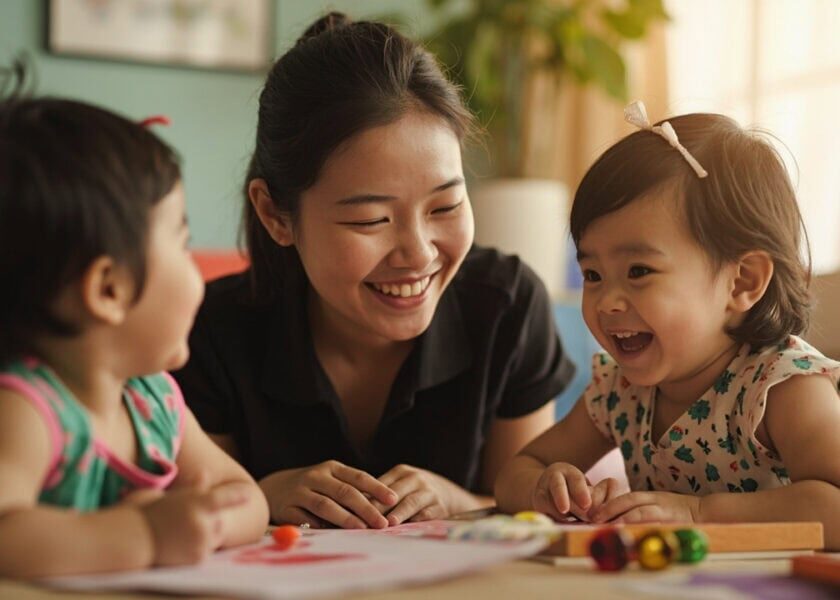
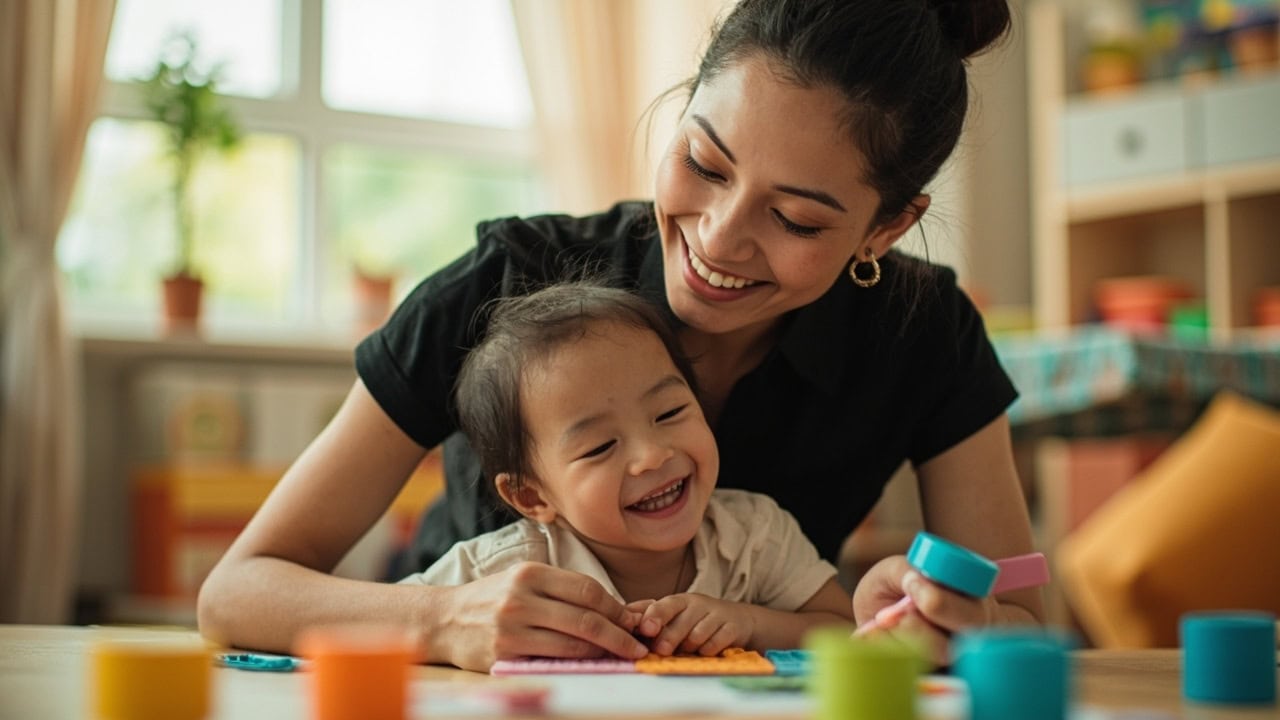
Now watch what happens through the day. A child becomes frustrated because the puzzle piece will not fit. In quality care, a trained caregiver does not solve the puzzle for the child. She sits beside them, names the frustration, and gives them a few more moments to try. When the child begins to escalate, she intervenes with calm, grounded presence — not punishment, not distraction, but regulation. She helps the child’s nervous system settle. And then she lets them try again.
This happens dozens of times in a single day. The frustration of sharing a toy. The disappointment of not being chosen first. The overwhelm of a loud transition between activities. Each moment is an opportunity — a tiny classroom where a child learns: I can feel big feelings and still be okay.
This is not academic readiness. It is emotional readiness. And it is the invisible academic advantage that no workbook can teach.
What to Look For at Pickup Time
Watch a child in quality care at pickup time, and you will see something remarkable if you know what to look for.
The child who runs to the gate with joy — that is wonderful, and it tells you something. But look closer. Look for the child who was uncertain this morning but is now calm, centred, genuinely curious about the world around them.
Look for the child who makes eye contact with their caregiver before leaving — not because they are afraid to go, but because there is a relationship there worth acknowledging.
Look for the child who climbs into the car and tells you about their day in complete sentences, with narrative, with feeling. That child has been spoken to all day. Listened to. Included.
These are the invisible markers of readiness:
- Not whether they can recite their alphabet.
- Not whether they can count to twenty.
- But whether they are building the internal story that says: I am capable. People care about me. The world is interesting. I can navigate it.
Why the Stakes Are Real
Not all childcare is created equal. I say this not to frighten you, but because you deserve to understand the stakes.
The early years are not a waiting room before real learning begins. They are the years when the brain builds its most fundamental architecture — the neural pathways that will determine how a child responds to stress, how they form relationships, how they regulate their emotions, how they feel about learning itself.
A child who spends their early years in a chaotic, understimulating, or emotionally disconnected environment does not simply “catch up” when they reach Primary 1. The gaps are not always visible on a report card, but they are there — in the child who shuts down under pressure, who cannot focus because their nervous system is always braced for something to go wrong, who has learned that the world is unpredictable and caregivers are unreliable.
This is why the choice of childcare is not a logistical decision. It is a developmental one. It is one of the most consequential choices you will make as a parent — not because the wrong choice means failure, but because the right choice means something. It means your child is being held, seen, and built up by people who understand what they are doing and why it matters.
EduNanny Singapore: An Approach Worth Understanding
EduNanny by BUTLER operates within the ECDA Childminding Pilot, and this matters more than you might think.
The childminding model offered is built around the same principles that developmental research consistently identifies as foundational: consistent relationships, individualised attention, home-based warmth, and caregivers who are trained to understand what they are building and why.
In an EduNanny setting, your child receives care in a home environment designed to feel familiar and safe. The caregiver ratios allow for the kind of connection that cannot exist in larger group settings — the kind where a caregiver genuinely knows your child’s rhythms, preferences, and cues. For infants, this approaches one-to-one care. For older children, the small ratios ensure no child is overlooked.
Practical Support for Singapore Families
The EduNanny model also comes with practical features that Singapore parents have told us matter to them:
- Monday to Friday care blocks that align with real working lives
- Fees structured to be accessible within the pilot framework
- CDA and Baby Bonus funds can be used where applicable — because the best care should not be available only to those who can afford premium private arrangements
- Regular updates and transparent communication about how your child spends their day, what they are exploring, how they are developing
- Pathways that adapt to your family — home-based care when that feels right, with the flexibility to evolve as your situation changes
Support When You Need It
Because parenting is full of uncertainty — questions that arise at 9 p.m. when the baby is finally asleep — EduNanny offers a chatbot to support parents with questions about development, care decisions, and the thousand small uncertainties that come with raising young children.
It is not a replacement for human guidance, but an extension of the same commitment: to be there, to be responsive, to help parents feel less alone.
What to Look For When Choosing Childcare
Whether you are considering EduNanny or any other care option, here is a framework grounded in what actually matters:
- Consistency of caregiver — Is your child likely to have the same primary caregiver over time, or a rotating cast? Consistent attachment is built through consistent presence.
- Ratios that allow connection — Can the caregiver genuinely know and respond to your child’s individual cues? Or is your child one of too many for that to be possible?
- Trained, intentional practitioners — Does the caregiver understand child development, not just supervision? Can they explain their approach to emotional regulation and learning through play?
- Emotional warmth you can feel — Visit at pickup time. Watch how the children are. Are they regulated? Curious? Connected? Or anxious and checking the door?
- Communication and transparency — Will you know how your child’s day is going? Will there be regular updates, honest observations, genuine partnership with you as a parent?
- Respect for your family’s values and needs — Does the arrangement feel like it was designed around your child’s wellbeing and your family’s real life?
What matters is not the setting but the quality of what happens inside it. Home-based care, when it offers consistent caregivers, small ratios, and trained practitioners, can provide something that large centre-based settings often cannot: the intimacy and predictability that secure attachment requires. The research on early development consistently points to relationship quality as the key variable — not physical space or programmatic bells and whistles.
The Foundation Is Everything
Let me return to the image I opened with. The question that keeps Singapore parents awake at night. Will my child actually be okay?
Here is what years of watching children grow has taught me: the answer to that question is not in a workbook. It is not in a school readiness assessment. It is not in the number of enrichment classes a child attends.
The answer is in this: Does your child feel safe? Does your child feel known? Does your child believe, in the quiet core of themselves, that the world is a place where they can learn and grow and belong?
If the answer to those questions is yes — even partly, even in progress — then your child has something that no academic head start can rival. They have the foundation. And foundations, as any builder will tell you, are everything.
Quality childcare is the quiet architect of this readiness. Not the flashiest curriculum. Not the most impressive facilities. But the daily, patient, intentional work of people who understand that what they are building will outlast any worksheet, any test, any transition.
You are not just choosing childcare when you make this decision. You are choosing the environment in which your child spends their most formative years. You are choosing who holds them when they fall. You are choosing who celebrates their small victories and sits with them through their hard moments. You are choosing, in a very real sense, what kind of person will walk into Primary 1 with their head held high and their heart steady.
That is not a small thing. It is everything.
If you would like to understand more about what thoughtful, development-oriented childminding looks like in Singapore, explore EduNanny Singapore. You can also learn about the EduNanny approach or get in touch with any questions about whether this might be the right fit for your family.