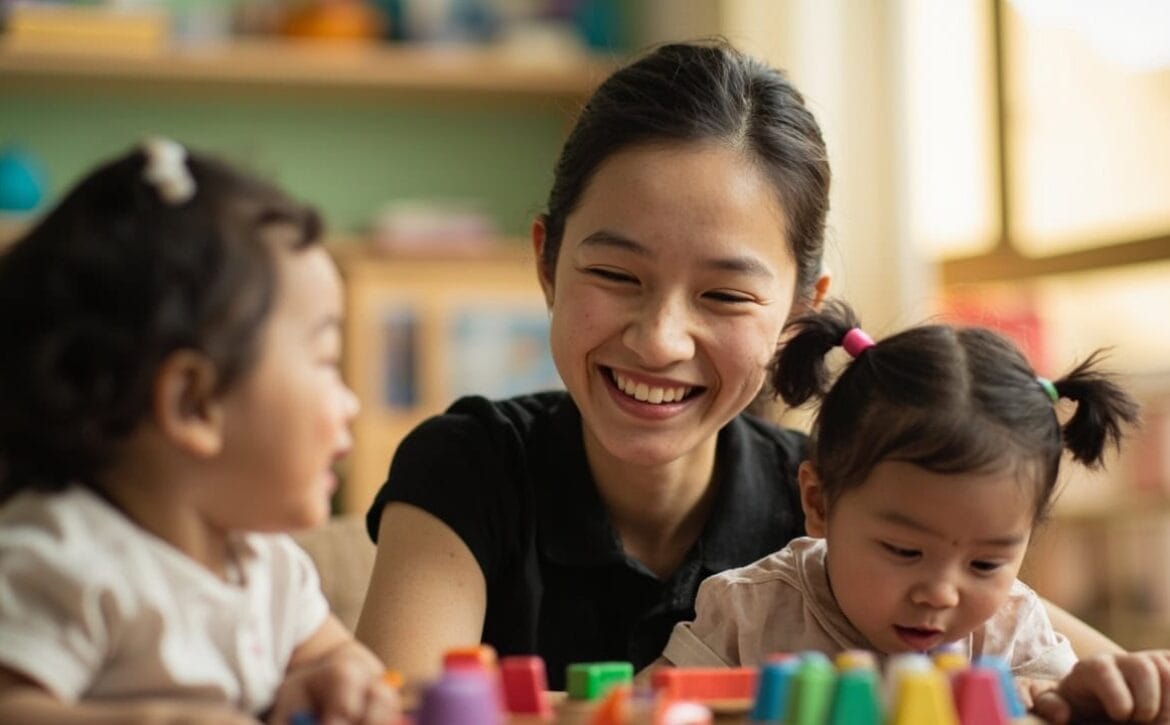
Fraud Blocker edunanny.com

Category: Childminding

edunanny-0632133c73c675792805180d3ef409e1
April 18, 2026

The Multilingual Advantage of Singapore’s Best Childcare

Quick Summary: Language Development in Singapore Childcare

  • Early childhood is the peak window for language acquisition — the brain is wired for language in the first six years more powerfully than at any other point in life.
  • Language requires interaction, not just exposure — back-and-forth conversation builds language far more effectively than passive media.
  • Quality childcare can be an active language environment — intentional caregiver interaction during daily routines scaffolds language development.
  • Singapore’s multilingual context creates specific opportunities — English, Mandarin, and heritage languages can all be supported through quality care.
  • You can observe language milestones and use them to evaluate whether your child’s environment is truly supporting their growth.

Understanding Singapore’s Multilingual Reality

Singapore is unlike almost anywhere else in the world. In a single day, a Singaporean child might hear English, Mandarin, Malay, Tamil, Teochew, Hokkien, Cantonese, Hindi, Malayalam, Bengali, Indonesian, Tagalog — sometimes all within the same household, the same neighbourhood, the same family gathering.

We are multilingual not by aspiration alone but by inheritance. By history. By the choices our parents and grandparents made about which languages to speak, which to pass on, and which to let fade. And now, as parents raising children in this environment, we carry a particular weight.

We want our children fluent in English — the language of their classrooms, their workplaces, their futures. We want them to have Mandarin, because it connects them to heritage, to extended family, to a culture and economy that spans continents. Some of us want them to hold onto dialects — the languages our grandparents speak with a warmth that somehow feels irreplaceable. Some of us are raising children between languages that do not share the same script, the same sounds, the same grammar, and we wonder how they will manage it all.

The research offers reassurance: young brains are extraordinarily well-equipped for learning multiple languages simultaneously. The neural pathways for language are carved deepest in the early years, when the brain’s plasticity is at its peak and language acquisition happens almost naturally — without conscious effort, without formal instruction, without the struggle adult language learners know too well.

But here is what many parents discover too late: this remarkable capacity needs something from the environment. It needs language to be present. Spoken to the child, around the child, with the child. It needs interaction — responsive, back-and-forth conversation, not passive exposure to screens or recordings. It needs caregivers who repeat words, who expand on what the child says, who name the world as they move through it together.


The Tension Every Working Parent Carries

And this is where the tension lives. Because we know — every working parent knows — that the years when language learning is most effortless are also the years when we are most likely to be away from our children for the bulk of their waking hours.

We have perhaps two to three waking hours on weekdays to pour language into our children. We drop them at childcare in the morning and pick them up when they are tired, when dinner needs to be made, when bedtime is approaching. And we wonder: is it enough? Have I already fallen behind?

Here is the reframe that changes everything: when your child is in quality childcare during the workday, those hours are not time spent away from language learning. In the right environment, with the right caregivers, those hours become some of the most language-rich hours of your child’s day.


What Language-Rich Childcare Actually Looks Like

This is not a platitude. It is a description of what actually happens when caregivers understand language development as part of their work — when they view every feeding time, every nappy change, every walk to the park, every moment of play as an opportunity to build language.

Consider what happens during a routine that may seem ordinary. Your child’s caregiver picks up your baby after a nap. She says, “Good morning, did you sleep well? Look, the sun is coming through the window. It’s a beautiful day today.” She names the sensation of being lifted, the texture of the blanket, the sound of birds outside. She is not performing. She is not reciting a script. She is doing what language-rich caregiving looks like in practice — turning routine into conversation, filling the spaces between care with the raw material of language.

Multiply this across a full day, a week, the months of your child’s first and second and third years. The child hears thousands of words — not in isolation but in context. He hears the same words repeated in predictable situations: “morning,” “hungry,” “milk,” “done,” “play,” “book,” “song.” He hears new words introduced with care and repetition. He hears stories with beginnings, middles, and ends, with characters who want things and face obstacles and find resolutions. He hears songs with rhythm and rhyme — cognitively important because rhyme helps children hear patterns within sounds, which is foundational for reading later on.

A Language-Rich Day: Concrete Examples

In a language-rich childcare environment, you might see a caregiver sitting with a small group of toddlers for story time. She is not simply reading the words on the page. She is pausing to ask questions: “What do you think will happen next?” “Where is the little rabbit going?” “Have you ever seen a rabbit?” She is pointing to pictures and naming what she sees. She is repeating key words: “The rabbit hopped. He hopped all the way home. Can you hop like the rabbit?” The children are not just listening. They are participating. They are hearing language in motion, language that responds to them, language that feels alive.

In another part of the room, you might see a caregiver feeding an infant. She is narrating the moment: “You’re eating banana today. It’s soft and sweet. Do you like it?” She is naming the action, the taste, the texture. When the baby makes a sound, she pauses and responds, as if in conversation. This is not just feeding. This is language scaffolding through the most basic of daily routines.

In a quiet corner, you might see a caregiver singing a familiar song with a toddler who is just beginning to find her voice. The caregiver sings the first line and pauses, waiting. The toddler attempts the next word. The caregiver repeats it back with delight: “Yes! Ball! You said ball!” This back-and-forth — this turn-taking that mirrors conversation — is one of the fundamental building blocks of language development. It teaches the child that her voice matters, that communication is reciprocal, that words have power.

These are not elaborate interventions. They do not require expensive technology or elaborate curricula. They require caregivers who have been trained to understand the significance of their own speech, their own interaction, their own responsiveness. They require a philosophy of care that takes language seriously.

Language Milestones: What You Can Observe

Understanding language milestones helps you evaluate whether your child’s environment is truly supporting their development. These are not milestones only specialists can track — they are observable, recognizable by any attentive parent.

During the first year, language development begins with recognition and response. Your baby learns to recognize voices, to turn toward sound, to coo and babble, to respond to her own name, to understand simple words like “no” and “bye-bye.” By the end of the first year, most babies are saying their first words or are very close to it. If your child is in quality care during this period, you should see caregivers talking to your baby constantly — narrating actions, naming objects, responding to coos as if they were meaningful contributions to a conversation. You should hear babbling in the room, back-and-forth vocalizations that mirror the rhythm of real conversation.

During the second year, language accelerates. Words begin to combine into simple phrases. Vocabulary expands rapidly — children at this age can learn several new words per day if the environment provides them. You should hear your toddler attempting new sounds, making requests, labeling things with increasing accuracy. In quality care, this is the period of explosive growth, where caregivers are naming everything, reading picture books repeatedly, singing songs that build vocabulary through repetition and rhyme.

During the third year and beyond, language becomes more complex. Children begin to form sentences, to ask questions, to tell simple stories, to engage in pretend play that requires language to coordinate and extend. You should see your child talking about things that happened earlier in the day, expressing preferences, initiating conversations with other children and with adults. In a language-rich environment, caregivers are not just talking to your child but talking with your child — holding real conversations, expanding on what the child says, introducing new vocabulary in context.


What to Look For When Choosing Childcare

Knowledge is empowering. If you know what to look for, you can ask the right questions when you visit a childcare environment.

Observe caregiver speech. Do caregivers speak to children as conversational partners, not just for management and instruction? Do they narrate routines? Do they respond to children’s sounds and attempts at words? Listen for language quality — not just the quantity of noise but the richness of words. Is there narrative? Back-and-forth exchange? Storybook reading that involves interaction, not just recitation?

Notice caregiver ratios. Real conversation requires time. Smaller ratios mean each child gets more responsive interaction — this is not a luxury but a language development necessity. Ask about language philosophy: how does the environment think about language development? Is it treated as a core responsibility or an afterthought? Are caregivers trained to understand the significance of their own speech?

Check for daily communication. Quality caregivers share what happened during the day — what your child ate, how they slept, what they enjoyed, what words they tried, what stories they heard. Language development is ongoing and should be part of the daily conversation between caregiver and parent.


How EduNanny Approaches Language Development

At EduNanny, language development is not something that happens in the margins of our work. It is central to what we do.

We are part of the ECDA Childminding Pilot, which means we operate within a framework that recognizes home-based and community-based childcare as a legitimate, quality pathway for Singapore families. Our caregivers are trained to understand language development as a core competency of their role. They know that the words they speak during a nappy change, during a feeding, during a walk, during a story — these are not incidental to the care they provide. They are the care.

Our ratios reflect this understanding. With up to one to three infants in our care, we ensure that each child has access to responsive, individualized interaction — the kind of back-and-forth that builds language most effectively. This is not a number we arrived at lightly. It is a ratio that makes real conversation possible.

Our care is structured around Monday to Friday blocks, designed around the rhythms of working family life. We know that Singapore parents need childcare that is reliable, that fits with work schedules, that does not require constant improvisation. And where applicable, families can access their childcare arrangements through CDA and Baby Bonus, making quality care financially accessible within the pilot fee structures.

We also believe in transparency. Communication between caregivers and parents is not a feature — it is a practice. Daily updates about your child’s experiences — what they ate, how they slept, what they enjoyed, what they are learning, what words they tried today — keep you connected to the language environment your child is in each day.

About Our Caregivers

The women and men who provide childcare in Singapore are sometimes spoken about as if they are simply substitutes for parents — filling a functional need until the family can resume. The best childcare caregivers are not substitutes for parents. They are language partners for your children during the hours when language learning is most active. They are the people who will speak thousands of words to your child, who will read your child dozens of stories, who will sing the songs your child will remember for the rest of their lives.

This is not a lesser role. It is a profound one. And the caregivers at EduNanny understand it as such.


A New Calculus for the Childcare Decision

Every parent in Singapore who works during the day makes a calculation. They weigh economic realities, professional demands, practical necessities of family life, against the hours they will not spend with their children during these precious early years. This calculation is not made lightly. It is made with a mixture of love and anxiety, of determination and doubt.

What I want you to know is this: the calculation you have been making — the one that weighs time spent away from your child against time spent building their future — may need a revision. Not because the time you spend with your children in the evenings and on weekends is any less valuable. It is invaluable. But because the hours in quality childcare during the workday can be, and should be, more than a placeholder. They can be a language environment. They can be a place where your child’s brain builds the neural pathways for communication, for reading, for thinking, for connection.

The child who hears thousands of words in context during the workday — words that are repeated, that are meaningful, that are woven into the fabric of daily life — begins Primary One with something more than vocabulary. She begins with the habit of language, the expectation that words matter, the understanding that communication is a two-way street. She begins with a foundation.

You cannot be two places at once. You cannot unwork your job to stay home during the years when language learning is most effortless. But you can choose a childcare environment that understands what it is doing when it speaks to your child. You can choose caregivers who know that every “look,” every “can you say,” every “what’s this,” every pause for response is building something lasting.

You can choose an environment where your child’s language — in English, in Mandarin, in your heritage language — is not lost during the hours you are away but is, quietly and steadily, growing.


Ready to Learn More?

EduNanny was built for families navigating the beautiful complexity of raising children in Singapore’s multilingual world. Families who want quality care that takes language development seriously. Families who deserve to feel, at the end of each workday, not guilt but trust — trust that the hours away were hours well spent, that something important was happening in their absence, that their child is not just being kept safe but is being built up, word by word, toward everything they will become.

If you are exploring infant care or childminding options in Singapore and want to understand how quality care can actively support your child’s language development — in English, in Mandarin, in your heritage language — we invite you to connect with us to learn more about our approach.

The language your child is building right now, in the hours you are not there, matters. It matters more than you know. And it is happening, every day, in the hands of caregivers who understand its significance.

Not just care. Language. Growth. A future built word by word, conversation by conversation, story by story, in the hours that matter most.


EduNanny is part of the ECDA Childminding Pilot, providing quality, development-focused childcare for Singapore families. Learn more about us or explore our approach.

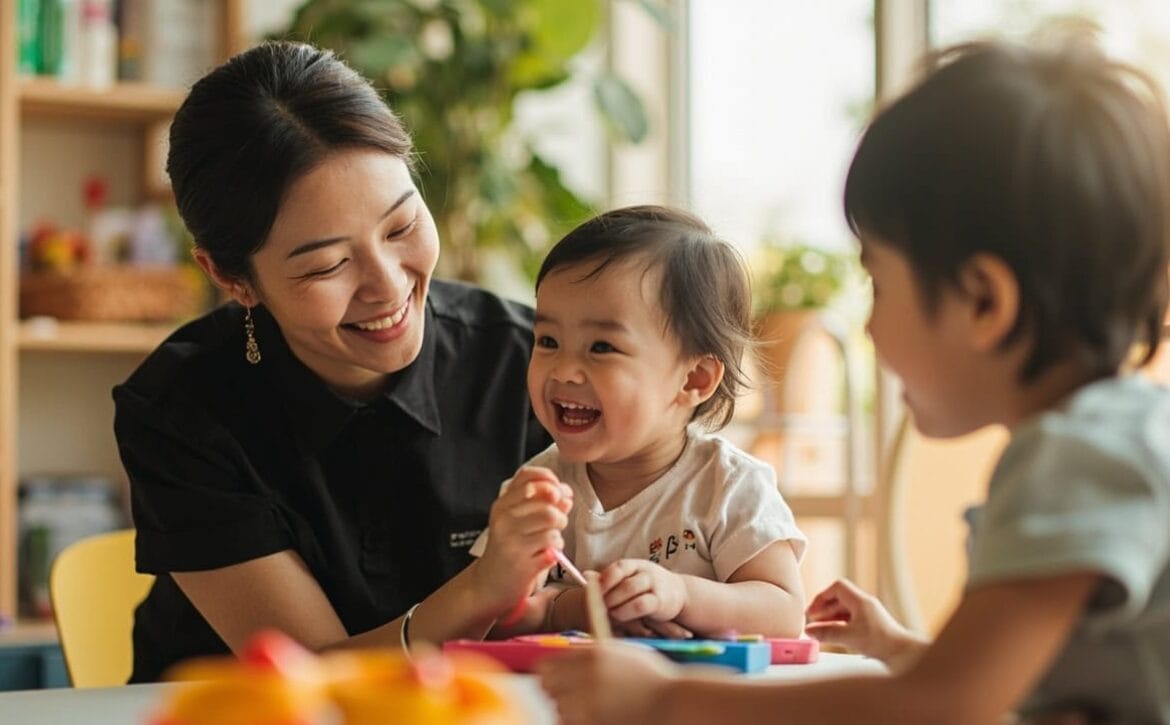
edunanny-06320fb137e73eb4d775db857acbfdc3
April 18, 2026

The Evening Moment That Builds Your Child’s Sense of Security

The Quiet Gap Every Working Parent Knows

You arrive at pickup. Your child is handed to you, or runs toward you, or clings to your legs. The caregiver gives you a brief update — she napped well, he ate all his lunch, she seemed happy today. And you say thank you, and you gather your things, and you walk to the car.

And somewhere in that walk, a question forms that you might not even say out loud: but what was it really like? Was she happy? Truly happy? Was he engaged? Was today a good day, or just a day that happened to be fine?

You are not doubting the caregiver. You are not doubting your choice. You are simply aware that you were not there. And in your not-being-there, a distance opens — a small, quiet gap between your child and your knowledge of your child.

Every working parent in Singapore lives inside that gap, every single day.

What is interesting about that gap is this: it does not have to exist as a source of anxiety. It can be a space of trust, of partnership, of the kind of confidence that comes not from omniscience but from connection. And the difference between those two experiences — the anxious gap and the confident gap — is not about whether you are a naturally anxious parent or a naturally calm one. It is about whether the childcare you have chosen has built the infrastructure for you to know what you need to know.


Two Children, Two Evenings

Let me paint you a picture. Two children, both in quality care. Both come home at roughly the same time. But their evenings are very different.

The First Evening

The first child comes home and is handed a screen almost immediately. Dinner is eaten in front of the television. Bath time is efficient. By the time bedtime stories begin, the child is overtired and fractious, and the parent is frustrated — wondering why the childcare did not prepare their child better for the evening, why the child seems so dysregulated, why this daily reunion feels like a battle instead of a homecoming.

The Second Evening

The second child comes home. The parent has arrived with a few minutes to breathe — to greet the caregiver, to receive the update, to simply stand in the doorway and let their child show them the block tower that is still standing, the painting on the drying rack, the friend who is leaving at the same time.

The walk to the car is slower. There is no phone. The parent crouches down and says, I missed you today. Tell me about your morning.

And the child — who has been in a quality environment all day with adults who spoke to them like full human beings — responds. Not in complete sentences, not in perfect recall, but in gestures and sounds and the particular language of their age. And the parent listens. Really listens. And asks a question, and listens again.

By the time they reach home, something has been transferred. The day’s experiences have been named. The child has been seen by two sets of eyes, not just one. And the evening unfolds with a different texture. Slower. Calmer. More connected.

What made the difference?

The childcare did not change. The child did not change. What changed was the parent’s approach to the reunion.

  • The decision to treat the walk from the classroom to the car as a meaningful moment, not a logistical one
  • The decision to receive the caregiver’s update as intelligence, not just information
  • The decision to come home with their child, rather than just bring their child home

The Science and Art of the Evening Transition

When we talk about quality infant care, we often focus on what happens during the day — and rightly so. The early years are a period of extraordinary neural development. In the first thousand days of life, a child’s brain forms connections at a speed that will never be matched again.

But here is what is equally important to understand: your child is not just physically arriving home in the evening. They are carrying an entire day of experiences, sensations, relationships, and emotions. And their nervous system — still developing, still learning to regulate itself — needs help making sense of all of that.

They cannot do it alone. That is not a weakness. That is the nature of being a young child.

What you are actually doing when you hold them

When you pick up your child and hold them — really hold them, with your phone in your bag and your to-do list on pause — you are doing neurological work. You are providing co-regulation. You are showing your child’s nervous system that it can slow down, that the stimulation of the day can settle, that they are safe now and the day is done.

Children whose evening transitions are calm and connected develop better emotional regulation, sleep more soundly, and show more secure attachment behaviours than children whose evenings are rushed, chaotic, or emotionally flat.

Reading the signs on hard evenings

There will be evenings when your child comes home and something is off. Not dramatically. Not catastrophically. But off. A little flat. A little more clingy than usual. A little quicker to tears.

Your instinct as a parent is to wonder: Did something go wrong? Is this a sign that the childcare is not working? Is my child unhappy?

Here is what quality infant care teaches us: sometimes a child comes home a little off because they had a hard day, and that is okay. Children have hard days. They get frustrated by a toy they cannot build, or they have a minor conflict over a book, or they simply did not sleep well during nap time. These are not failures of care. These are the ordinary textures of early childhood — and a quality setting will not hide them from you.

If your child had a hard morning and needs extra closeness in the evening, you need to know that. If they were fascinated by something new and are still processing it, you need to know that too. If they skipped their nap and are running on fumes, that is useful information for your evening planning.

None of these things mean anything is wrong. They are simply the weather of your child’s day — and you deserve to dress accordingly.


A Partnership Built for the Evening Reunion

At EduNanny Singapore, we have thought deeply about what happens at the moment of handover. Not just what happens during the day — though that matters enormously — but what happens at that door, at six o’clock in the evening. What should that exchange feel like? What should it give you?

The answer is not just information. It is understanding. It is not a data report. It is a window into your child’s inner life that allows you to step in and do your work — the parent’s work — with confidence.

We built our communication protocols around this truth: when we hand your child back to you in the evening, we are not just completing a transaction. We are transferring care. And that transfer includes honesty — not just about the highlights but about the textures, the small struggles, the moments that might have been difficult.

Because you are not just a consumer of childcare. You are your child’s primary attachment figure — and you need to know what you are receiving so that you can meet your child where they are.

What parents often ask us

“How do I know my child is happy?”

You will never know everything — and that is not the goal. The goal is to know enough. To be able to read the signals. To trust that when something is genuinely wrong, you will be told. Our caregivers are trained to notice, to document, and to share — not just the good moments, but the full picture of your child’s day.

“What if the caregiver tells me something concerning?”

That is exactly what should happen. Transparency is not a sign that something is wrong — it is a sign that you have a real partnership. A caregiver who only tells you the good news is not giving you the information you need to parent well. The evenings when your child comes home a little flat are not failures. They are data. And you need that data.

“I feel guilty about not being there during the day.”

Many parents carry this. Here is what quality care teaches us: presence is not only physical. When you arrive at pickup with your attention, your questions, your calm — when you extend the day’s work into your home — you are not compensating for absence. You are completing a circle. Your child has been held by trusted hands all day. And now they are held by yours. Both matter.

What our programme offers

  • Home-based pathways — a setting that feels like home, with ratios that allow for genuine one-to-one attunement, and routines that can adapt to your child’s natural rhythms
  • Community and centre-based pathways — structure and socialisation in environments that are warm, language-rich, and developmentally appropriate
  • Research-informed ratios — we maintain the infant ratios that research tells us matter, because a caregiver stretched across too many children cannot truly see any of them
  • Active participation in the ECDA Childminder Pilot — a model that is high-quality and accessible, because premium care should not be a privilege available only to the wealthiest families

Making the Evening Your Own

The most confident parents have turned the evening reunion into something consistent — a ritual their child comes to expect, a predictable moment of connection that anchors the transition from childcare to home.

This does not have to be elaborate. It might be:

  • The same greeting each day: “I missed you. I’m so happy to see you.”
  • A slow walk with no agenda except being together
  • A question asked before the radio goes on
  • A moment of holding before anything else happens

Practical steps that make a meaningful difference

  • Arrive a few minutes early. Give yourself space to breathe before you greet your child.
  • Receive the caregiver’s update as information worth listening to — ask a follow-up question if something is unclear.
  • Crouch down to your child’s level. Make eye contact. Let them show you something from their day.
  • Put your phone away during the walk to the car. This is the window.
  • Ask one open question: “What was your favourite part of today?” or “Who did you play with?”
  • Name what you observe: “You look really proud of that painting.”
  • Let the transition be slow. The rush can wait.

Over time, this ritual becomes something your child carries with them. They learn that the end of the day means something. They learn that Mama or Papa or their caregiver is there to receive them — fully, attentively, with all the love they carry.

That is not a small thing. That is the foundation of security.


Why This Matters More Than You Think

Research on attachment tells us something important, and something every parent intuitively knows: the children who thrive are not the children who had perfect childhoods. They are the children who had parents who showed up — not perfectly, not without struggle, but consistently, attentively, with the willingness to meet them where they were.

The evening reunion is one of those moments of showing up. Every single day. A daily practice of presence that compounds over years into something extraordinary.

You are not an observer in your child’s life. You are not a passenger on a journey that happens elsewhere. You are the parent — and every evening, at the door of the classroom or the home or the centre, your child hands you back to themselves, and you have the chance to receive them fully, attentively, with all the love you carry.

That is what quality childcare prepares you to do. That is what the evening reunion is for. And that is what we have built our programme to support — not just the hours of care, but the partnership that extends into your evenings, your weekends, and the years of your child’s life.

Your next step

If you are researching infant care or childminding in Singapore, we invite you to see what a partnership looks like when it is designed with the evening reunion in mind.

Visit our centres. Meet our caregivers. Ask us about our communication protocols, our ratios, and our approach to daily handover. We believe transparency builds stronger partnerships than reassurance ever can — and we are happy to show you exactly what we mean when we talk about extending the day’s work into your home.

The reunion is waiting. And you are ready for it.

EduNanny Singapore by BUTLER — where the childcare partnership becomes real, every single evening.


Learn more about EduNanny Singapore and our approach to quality infant care and childminding. Connect with our team to explore your options or read more about who we are and our participation in the ECDA Childminder Pilot.

edunanny-06320c44e03773f0704ecbab850e510c
April 18, 2026

The Distance Between Who You Were and Who You’ve Become

There Is a Version of Yourself You Have Not Seen in a While

Not the parent you have become—though you have become a remarkable one—but the person you were before. The one who had plans. Who moved through the world with a particular kind of confidence, a sense of direction, a quiet belief that the life you were building was yours to shape.

That person did not disappear. But something has pressed down on them, gently at first, then with the weight of every early morning, every commute, every spreadsheet opened at midnight while a small hand reaches for you from the cot.

You have not failed. You have been carrying more than one person was designed to carry alone.

If this sounds familiar, I want you to sit with it for a moment—not as a confession, not as a problem to solve, but as a recognition. Because what I have come to understand, sitting with families across Singapore, is that this feeling of having stepped back from your own life is not a weakness in you. It is the predictable outcome of an unresourced family system.

It is what happens when the demands of raising a child, sustaining a career, maintaining a home, and holding a partnership together all land on the same person, without enough support to carry it.

Here is what I also want you to know: this is not a story about outsourcing a problem. It is not about handing your child to someone else and walking away. It is about choosing a partner in care—someone who walks alongside you in the raising of your child, who extends your family’s capacity rather than replacing your role.

And when you find that partner, the distance between who you were and who you have become is not a gap that can never be bridged.


The Diminishment No One Warns You About

Here is what the conversation about childcare usually looks like. You start researching infant care options the way you would research a product purchase—by comparing ratios, checking credentials, reading reviews about safety and curriculum. And those things matter. They matter enormously.

But I want to suggest to you that there is a dimension of this decision that no checklist captures, and it is the one that will ultimately matter most to you.

Choosing quality childcare is not only a decision about where your child goes during the day. It is a decision about who you are becoming. It is a decision about the kind of partner you want to be, the professional you want to show up as, the human being you want to reclaim from beneath the exhaustion.

It is one of the most quietly consequential choices a parent can make, and it is almost never framed that way.

The Grief That Creeps In Quietly

There is a particular kind of loss that happens in early parenthood, and it is not the loss of sleep or freedom—though those are real. It is the loss of a version of yourself that you had to set down because there was no other way forward.

The morning spin class you stopped attending. The career momentum you put on pause. The weekends that became logistics rather than restoration. The conversations with your partner that used to be about dreams and now are about drop-offs and grocery lists and who is picking up the child from the infant care centre.

This grief is quiet. It does not announce itself. But if you sit with it honestly, you will recognize it.


What Actually Happens When You Find the Right Support

Here is what I have seen happen when a family finds the right support.

The child settles into an environment where they are genuinely known—not processed through a rotation of unfamiliar faces, but held with intention by people who understand the rhythms of early development. There is a stillness that comes over a child when they feel safe in a way that goes beyond supervision. They begin to explore. They begin to flourish.

And here is what is less obvious, but no less true: when your child flourishes in your absence, something inside you unlocks.

You stop carrying the low hum of guilt that has been running beneath every work meeting, every commute, every evening when you are too depleted to be fully present. You breathe. And in that breath, you find something you did not know you had lost—the capacity to be genuinely, freely yourself.

Restoration in the Texture of a Day

Think about what restoration looks like in the actual texture of a day.

It looks like a mother who, for the first time in months, makes it to her morning spin class not because she has somehow found more hours in the day, but because she knows her daughter is in a place where she is loved and growing and safe.

It looks like a father who walks into a work presentation and feels, for the first time in a long while, that he is leading from his full self—not the depleted, distracted version running on caffeine and anxiety, but the one who actually has something to offer.

It looks like a couple who, on a Saturday morning, sit across from each other over coffee and actually talk—not about logistics, not about who dropped off, not about what went wrong that week—but about themselves. About where they are going. About the life they are building together.

Because the distance that crept in was not about a lack of love. It was about a lack of bandwidth. And bandwidth, once restored, changes everything.


The Singapore Reality: Why the Pressure Is Different Here

I want to speak specifically about what this looks like within the landscape of Singapore, because the pressures here are real and particular.

  • The cost of living means dual-income households are not a luxury—they are a necessity. Which means there is no margin for one parent to step back without financial consequence.
  • The demands of a competitive professional environment mean that showing up fully matters in ways that feel high-stakes. The career you built before your child arrived still needs you to show up for it.
  • Distance from extended family is a reality for so many Singapore households. The village that other cultures take for granted is not automatically there.
  • The physical and emotional density of life in a small city-state means everything happens in compressed space. There is nowhere to retreat to.

These are not abstractions. They are the daily reality of families who are doing their very best with what they have.

And the honest truth is that many Singapore parents are running on fumes, not because they are failing, but because the system around them has not given them what they need.

There is a quiet grief in that. But I want to tell you that the door is still open.


What Quality Childminding Actually Looks Like

When you choose a childminder or an infant care environment with genuine intentionality, you are not stepping away from parenting. You are stepping into a more sustainable version of it.

What should you look for? Beyond the credentials and ratios, here is what distinguishes genuine quality:

  • Intentionality of relationship. Your child is not processed through a rotation of unfamiliar faces. They are known. They are held with attention.
  • Understanding of developmental rhythms. The caregiver understands what your child needs at this stage—not just supervision, but responsive, thoughtful engagement.
  • Communication that builds trust. You do not have to wonder. You can know. And that knowing is part of what restores you.
  • Consistent caregiver ratios. When one caregiver is responsible for three children rather than eight, your child is not one in a crowd. They are one, seen and known.
  • A partner who sees the whole family. Quality care understands that when a child is thriving, a parent is set free. That these two outcomes are not separate—they are the same outcome, seen from two sides of the same door.

There is a particular kind of confidence that returns to a parent when they know their child is in extraordinary hands. It is not the confidence of someone who does not care. It is the confidence of someone who cares so deeply that they made the most considered choice they could.

That confidence changes how you speak to your child at the end of the day. It changes how you listen to your partner. It changes how you show up at work, at the dinner table, in the quiet moments when your child looks up at you and sees someone fully present.

You cannot give what you do not have. And when quality care gives you back your reserves, you give back to your family in ways you had forgotten were possible.

What This Looks Like in Practice: An Example

For families in Singapore seeking care that meets these standards, there are options worth knowing about. EduNanny Singapore, operating through the ECDA Childminding Pilot, structures its approach around these very principles: caregiver ratios designed for genuine attentiveness, communication practices that keep parents informed throughout the day, and a philosophy that sees the whole family as part of the care equation.

What matters most is not the specific name on the door, but whether the arrangement reflects these values in practice—whether your child is known and held with intention, whether you receive the transparency that allows you to breathe, whether the caregiver ratios allow for the kind of responsive care that early development requires.

Addressing Common Concerns

Let me speak to what I hear most often from parents who are considering this step.

Is choosing childcare admitting I cannot cope?

No. Choosing quality childcare is one of the most affirming decisions a parent can make, because it says that you believe your family deserves more than survival. It says that you believe your child deserves parents who are alive, present, growing, and in love with their own lives—not just in love with their children, though that love is infinite, but in love with who they are.

Am I stepping away from parenting?

You are stepping into a more sustainable version of parenting. One where your child receives the richness of thoughtful, responsive care, and where you receive something equally precious: the space to be whole.

How do I know I can trust the caregiver?

Trust is built through transparency, consistency, and communication. Look for arrangements that offer clear communication practices, opportunities to build relationship before care begins, and ongoing connection throughout. Trust is also built over time. A quality care partner commits to being a long-term foundation for your family’s wellbeing.


The Path Back to Yourself

Let me bring us back to what this is really about.

It is about a parent who, one morning, realizes that the distance between who they were and who they have become is not a gap that can never be bridged. It is about the moment you stop apologizing for needing help and start claiming the right to restoration.

It is about understanding that choosing quality childcare is not a concession. It is one of the most affirming decisions a parent can make, because it says that you believe your family deserves more than survival.

Your child is watching you. Not just for what you do, but for who you are. They are learning from the way you move through the world, from the confidence in your step, from the lightness in your voice, from the presence you bring to the dinner table.

And when you are restored—when you are no longer running on empty—your child does not lose a parent. They gain one. They gain a parent who is fully there, not because they never leave, but because every time they return, they return as themselves.

A Few Things to Consider as You Explore Your Options

  • Think about ratios, but also about relationship continuity. Who will actually be caring for your child day to day? Can you meet them? Can you imagine your child forming a secure attachment with them?
  • Ask about communication. How will you know what happens during the day? What is the protocol for updates, concerns, milestones?
  • Consider the whole family system. The best infant care centre in Singapore is the one that sees you as part of the equation—not just your child.
  • Trust your instincts. You know yourself and your child better than anyone. After doing your research, ask yourself: does this feel right? Does it feel like a place where both my child and I would be seen?
  • Think long term. This is not a short-term arrangement. Choose a partner you can see yourself working with across the arc of your child’s early development.

So if you have been carrying this quietly, if you have been wondering whether there is more to your life than the next drop-off and the next meeting and the next load of laundry and the next sleepless night—if you have been quietly grieving the version of yourself that you had to set aside—I want you to know that she is still there. He is still there.

And the path back is not as far as you think.

It begins with a decision. A small one, in the end. But it is the decision that changes everything.

Choose the care that sees your child. Choose the partner that sees you. And watch what happens when the whole family begins to flourish—not in the way the world measures success, but in the way that actually matters.

In the morning, when your child reaches for the caregiver’s hand with trust, and you walk out feeling something you have not felt in a long time.

In the evening, when you come home and you are actually home—not just present in body, but there in every way that counts.

In the marriage that finds its way back to itself.

In the career that reignites because you have the clarity and the energy to bring your full self to it.

In the quiet, unremarkable moments of a life that is being lived, fully, by someone who has come back to themselves.

You were never meant to do this alone.

And now, you do not have to.


If this article has resonated with you, and you would like to explore what thoughtful, development-oriented childminding could look like for your family in Singapore, EduNanny welcomes the opportunity to begin a conversation.

Learn more about who we are and the standards that guide our approach to caring for children and supporting families across Singapore.

edunanny-063208e2ac1b7ed0fbdf8dc6c346d470
April 18, 2026

The Three Observable Signs That Tell You Your Childcare is Truly Premium

The Quiet Tension Every Parent Feels After Enrollment

Most conversations about childcare focus on the threshold — choosing, deciding, crossing the door for the first time. Those conversations matter. But the space that exists after the decision — the weeks, the months, the ordinary Tuesdays that follow enrollment — that is where most parents actually live. And it is the least discussed of all.

Here is what we hear from parents who have chosen thoughtfully: the doubt does not go away on its own. Not because they chose poorly, but because they lack a framework to evaluate what they are seeing. They know they want quality. They know they are paying for quality. But they have not been given the tools to recognise quality when it is in front of them — or to identify when something is genuinely missing.

This is the practical trust gap. It is not about anxiety or distrust. It is about the absence of specific, observable dimensions that allow a parent to verify what they are experiencing. Until that gap is closed, the question keeps surfacing — in the morning, in the evening, in the middle of the day when you are at work wondering what is happening in your child’s room.

The good news is that this gap can be closed. Not with reassurance, but with knowledge. Once you understand what premium childcare actually looks like in practice — not as a feeling, not as a promise, but as a set of concrete, recognisable qualities — the doubt transforms into something else entirely. Not certainty as an emotion, but certainty as understanding.


What Premium Quality Actually Looks Like: Three Observable Dimensions

When we talk about premium childcare, we are not talking about nicer toys or a more attractive space. We are talking about something more fundamental: the quality of attention your child receives, the depth of knowledge the caregiver develops about your child, and the way that knowledge translates into daily care that is genuinely responsive rather than merely competent.

1. Consistency: When the Caregiver Knows Your Child

Consistency in childcare is often understood as the same person showing up on the same days. That matters. But the deeper meaning of consistency is the accumulation of knowledge that happens when a caregiver sees the same child, in the same space, over weeks and months.

When that kind of familiarity exists, the caregiver does not just recognise your child. They know them. They can read the particular quality of a cry that means hunger as opposed to fatigue. They know the precise degree of room temperature that soothes rather than agitates. They notice which textures and sounds genuinely engage your child and which are merely tolerated.

This is not warmth as a sentiment. It is warmth as accumulated expertise. And it is only possible when the ratio of caregivers to children allows for genuine, sustained attention.

How do you know when consistency is present?

  • Your child’s name is spoken with a particular inflection — not generically, not loudly across a room, but with the care that comes from genuine relationship
  • The day flows without constant redirection because the caregiver has learned your child’s rhythms and built a routine around them
  • Your child moves through the environment with a particular ease — not compliant, not subdued, but genuinely comfortable
  • The caregiver notices and mentions small things: a new sound, a shift in mood, a way your child responded to something for the first time

2. The Evening Transition: A Diagnostic Window

The first twenty minutes after you pick up your child is not a sentimental observation. It is a diagnostic window, and it is remarkably revealing.

A child who has been in a genuinely attentive environment does not come home depleted. A child who has been genuinely cared for — not just supervised, not just managed, but known — arrives home with a particular quality of ease. They are glad to see you, of course. But they are not clinging. They move through space with a quiet confidence that tells you something very specific: the environment they were in was safe enough and interesting enough that leaving it does not feel like a rescue.

You may notice other things. Your child might mention the caregiver by name — not as an authority figure but as a familiar presence. They might refer to something that happened during the day with a specificity that would only be possible if someone close to them noticed and engaged with it.

The evening transition is not a test of your child. It is a window into the quality of the environment they have been in all day.

Now compare that to the child who arrives home visibly exhausted in a way that has nothing to do with physical tiredness. The child who is clingy, overstimulated, dysregulated. That child may have been supervised capably. They may have been kept safe, fed, and changed. But they were not known. And the difference between those two experiences — being supervised and being known — is something your child will show you every single evening if you know how to look.

3. The Quality of Communication

This is the dimension that separates premium care from merely adequate care in the most concrete way: the quality of what the caregiver tells you about your child’s day.

What does professional caregiver communication actually look like? It looks like updates that respect your intelligence. It looks like descriptions of your child’s day that are specific, not generic. It looks like a caregiver who tells you not just that your child had a good day, but what a good day looked like for your child specifically:

  • The moment they stacked the blocks in a particular way for the first time
  • The moment they reached for another child instead of reaching for a toy
  • The word they said that seemed to arrive from somewhere new
  • The way they settled after a fall and what that said about their growing sense of resilience

These are not small observations. These are the observations of someone who is watching your child as an individual, not as one on a list. And they are the observations that tell you your child is not being cared for in the generic sense — managed, supervised, kept safe — but being cared for in the specific sense. Known. Attended to. Seen.

When the updates you receive are vague, when they use language that could describe any child in any programme, when they feel more like reassurance than observation — that is information too. It is not a reason to panic. But it is a reason to ask more questions. Because when you begin to understand what genuine observation looks like, you become able to recognise its absence.


You Are Not Doubting — You Are Participating

There is a version of the trust conversation that frames it as surrender. Choose a provider you trust, the advice goes, and then trust them completely. Do not second-guess. Do not question. Accept.

We understand the intention behind this. Anxiety is real, and it can be destructive, and no parent benefits from living in perpetual doubt. But there is a difference between trust as surrender and trust as informed confidence. One is fragile. The other holds.

The difference is knowledge. When you understand what you are looking at — when you know the difference between a child who is being supervised and a child who is being known, between an update that is genuine and one that is perfunctory, between a caregiver who is present and a caregiver who is merely on shift — then your confidence in quality becomes something real. It is not blind. It is earned, and it is grounded, and it is yours.

You are not the parent who interrogates every report or the parent who distrusts every absence of detail. You are the parent who has been given a framework — real, concrete, observable dimensions of quality — and who uses that framework to read what is actually happening in their child’s life.

That parent is not anxious. That parent is informed. And that parent, when they see genuine quality, recognises it immediately and trusts it deeply — because they know exactly why they are trusting.


Why the Singapore Context Makes This Especially Important

For parents in Singapore, the childcare landscape presents particular challenges. The cost of quality infant care is significant, and the range of options — from large childcare centres to home-based childminders under the ECDA Childminding Pilot — can feel overwhelming.

Parents often feel pressure to choose quickly, to commit before they are truly confident, to trust before they have the evidence to evaluate. This is precisely why the framework we have described matters so much in a Singapore context.

The parent who understands what to look for — who can read the evening transition, who knows what genuine caregiver communication looks like, who understands why caregiver consistency creates the conditions for real familiarity — is the parent who can make decisions with confidence rather than anxiety, even in a complex and crowded market.

You are paying for premium care, and for many families in Singapore, that represents a significant financial commitment. One that reflects a genuine belief that their child deserves the best possible start, and a willingness to make real sacrifices to provide it.

That commitment deserves to be honoured. It deserves to be met with transparency, with consistency, with the kind of quality that holds up to scrutiny — not because the parent is entitled, but because the child’s formative years are genuinely, irreplaceably important.


How EduNanny Makes Quality Observable

EduNanny operates differently, and it is worth saying so directly — because this is not marketing language, it is a description of a specific, deliberate practice.

EduNanny does not ask you to trust blindly. EduNanny invites you to watch closely. Because genuine quality does not need to be protected from scrutiny. It is strengthened by it.

Caregiver ratio. EduNanny’s home-based childminding model, aligned with the ECDA Childminding Pilot, maintains a ratio of up to one caregiver to three infants. This creates the conditions for genuine familiarity, individual attention, and the kind of sustained, intimate knowledge we have been describing throughout this article.

Regularity of care. The service operates within Monday to Friday blocks, offering the predictability that young children need to feel secure. For young infants especially, this kind of structured regularity is not a convenience — it is a developmental support.

Communication as an active practice. Updates from EduNanny caregivers are specific, not generic. They give you a real picture of what your child’s day looked like, not just a reassuring summary. When you receive an update that tells you what “fine” looked like for your child today and why it mattered, you will understand the difference immediately.

Transparency infrastructure. Where CCTV measures are in place, they serve a clear purpose: transparency, accountability, and the peace of mind that comes from knowing that what is happening in your child’s day is observable, not hidden. This is not surveillance. It is the infrastructure of trust.

Payment accessibility. CDA and Baby Bonus options are available, which means quality care is not only available to families with significant discretionary income — it is structured to be within reach. The quality of a child’s early environment should not be determined solely by accident of birth.


Addressing the Concerns You Might Still Have

“What if I am being too demanding? Maybe this is just what childcare is.”

You are not being too demanding. You are being attentive. The parent who notices that updates are vague or that their child comes home dysregulated every evening is not a difficult parent. They are a parent who is paying attention — and that attention is exactly what your child needs you to have.

“How do I bring this up with my caregiver without feeling like I am micromanaging?”

Ask specific questions. Instead of “How was my child’s day?” try “Did anything happen today that seemed particularly interesting or new for them?” Instead of “Are they settling in okay?” try “What does settling in look like for them specifically?” When you ask for specifics, you signal that you are an engaged parent who expects real information. Most genuine caregivers appreciate this.

“What if the update I receive is vague and I am not sure whether that means something is wrong?”

Vague updates are not necessarily a sign that something is wrong. They may simply be a sign of a caregiver who has not yet developed the habit of sharing specific observations. But they are a reason to ask more questions — and a reason to watch more closely. Trust your instincts. If something feels missing, it is reasonable to want more.


Your Framework for Evaluating Quality

Here is a simple way to hold everything we have discussed together. When you are evaluating the quality of your child’s care, you can ask yourself these questions:

  • Consistency: Does my child have a primary caregiver who sees them regularly? Does the caregiver know my child as an individual — their rhythms, their preferences, their particular ways of expressing needs?
  • Evening transition: Does my child come home with a quality of ease? Are they glad to see me without being desperate? Are they calm, curious, and present?
  • Communication: Do I receive specific updates about my child’s day — observations that could only come from someone who has been paying close attention to my specific child?
  • My own confidence: Do I feel like an intelligent participant in my child’s care, or like a passive recipient of reassurance? Can I articulate what is good about the care my child is receiving?

When the answer to these questions is yes, you are not just hoping for quality. You are seeing it. And that is exactly where you want to be.

Over the weeks and months that follow enrollment, as your knowledge deepens, so will your confidence. Not the fragile kind that requires you to look away. The real kind — the kind that is grounded in specifics, sustained by observation, and built to last.


The Invitation

EduNanny is here for the parent who wants more than reassurance. The parent who asks the hard questions and expects real answers. The parent who is not a consumer to be satisfied but an intelligent participant whose attention and judgment are genuinely valued.

We work together — caregivers and families, side by side — to give your child something worthy of the years they are made of.

So the next time you drop your child off in the morning and feel that small, quiet question surface again — the one that asks whether this is truly what you hope it is — we want you to listen to it differently. Not as doubt, but as an invitation.

An invitation to look. To notice. To ask. And to trust yourself to recognise quality when you see it, because you now know exactly what to look for.

A childcare provider that invites your scrutiny is not afraid of what you will find. It is confident in it. And that confidence — the confidence that comes from knowing you are watching — is not a burden on the care. It is what makes the care genuinely excellent.

You chose premium care. The decision was deliberate. Now you have the framework to know that the choice was right — not because you were told to trust, but because you can see it.

That is the kind of peace that lasts.


If you are a parent in Singapore exploring infant care options and want to experience what genuine quality looks like in practice, we invite you to start a conversation with EduNanny. We are here to answer your questions, show you our approach, and help you understand exactly what premium childminding can offer your family.

Learn more about who we are and the standards we hold ourselves to, or explore our home-based childminding programme to see whether it might be the right fit for your family.

edunanny-0632057d4715e1c555849ed46e04001e
April 18, 2026

Inside Singapore’s Best Childcare: What Every Parent Needs to Know

The Hours You Cannot See: A Parent’s Complete Sensory and Emotional Map of Quality Childcare

Every morning, across Singapore, a parent stands at a threshold.

Perhaps it is a doorway into a home. Perhaps it is the entrance to a centre. The child is in their arms, or holding their hand, or already looking toward something inside that the parent cannot quite make out. And in that moment before the parent turns and walks away, a question forms. It is not always spoken. Sometimes it is not even fully conscious. But it lives in the space between the parent and the door, and it sounds something like this:

What is actually happening to my child right now, in the hours that I am not here?

You are not a bad parent for wondering. You are not uncertain because you are weak. You are wondering because you love your child, and love wants to know. It wants to understand what fills the space it cannot occupy.

So you imagine. You imagine the worst sometimes, and sometimes you imagine the best, and mostly you imagine fragments—moments you have pieced together from photos, from brief descriptions, from the few minutes at drop-off and the few minutes at pick-up.

But a full day has hours in it. Hours that belong to your child, and to the people who care for them, and to the environment that surrounds them. And those hours deserve more than fragments. They deserve a map.

This article gives you that map. You will find a clear understanding of what happens during drop-off and why it matters, the sensory landscape of quality care, how caregiver warmth and consistency show up in small real moments, why language exposure happens naturally in quality environments, how peer play and social skills develop through guided interaction, what rest rhythms look like and why they support development, and how pick-up becomes the visible evidence of a day well spent.


The Morning: A Threshold, Not an Abandonment

Your child wakes, perhaps still drowsy, perhaps already alert. The routine of getting ready begins—clothes, breakfast, the journey through Singapore’s morning streets. And then the arrival itself.

What happens in the first minutes of drop-off matters more than most parents are told.

In quality care, the caregiver is already expecting you. They know your child’s name. They know your child’s face. And they know that this threshold—this moment of transfer from your arms to theirs—is not a small thing.

For an infant, the world is still largely held together by the people in it. So when you hand your child to someone, you are not just handing over logistics. You are making a statement: this person is safe. This place is safe.

The caregiver receives that statement and responds. They do not rush you out. They give your child a moment to look at them, to see that your face is calm, that you are not anxious, that this is a normal and good thing to do. They speak to your child by name. They reach out with open hands.

And when your child goes to them, they hold your child in a way that communicates: I have you. You can let go.

This is not a performance. This is the first lesson of the day, and it is the most important one.

Quality drop-off teaches your child that parting is not abandonment. That leaving is not a form of loss. That there are places beyond home where hands are still warm and voices are still familiar and the world still makes sense.

Your child may cry. And if they do, the caregiver will hold them gently and let them cry, and stay with them in the crying, and not rush to distract or silence. Because crying is honest. Crying says: this is hard, and I am heard.

The caregiver who stays with that—who does not dismiss it, who does not make the child feel that their distress is a problem to be solved quickly—is teaching your child something that will serve them for a lifetime. They are teaching your child that their feelings are valid, and that they will not be left alone with them.


What Quality Care Looks, Sounds, and Feels Like

What does it smell like, a room where children spend their days?

In quality care, it does not smell like bleach or sanitizer. It smells, if you are paying attention, like warm food, like clean cloth, like the particular sweetness of a child’s hair after a morning of movement. It smells human. It smells alive.

What does it sound like? Not silence—never silence, because silence is not where children grow. Quality care sounds like language. It sounds like a caregiver narrating the moment: Now we are washing our hands. The water is warm. Can you feel the water?

It sounds like questions asked with genuine curiosity. It sounds like a child’s name spoken with warmth, again and again, until that name becomes a kind of anchor. It sounds like laughter that rises and falls naturally, like conversations between two people who are paying attention to each other.

And what does it feel like? Quality care feels warm, but not stifling. It feels alive with movement, but not chaotic. There is a texture to the space—soft furnishings in corners, natural materials on the floor, light that changes throughout the day as the sun moves across Singapore’s skies.

There are quiet zones and active zones. There are spaces designed for the body that is still learning what its body can do.

Everything in the environment has been considered, not as decoration, but as invitation. Every object is there because a child might need it. Every arrangement is there because a child might find meaning in it.

This is the sensory landscape your child inhabits during the hours you are not there. It is not background. It is not accident. It is design, with intention and care.


The Caregiver: Consistency That Transforms Supervision Into Care

Now let us talk about the person who holds your child’s hand.

In quality care, the caregiver is not interchangeable. This matters more than most parents realize.

A child does not simply need an adult. A child needs a particular adult who knows them, who has learned their rhythms, who can read their face when they are tired or hungry or overwhelmed. A child needs someone who has held them through many mornings, not just one.

Someone who has learned that this child likes to be sung to before naptime, or that this child needs a moment of quiet before joining a group activity, or that this child’s face tells a story that words have not yet arrived to tell.

With a ratio of one to three infants—sometimes even more attentive, depending on the arrangement—this kind of knowledge is possible. It is not forced by policy alone. It is made possible by a philosophy that says: the relationship is the work.

The relationship is what transforms supervision into care. The relationship is what makes your child feel known, not just looked after.

Small Moments, Big Impact

Throughout the day, this caregiver moves with your child through small moments that you will never see:

  • A hand held during a moment of uncertainty
  • A name spoken with warmth when your child looks up
  • A gentle redirection when two children reach for the same toy
  • A real celebration when your child stacks a block, says a new word, or makes eye contact and smiles

These are not dramatic moments. They do not make headlines. But they are the material from which a child’s sense of self is built. They are the evidence, repeated hundreds of times across months and years, that the world is responsive, that adults can be trusted, that the child is worthy of attention and delight.


The Rhythm of the Day: Language, Play, Rest, and Growth

Children are not small adults. Their bodies need rest in ways that are different from ours. Their play is not frivolous—it is work, the most serious work of early childhood. And their discovery is not random—it is a process of making sense of a world that is vast and new and full of things that do not yet have names.

In quality care, the day has a rhythm. There are predictable patterns that a child can feel in their body, even before they understand what time it is.

Language: The Quiet Engine of Early Development

Language is everywhere in quality care, in a way that it often is not in a home where one adult is managing many tasks.

Language is not taught. It is caught. It happens when a caregiver describes what the child is seeing: That is a yellow truck. You are pushing it fast. It goes down the ramp.

Language happens when a caregiver follows the child’s lead and builds on what the child is interested in, naming it, extending it, repeating it. Language happens when a caregiver responds to a child’s attempt at communication—not just hearing the cry but interpreting it, and speaking back: I hear you. You want more. Here is more.

By the end of a day in quality care, a child has heard thousands of words directed at them, and not just words but responsive words, words that follow, words that matter. This is not curriculum. This is conversation. This is the quiet engine of early language development, running all day long.

Rest: A Genuine Pause

There is lunch, and then rest—a genuine rest, not a pause between activities. Rest for a toddler might look like lying on a mat with a book, looking at pictures, breathing. Rest for an infant might look like sleep, deep and uninterrupted, in a space that is safe and dim and warm.

This is not wasted time. Rest is when the brain processes the morning’s learning. Rest is when the body recovers. Rest is essential to the work of growing.

Peer Play: Learning to Be Human With Others

There is time, too, for peer play. For children to learn what it means to be with others.

This is not a skill that arrives automatically. It is learned, slowly, in the company of adults who help when it is hard and step back when it is not.

Two toddlers reach for the same toy, and an adult is there—not to solve the problem, but to name it, to help words form where fists might otherwise clench.

A child wants to join a group and does not yet know how, and a caregiver notices, and gently offers an entry point: Can you bring your block over? The children are building a road.

This is social scaffolding. It is invisible to the untrained eye. But it is happening all day long, in ways that are quietly building a child’s capacity to be human with others.


What You See When You Return

The door opens. You walk in. And your child looks up.

What do you see in that face?

In quality care, you see a child who is not distressed. Not because distress has been medicated or hidden, but because the day has been attended to.

You see a child who may or may not come to you immediately—some children need a moment to finish what they are doing, some children run, some children smile from across the room—but who looks glad. Who looks like themselves. Whose face holds something of the day in it, not because they are troubled by the day’s end, but because the day has been full.

Sometimes there is news. Your child pulls you toward something they made, or shows you a book they read, or points at a window where they saw a bird. Sometimes there is no news at all, just a quiet contentment, a readiness to be with you again. Both are evidence. Both are signs that the day was good.

The Handover Conversation

The caregiver speaks to you. They tell you things—not as an afterthought, but as part of a genuine partnership:

  • What your child ate
  • How your child slept
  • What made them laugh
  • What they worked on

This is not obligation. This is transparency. This is a caregiver who knows that you are the most important person in your child’s life, and that you deserve to know how your child’s day was spent.


What Quality Care Means for Your Child

Your child needs more than supervision. Your child needs someone who notices when they are tired before they become overtired.

Your child needs someone who helps them navigate the hard moment when another child takes their toy.

Your child needs someone who names their feelings when they are too young to name them alone: You are frustrated. That is okay. I am here.

Your child needs someone who celebrates them, genuinely, when they do something new, who claps and means it, who says their name with delight.

This is what quality care provides. Not a substitute for you. A complement to you. A team working toward the same goal: a child who is safe, who is known, who is growing in every way a small human can grow.

And your child needs this every day. Not some days. Every day.

Because development does not pause for weekends. Because the brain builds connections in the hours of play and interaction and language and rest. Because the person your child is becoming is shaped, moment by moment, by the quality of what happens in those hours.


EduNanny by BUTLER: Built for These Hours

This is what EduNanny has built. Not just a service. Not just a solution to a logistical challenge. A full commitment to what happens between drop-off and pick-up.

EduNanny is part of Singapore’s ECDA Childminding Pilot, which means their approach is grounded in standards, oversight, and a genuine belief that childcare is not a luxury—it is a foundation.

Whether your family chooses a home-based arrangement, a community pathway, or a centre-based setting, the values are the same. The attention to ratios is the same. The belief that every child deserves to be known is the same.

The Numbers That Make Everything Else Possible

EduNanny operates with a one-to-three infant ratio at its most intimate levels. This is not a number plucked from a brochure. This is a structure that makes everything else possible.

It makes caregiver consistency possible. It makes language-rich interaction possible. It makes the kind of responsiveness that a child needs in order to thrive—not just to be safe, but to be truly, fully thriving.

The Caregivers Themselves

Let us speak plainly about the people who do this work.

In Singapore, childminders are often treated as a stopgap. A temporary arrangement. A backup plan while families search for something more permanent.

But that framing misses something essential. The childminder is not a lesser form of childcare. The childminder, in a high-quality arrangement, is a developmental professional who spends more waking hours with your child than you do.

The childminder is the person who sees your child’s first independent steps, your child’s first cooperative play, your child’s first moment of pure delight at mastering something new. The childminder is, in the most literal sense, a person who matters enormously to your child’s life.

EduNanny understands this. Their caregivers are not hired as interchangeable staff. They are trained, supported, and valued as professionals. They are given the conditions they need to do their work well: low ratios, reasonable expectations, genuine respect.

And in return, they bring something to your child that cannot be purchased or programmed. They bring warmth. They bring consistency. They bring the kind of presence that says, in every moment: I see you. You are not alone. I will stay with you.

This is the dignity of the work. And EduNanny holds it.

Accessibility by Design

For families, EduNanny has thought carefully about accessibility. The pilot fee structures are designed to be affordable. CDA and Baby Bonus funds can be used. Subsidies apply where relevant. Monday to Friday care blocks offer the regularity that working parents need.

This is not an afterthought—it is part of the design. Because quality care should not be reserved for families who can afford premium pricing. Quality care should be available to the families who need it most.

Transparency You Can Trust

EduNanny by BUTLER also brings something that many childcare arrangements do not: genuine transparency.

  • Where CCTV is deployed, parents can see
  • Where communication systems are in place, parents are informed
  • Where caregiver relationships are built, parents are welcomed as partners

This is not about surveillance. It is about trust. And trust, in childcare, is everything.

The Partnership Between Parent and Provider

Quality care understands, and EduNanny has built into its very foundation: you are not outsourcing your parenting. You are entering into a partnership.

The hours your child spends in care are not a gap in their life. They are a part of their life—perhaps the most formative part of their early life, given how many hours they spend there.

And so the relationship between you and your child’s caregiver is not a transaction. It is a collaboration. It is two sets of eyes on the same child, two sets of hands helping the same small person grow, two voices—yours at home, theirs during the day—speaking a consistent language of care.

EduNanny welcomes this. They communicate. They share. They invite you in, not just to see but to participate. Because the child who thrives is the child who knows that home and care are connected, that the people who love them are talking to each other, that the world they move through is coherent and kind.


What to Look For: A Practical Guide for Parents

When you are evaluating childcare options in Singapore, here is what to look for:

At Drop-Off

  • Does the caregiver seem genuinely glad to see your child?
  • Do they take time with the transition, or rush you out?
  • Do they speak to your child by name?
  • Does your child seem to recognize them?

During the Visit

  • What does the room smell like? It should smell human, not sterile
  • What does it sound like? There should be language, conversation, warmth
  • How do caregivers speak to children—with warmth and genuine attention?
  • What is the ratio? For infants, one to three is ideal
  • Is the space designed for children—safe, inviting, textured?

At Pick-Up

  • How does your child look? Content, curious, themselves?
  • Does the caregiver share information about the day?
  • Does your child seem glad to see you, or relieved to leave?
  • Is there continuity in who cares for your child day to day?

The Questions to Ask

  • What is the caregiver-to-child ratio?
  • Who will be my child’s primary caregiver?
  • How do you handle feeding, sleeping, and emotional moments?
  • What does a typical day look like?
  • How do you communicate with parents?
  • What training do your caregivers have?
  • Can I see the space during an ordinary day, not just during a tour?

The Question You Have Been Carrying

There is a question you carry. You carry it in the mornings before drop-off. You carry it in the quiet hours at work, when your mind drifts to what your child is doing. You carry it in the evenings, when you are tired and the day is ending and you still wonder:

Was my child okay? Was my child happy? Was my child thriving?

EduNanny answers that question. Not with promises they cannot keep. Not with words alone. They answer it with evidence. With openness. With a commitment to the kind of transparency that lets you see, even when you cannot be there.

Your child is safe. Your child is known. Your child is in a place where hands are warm and voices are kind and every hour is an opportunity for growth.

You can trust that. Not because EduNanny tells you to—but because you can see it. In your child’s face. In your child’s voice. In the way your child runs toward the door each morning, ready for the day ahead.

You are not a perfect parent. No one is. You are a parent who loves your child, and who wants the best for them, and who is navigating a world that does not always make that easy.

You are doing enough. And the people who care for your child during the hours you cannot be there—they are doing enough too. Not because they are perfect, but because they are attentive. Because they bring warmth and intention and genuine care to every moment. Because they have been given the conditions to do this work well, and they do it.

When you drop your child at EduNanny, you are not abandoning them. You are entrusting them to a place that will hold them. That will notice them. That will help them grow into the person they are meant to become.

And when you pick them up at the end of the day, and they look at you with a face that says: I had a good day. I was seen. I was loved.

You will know. You will know that the question you have been carrying has been answered. That the hours you cannot see are hours well spent. That your child is exactly where they should be.

EduNanny by BUTLER: A Partnership, A Trust, A Choice

  • Not a service. A partnership.
  • Not a transaction. A trust.
  • Not a compromise. A choice you can feel good about, every single morning, when you hand your child to someone who is ready, and warm, and glad to see them.

That is what quality care looks like. That is what it feels like. That is what it is.

And that is what EduNanny by BUTLER has built, for you, and for your child, and for every family in Singapore who deserves to know that the hours in between drop-off and pick-up are hours filled with care.

The first thousand days matter. The years before school are not a waiting room. They are the foundation. And EduNanny builds that foundation, day by day, with intention and care.

If you are ready to learn more about EduNanny’s approach to quality childminding in Singapore, we invite you to reach out to begin a conversation.

edunanny-06320152262acef7bc2d12582dfebf4a
April 18, 2026

Why Quality Childcare Builds Confidence Better Than Enrichment Classes

The Question Singapore Parents Carry Alone

There is a question Singapore parents carry quietly. Usually in the evening. Usually when the house is finally still. It is not a question they voice at playdates or raise at family gatherings. It surfaces when they are weighing childcare options, reading enrollment timelines, or hearing another parent speak confidently about their child’s primary school preparation.

The question sounds something like this: Am I giving my child what they actually need for the years ahead, or am I making a choice that feels right now but falls short when it matters?

This question is more common than you might think. And it deserves a more honest answer than most parents receive.


The Insight Most Parents Miss

Singapore parents investing in quality childcare often feel they must justify that choice—as though they are trading something precious, some academic advantage or developmental edge, for the convenience of returning to work or the restoration of their own wellbeing. At the same time, parents approaching primary school enrollment carry a different but related anxiety: the fear that their child may not be ready in ways that schools actually value.

Here is what most parents do not realize: this tension is built on a false assumption about what school readiness means and where it comes from.

We talk about childcare as though it is about keeping children safe and occupied while parents work. We talk about school readiness as though it begins when a child enters a classroom. But the reality is that readiness for primary school begins the moment a child begins to form attachments—the moment they start learning that the world is predictable, that adults respond when they call, that other children can be partners in play as well as rivals for toys.

When you understand what top primary schools are actually assessing—and how readiness develops—you see that quality childcare is not a compromise between present needs and future success. When done thoughtfully, it is the very foundation on which that future success is built.


What Elite Primary Schools Actually Seek

When Singapore’s top primary schools assess a child for admission—whether through interviews, observation periods, or the assessments that shape cohort placement—they are not primarily looking for academic knowledge. They are not testing whether a child can recite multiplication tables or read ahead of their age.

They are watching for something harder to teach and more valuable to have:

  • Confidence—the quiet internal knowledge that they can handle what comes next
  • Relational fluency—the way a child navigates a new group, speaks to unfamiliar adults, handles the unexpected
  • Emotional regulation—how a child responds when frustrated, recovers from disappointment, modulates reactions in a structured environment
  • Independence—whether a child can manage their own belongings, follow multi-step instructions, separate from a caregiver without prolonged distress

These are the capacities that predict school success—not just academic performance, but the experience of thriving versus merely surviving the primary years.

These capacities do not emerge from flashcards or enrichment worksheets. They emerge from relationships. They develop through daily experience. They are built in the moments when a child feels secure enough to explore, challenged enough to grow, and supported enough to fail and try again.


How Quality Childcare Builds School Readiness

The Secure Base: Where Confidence Begins

Consider what actually happens in a quality childcare setting—not the abstract concept, but the daily texture of experience that shapes a child’s developing sense of self and capability.

A child in a small group with a responsive caregiver learns something profound about themselves: they matter. When they signal hunger, discomfort, curiosity, or distress, someone notices and responds.

A child who experiences consistent responsiveness develops what psychologists call a secure base—an internal working model that says: the world is reliable, adults can be trusted, and I am capable of affecting my environment positively.

This is not softness or coddling. This is the psychological architecture that allows a child to walk into a primary school classroom and believe, without evidence yet, that they can handle what comes next.

Confidence is not bravado. It is the quiet internal knowledge that you have been handled with care and can therefore handle yourself.

Peer Interaction: The Training Ground for Social Competence

When children play together under the facilitation of an attentive caregiver, they are doing something far more valuable than entertainment. They are learning to negotiate. They are practicing compromise. They are discovering that other children have desires and feelings that may not align with their own—and that these differences can be navigated rather than simply dominated or yielded to.

A caregiver who observes these moments—who steps in at the right moment to name emotions, to model language, to support resolution without removing the learning opportunity—is doing what the best primary school teachers wish all their incoming students had already experienced.

Social competence is not something that can be taught in a single lesson. It is a capacity built through hundreds of small negotiations, and quality childcare provides exactly this training ground.

The Transition Architecture: Building Resilience Before School

There is another dimension worth examining: the daily transitions that quality care provides. Arriving at a new environment. Separating from a familiar caregiver. Adapting to a different routine.

These are not disruptions to be minimized—they are opportunities. A child who has learned to manage the transition from home to care, who has built resilience through the predictable rhythm of departure and reunion, arrives at primary school with a transferable skill.

They know, in their body, that transitions are survivable. That the discomfort of the unfamiliar does not last forever. That there is a reliable pattern of leaving and returning.

This is what allows some children to walk into P1 on their first day with relative calm while others dissolve into distress—not because one is smarter or more prepared academically, but because one has already built the emotional muscles that primary school requires.

Emotional Regulation: A Learned Capacity

Emotional regulation is not a trait you are born with. It is a learned capacity, and it is learned through relationship.

When a caregiver names a child’s emotions aloud—”I can see you’re really frustrated that the tower fell”—the child learns that their feelings are valid and manageable. When a caregiver models calm in the face of a child’s storm, the child begins to internalize that calmness is possible, that overwhelm does not have to be the final word.

This is not touchy-feely theory. This is the concrete work that happens in quality care every day, and it produces children who arrive at primary school able to sit with discomfort, to wait, to recover from setbacks without falling apart.

These are the children teachers notice. These are the children who thrive.


What Quality Care Looks Like in Practice

You may be thinking: this all sounds compelling, but how do I know if my child is actually getting this? How do I know if the care arrangement I’m choosing is building these capacities or simply keeping my child occupied?

Here are the observable signs that care is building school-relevant capacities:

  • Your child’s caregiver is genuinely present—not just watching but attuning. Eye contact is frequent. Responses are timely and warm.
  • Your child seems to look forward to care—they mention their caregiver with warmth, have begun to develop what looks like a genuine relationship with the adults in their life.
  • Conflicts are handled with support, not removal—children are helped to work through disagreements rather than having every frustration solved for them.
  • Age-appropriate challenges are offered—opportunities to try things that are slightly hard, to manage small frustrations, to build mastery through effort.
  • Your child is becoming more confident, not less—more socially at ease, more willing to try, more willing to persist.

These are not accidental outcomes. They cannot be assumed. They require intentionality in how care is designed and delivered.


The EduNanny Approach

EduNanny by BUTLER exists as something more than a childcare option. As a participant in the ECDA Childminding Pilot, our approach has been shaped by a recognition at the national level that home-based and community-based care pathways deserve quality standards equal to those we expect in centre-based settings.

Our model reflects this belief:

  • Intimate ratios of up to one to three for infants, ensuring that every child receives the responsiveness that builds security
  • Trained caregivers who are not simply overseers but partners in your child’s development—trained to observe, to attune, to create the daily experiences that build the capacities schools value
  • Consistent schedules Monday through Friday, in care blocks that allow the consistency children need to build attachment and the rhythm that makes transitions manageable
  • Accessible pathways—utilizing CDA and Baby Bonus where applicable, so that quality care is within reach for families who want it

We believe transparency matters. Where CCTV measures are in place, they exist not because we have anything to hide, but because we understand that parents deserve to feel connected to their child’s daily experience. Our communication practices are designed to give you real insight into what your child is doing, how they are developing, and what moments of growth are unfolding in your absence.

We also know that parenting raises questions between scheduled consultations. Our Thomas AI Chatbot offers quick guidance, practical insight, a second opinion on whether something is developmentally typical—not replacing human judgment, but supplementing the support we offer so that you feel less alone in the journey.


Your Next Step

There is a long view here that deserves honoring. In the pressure of parenting decisions, it is easy to think in terms of months—the next milestone, the next transition, the next deadline. But school readiness is not built in months. It is built in years.

It is the accumulated product of thousands of responsive interactions, hundreds of peer negotiations, dozens of small moments where a child learned that they could handle something hard, that an adult believed in them, that the world was safe enough to explore.

You are making an investment in that long view every day you choose quality care for your child. You are not choosing between now and then. You are choosing a path that serves both.

Your child’s school readiness is not something that begins when school begins. It is being built right now, in the care you are thoughtful enough to seek, in the relationships you are wise enough to prioritize.

That readiness will carry your child further than any enrichment class ever could.

If you are exploring infant care or childminding options in Singapore—if you want a partner who understands that what happens in these early years matters more than most parents realize—we would welcome the conversation.

Get in touch to learn more about how EduNanny supports the foundations of school readiness, one thoughtful day at a time.

edunanny-0631fa6ad8e6cd8031c86ff5b51d50f2
April 18, 2026

The Childcare Decision That Restores Your Evening and Marriage

“`html

The Quiet Erosion of Connection in Singapore Families

There is a moment that most Singapore parents will recognise, even if they have never said it aloud to anyone.

It happens around seven in the evening. The workday has ended, but the workday of parenting has not. The commute home is already a blur of fatigue settling into the shoulders, the mind still half-occupied with messages not yet answered and meetings still looming tomorrow. Then the door opens. The child reaches up. The evening begins.

And something happens in that opening moment that few childcare conversations ever address. The parent who walks through the door is often not the partner their spouse married. They are depleted. Running on what remains. And the other parent — the one who has been holding the home together since the morning handoff — is also depleted, also running on what remains, and the gap between what they each have left to give has quietly become the distance between them.

This is not a story of a marriage in trouble. It is a story of two people who love each other, who chose each other, who still choose each other every day, but who have somehow arrived at a place where the person they have most to say to is the child between them, and the person they have the least energy for is the one sitting beside them on the couch.

It is quiet. It is common. And it is, for many Singapore couples, accepted as simply what happens when you have children.

Two Careers, One Family, Not Enough Hours

What we know about Singapore families raising children while building careers is this: the pressure is extraordinary. Dual-income households are not a trend here — they are a necessity for most families. The cost of raising a child, the expectations of professional life, the hours spent commuting and commuting again, the weight of parental aspiration in a city where every parent wants their child to have more than they had — all of this falls on both parents equally, and neither parent has very much left.

The conventional narrative says parents must choose. They must choose between the child and the career, between the family and the future, between the relationship and the responsibility. But this framing misses something essential: a family is not a collection of separate needs that compete against each other. A family is a system. When one part of that system is under strain, every part feels it. When one part begins to heal, the healing radiates outward.

The Childcare Decision That Quietly Becomes a Marriage Decision

Here is what most childcare conversations never explore: the decision about who cares for your child during the day is not only a decision about your child. It is a decision about the kind of parents you will be this evening. It is a decision about the kind of partners you will be this weekend. It is a decision about whether, in five years, you will still recognise the couple you were before children — or whether you will look at each other across some invisible divide and wonder what happened to the intimacy you once took for granted.

For families caught in the exhausting cycle of inadequate or mismatched childcare, the evening hours between collecting your child and the house finally quieting for the night become a battlefield of small crises. The child is overtired and fussy. The parent who picked them up is still processing the workday. The other parent arrives home to find a scene that feels like controlled chaos, and the space for connection — the greeting, the eye contact, the hand on the shoulder, the “how was your day, really” — gets swallowed by logistics. Who feeds the child. Who bathes the child. Who reads the bedtime story while the other collapses on the kitchen floor with cold tea.

The evening that should restore the family instead depletes it further.

Now consider what happens when the childcare is right. When a child has spent their day in an environment of warmth and attentiveness — where their needs were met before they became urgent and their curiosity was supported rather than contained — something changes in that evening handoff. The child is not a bundle of accumulated frustration. The child is a child who has had a good day, who is happy to see their parents, who can be put down without screaming and picked up again without desperation.

And the parent who walks through the door to that greeting is a different parent. Not a better parent. Just a more present one. A parent who arrives home not already running on empty, but with something left in the tank. A parent who can actually see their partner when they walk through the door, instead of seeing only another set of hands needed for the evening routine.

Emotional Reserves: The Hidden Currency of Intimacy

Here is something that parents rarely say aloud but feel deeply: the exhaustion of early parenthood is not only physical. It is relational. It is the exhaustion of feeling unseen by the one person whose eyes are always on the child. It is the exhaustion of wanting to reach for your partner and finding that both of you are already reaching for the child — and somewhere in that constant reaching, the two of you have stopped reaching for each other.

Emotional reserves are not a luxury for a marriage — they are the currency of intimacy. They are what allows a tired parent to say, “Tell me about your day,” and mean it. They are what allows two people to laugh together at the ridiculous thing the child did, instead of staring at each other across the exhaustion wondering why everything feels so hard.

When quality childcare restores the evening, it restores something else. It gives parents back their emotional reserves. And when those reserves return, something remarkable happens: the couple discovers they are still the same people who fell in love. The life they built before children is not gone, only paused. Their child is not the reason they drifted apart — their child is the reason they must, and now can, come back together.

Shared Values as Relationship Infrastructure

This is where the childcare decision becomes something more than logistics. When two parents sit down together and ask, “What do we want for our child? What do we believe matters in how they are cared for? What kind of people do we want them to become?” — and when they find that they share these answers, not in the vague way of people who love each other but in the specific way of people who have thought carefully together — they have built something important.

They have built the foundation of how they will parent as a team for the next eighteen years.

That foundation, that shared infrastructure of values, does not only serve the child. It serves the marriage. Because a couple who has made a thoughtful decision together about something this important has proven to themselves that they can do this — that they can navigate parenthood not as two exhausted individuals passing each other in the hallway, but as a unit. As partners.

What Quality Childcare Looks Like in Practice

For parents researching their options in Singapore, understanding what quality care actually looks like matters. Here are the elements that distinguish care which restores the evening from care that merely occupies the day:

  • Consistent, warm transitions: The morning handover should build confidence, not anxiety. The evening return should feel like continuity, not disruption.
  • Transparent communication: A photo or note during the day allows a parent at work to feel connected to their child’s experience — this is not a luxury, it is infrastructure for peace of mind.
  • Small ratios, genuine attention: When every child receives the attention they deserve, no child arrives home as a bundle of accumulated frustration.
  • Flexible pathways: Home-based and centre-based options give families genuine choice in how care is structured around their specific situation.
  • Accessible fee structures: The financial weight of quality care should not defeat the emotional benefit of it. Support mechanisms like CDA and Baby Bonus can ease this burden.

Addressing the Concerns Singapore Parents Actually Have

“I feel guilty leaving my infant with someone else.”
This guilt is understandable, and it is also a signal that you care deeply. The question is not whether care outside the home is necessary — for most Singapore families, it is — but whether the care you choose leaves you feeling confident and at peace, or anxious and worried. Quality care should reduce this guilt over time, not amplify it.

“We can’t afford premium childcare on top of everything else.”
The cost of childcare must be weighed against the cost of a marriage under strain, a parent burning out, or a child arriving home from care each day feeling unsettled. These are not easy calculations, but they are the right ones. Explore what support mechanisms are available to you, and consider whether investing in quality care is investing in the system that keeps everything else functioning.

“How do I know if the caregiver actually cares about my child?”
You know by watching the transitions. You know by the communication you receive. You know by the way your child responds to being handed over and the way they respond when they are collected. Trust is built in these small moments, day after day. Choose care where you can see the evidence of genuine attentiveness.

“What if my child doesn’t settle or adjust well?”
Adjustment takes time, and quality care understands this. Look for providers who work with you during the transition period, who communicate openly about how your child is settling, and who have the flexibility to respond to your child’s individual needs. A good start does not always mean an easy start, but it means you are supported through the process.

Coming Home to Each Other

There is a moment that comes, in families where the childcare decision has been made well, that is deeply familiar and yet somehow surprising every time it happens. It is the moment, after the child has been fed and bathed and read to and kissed goodnight, when the house finally goes quiet. The door to the child’s room closes softly. And the two parents are left standing in the kitchen or the living room, looking at each other, and there is a space between them that is not empty.

It is full. Full of the shared joy of having done this together. Full of the quiet satisfaction of an evening that worked. Full of the simple, profound pleasure of having each other.

This is what quality childcare gives back to a marriage. Not the romance of the honeymoon — which belongs to a different season of life — but something more durable and more meaningful: the partnership. The companion. The friend who knows exactly what this is like, who is in this as deeply as you are, who can be laughed with and leaned on and held when the day has been too long.

The couple who rests together parents together longer and better. This is not a slogan — it is an observation of what actually happens in families where the evening has been restored.

Choosing the right care is not only choosing a service. It is choosing to invest in the entire family ecosystem. It is choosing to believe that the couple you were before children still exists, and deserves to come back. It is choosing to parent as a team, night after night, for years to come.

What you will find — what parents consistently find — is that when the family breathes, the marriage breathes. And when the marriage breathes, everything changes. The way you talk to each other in the morning. The way you make decisions. The way you dream about the future. The way you look at your sleeping child and at each other and understand, quietly, that this is what you built together.


If this resonates with where you and your partner are right now, we invite you to explore how EduNanny approaches infant care and childminding as part of a whole-family system — starting here.

A conversation about care is, at its heart, a conversation about the family you are building together. Because the best decisions are the ones made with your whole family in mind — not just the child, but the couple raising them.

“`

edunanny-0631f6f62b2754166fc3ae0c5fbd3d7f
April 18, 2026

Beyond Enrollment: Growing Your Childcare Partnership

The Moment Every Singapore Parent Knows

There is a moment, familiar to every parent who has entrusted their child’s care to another, when the door closes behind you. The latch clicks. You stand in the corridor, or the lift lobby, or the staircase of your HDB flat, and for just a breath you wonder: will this be okay?

Will the person I have chosen understand my child the way I do? Will they notice the slight tiredness around her eyes, the particular way she holds her spoon when she is pleased with herself, the hum she makes when she is about to fall asleep?

That moment of doubt is real, and it is honest. But here is what we want you to know: the question you asked in that corridor is not the last question you will ever need to ask. It is only the first.

Understanding this—that your relationship with your child’s caregiver is not a decision you make once and then set aside, but a living thing that breathes and changes and deepens—is the difference between childcare that merely functions, and childcare that truly flourishes.


Why Childcare Is a Relationship, Not a Transaction

EduNanny Singapore was built on a belief that may seem simple but carries enormous weight: that the partnership between parent and caregiver is one of the most important relationships in your child’s life, and like all important relationships, it requires intention, language, and ongoing cultivation.

Not just in the first weeks. Not just at enrollment. But across every stage of your child’s development—from the quiet stillness of infancy through the roaring discovery of toddlerhood, and into the curious complexity of the preschool years.

This is the story we want to share with you today. Not the story of finding childcare—many of you have already done that—but the story of what happens after. The story of growing a partnership that is worthy of the trust you have placed in it.

What Sustained Partnership Looks Like

There is a particular kind of relationship that Singapore parents often describe when they speak about long-term childcare partnerships. They talk about the caregiver who has been with their family since the early months, who knows the family’s rhythms as intimately as they know their own.

This caregiver knows that the eldest child is nervous before exams, and so they give her extra patience on those mornings. They know that the youngest hates having his face wiped, and so they have found the exact technique that makes it less distressing. They know that on Wednesdays the family eats together later, and so they plan the afternoon nap accordingly.

This knowledge does not appear overnight. It accrues over months and years, built through thousands of small interactions and the accumulated trust of showing up consistently, professionally, and with genuine warmth.

In a city where families are often nuclear, where grandparents may live across the causeway or across the island, where both parents may work demanding jobs, the caregiver who stays—who grows alongside your child—is one of the most stabilizing presences in your family’s life.


Growing Together: From Infant to Toddler and Beyond

When your child is an infant, the partnership between you and your caregiver is built on a particular kind of trust—the trust of vulnerability. Your baby cannot tell you what she needs in words. She cannot explain that she is gassy, or overstimulated, or simply yearning for the sound of your voice. She communicates through the language of her body, her cries, the way she turns her head.

In those early months, your caregiver is learning this language too—your child’s rhythms, her preferences, the precise temperature she likes her milk, the exact pressure of touch that calms her. This is intimate work. It happens in small moments: a hand placed gently on a back, a song hummed at the right pitch, a response to a coo that feels almost instinctive.

Building Trust in the Infant Months

  • Detailed handover notes about feeding schedules, sleep patterns, and comfort preferences
  • Regular updates about how your baby responded to different soothing techniques
  • Shared observations about your infant’s emerging personality and cues
  • A caregiver who asks questions about your baby’s habits and listens carefully to your answers

And as a parent, you are watching this unfold. You return each evening to hear about these small discoveries. You are sharing in the creation of a relationship that belongs to your child but that you are also, always, a part of.

Then watch what happens as your infant grows. The baby who once lay quietly, who needed only to be held and fed and soothed, begins to transform. She discovers her hands. She reaches for objects. She pulls herself upright, and then she walks—clumsily, triumphantly, with a kind of reckless joy that stops your heart.

In this transformation, everything changes. The communication between you and your caregiver must change too.

The infant who once needed physical comfort now needs something more complex: someone who can scaffold her curiosity, who can challenge her appropriately, who can be patient with the frustration of a tower of blocks that keeps falling. Your caregiver is no longer simply maintaining your baby’s comfort. They are becoming a co-explorer of her development—a partner in her growing understanding of the world.

Where Parents Feel the Shift

This is where many parents begin to feel a quiet tension. The partnership that felt so natural in the infant months—the shared focus on soothing and feeding and sleep—now requires something different. It requires conversation. It requires a deliberate effort to stay aligned with what your child needs at each new stage.

Here is the truth we have learned from working with families across Singapore: this tension is not a sign that something is wrong. It is a sign that your child is growing, and that your partnership must grow with her.


How to Maintain a Strong Caregiver Partnership

The parents who navigate this most successfully are not those who never feel uncertain. They are those who approach the partnership with a particular mindset—one that sees active maintenance as a skill, not a luxury.

They understand that communication with your caregiver is not something that happens only when there is a problem. It is something that should happen regularly, deliberately, with the same care you would bring to any important relationship in your life.

Regular Check-Ins and Ongoing Dialogue

Not necessarily long meetings, but brief, intentional conversations where you share what you are observing at home and where your caregiver shares what they are noticing in your child’s time with them. This exchange of language is the bloodstream of your partnership—keeping the relationship alive, responsive, and genuinely attuned to your child.

Questions Worth Asking Regularly

  • What is she most interested in right now?
  • What frustrates her?
  • What makes her laugh?
  • How is she responding to other children?
  • What new skills has she been practising?

Observations to Share From Home

  • She has been fighting bedtime more than usual
  • She has started pointing to pictures in books and saying the names
  • She seems to be going through a phase of wanting to do everything herself
  • There is a new fear or attachment behaviour we are noticing at home

Giving and Receiving Feedback with Grace

There will be moments when something is not working. Perhaps the daily reports have become too brief, and you feel disconnected from what happens during the day. Perhaps your toddler has developed a new behaviour that is challenging at home, and you want to make sure your caregiver is responding in a way that aligns with your approach.

The key is specificity. Name exactly what you have noticed and what you would like to see. Most professional caregivers appreciate clear communication because it helps them do their job better.

  • “I noticed the daily notes have been shorter lately—I’d love more detail about her meals and activities if that’s possible.”
  • “We are working on gentle discipline at home. Can we discuss some approaches that feel aligned with what you are doing?”
  • “She has been having trouble with transitions. What strategies seem to work best with her?”

Signs Your Partnership Is Deepening

  • Your caregiver anticipates your child’s needs before you mention them
  • They share observations and insights proactively, not just in response to your questions
  • You feel comfortable raising concerns and know they will be received with openness
  • Your child shows genuine excitement or comfort when seeing their caregiver
  • The handover conversations feel like collaborative problem-solving rather than information transfer
  • Your caregiver references previous conversations and follows up on earlier discussions

What EduNanny Offers and Questions to Ask

When you partner with EduNanny, you are not simply enrolling your child in a service. You are entering into a relationship that we will help you maintain.

Our caregivers are trained not only in infant and child development but in the art of partnership communication. They understand that transparency is not a burden but a gift—that parents who know what is happening during the day sleep better at night, and that children benefit when the adults in their lives are aligned.

What This Looks Like in Practice

  • Regular updates that go beyond the perfunctory: snapshots of your child’s morning activities, notes on developmental milestones observed, photos that capture moments of discovery
  • Transparent communication—not because parents are watching for mistakes, but because trust is reinforced by openness
  • Professional development that prepares caregivers to be partners in your child’s growth, not just supervisors of their activities
  • Consistent caregiver relationships designed to build over time, not reset with every enrollment period

Our participation in the ECDA Childminder Pilot reflects our belief that Singapore families need options that honor the long arc of child development, not just the initial decision. Our infant ratios—up to one to three in our pilot structure—ensure that your caregiver can truly know your child, respond to their individual needs, and build the kind of intimate understanding that transforms care into partnership.

Questions to Ask When Researching Childcare

  • How does this service approach communication between caregivers and parents?
  • What is the caregiver-to-infant ratio, and how does that affect the kind of attention my child will receive?
  • How are caregivers trained to observe and document developmental milestones?
  • What does the handover process look like on a daily basis?
  • How does the service handle transitions as children grow from infants to toddlers?
  • Is there an expectation of ongoing dialogue, or does communication happen mainly when there is a problem?
  • How does the service support continuity of caregiver relationships over time?

The Emotional Payoff of a Sustained Partnership

There is a moment that parents describe to us again and again—a moment that makes all the intentional cultivation worthwhile.

It happens at the end of a long day. You walk into your home and hear your caregiver say, with genuine enthusiasm, “She did something amazing today—watch this,” and then they show you a picture of your daughter’s first attempt at stacking three blocks, her face alight with the pride of discovery.

Or you arrive to collect your child and find them settled in a quiet moment with their caregiver, engaged in a picture book. Your toddler looks up and smiles—not because they are relieved to see you, though they may be, but because they are content where they are, and they want to share that contentment with you.

These moments are the fruit of sustained partnership. They are possible only when the adults in your child’s life have built enough trust, enough shared understanding, and enough mutual respect to create a space where your child can flourish.

What You Are Really Choosing

Your child will change. She will move through stages that you cannot yet imagine, each one bringing new gifts and new challenges. The infant who needed only your arms will become a toddler with opinions, a preschooler with questions, a child who will surprise you with her insights and confound you with her contradictions.

And through all of these changes, you will need a partner—someone who knows your child, who loves her in their own professional way, who can be a steady presence as you navigate the beautiful chaos of raising a human being.

They are the continuity your child craves. They are the familiar face when you drop your toddler at a new centre-based programme, the one who can reassure her that this is safe, this is okay, because they have been okay before. They are the gentle hand that bridges the gap between home and the wider world.


Ready to Begin a Partnership That Lasts?

Tomorrow morning, your child will wave goodbye, or cry, or not notice you leaving because she is already engaged in something fascinating. And when you turn away, you will carry with you the quiet knowledge that you have chosen a partnership worthy of your trust—a partnership that will ask something of you, yes, but that will also give you something back that is rare and precious in this busy city of ours.

You will give your child the gift of continuity. You will give yourself the gift of a trusted collaborator in the most important work of your life. And you will discover, as so many families in Singapore already have, that the relationship you build with your caregiver—nurtured with intention, sustained with care—becomes one of the most rewarding dimensions of your experience as a parent.

If you are researching infant care or childminding options in Singapore and want to explore a relationship built on transparency, intention, and sustained commitment, we would welcome the conversation.

Whether you are taking your first steps into childcare or looking for a partnership that can grow with your family through the years ahead, EduNanny is here to answer your questions and help you find the right fit.

Begin your journey with us today.


At EduNanny, we believe that great childcare is built on great partnerships. Learn more about our approach or get in touch to start the conversation.

edunanny-0631f39cf6aa5ad82a5222e346cf4492
April 18, 2026

How Singapore Parents Can Learn to See Quality Childcare

Observation Skills: What to Watch For in Real Time

When a caregiver speaks to a child, how long does the child have to process before the next interaction arrives? In high-quality infant care, there is a quality of attention that includes waiting. The caregiver does not rush from one task to the next. She gives the child time to respond in their own time, and when that response comes, she receives it as if it matters.

Because it does.

What Attunement Looks Like

This is what we call attunement, and it is the single most important thing you can learn to recognise. Attunement is not a warm personality or a gentle voice, though those things matter. It is something more specific: the caregiver’s ability to read what the child needs in the present moment and to respond in a way that meets that need accurately.

Watch for the caregiver who notices when a child’s body begins to tense before a transition. Watch for the one who reads a slight withdrawal and adjusts her approach before the child escalates. Watch for the caregiver who is not just managing behaviour but genuinely participating in the child’s experience of the morning.

You will know attunement when you see it because the child will look at ease.

“The caregiver who waits—who gives a child the space to respond in their own time, and who receives that response as if it matters—reveals something that no policy document can capture.”

Reading Children’s Bodies

Children, especially infants and toddlers, are extraordinarily honest. They have not yet learned to perform comfort they do not feel. So pay attention to what their bodies are telling you:

  • Is the child’s body soft, or is there a general background tension even when the child appears to be engaged with an activity?
  • Are children able to move freely and with purpose, or is most movement directed and controlled by adults?
  • When a child moves toward a caregiver, is there a sense of seeking closeness, or is there hesitation—a checking of the adult’s availability before approaching?

These are not dramatic signals. They will not announce themselves with crying or obvious distress. They are subtle. But they are also consistent, and once you begin to notice them, you will find that the quality of a programme reveals itself within minutes of walking through the door.


The Environment: What It Really Reveals

The learning materials on the shelves, the art displayed on the walls, the ratio of children to toys, the square footage of the play space, the presence of natural materials versus plastic, the amount of natural light—all of these matter, but not in the way you might think. They are not what you are evaluating. What you are evaluating is what these environmental choices reveal about the programme’s underlying philosophy and, more specifically, about how that philosophy translates into daily practice.

Philosophy in Practice vs Philosophy on Display

The environment tells you what the programme believes. What you need to understand is whether those beliefs are held deeply or merely proclaimed.

Consider these alignments:

  • Child-led learning will have open-ended materials, but it will also have caregivers who follow children’s leads rather than directing them.
  • Independence will have spaces designed for children to move freely, but it will also have caregivers who step back appropriately rather than intervening constantly.
  • Respect for children will show in how caregivers speak to them—not just in the presence of parents, but in every interaction throughout the day.

The environment and the interaction must align. When they do not, the environment is decoration, and the philosophy is aspiration rather than practice.

Sensory Details That Matter

Ask yourself as you walk through: do these materials get used? Not are they available, but do the children actually engage with them in meaningful ways? Is the space arranged for children’s autonomy, or does everything require adult assistance?

Notice the details that often go unmentioned in tours:

  • The noise level—is it comfortable, or does it feel chaotic?
  • The smell—clean, natural, and warm, or clinical and synthetic?
  • The pace at which children move through the space
  • Whether children can find quiet corners or private spaces when they need them

These sensory observations matter because they describe what daily life actually feels like in this environment—and daily life is what your child will experience.

The Gap Between Visits and Daily Life

During a centre visit, everyone is on their best behaviour. The caregivers know they are being observed. The children are on their best behaviour. The atmosphere is shaped by the occasion.

But what you are choosing is not the visit. You are choosing the Tuesday morning three months from now, when the programme is running on routine, when your child has had a rough night and arrives clingy, when a caregiver is managing a difficult transition, when the energy of the room is shaped by factors that no tour can anticipate or control.


The Six-Week Observation Period

In those first weeks of any new childcare arrangement, you are not just settling your child. You are also, deliberately, observing. The things you want to observe during this period are not the same things the centre tour showed you.

What to Track in the First Six Weeks

  • How your child looks when you pick them up. Not just whether they are happy to see you, which is natural and expected, but whether they transition smoothly, whether they carry any residue of stress from the day, whether they seem to have been genuinely cared for in the full sense of that word.
  • Whether caregivers remember details. Do they reference your child’s particular preferences and rhythms? Is there continuity in the relationship, or a sense that your child is interchangeable with any other child in the room?
  • The quality of communication. How does the programme share information with you? Is it transactional, limited to the required daily reports, or is there a genuine interest in building your understanding of your child’s experience?

When you ask questions, do you receive answers that reflect deep knowledge of your child, or do you receive scripted responses that could apply to any child?

The quality of communication is one of the clearest indicators of the partnership culture that exists within a programme. Where caregivers are treated as professionals with meaningful knowledge to contribute, communication tends to be rich and two-way. Where caregivers are interchangeable and their role is merely custodial, communication tends to be thin and defensive.

Questions Worth Asking

Parents often feel uncertain about what to ask during centre visits, and they often ask the wrong things. They ask about curriculum and receive rehearsed answers about developmental milestones. They ask about safety and receive reassurance about protocols and certifications. These are not useless questions, but they are the questions that every programme has prepared to answer. What you want to ask are the questions that reveal what actually happens when no one is evaluating.

  • Ask about staff turnover. Not just whether the centre meets its ratio requirements, but how long caregivers have been in their roles, why previous caregivers left, whether there is a career pathway that keeps skilled caregivers invested in their work.
  • Ask about how the programme handles difficult moments. When a child is in distress, what does the response look like? When a caregiver is struggling, how is that addressed?
  • Ask about professional development. Are caregivers supported in building their skills, or are they expected to arrive fully formed and then simply maintain?
  • Ask open-ended questions about individual children. Not about the programme’s philosophy in general, but about how that philosophy shows up in specific moments with specific children.

Watch how these questions are received. Does the caregiver light up, drawing on detailed knowledge and genuine affection? Or does the response become general, impersonal—the verbal equivalent of a brochure?

The answers to these questions will not be in any orientation pack. But they will tell you more about the quality of a programme than any tour could.


What You’re Really Looking For

Beneath all of these practical observations, there is something deeper. You are looking for someone who will love your child. Not in the way you love your child, not replacing what you provide, but genuinely caring about your child’s wellbeing and development in a way that goes beyond professional obligation.

You are looking for people who have chosen this work, who find meaning in it, who experience genuine satisfaction when a child makes a breakthrough in language or finds comfort in a new way or masters a skill that was just out of reach.

This is not naive. This is not wishful thinking. This is the foundation on which all quality rests.

Without it, no ratio, no curriculum, no amount of training can substitute. With it, caregivers find ways to meet challenges, to adapt, to persist through the difficult moments, to grow in their skills because they care about the outcome.

The Partnership Dimension

This partnership dimension matters more than most parents realise when they begin their search. You are not simply outsourcing childcare. You are entering into a relationship that will span years, that will shape your child’s sense of security, that will influence how your child learns to relate to other adults in positions of care.

The programme that treats you as a client to be served is not the programme that will offer your child what they need.

The programme that treats you as a partner—that invites your knowledge of your child into the daily programme, that sees your role as complementary rather than separate—this is the programme that will genuinely support your child’s development.

Addressing Common Concerns

“How do I know if my child is really thriving, not just being managed?”

Look for signs of genuine engagement: Does your child demonstrate curiosity? Do they seek out specific caregivers or activities? Does their language and social behaviour show growth over time—not just at milestones, but in the richness of their daily interactions?

“What if I don’t click with the caregiver—is that a problem?”

Some personality differences are normal. What matters more is whether your child thrives and whether the caregiver demonstrates attunement, warmth, and professionalism. Your relationship with the caregiver can develop over time; your child’s experience cannot wait.

“Is it disloyal to keep observing after I’ve enrolled my child?”

Not at all. Observing is not distrust—it is engagement. The best childcare arrangements are built on ongoing communication and mutual respect. Your attention to your child’s experience is exactly what a quality programme should welcome.

“What if I chose wrong in the first place?”

Quality matters most in the early years, but it is never too late to adjust. If you notice consistent signs that a programme is not meeting your child’s needs, it is worth reconsidering. The goal is not a perfect choice on paper—it is a genuine fit in practice.


What This Means for Your Search in Singapore

For families navigating the choices available in Singapore, understanding what those underlying conditions are—what to look for and what to ask—is the most valuable thing you can bring to your search.

You are not helpless in this process. You do not have to simply trust that quality exists and hope you have found it. You can learn to see quality. You can develop the observational skills that reveal what tours cannot, that distinguish genuine care from competent performance, that allow you to make decisions with confidence rather than second-guessing.

The parent who learns to observe well does not just choose better childcare. They become better partners in their child’s care. They understand what their child experiences during the day, what their child’s needs are, how those needs shift and develop over time. They are able to engage with caregivers in meaningful ways, to contribute their own knowledge, to participate in a genuine collaboration rather than simply handing over responsibility and hoping for the best.

Where EduNanny Singapore Fits

What EduNanny Singapore has built, through its participation in the ECDA Childminding Pilot, is a model designed to make this kind of quality possible.

By operating within a framework that values small ratios, that invests in caregiver training and development, that maintains clear communication channels and transparent practices, EduNanny creates the conditions in which genuine attunement can flourish.

The home-based model, in particular, offers something that centre-based care often struggles to replicate:

  • The intimacy of a smaller setting
  • The consistency of a primary caregiver relationship
  • The ability to truly individualise care in ways that larger programmes cannot match

This does not mean that home-based care is inherently superior for every family. What it means is that quality is possible across different models when the underlying conditions support it—and that for families who value consistency, individualised attention, and a genuine partnership model, home-based childminding offers a clearly aligned option.

EduNanny offers a clear choice, built on principles that make genuine quality possible, and delivered with the transparency that lets you evaluate for yourself whether the standard is being met.

Your Observation Toolkit: A Quick Reference

As you visit programmes and begin your search, keep these indicators in mind:

Signs of Attunement

  • Caregivers give children time to respond without rushing
  • Caregivers notice and respond to subtle shifts in a child’s mood or energy
  • Interactions feel reciprocal rather than directive
  • Caregivers speak about children with warmth and specificity

Signs of Children’s Ease

  • Children’s bodies appear relaxed, not tense or rigid
  • Children move freely and with purpose
  • Children approach caregivers without hesitation
  • Children engage in play that shows genuine involvement

Signs of Philosophy in Practice

  • Materials are actually used, not just displayed
  • Caregivers follow children’s leads, not just the schedule
  • The environment supports children’s autonomy
  • Sensory details—noise, smell, pace—feel comfortable

Signs of Partnership Culture

  • Communication is rich and two-way
  • Caregivers remember details about your child
  • Your questions receive thoughtful, specific answers
  • You feel like a collaborator, not just a client

The Parent Who Observes Well

This is what the first years are really about. Not just developmental milestones, not just readiness for school, though those things matter. They are about building the capacity to relate, to learn, to trust, to grow.

And the people who care for your child during these years are not just caregivers. They are, in the truest sense, your partners in this most important work.

Evaluating childcare quality is not a burden we are placing on you. It is a gift we are offering you.

The parent who knows how to see quality is never at the mercy of programmes, brochures, or sales pitches. They are capable. They are confident. They are true partners in their child’s care.

And that is exactly what your child needs you to be.


Ready to Begin Your Search?

For families seeking a different kind of childcare relationship—one built on small ratios, consistent caregivers, transparent communication, and genuine partnership—EduNanny Singapore offers a thoughtfully designed option rooted in the principles outlined above.

Explore our approach to discover whether it aligns with what you are looking for. You can also learn more about our caregivers and reach out to start a conversation.

Because you deserve to feel confident about who cares for your child.

edunanny-0631f00191679313cfe5cf5f86e0c747
April 18, 2026

How Quality Childcare Restores the Singapore Family Rhythm

The Quiet Fracture in Singapore Family Life

There is a particular quality of silence that lives in a Singapore household at six in the morning. Before the commute begins, before the school run demands its urgency, before the day fractures into its competing obligations—there is a moment when parents stand in their children’s bedrooms and watch them sleep, and they ask themselves a question they cannot escape: will today be the day we get this right?

This is the question that lives beneath the surface of every Singapore parent who has made the decision to entrust their child’s care to someone else. It is not a question about logistics. It is not a question about convenience. It is a question about whether the life they are building for their family will hold together under the weight of modern demands, or whether it will slowly, quietly come apart.

We live in a city that runs with extraordinary efficiency in so many ways. Our trains arrive on time. Our infrastructure hums. Our children are fed, sheltered, educated, and loved. And yet—something in the daily architecture of family life feels like it is operating at the edge of its capacity.

Parents wake already tired. Children arrive at childcare already hungry for connection. Evenings collapse into routines that feel less like belonging and more like endurance. The question is not whether Singapore families love their children. The question is whether the rhythm of daily life itself has become something that depletes rather than sustains.

This is the fracture that most conversations about childcare never address. They speak of guilt, which matters. They speak of attachment, which matters. They speak of brain development in the early years, which matters enormously. But beneath all of these concerns lives something more fundamental: the texture of a family’s day. The way morning feels. The way homecoming feels. The way a parent’s presence in the evening either restores or merely endures.


What Quality Childcare Actually Does

When a family chooses quality childcare—not merely adequate care, not just a place where a child is supervised, but genuinely excellent care—they are not simply solving a logistical problem. They are restructuring the architecture of their daily life. They are creating the conditions for a different kind of family existence, one in which the morning does not begin in panic, in which the commute is not tainted by the anxiety of leaving a crying child, in which the workplace is not haunted by the suspicion that something is being lost in the separation.

The Morning Restoration

Consider what becomes possible when that architecture is rebuilt. The morning, first of all, changes. Instead of the desperate choreography of getting a child ready while simultaneously preparing yourself for work, there is space. Space for breakfast that resembles a meal. Space for a proper goodbye that is more than a hurried exchange at the door. Space for a child who is calm because they trust where they are going, and a parent who is calm because they trust where they are leaving their child.

This is not a small thing. This is the first restoration of the day, and it ripples outward in ways that compound throughout every hour that follows.

What the Child Gains

For the child, the implications are profound. In care arrangements where caregiver-to-infant ratios are structured around responsive attention—where a caregiver has the capacity to notice cues, to respond with warmth, to create consistent environmental rhythm—something extraordinary happens. The child develops a secure base from which to explore. The child arrives home whole, not depleted. The child brings back to the family the quiet confidence of someone who has been well cared for, which is different from someone who has merely been kept safe.

The Evening Return

There is a moment that families in quality care arrangements report again and again. It is the moment in the evening when a child comes home and the family sits down together. Not to rush through dinner. Not to collapse into parallel silences in front of separate screens. But to be together—perhaps sharing a meal, perhaps talking about the day, perhaps simply existing in the same space with a quality of attention that feels like home.

When that moment is present, we know that the childcare arrangement is serving its deepest purpose. When that moment is depleted, we know that something in the architecture needs to be rebuilt.

What the Family Regains

There is a concept in family systems work that we sometimes call homeostatic balance: the delicate equilibrium that allows a family to function as a unit rather than as a collection of individuals in close proximity. When that balance is disrupted—when the demands of childcare and work and commute and household converge into a system that is perpetually running on deficit—something gives way.

Often it is the parents’ sense of themselves—their identities as people beyond their roles as caregivers. Often it is the quality of connection between partners, eroded by exhaustion and the unspoken resentment that builds when both parents are running on empty. Often it is the evening itself, which arrives as a crisis to be managed rather than a gift to be received.

Quality childcare restores the home. This is the insight that most discussions of childcare miss. It is not just the child who is being cared for during the day—it is the entire family system that is being given the chance to breathe, to regroup, to return to itself in the evening with something left to give.

The Compound Effect Over Time

Over time, this restoration compounds in ways that are remarkable to witness. Families who began by simply trying to survive the logistics of modern parenting find, months later, that something has shifted.

Parents report that they feel more themselves again—more present as partners, more grounded as individuals, more capable of the patience and warmth that their children deserve. Children who have experienced consistent, quality care arrive at new developmental stages with a confidence that is rooted in security. The home becomes a place where people want to be, not because they have to be, but because it has become genuinely restorative.

This is the compound effect of a restored family rhythm. It is not dramatic in any single moment. It is the accumulation of hundreds of mornings that no longer begin in crisis, of evenings that no longer end in exhaustion, of a parental presence that is sustained rather than depleted. It is the slow, quiet rebuilding of a family culture that can carry the weight of modern life without being crushed by it.


What Quality Childminding Looks Like in Practice

Understanding that quality care matters is one thing. Understanding what it actually looks like is another. For families exploring their options in Singapore, there are specific markers that distinguish genuinely excellent care from merely functional supervision.

Caregiver Attention and Ratios

Quality childminding begins with the fundamental question of attention. When an infant or toddler is in care, they need more than supervision—they need responsive, attentive presence. This requires caregiver-to-child ratios that allow for genuine noticing: the ability to observe cues, to respond to needs as they arise, to create the kind of consistent environmental rhythm that helps a young mind organize itself.

In arrangements that maintain lower ratios—one caregiver for every few infants—caregivers can attune to individual children’s patterns, understand their signals, and respond with the consistency that builds security rather than just managing safety.

Trust and Transparency

The practical dimensions of trust matter enormously. Transparency in communication, regular updates that allow parents to feel connected to their child’s day even while apart, and the ability to check in when needed—these are not peripheral concerns. They are the conditions that make it possible for parents to release the background worry that otherwise erodes their capacity to be present.

When a parent knows that they will receive updates, that they can check in if they need to, that the environment their child is in is one of openness rather than secrecy, something in their nervous system relaxes. They can work. They can be present in the world. They can return home to their child without the accumulated weight of a day spent in anxiety.

The Caregiver as Partner

In a culture that sometimes struggles to honor care work as a profession of dignity and skill, quality approaches recognize that the caregiver is not a peripheral figure in the family’s story—she is central to it. The families in genuine quality care develop relationships with their caregivers that are built on trust, on mutual respect, on the shared understanding that everyone in this arrangement is working toward the same goal: the wellbeing of the child and the strength of the family.

This is a partnership, not a transaction. And when it works as it should, everyone in the family feels the difference.


The ECDA Childminding Pilot: A Pathway Built Around Families

EduNanny’s participation in the ECDA Childminding Pilot reflects a whole-family understanding that goes beyond simply providing a service. The pilot structures that allow for home-based care pathways alongside other options recognize that every family has different needs, different rhythms, different circumstances.

For some families, the intimacy of home-based care where a caregiver comes to the family provides the continuity that their child needs. For others, the community environment of a centre-based setting offers a richness of social experience that their family values. What matters is not which pathway is chosen in the abstract, but which arrangement genuinely fits the architecture of that particular family’s life.

For families navigating the financial realities of quality care, structures within the pilot also make thoughtful support more accessible. The use of the Child Development Account and Baby Bonus for eligible families, within the pilot fee structures, means that the question of whether a family can afford quality care is not answered with an automatic no. This matters enormously, because quality childcare should not be a privilege reserved for those with the highest incomes. It should be available to the families who need it most—in the city that has built so much of its future on the strength of its next generation.


Common Concerns Singapore Parents Have

“Am I failing my child by choosing childcare?”

This concern surfaces repeatedly, and it deserves an honest answer. The research on child development consistently shows that what children need in their early years is responsive, consistent, warm care—whether that care comes from a parent or from a trusted caregiver in a quality arrangement. The question is not whether someone else will be involved in your child’s life. The question is whether the care your child receives is genuinely excellent. Quality childcare, chosen thoughtfully, is not a failure. It is a decision to ensure that your child’s daily life is structured around their needs, not just around a parent’s guilt.

“How do I know I can really trust someone with my child?”

Trust is built through transparency, consistency, and communication. The right care arrangement will give you visibility into your child’s day. It will give you regular updates. It will allow you to build a relationship with the caregiver so that you understand their approach, their values, and their care philosophy. Trust is not a feeling you have to manufacture through sheer force of will—it is a structure you build through reliable, open communication over time.

“Will this actually help our family’s daily life, or will it just add another thing to manage?”

This is the right question to ask, and it is the question this article has been exploring. The answer depends entirely on whether the childcare arrangement you choose is genuinely excellent or merely adequate. Adequate childcare solves logistics but leaves the family’s daily rhythm still fractured. Quality childcare rebuilds that rhythm from the ground up. The difference between these two outcomes is significant—and it is worth taking the time to find an arrangement that will truly serve your family’s architecture.

“What if the arrangement doesn’t work for us over time?”

Families change, and care arrangements should be flexible enough to evolve with them. The pilot pathways that offer both home-based and centre-based options recognize this. The ability to adjust arrangements as your child’s needs change, as your family’s circumstances shift, is part of what it means to have quality care that truly serves rather than simply functions.


Practical Guidance for Choosing Infant Care in Singapore

For parents beginning the search for quality infant care or childminding, here are the questions worth asking—and what to listen for in the answers.

Questions to Ask Potential Caregivers or Centres

  1. What is the caregiver-to-child ratio, and how does it change as children grow?
  2. How do you handle communication with parents throughout the day?
  3. What does a typical day look like for the children in your care?
  4. How do you approach routine and environmental rhythm for infants?
  5. What is your philosophy on responsive care and attachment?
  6. How do you handle updates, check-ins, and transparency for parents?
  7. What training or experience do your caregivers have?
  8. Are there opportunities for parents to build relationships with caregivers?

Signs That Point Toward Quality

  • Ratios that allow for genuine attention and responsiveness
  • Communication structures that keep parents informed without requiring constant checking
  • A philosophy that understands the child’s care within the context of the whole family
  • Caregivers who are treated as professionals and partners, not interchangeable staff
  • Flexibility to adapt to individual family rhythms and needs
  • Transparency about the care environment and daily activities

The Courage to Choose Differently

There is a kind of courage in making this decision. It requires releasing the story that you should be able to do this alone, that needing support is a sign of inadequacy. It requires believing that the restored family—calm in the morning, whole in the evening, sustained over months and years—is not a fantasy but a real possibility, available to families who find the right kind of care.

Choosing quality childcare in Singapore today means accepting that the life you want for your family is not a luxury—it is a necessity. It means believing that your family’s daily rhythm is worth investing in, not because you are failing as a parent by seeking support, but because you are honoring the full complexity of what it takes to raise children well in a city that makes many demands.

The silence at six in the morning is still there. But it can be different now—not the silence of a parent wondering if they are failing, but the silence of a family at rest, knowing that they have found their rhythm, knowing that the day ahead will be met with strength, knowing that the evening will return them to each other whole.

This is what becomes possible when childcare works. This is what quality care is here to build: a city where children grow up secure and parents grow back into themselves, where the daily life of the family becomes not a burden to be carried but a foundation to be built upon.

The question you asked yourself in the morning is not whether you will get this right. It is whether you are ready to find out what your family becomes when the rhythm is restored.

At EduNanny, we believe that every family deserves to discover their own rhythm—one built on trust, developmental care, and the kind of thoughtful support that makes room for both children and parents to flourish. If you are exploring infant care or childminding options in Singapore and want to understand how quality care might transform your family’s daily rhythm, we invite you to begin a conversation with us.

Speak with our team about your family’s needs