Inside Singapore’s Best Childcare: What Every Parent Needs to Know
The Hours You Cannot See: A Parent’s Complete Sensory and Emotional Map of Quality Childcare
Every morning, across Singapore, a parent stands at a threshold.
Perhaps it is a doorway into a home. Perhaps it is the entrance to a centre. The child is in their arms, or holding their hand, or already looking toward something inside that the parent cannot quite make out. And in that moment before the parent turns and walks away, a question forms. It is not always spoken. Sometimes it is not even fully conscious. But it lives in the space between the parent and the door, and it sounds something like this:
What is actually happening to my child right now, in the hours that I am not here?
You are not a bad parent for wondering. You are not uncertain because you are weak. You are wondering because you love your child, and love wants to know. It wants to understand what fills the space it cannot occupy.
So you imagine. You imagine the worst sometimes, and sometimes you imagine the best, and mostly you imagine fragments—moments you have pieced together from photos, from brief descriptions, from the few minutes at drop-off and the few minutes at pick-up.
But a full day has hours in it. Hours that belong to your child, and to the people who care for them, and to the environment that surrounds them. And those hours deserve more than fragments. They deserve a map.
This article gives you that map. You will find a clear understanding of what happens during drop-off and why it matters, the sensory landscape of quality care, how caregiver warmth and consistency show up in small real moments, why language exposure happens naturally in quality environments, how peer play and social skills develop through guided interaction, what rest rhythms look like and why they support development, and how pick-up becomes the visible evidence of a day well spent.
The Morning: A Threshold, Not an Abandonment
Your child wakes, perhaps still drowsy, perhaps already alert. The routine of getting ready begins—clothes, breakfast, the journey through Singapore’s morning streets. And then the arrival itself.
What happens in the first minutes of drop-off matters more than most parents are told.
In quality care, the caregiver is already expecting you. They know your child’s name. They know your child’s face. And they know that this threshold—this moment of transfer from your arms to theirs—is not a small thing.
For an infant, the world is still largely held together by the people in it. So when you hand your child to someone, you are not just handing over logistics. You are making a statement: this person is safe. This place is safe.
The caregiver receives that statement and responds. They do not rush you out. They give your child a moment to look at them, to see that your face is calm, that you are not anxious, that this is a normal and good thing to do. They speak to your child by name. They reach out with open hands.
And when your child goes to them, they hold your child in a way that communicates: I have you. You can let go.
This is not a performance. This is the first lesson of the day, and it is the most important one.
Quality drop-off teaches your child that parting is not abandonment. That leaving is not a form of loss. That there are places beyond home where hands are still warm and voices are still familiar and the world still makes sense.
Your child may cry. And if they do, the caregiver will hold them gently and let them cry, and stay with them in the crying, and not rush to distract or silence. Because crying is honest. Crying says: this is hard, and I am heard.
The caregiver who stays with that—who does not dismiss it, who does not make the child feel that their distress is a problem to be solved quickly—is teaching your child something that will serve them for a lifetime. They are teaching your child that their feelings are valid, and that they will not be left alone with them.
What Quality Care Looks, Sounds, and Feels Like
What does it smell like, a room where children spend their days?
In quality care, it does not smell like bleach or sanitizer. It smells, if you are paying attention, like warm food, like clean cloth, like the particular sweetness of a child’s hair after a morning of movement. It smells human. It smells alive.
What does it sound like? Not silence—never silence, because silence is not where children grow. Quality care sounds like language. It sounds like a caregiver narrating the moment: Now we are washing our hands. The water is warm. Can you feel the water?
It sounds like questions asked with genuine curiosity. It sounds like a child’s name spoken with warmth, again and again, until that name becomes a kind of anchor. It sounds like laughter that rises and falls naturally, like conversations between two people who are paying attention to each other.
And what does it feel like? Quality care feels warm, but not stifling. It feels alive with movement, but not chaotic. There is a texture to the space—soft furnishings in corners, natural materials on the floor, light that changes throughout the day as the sun moves across Singapore’s skies.
There are quiet zones and active zones. There are spaces designed for the body that is still learning what its body can do.
Everything in the environment has been considered, not as decoration, but as invitation. Every object is there because a child might need it. Every arrangement is there because a child might find meaning in it.
This is the sensory landscape your child inhabits during the hours you are not there. It is not background. It is not accident. It is design, with intention and care.
The Caregiver: Consistency That Transforms Supervision Into Care
Now let us talk about the person who holds your child’s hand.
In quality care, the caregiver is not interchangeable. This matters more than most parents realize.
A child does not simply need an adult. A child needs a particular adult who knows them, who has learned their rhythms, who can read their face when they are tired or hungry or overwhelmed. A child needs someone who has held them through many mornings, not just one.
Someone who has learned that this child likes to be sung to before naptime, or that this child needs a moment of quiet before joining a group activity, or that this child’s face tells a story that words have not yet arrived to tell.
With a ratio of one to three infants—sometimes even more attentive, depending on the arrangement—this kind of knowledge is possible. It is not forced by policy alone. It is made possible by a philosophy that says: the relationship is the work.
The relationship is what transforms supervision into care. The relationship is what makes your child feel known, not just looked after.
Small Moments, Big Impact
Throughout the day, this caregiver moves with your child through small moments that you will never see:
- A hand held during a moment of uncertainty
- A name spoken with warmth when your child looks up
- A gentle redirection when two children reach for the same toy
- A real celebration when your child stacks a block, says a new word, or makes eye contact and smiles
These are not dramatic moments. They do not make headlines. But they are the material from which a child’s sense of self is built. They are the evidence, repeated hundreds of times across months and years, that the world is responsive, that adults can be trusted, that the child is worthy of attention and delight.
The Rhythm of the Day: Language, Play, Rest, and Growth
Children are not small adults. Their bodies need rest in ways that are different from ours. Their play is not frivolous—it is work, the most serious work of early childhood. And their discovery is not random—it is a process of making sense of a world that is vast and new and full of things that do not yet have names.
In quality care, the day has a rhythm. There are predictable patterns that a child can feel in their body, even before they understand what time it is.
Language: The Quiet Engine of Early Development
Language is everywhere in quality care, in a way that it often is not in a home where one adult is managing many tasks.
Language is not taught. It is caught. It happens when a caregiver describes what the child is seeing: That is a yellow truck. You are pushing it fast. It goes down the ramp.
Language happens when a caregiver follows the child’s lead and builds on what the child is interested in, naming it, extending it, repeating it. Language happens when a caregiver responds to a child’s attempt at communication—not just hearing the cry but interpreting it, and speaking back: I hear you. You want more. Here is more.
By the end of a day in quality care, a child has heard thousands of words directed at them, and not just words but responsive words, words that follow, words that matter. This is not curriculum. This is conversation. This is the quiet engine of early language development, running all day long.
Rest: A Genuine Pause
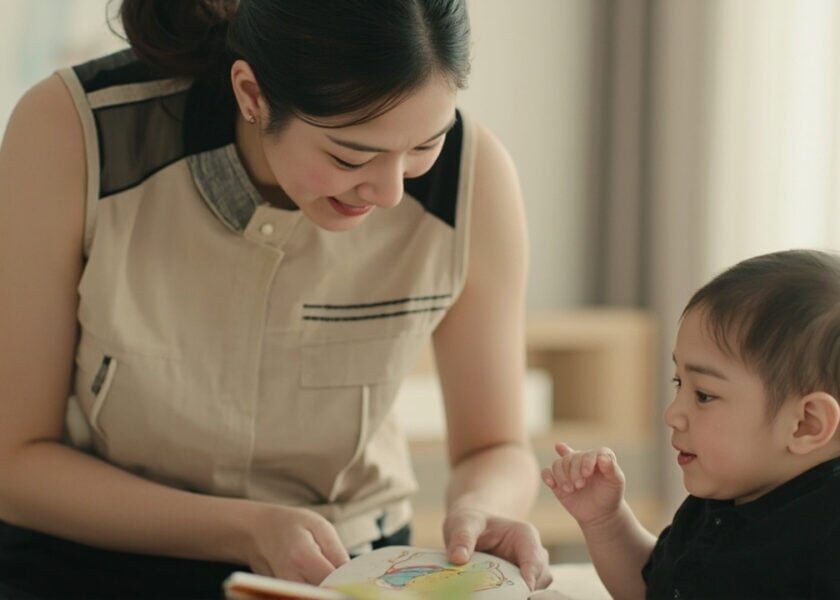
There is lunch, and then rest—a genuine rest, not a pause between activities. Rest for a toddler might look like lying on a mat with a book, looking at pictures, breathing. Rest for an infant might look like sleep, deep and uninterrupted, in a space that is safe and dim and warm.
This is not wasted time. Rest is when the brain processes the morning’s learning. Rest is when the body recovers. Rest is essential to the work of growing.
Peer Play: Learning to Be Human With Others
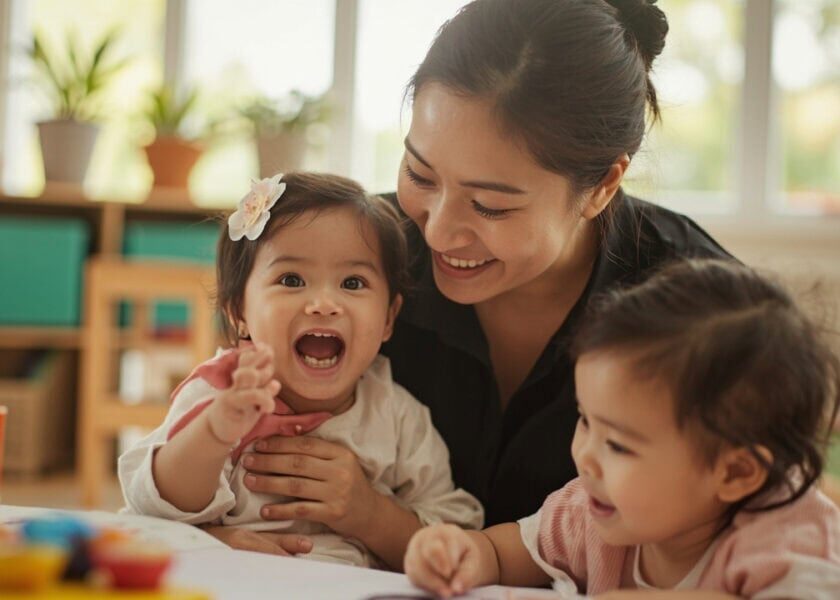
There is time, too, for peer play. For children to learn what it means to be with others.
This is not a skill that arrives automatically. It is learned, slowly, in the company of adults who help when it is hard and step back when it is not.
Two toddlers reach for the same toy, and an adult is there—not to solve the problem, but to name it, to help words form where fists might otherwise clench.
A child wants to join a group and does not yet know how, and a caregiver notices, and gently offers an entry point: Can you bring your block over? The children are building a road.
This is social scaffolding. It is invisible to the untrained eye. But it is happening all day long, in ways that are quietly building a child’s capacity to be human with others.
What You See When You Return
The door opens. You walk in. And your child looks up.
What do you see in that face?
In quality care, you see a child who is not distressed. Not because distress has been medicated or hidden, but because the day has been attended to.
You see a child who may or may not come to you immediately—some children need a moment to finish what they are doing, some children run, some children smile from across the room—but who looks glad. Who looks like themselves. Whose face holds something of the day in it, not because they are troubled by the day’s end, but because the day has been full.
Sometimes there is news. Your child pulls you toward something they made, or shows you a book they read, or points at a window where they saw a bird. Sometimes there is no news at all, just a quiet contentment, a readiness to be with you again. Both are evidence. Both are signs that the day was good.
The Handover Conversation
The caregiver speaks to you. They tell you things—not as an afterthought, but as part of a genuine partnership:
- What your child ate
- How your child slept
- What made them laugh
- What they worked on
This is not obligation. This is transparency. This is a caregiver who knows that you are the most important person in your child’s life, and that you deserve to know how your child’s day was spent.
What Quality Care Means for Your Child
Your child needs more than supervision. Your child needs someone who notices when they are tired before they become overtired.
Your child needs someone who helps them navigate the hard moment when another child takes their toy.
Your child needs someone who names their feelings when they are too young to name them alone: You are frustrated. That is okay. I am here.
Your child needs someone who celebrates them, genuinely, when they do something new, who claps and means it, who says their name with delight.
This is what quality care provides. Not a substitute for you. A complement to you. A team working toward the same goal: a child who is safe, who is known, who is growing in every way a small human can grow.
And your child needs this every day. Not some days. Every day.
Because development does not pause for weekends. Because the brain builds connections in the hours of play and interaction and language and rest. Because the person your child is becoming is shaped, moment by moment, by the quality of what happens in those hours.
EduNanny by BUTLER: Built for These Hours
This is what EduNanny has built. Not just a service. Not just a solution to a logistical challenge. A full commitment to what happens between drop-off and pick-up.
EduNanny is part of Singapore’s ECDA Childminding Pilot, which means their approach is grounded in standards, oversight, and a genuine belief that childcare is not a luxury—it is a foundation.
Whether your family chooses a home-based arrangement, a community pathway, or a centre-based setting, the values are the same. The attention to ratios is the same. The belief that every child deserves to be known is the same.
The Numbers That Make Everything Else Possible
EduNanny operates with a one-to-three infant ratio at its most intimate levels. This is not a number plucked from a brochure. This is a structure that makes everything else possible.
It makes caregiver consistency possible. It makes language-rich interaction possible. It makes the kind of responsiveness that a child needs in order to thrive—not just to be safe, but to be truly, fully thriving.
The Caregivers Themselves
Let us speak plainly about the people who do this work.
In Singapore, childminders are often treated as a stopgap. A temporary arrangement. A backup plan while families search for something more permanent.
But that framing misses something essential. The childminder is not a lesser form of childcare. The childminder, in a high-quality arrangement, is a developmental professional who spends more waking hours with your child than you do.
The childminder is the person who sees your child’s first independent steps, your child’s first cooperative play, your child’s first moment of pure delight at mastering something new. The childminder is, in the most literal sense, a person who matters enormously to your child’s life.
EduNanny understands this. Their caregivers are not hired as interchangeable staff. They are trained, supported, and valued as professionals. They are given the conditions they need to do their work well: low ratios, reasonable expectations, genuine respect.
And in return, they bring something to your child that cannot be purchased or programmed. They bring warmth. They bring consistency. They bring the kind of presence that says, in every moment: I see you. You are not alone. I will stay with you.
This is the dignity of the work. And EduNanny holds it.
Accessibility by Design
For families, EduNanny has thought carefully about accessibility. The pilot fee structures are designed to be affordable. CDA and Baby Bonus funds can be used. Subsidies apply where relevant. Monday to Friday care blocks offer the regularity that working parents need.
This is not an afterthought—it is part of the design. Because quality care should not be reserved for families who can afford premium pricing. Quality care should be available to the families who need it most.
Transparency You Can Trust
EduNanny by BUTLER also brings something that many childcare arrangements do not: genuine transparency.
- Where CCTV is deployed, parents can see
- Where communication systems are in place, parents are informed
- Where caregiver relationships are built, parents are welcomed as partners
This is not about surveillance. It is about trust. And trust, in childcare, is everything.
The Partnership Between Parent and Provider
Quality care understands, and EduNanny has built into its very foundation: you are not outsourcing your parenting. You are entering into a partnership.
The hours your child spends in care are not a gap in their life. They are a part of their life—perhaps the most formative part of their early life, given how many hours they spend there.
And so the relationship between you and your child’s caregiver is not a transaction. It is a collaboration. It is two sets of eyes on the same child, two sets of hands helping the same small person grow, two voices—yours at home, theirs during the day—speaking a consistent language of care.
EduNanny welcomes this. They communicate. They share. They invite you in, not just to see but to participate. Because the child who thrives is the child who knows that home and care are connected, that the people who love them are talking to each other, that the world they move through is coherent and kind.
What to Look For: A Practical Guide for Parents
When you are evaluating childcare options in Singapore, here is what to look for:
At Drop-Off
- Does the caregiver seem genuinely glad to see your child?
- Do they take time with the transition, or rush you out?
- Do they speak to your child by name?
- Does your child seem to recognize them?
During the Visit
- What does the room smell like? It should smell human, not sterile
- What does it sound like? There should be language, conversation, warmth
- How do caregivers speak to children—with warmth and genuine attention?
- What is the ratio? For infants, one to three is ideal
- Is the space designed for children—safe, inviting, textured?
At Pick-Up
- How does your child look? Content, curious, themselves?
- Does the caregiver share information about the day?
- Does your child seem glad to see you, or relieved to leave?
- Is there continuity in who cares for your child day to day?
The Questions to Ask
- What is the caregiver-to-child ratio?
- Who will be my child’s primary caregiver?
- How do you handle feeding, sleeping, and emotional moments?
- What does a typical day look like?
- How do you communicate with parents?
- What training do your caregivers have?
- Can I see the space during an ordinary day, not just during a tour?
The Question You Have Been Carrying
There is a question you carry. You carry it in the mornings before drop-off. You carry it in the quiet hours at work, when your mind drifts to what your child is doing. You carry it in the evenings, when you are tired and the day is ending and you still wonder:
Was my child okay? Was my child happy? Was my child thriving?
EduNanny answers that question. Not with promises they cannot keep. Not with words alone. They answer it with evidence. With openness. With a commitment to the kind of transparency that lets you see, even when you cannot be there.
Your child is safe. Your child is known. Your child is in a place where hands are warm and voices are kind and every hour is an opportunity for growth.
You can trust that. Not because EduNanny tells you to—but because you can see it. In your child’s face. In your child’s voice. In the way your child runs toward the door each morning, ready for the day ahead.
You are not a perfect parent. No one is. You are a parent who loves your child, and who wants the best for them, and who is navigating a world that does not always make that easy.
You are doing enough. And the people who care for your child during the hours you cannot be there—they are doing enough too. Not because they are perfect, but because they are attentive. Because they bring warmth and intention and genuine care to every moment. Because they have been given the conditions to do this work well, and they do it.
When you drop your child at EduNanny, you are not abandoning them. You are entrusting them to a place that will hold them. That will notice them. That will help them grow into the person they are meant to become.
And when you pick them up at the end of the day, and they look at you with a face that says: I had a good day. I was seen. I was loved.
You will know. You will know that the question you have been carrying has been answered. That the hours you cannot see are hours well spent. That your child is exactly where they should be.
EduNanny by BUTLER: A Partnership, A Trust, A Choice
- Not a service. A partnership.
- Not a transaction. A trust.
- Not a compromise. A choice you can feel good about, every single morning, when you hand your child to someone who is ready, and warm, and glad to see them.
That is what quality care looks like. That is what it feels like. That is what it is.
And that is what EduNanny by BUTLER has built, for you, and for your child, and for every family in Singapore who deserves to know that the hours in between drop-off and pick-up are hours filled with care.
The first thousand days matter. The years before school are not a waiting room. They are the foundation. And EduNanny builds that foundation, day by day, with intention and care.
If you are ready to learn more about EduNanny’s approach to quality childminding in Singapore, we invite you to reach out to begin a conversation.